
TB-500: A Research Overview
TB-500 is the synthetic, N-acetylated LKKTETQ heptapeptide drawn from the central actin-binding region of thymosin beta-4. This overview traces the fragment's beta-thymosin lineage, its molecular properties, how it is classified, and its regulatory standing. Educational reference.

For research use only. Not for human consumption. This article is educational reference material. It is not medical advice and is not a recommendation to use any substance.
A fragment, not a peptide of its own
TB-500 is best understood not as an independent molecule but as an isolated working part of a larger one. The designation refers to a synthetic, N-terminally acetylated heptapeptide with the sequence Ac-LKKTETQ, corresponding to residues 17 through 23 of thymosin beta-4 (Tβ4), a 43-amino-acid polypeptide of the beta-thymosin family. In the published research literature this seven-residue stretch is characterized as the central actin-binding region of the parent peptide, and TB-500 exists as a research reagent precisely because investigators wanted to study that region in isolation from the rest of the molecule.
That framing matters for reading anything written about the compound. Findings reported for full-length Tβ4 do not automatically transfer to the fragment, and vice versa; the two are related but structurally distinct entities. TB-500 is not approved by any regulatory authority for therapeutic use in humans and is classified as a research-use-only compound. The sections below trace where the fragment comes from, what it is at the molecular level, how it was analytically pinned down, and where it sits in classification and regulatory terms. The reported molecular activity of the sequence is treated in depth in the companion TB-500 mechanism of action article.
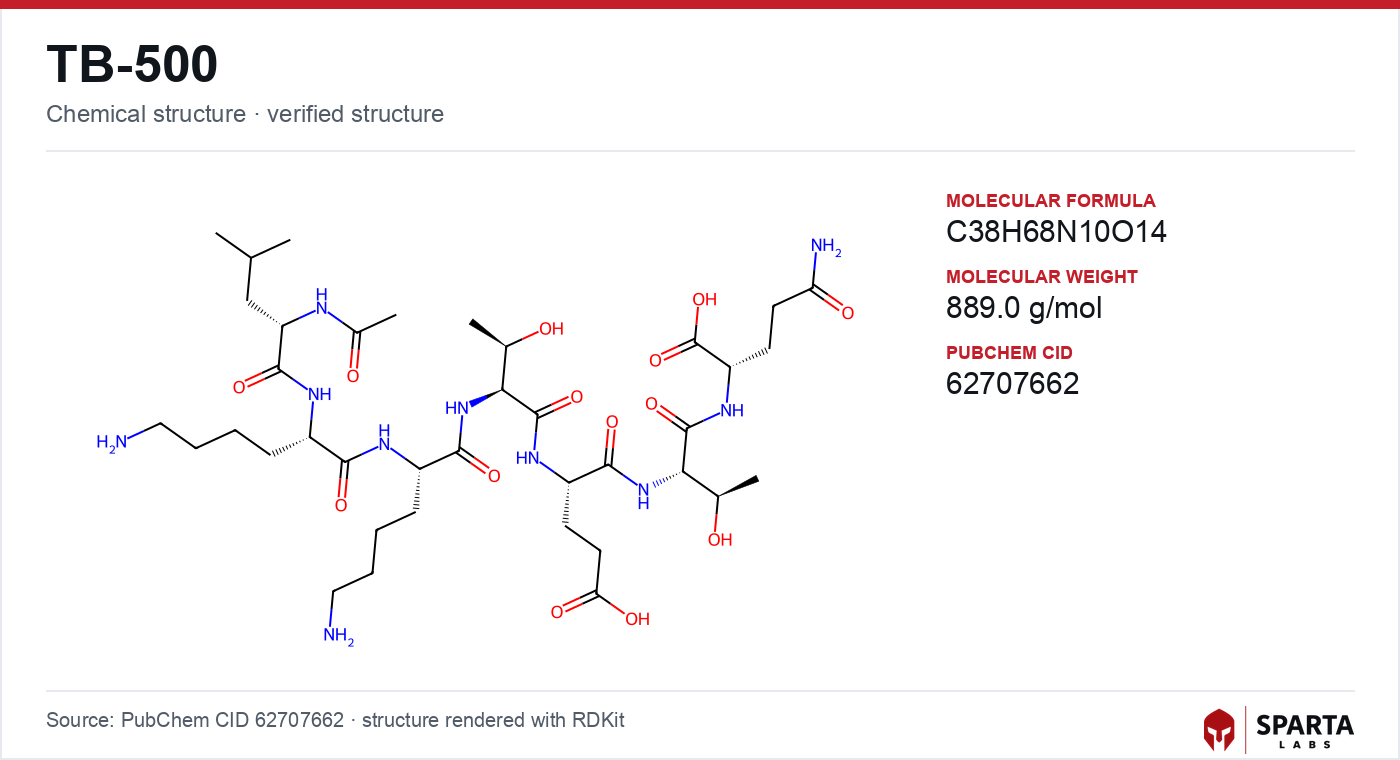
Figure: chemical structure of TB-500.
From thymic hormone to cytoskeletal peptide
The scientific lineage that produced TB-500 began with the isolation of the parent peptide. Thymosin beta-4 was purified from calf thymus and its complete amino acid sequence reported by Low, Hu, and Goldstein in the Proceedings of the National Academy of Sciences USA in 1981, within a research program focused on thymic peptides associated with immune-cell development [1].
Findings from research models do not establish safety or efficacy in humans. Sparta Labs makes no claims about the use of this compound.
The interpretive frame shifted a decade later. In 1991, Safer, Elzinga, and Nachmias reported in the Journal of Biological Chemistry that Tβ4 was indistinguishable from Fx, a previously described actin-sequestering peptide, identifying Tβ4 as a major G-actin-binding protein in mammalian cells [2]. That reassignment moved Tβ4 out of the thymic-hormone conversation and into cytoskeletal biology, and it set up the obvious next question: which part of the sequence does the actin binding.
Answering that question required systematic mapping of the peptide's active regions. A 2003 study in the FASEB Journal by Philp, Huff, Galli, Wei, Bhattacharya, Kleinman, and colleagues reported that the actin-binding sequence within Tβ4 was associated with angiogenic activity in cell and chorioallantoic membrane assay models, identifying LKKTETQ as a structurally minimal active fragment worth studying on its own [3]. That result is what made an independent LKKTETQ reagent scientifically interesting, and it is the direct ancestor of the compound now sold as TB-500. The same regenerative-peptide research cluster is often discussed alongside BPC-157 and the copper-binding tripeptide GHK-Cu, which are studied through entirely separate molecular pathways.
The beta-thymosin fold and the WH2 connection
To place TB-500 structurally, it helps to know what kind of protein it is carved from. Beta-thymosins are small, intrinsically disordered, N-terminally acetylated peptides that lack a stable folded structure in isolation but adopt partial secondary structure on contact with G-actin. The intact Tβ4 sequence carries two short alpha-helical segments, an N-terminal helix spanning roughly residues 5 to 16 and a C-terminal helix spanning roughly residues 31 to 39, that flank the central LKKTETQ region [5].
The structural mechanics of that actin contact were resolved crystallographically by Irobi and colleagues, whose work in the EMBO Journal in 2004 described how the beta-thymosin module wraps across an actin monomer, contacting multiple surface patches that span both the barbed-end and pointed-end faces of the subunit [5]. That paper is also where the family relationship to the wider cytoskeletal world becomes explicit: the beta-thymosin actin-binding element is closely related to the WH2 (Wiskott-Aldrich homology 2) module, a short actin-monomer-binding motif that recurs across many actin-regulatory proteins. TB-500 corresponds to the central portion of that binding element, isolated from the flanking helices that contribute additional contacts in the full peptide. It is precisely this loss of the flanking structure that makes the fragment a useful experimental probe rather than a stand-in for the parent.
Molecular identity of the acetylated heptapeptide
At the molecular level TB-500 is a defined, discrete species. It comprises only the LKKTETQ heptapeptide bearing an acetyl group on the N-terminus (Ac-LKKTETQ), giving a molecular weight of approximately 839 daltons, roughly one-sixth the mass of the 4,921-dalton parent peptide.
The sequence composition is informative. It is dominated by charged and polar residues: two lysines (K) contributing positive charge, a glutamate (E) contributing negative charge, and threonine (T) and glutamine (Q) contributing polar surface, with a single leucine (L) providing the only markedly hydrophobic side chain. That charge-rich makeup is consistent with the electrostatic contacts observed at the Tβ4-actin interface in structural studies [5], and it is one reason the fragment is short yet sequence-specific. The N-terminal acetylation is not incidental. It matches the naturally acetylated N-terminus of the beta-thymosin family and is part of what defines the reagent as the biologically relevant form rather than a bare synthetic peptide. Purity conventions and verification approaches for the synthetic fragment are covered in the TB-500 sourcing and quality reference.
How the reagent was analytically pinned down
A distinctive feature of TB-500's documented history is that its precise chemical identity in commercial research supply was established largely through analytical and anti-doping chemistry rather than through a discovery paper of its own. Because the fragment reached research supply channels under a trade-style code rather than a formal chemical name, defining exactly what "TB-500" contained became an analytical task.
That task was carried out by Weidemann, Görgens, Dib, Düe, Guddat, and colleagues, who reported in Drug Testing and Analysis in 2013 that the active content of TB-500 preparations is N-acetyl-LKKTETQ, and characterized its detection in equine urine and plasma by liquid chromatography-mass spectrometry [4]. This work is significant for two reasons. First, it fixed the molecular definition of the reagent, confirming the acetylated heptapeptide rather than some longer or unmodified variant. Second, it created the detection methodology that underlies the compound's treatment in regulated anti-doping contexts. Later published research building on that characterization is summarized in the TB-500 published research article, and the fuller chronology appears in the TB-500 discovery and regulatory history reference.
Where TB-500 sits pharmacologically
In the peer-reviewed literature, thymosin beta-4 and its active fragments are discussed as modulators of actin dynamics, cell migration, and tissue-repair signaling in preclinical models, and are grouped within a growth-factor-modulator category rather than as classical receptor ligands [7]. That grouping is worth stating precisely because the fragment does not fit several familiar peptide categories: Ac-LKKTETQ is not a growth-hormone secretagogue, not a hormone-receptor agonist, and not a cytokine in the conventional pharmacological sense.
Its characterized activities in the literature are, instead, direct binding to G-actin and, separately, modulation of inflammatory signaling in cell-culture models, two activities that have been studied largely in parallel across the Tβ4 body of work [7]. This classification is mirrored in regulatory anti-doping frameworks: the WADA Prohibited List places Tβ4 and its derivatives, including TB-500, in the S2 class of peptide hormones, growth factors, growth factor mimetics, and related substances, specifically as growth factor modulators [6]. Within Sparta Labs' broader immune-peptide cluster, a structurally and functionally unrelated point of contrast is thymosin alpha-1, which shares only the "thymosin" naming heritage and derives from a different precursor.
Regulatory standing and the parent-peptide trials
TB-500 (Ac-LKKTETQ) and the full-length thymosin beta-4 peptide are not approved by the United States Food and Drug Administration (FDA), the European Medicines Agency (EMA), or equivalent regulatory bodies for any therapeutic indication.
A recurring point of confusion is worth separating out. The intact 43-amino-acid Tβ4 peptide has been evaluated in FDA-reviewed clinical trials as investigational compounds developed by RegeneRx Biopharmaceuticals, Inc.: an ophthalmic formulation designated RGN-259 studied in ocular-surface contexts, and an injectable formulation designated RGN-352 studied in cardiac-repair contexts [8]. A phase 2 randomized trial of the ophthalmic formulation was reported by Sosne, Dunn, and Kim in Cornea in 2015 [8]. These programs evaluated the intact parent peptide, not the LKKTETQ fragment and not TB-500. No approved-drug status attaches to the fragment as a consequence of those trials.
On the anti-doping side, Tβ4 and its derivatives are prohibited in sport under the WADA Prohibited List (S2 category), in both in-competition and out-of-competition contexts [6]. Researchers sourcing the synthetic fragment for preclinical study can review specifications on the TB-500 product page.
References
-
Low TL, Hu SK, Goldstein AL. Complete amino acid sequence of bovine thymosin beta 4: a thymic hormone that induces terminal deoxynucleotidyl transferase activity in thymocyte populations. Proc Natl Acad Sci USA. 1981;78(2):1162–1166. PMID: 6940133. View on PubMed
-
Safer D, Elzinga M, Nachmias VT. Thymosin beta 4 and Fx, an actin-sequestering peptide, are indistinguishable. J Biol Chem. 1991;266(7):4029–4032. PMID: 1999398. View on PubMed
-
Philp D, Huff T, Galli U, Wei S, Bhattacharya B, Kleinman HK, et al. The actin binding site on thymosin beta4 promotes angiogenesis. FASEB J. 2003;17(14):2103–2105. PMID: 14500546. View on PubMed
-
Weidemann S, Görgens C, Dib J, Düe M, Guddat S, et al. Doping control analysis of TB-500, a synthetic version of an active region of thymosin β4, in equine urine and plasma by liquid chromatography-mass spectrometry. Drug Test Anal. 2013;5(6):441–449. PMID: 23084823. View on PubMed
-
Irobi E, Aguda AH, Larsson M, Guerin C, Yin HL, Burtnick LD, et al. Structural basis of actin sequestration by thymosin-β4: implications for WH2 proteins. EMBO J. 2004;23(18):3599–3608. PMC517612. Full text on PMC
-
World Anti-Doping Agency. The Prohibited List 2024. Montreal: WADA; 2024. Source: wada-ama.org
-
Goldstein AL, Hannappel E, Sosne G, Kleinman HK. Thymosin β4: a multi-functional regenerative peptide. Basic properties and clinical applications. Expert Opin Biol Ther. 2012;12(1):37–51. PMID: 22087795. View on PubMed
-
Sosne G, Dunn SP, Kim C. Thymosin β4 significantly improves signs and symptoms of severe dry eye in a phase 2 randomized trial. Cornea. 2015;34(5):491–496. PMID: 25826322. View on PubMed
Disclaimer. Statements in this article have not been evaluated by the Food and Drug Administration. This compound is not intended to diagnose, treat, cure, or prevent any disease. Sparta Labs sells research-use-only materials. Content is provided for educational and informational purposes only and does not constitute medical advice. Consult a qualified medical professional for any health concerns.
Frequently asked questions
What is TB-500 and how does it relate to thymosin beta-4?
TB-500 is a synthetic, N-terminally acetylated heptapeptide (Ac-LKKTETQ) corresponding to residues 17 through 23 of the 43-amino-acid polypeptide thymosin beta-4. In the research literature this short sequence is described as the central actin-binding region of the parent peptide. TB-500 is classified as a research-use-only compound and is not approved by any regulatory authority for therapeutic use in humans.
Why is TB-500 studied as a fragment rather than the whole thymosin beta-4 peptide?
Mapping studies through the 1990s and early 2000s identified LKKTETQ as a structurally minimal region associated with actin binding and, in one cell and chorioallantoic membrane assay, angiogenic activity. Isolating this heptapeptide let researchers examine the contribution of the central region separately from the flanking helices of the full peptide. In that literature it functions as a tool compound rather than an approved product.
What is the WH2 module and why is it relevant to TB-500?
WH2 (Wiskott-Aldrich homology 2) is a short actin-monomer-binding motif found across many cytoskeletal proteins. Crystallographic work on thymosin beta-4 described how its beta-thymosin/WH2-type module contacts an actin monomer across multiple surface patches. The LKKTETQ sequence isolated as TB-500 lies within this central actin-binding region of the parent fold.
Is TB-500 FDA approved?
TB-500 (Ac-LKKTETQ) and the parent peptide thymosin beta-4 are not approved by the FDA, EMA, or equivalent regulatory bodies for any therapeutic indication. FDA-reviewed clinical trials under the designations RGN-259 and RGN-352 evaluated the full-length 43-amino-acid thymosin beta-4 peptide, not the LKKTETQ fragment or TB-500 specifically.
How is TB-500 classified under anti-doping frameworks?
The World Anti-Doping Agency lists thymosin beta-4 and its derivatives, which include TB-500, in the S2 category of the Prohibited List as growth factor modulators, with the prohibition applying both in and out of competition. Analytical chemistry published in 2013 formally characterized the active content of TB-500 preparations as N-acetyl-LKKTETQ and described detection methods in biological matrices.