
Tesamorelin Mechanism of Action
A mechanism-focused reading of tesamorelin as a DPP-IV-stabilized GHRH analog: how the trans-3-hexenoic acid cap preserves class B receptor docking, how Gs-cAMP-PKA signaling reaches the GH gene, and why the pituitary feedback loop stays intact. Educational reference.

For research use only. Not for human consumption. This article is educational reference material. It is not medical advice and is not a recommendation to use any substance.
Introduction
Tesamorelin is a synthetic peptide built on the full 44-residue sequence of human growth hormone-releasing hormone (GHRH), modified at its N-terminus to resist enzymatic degradation. Its reported pharmacology is that of a GHRH-receptor agonist: it engages the same pituitary receptor as the endogenous hormone and, through that receptor, drives the intracellular signaling that leads to pulsatile growth hormone (GH) release. What distinguishes tesamorelin mechanistically from GH itself, and from the unrelated ghrelin-mimetic secretagogues, is that it acts a step upstream, at the pituitary, leaving the downstream regulatory architecture of the GH axis in place. This article traces that mechanism from the chemistry of the molecule through receptor engagement, intracellular signaling, and the hepatic GH-IGF-1 relay, with attribution to the primary literature at each step.
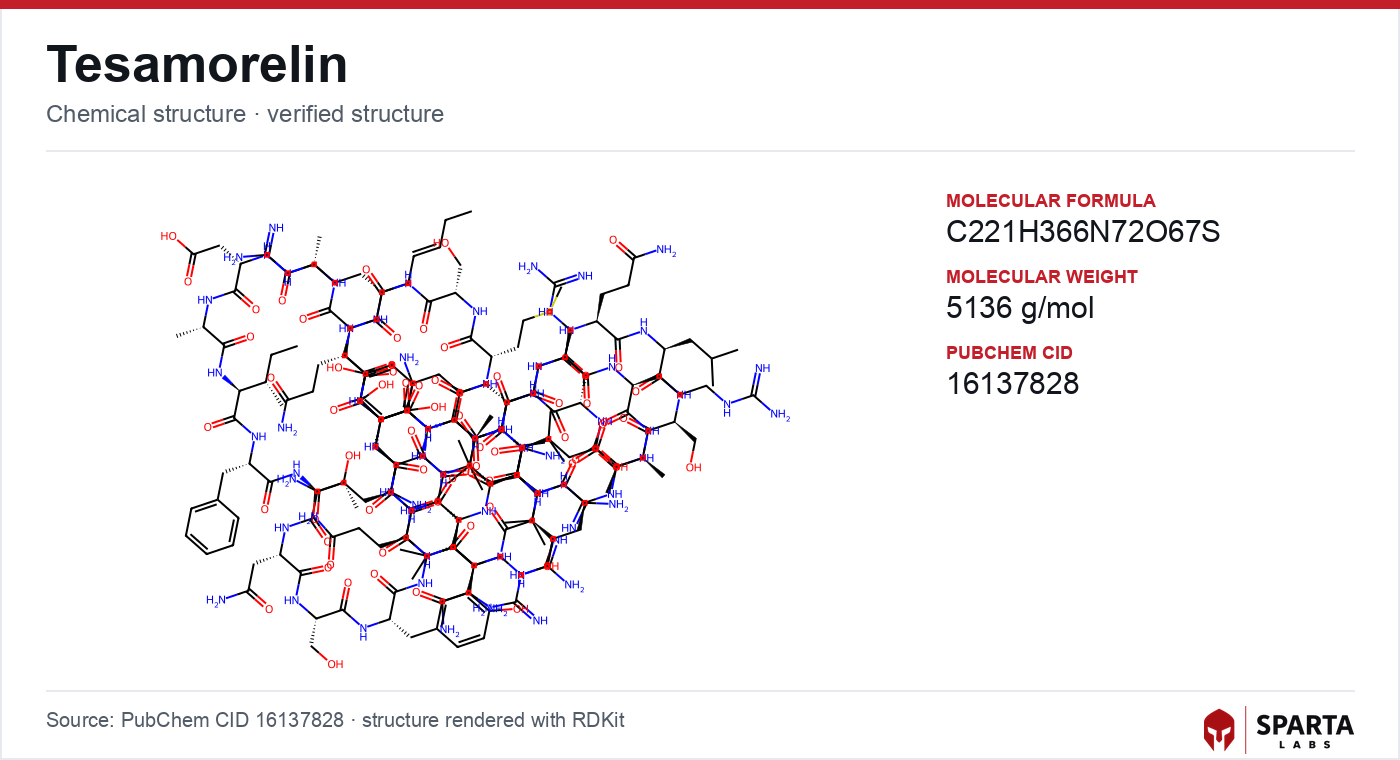
Figure: chemical structure of Tesamorelin.
The DPP-IV Problem the Molecule Was Designed Around
Any account of tesamorelin's mechanism has to begin before receptor binding, with a chemical liability of native GHRH. Endogenous GHRH is short-lived in circulation because dipeptidyl peptidase IV (DPP-IV) cleaves the peptide at the Tyr1-Ala2 bond, excising the first two residues. That cleavage is mechanistically consequential rather than merely a matter of clearance rate: the N-terminal region of GHRH, roughly residues 1 through 29, carries the principal receptor-binding determinants, so removing the leading residues produces a fragment with sharply reduced receptor engagement.
Tesamorelin addresses this by conjugating a trans-3-hexenoic acid group to the alpha-amine of the first residue. The modification sterically blocks DPP-IV access to the Tyr1-Ala2 bond while, according to the structural literature, preserving the spatial presentation of the receptor-binding helix so that the modified peptide still docks productively at the receptor [2]. The design logic is therefore additive rather than substitutive: the native sequence is retained, and the cap is chosen to protect the cleavage site without disrupting the binding face. This N-terminal-stabilization strategy is one of several the GHRH-analog class has explored; the CJC-1295 with DAC mechanism-of-action article describes a different chemical approach to the same cleavage vulnerability, which makes the two compounds a useful pair for understanding how analog design targets a single enzymatic bond.
Docking at a Class B G Protein-Coupled Receptor
The molecular target of tesamorelin is the growth hormone-releasing hormone receptor (GHRH-R, also written GHRHR), a member of the class B, or secretin-like, family of G protein-coupled receptors (GPCRs). Class B GPCRs are structurally distinguished by a large extracellular N-terminal domain and a seven-transmembrane helical core, and they characteristically bind peptide agonists through a two-domain mechanism: the C-terminal portion of the peptide is captured by the extracellular domain, which positions the peptide's N-terminus to insert into and activate the transmembrane bundle.
This two-domain model explains why the N-terminal integrity that DPP-IV threatens is so important. The extracellular domain anchors the ligand, but it is the N-terminal segment, the part tesamorelin's cap protects, that supplies the activation signal by engaging the transmembrane helices. Schally and colleagues characterized pituitary GHRH receptors pharmacologically across the 1980s and 1990s, and later molecular cloning confirmed the receptor's class B GPCR identity [1]. A 2025 review in Reviews in Endocrine and Metabolic Disorders synthesized the structural and functional evidence, detailing how the extracellular domain coordinates ligand docking and how receptor occupancy initiates the conformational changes that propagate an intracellular Gs-mediated signal [1].
GHRH-R expression is concentrated on anterior pituitary somatotrophs, the specialized cells that synthesize and secrete GH. That tissue localization is what confines the primary pharmacology to the pituitary. It also distinguishes tesamorelin's target from the ghrelin/GHS-R1a receptor that mediates the peptidyl secretagogue class; the GHRP-6 mechanism-of-action article and the hexarelin mechanism-of-action article describe that separate receptor and its distinct signaling, and the two receptor systems are reported to converge only downstream, at the level of GH output from the same somatotroph population.
From Receptor Occupancy to the GH Gene: The Gs-cAMP-PKA-CREB Relay
Once the receptor-binding helix engages the transmembrane core, GHRH-R couples to the stimulatory heterotrimeric G protein Gs. The Gs alpha subunit activates adenylyl cyclase, raising intracellular cyclic adenosine monophosphate (cAMP). Elevated cAMP in turn activates protein kinase A (PKA), and PKA phosphorylates downstream effectors including the transcription factor CREB (cAMP response element-binding protein) [1].
Findings from research models do not establish safety or efficacy in humans. Sparta Labs makes no claims about the use of this compound.
The significance of the CREB step is that it couples receptor activation to two timescales at once. On the fast timescale, the signaling wave promotes exocytosis of GH from pre-formed secretory granules, giving an immediate pulse of hormone. On the slower timescale, CREB-mediated transcription has been reported to drive expression of the GH gene (Gh1), replenishing the secretory pool through de novo synthesis [1]. Stanley and colleagues (2011) examined this pharmacodynamic output directly in 13 healthy adult males, using frequent overnight blood sampling with deconvolution analysis; they reported that tesamorelin administration was associated with statistically significant increases in mean overnight GH, GH pulse amplitude, and total GH secretory mass relative to baseline, with a corresponding elevation in IGF-1 [3].
Beyond the dominant Gs-cAMP arm, the GHRH-receptor literature describes secondary signaling branches, including calcium-calmodulin-dependent pathways and, to a lesser extent, phospholipase C-mediated inositol phosphate signaling. The quantitative weighting of these secondary cascades relative to the principal cAMP pathway in adult human somatotrophs remains, per the reviews, an incompletely resolved question characterized largely in vitro and in rodent systems [1].
Why Pituitary Feedback Stays in Circuit
A defining mechanistic feature of GHRH-analog pharmacology, and the clearest point of contrast with exogenous recombinant human GH (rhGH), is where the compound acts in the axis. Because tesamorelin stimulates the pituitary rather than supplying finished hormone, the physiological brakes on GH output remain functional above it. Hypothalamic somatostatin tone continues to gate somatotroph secretion, and IGF-1-mediated long-loop negative feedback continues to report back on axis activity.
Stanley and colleagues (2011) framed their data in exactly these terms: tesamorelin administration in healthy men did not generate supraphysiologic GH excursions inconsistent with the normal ultradian pulsatile pattern, an observation they attributed to intact somatostatin- and IGF-1-mediated feedback remaining operative throughout the study [3]. Exogenous rhGH, by contrast, bypasses pituitary regulation entirely and can suppress endogenous GHRH secretion through the same long-loop feedback. This upstream-versus-downstream distinction is the mechanistic reason the two approaches produce different secretion dynamics, and it is a recurring theme across the secretagogue and GH-axis literature.
The Hepatic Relay: GH to IGF-1
The proximal downstream event after GHRH-R activation is release of GH into the portal and peripheral circulation. From there, GH acts on GH-receptor (GHR)-expressing tissues throughout the body, most prominently the liver. In hepatocytes, GHR signals through the JAK2-STAT5b pathway to drive production and secretion of insulin-like growth factor-1 (IGF-1), the peripheral effector that carries much of the systemic GH signal. This hepatic relay is why circulating IGF-1 served as a downstream pharmacodynamic readout across the tesamorelin trials, and it is the shared endpoint that connects the GHRH-analog and secretagogue families to compounds acting directly at the IGF-1 tier, such as those discussed in the IGF-1 LR3 mechanism-of-action article.
In the phase 3 program in HIV-infected patients with lipodystrophy reported by Falutz and colleagues, tesamorelin administration was associated with measurable changes in IGF-1 and in visceral adiposity [4,5]. The mechanistic account offered for the adipose-tissue observations invokes GH's reported lipolytic signaling, in which GHR activation has been described as raising hormone-sensitive lipase activity and lowering lipid uptake via downregulation of lipoprotein lipase. The literature notes, however, that the tissue-level contributions to the visceral changes in this population are complicated by the multifactorial pathophysiology of HIV-associated lipodystrophy itself, so the direct-GH versus IGF-1-mediated split is not fully resolved. Stanley and colleagues (2019) later reported, in a randomized placebo-controlled trial in HIV-infected individuals with non-alcoholic fatty liver disease, a significantly greater reduction in hepatic fat fraction over 12 months in the tesamorelin arm than in the placebo arm, proposing GH-axis signaling in the liver, including hepatic lipid-oxidation pathways and IGF-1-mediated effects, as the mechanistic substrate for that observation [6].
Open Mechanistic Questions
Several parts of the mechanism remain under active characterization in the published literature, and they are worth stating plainly because they mark the boundary of what the primary sources actually establish.
First is the division of labor between direct GH-mediated lipolysis and indirect IGF-1-mediated effects in the visceral-adiposity findings. Adipose tissue expresses both GH receptors and IGF-1 receptors, so both arms of the GH-IGF-1 axis are plausibly engaged, and disentangling them is an ongoing tissue-level effort rather than a settled result. Second is the behavior of somatostatin tone in populations with pre-existing GH secretory abnormalities, a documented feature of HIV-associated lipodystrophy, and how that altered feedback set-point modifies the pharmacodynamic response to GHRH-R agonism. Third are the secondary receptor-signaling arms, the phospholipase C and calcium-calmodulin branches, whose contribution in adult human somatotrophs has not been mapped as thoroughly as the cAMP pathway [1]. Finally, GHRH-R expression at extrapituitary sites, including pancreatic tissue and certain immune and peripheral cells, raises questions about activity beyond the pituitary that complement rather than replace the primary somatotroph pharmacology.
The clinical evidence base underlying these mechanistic questions is summarized in the tesamorelin published research article, which walks through the phase 3 trials and the subsequent hepatic and metabolic investigations, and the compound's classification and discovery context are covered in the tesamorelin research overview. Researchers reviewing analytical identity and specification data can consult the documentation for tesamorelin from Sparta Labs on the product page.
References
-
Siejka A, Barabutis N. Growth hormone-releasing hormone receptor (GHRH-R) and its signaling. Rev Endocr Metab Disord. 2025;26(2):271-284. PMID: 39934495. DOI: 10.1007/s11154-025-09952-x. PubMed
-
National Library of Medicine. Tesamorelin. LiverTox: Clinical and Research Information on Drug-Induced Liver Injury. Bethesda: National Institute of Diabetes and Digestive and Kidney Diseases; 2019. Available at NCBI Bookshelf
-
Stanley TL, Chen CY, Branch KL, Makimura H, Grinspoon SK. Effects of a growth hormone-releasing hormone analog on endogenous GH pulsatility and insulin sensitivity in healthy men. J Clin Endocrinol Metab. 2011;96(1):150-8. PMID: 20943777. DOI: 10.1210/jc.2010-1587. PubMed
-
Falutz J, Allas S, Blot K, Potvin D, Kotler D, Somero M, et al. Metabolic effects of a growth hormone-releasing factor in patients with HIV. N Engl J Med. 2007;357(23):2359-70. DOI: 10.1056/NEJMoa072375. Journal
-
Falutz J, Mamputu JC, Potvin D, Moyle G, Soulban G, Loughrey H, et al. Effects of tesamorelin, a growth hormone-releasing factor, in HIV-infected patients with abdominal fat accumulation: a randomized placebo-controlled trial with a safety extension. J Acquir Immune Defic Syndr. 2010;53(3):311-22. PMID: 20101189. PubMed
-
Stanley TL, Fourman LT, Feldpausch MN, Purdy J, Zheng I, Pan CS, et al. Effects of tesamorelin on non-alcoholic fatty liver disease in HIV: a randomised, double-blind, multicentre trial. Lancet HIV. 2019;6(12):e821-e830. PMID: 31611038. DOI: 10.1016/S2352-3018(19)30338-8. PubMed
Disclaimer. Statements in this article have not been evaluated by the Food and Drug Administration. This compound is not intended to diagnose, treat, cure, or prevent any disease. Sparta Labs sells research-use-only materials. Content is provided for educational and informational purposes only and does not constitute medical advice. Consult a qualified medical professional for any health concerns.
Frequently asked questions
What receptor does tesamorelin bind, and how is it different from a ghrelin-mimetic secretagogue?
Tesamorelin engages the growth hormone-releasing hormone receptor (GHRH-R), a class B secretin-family G protein-coupled receptor concentrated on anterior pituitary somatotrophs. This is a distinct target from the ghrelin/GHS-R1a receptor that mediates the peptidyl secretagogues such as GHRP-6 and hexarelin, which is why the two families are reported to act through different signaling entry points on the same cell.
Why does the trans-3-hexenoic acid modification matter mechanistically?
Native GHRH is cleaved rapidly at the Tyr1-Ala2 bond by dipeptidyl peptidase IV (DPP-IV), which removes the residues most important for receptor engagement. Tesamorelin carries a trans-3-hexenoic acid group on the N-terminal amine that blocks this cleavage while preserving the spatial presentation of the receptor-binding helix, so the molecule reaches the receptor in an intact, activation-competent form.
What intracellular signaling cascade does GHRH-R activation trigger?
Ligand binding couples GHRH-R to the stimulatory G protein Gs, activating adenylyl cyclase and raising intracellular cyclic AMP. cAMP activates protein kinase A, which phosphorylates the transcription factor CREB. This links receptor occupancy both to immediate release of stored growth hormone and to longer-term transcription of the GH gene, according to the receptor-signaling literature.
Why is preserved GH pulsatility a notable feature of the reported mechanism?
Because tesamorelin acts upstream at the pituitary rather than replacing growth hormone directly, the hypothalamic somatostatin brake and IGF-1-mediated long-loop feedback remain in circuit. Stanley and colleagues (2011) reported that administration in healthy men raised GH pulse amplitude and secretory mass without generating supraphysiologic excursions inconsistent with the normal ultradian pattern.
What downstream axis carries GHRH-R signaling to peripheral tissue?
Pulsatile GH released from somatotrophs acts on GH-receptor-expressing tissues, most prominently hepatocytes, where JAK2-STAT5b signaling drives production of insulin-like growth factor-1 (IGF-1). Much of the systemic GH-axis output is transmitted through this hepatic GH-to-IGF-1 relay, which the tesamorelin clinical literature tracked through circulating IGF-1 measurements.