
Tesamorelin: A Research Overview
How a single N-terminal hexenoyl group turned native GHRH(1-44) into tesamorelin: the chemistry, the DPP-IV problem it solves, and the FDA approval record of the first GHRH analog cleared in the US. Educational reference.
For research use only. Not for human consumption. This article is educational reference material. It is not medical advice and is not a recommendation to use any substance.
Introduction
Tesamorelin (development code TH9507; brand name Egrifta) is a synthetic analog of human growth hormone-releasing hormone (GHRH). Chemically it is unusual among research peptides in that it does not truncate, substitute, or re-engineer the parent hormone's sequence. It reproduces the entire 44-residue GHRH molecule and adds a single fatty-acid group at one end. That minimalist design choice, one small modification on an otherwise native sequence, is the reason the compound is of interest to researchers studying the growth-hormone axis, and it is the organizing theme of this overview.
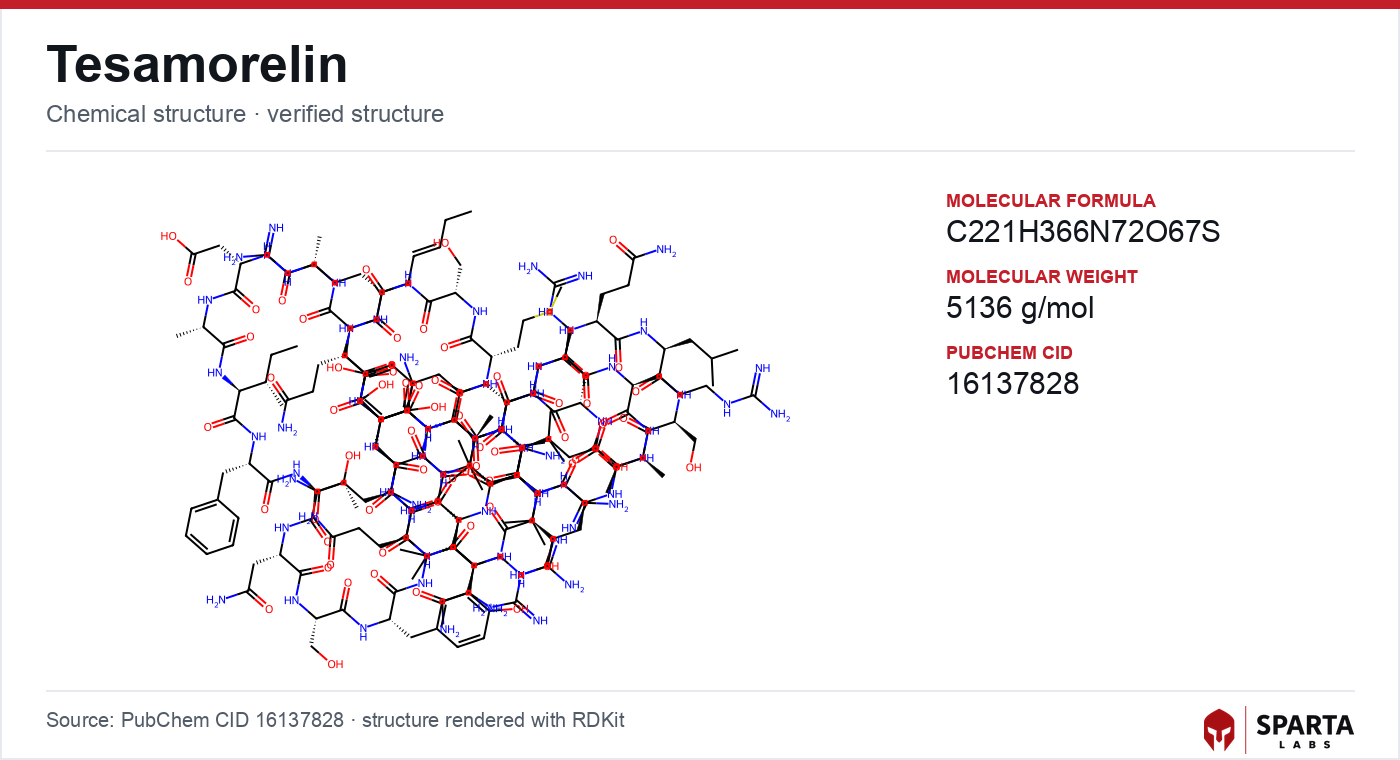
Figure: chemical structure of tesamorelin.
A stabilized copy of a native hormone
Human GHRH exists in the body predominantly as a 44-amino-acid peptide, GHRH(1-44)-NH2, secreted by the hypothalamus. The portion of the molecule that actually engages the GHRH receptor is contained within the first 29 residues; the remaining C-terminal residues are not required for receptor activation, though the full-length, C-terminally amidated form is the principal circulating species [1].
Tesamorelin retains this complete 44-residue architecture, including the C-terminal amide. Its molecular weight is approximately 5,135 daltons. What distinguishes it from the endogenous molecule is a single addition: a trans-3-hexenoic acid (hexenoyl) group conjugated to the alpha-amine of the N-terminal tyrosine residue. No amino acid in the sequence is changed. In that sense tesamorelin is best understood not as a redesigned peptide but as native GHRH carrying one protective cap.
The DPP-4 problem and the hexenoyl fix
To understand why that cap matters, it helps to understand what happens to unmodified GHRH in circulation. The enzyme dipeptidyl peptidase-4 (DPP-4) rapidly cleaves the first two residues (Tyr-Ala) from the N-terminus of GHRH. Because those N-terminal residues are essential for receptor engagement, this cleavage inactivates the hormone, and native GHRH is described in the literature as having a very short circulating stability as a result [1].
The trans-3-hexenoic acid group on tesamorelin sits directly at that vulnerable N-terminus. Its role, as described in the pharmacological record, is steric: by occupying the alpha-amine of the first residue it obstructs DPP-4's access to the cleavage site, so the intact peptide persists in circulation longer than the unmodified hormone would [2]. This is a recurring strategy in GHRH-analog chemistry. A related design lineage, the CJC-1295 family, pursues the same goal of resisting rapid degradation through a different chemical route, as discussed in the CJC-1295 with DAC research overview. Tesamorelin and the CJC series illustrate two contrasting engineering answers to the same underlying instability problem in GHRH.
The receptor-facing chemistry of tesamorelin is unchanged by the modification, and the details of how the intact peptide interacts with its receptor are treated separately in the tesamorelin mechanism of action article.
Where tesamorelin sits among growth hormone secretagogues
"Growth hormone secretagogue" is an umbrella term covering compounds that prompt the pituitary to release growth hormone. Within that umbrella there are two mechanistically separate families, and tesamorelin belongs to only one of them.
The first family, to which tesamorelin belongs, consists of GHRH analogs. These act at the GHRH receptor (GHRH-R), a class B G-protein-coupled receptor expressed on anterior-pituitary somatotroph cells [3]. The second family consists of the ghrelin-mimetic peptides, or growth hormone-releasing peptides (GHRPs), which act instead at the growth hormone secretagogue receptor, GHS-R1a. Compounds such as ipamorelin and hexarelin belong to this second, ghrelin-receptor family. Tesamorelin does not engage GHS-R1a, and the ghrelin-mimetics do not engage GHRH-R. This receptor-level separation is why the two families are studied as distinct pharmacological classes rather than as substitutes for one another.
Because a GHRH analog acts upstream, at the pituitary, rather than substituting for growth hormone itself, the physiological feedback architecture that normally governs the growth-hormone axis, including somatostatin-mediated restraint, remains part of the system under study [3]. This is the principal reason GHRH analogs are of interest as research tools for probing the endogenous regulation of the axis.
A three-generation FDA approval record
Tesamorelin has an unusually well-documented regulatory history for a peptide of its class. The FDA granted initial approval on November 10, 2010 (NDA 022505), for the reduction of excess abdominal fat in HIV-infected adults with lipodystrophy [4]. This made tesamorelin the first GHRH analog cleared by the FDA for a human indication.
Two reformulations followed. A single-vial preparation, Egrifta SV, received supplemental FDA approval in 2019. A later formulation, Egrifta WR, received supplemental approval in 2025 [2]. These successive approvals reflect ongoing formulation work by the manufacturer rather than any expansion of the approved indication.
That indication has not been broadened: tesamorelin is not FDA-approved for any use beyond the reduction of excess abdominal fat in HIV-infected adults with lipodystrophy. Its regulatory standing as a prescription pharmaceutical is entirely separate from its availability as a research-use-only material. Research-grade tesamorelin from Sparta Labs is verified for identity and purity by independent third-party analysis.
From a pancreatic tumor to a named drug
The scientific lineage of tesamorelin traces back to the structural characterization of GHRH itself. In 1982, Guillemin, Brazeau, Bohlen, Esch, Ling, and Wehrenberg reported in Science the isolation and sequence of a 44-residue growth hormone-releasing factor recovered from a pancreatic tumor of a patient with acromegaly, whose ectopic secretion of the factor had driven the disease [5]. A closely related tumor-derived form was characterized independently around the same period. Hypothalamic GHRH was subsequently shown to share this sequence, establishing GHRH(1-44) as the reference molecule for the field.
Findings from research models do not establish safety or efficacy in humans. Sparta Labs makes no claims about the use of this compound.
That reference sequence became the template for tesamorelin. Theratechnologies, a Montreal-based biopharmaceutical company, developed the hexenoyl-modified analog under the code TH9507 before it received the international nonproprietary name tesamorelin. Its pivotal clinical evaluation in adults with HIV-associated visceral fat accumulation was reported by Falutz and colleagues, first in a 2007 New England Journal of Medicine study and subsequently in a 2010 randomized, placebo-controlled trial with a safety extension [6][7]. Those trials form the published evidence base most frequently cited in connection with the compound; they are summarized in the tesamorelin published research article.
References
-
Muller EE, Locatelli V, Cocchi D. Neuroendocrine control of growth hormone secretion. Physiol Rev. 1999;79(2):511-607. PMID: 10221989. DOI: 10.1152/physrev.1999.79.2.511. PubMed
-
National Institute of Diabetes and Digestive and Kidney Diseases. Tesamorelin. LiverTox: Clinical and Research Information on Drug-Induced Liver Injury. Bethesda: NIDDK; 2019. NCBI Bookshelf
-
Mayo KE, Godfrey PA, Suhr ST, Kulik DJ, Rahal JO. Growth hormone-releasing hormone: synthesis and signaling. Recent Prog Horm Res. 1995;50:35-73. PMID: 7740167. DOI: 10.1016/b978-0-12-571150-0.50007-0. PubMed
-
U.S. Food and Drug Administration. Summary Review for Regulatory Action: Egrifta (tesamorelin for injection), NDA 022505. Silver Spring: FDA; 2010. FDA
-
Guillemin R, Brazeau P, Bohlen P, Esch F, Ling N, Wehrenberg WB. Growth hormone-releasing factor from a human pancreatic tumor that caused acromegaly. Science. 1982;218(4572):585-7. PMID: 6812220. DOI: 10.1126/science.6812220. PubMed
-
Falutz J, Allas S, Blot K, Potvin D, Kotler D, Somero M, et al. Metabolic effects of a growth hormone-releasing factor in patients with HIV. N Engl J Med. 2007;357(23):2359-70. PMID: 18057338. DOI: 10.1056/NEJMoa072375. PubMed
-
Falutz J, Mamputu JC, Potvin D, Moyle G, Soulban G, Loughrey H, et al. Effects of tesamorelin, a growth hormone-releasing factor, in HIV-infected patients with abdominal fat accumulation: a randomized placebo-controlled trial with a safety extension. J Acquir Immune Defic Syndr. 2010;53(3):311-22. PMID: 20101189. DOI: 10.1097/QAI.0b013e3181cbdaff. PubMed
Disclaimer. Statements in this article have not been evaluated by the Food and Drug Administration. This compound is not intended to diagnose, treat, cure, or prevent any disease. Sparta Labs sells research-use-only materials. Content is provided for educational and informational purposes only and does not constitute medical advice. Consult a qualified medical professional for any health concerns.
Frequently asked questions
What is tesamorelin and what class of compound is it?
Tesamorelin is a synthetic 44-amino-acid peptide that reproduces the full sequence of human growth hormone-releasing hormone, GHRH(1-44)-NH2, with one added chemical group at the N-terminus. It is classified pharmacologically as a GHRH receptor agonist, a subtype of growth hormone secretagogue. It was developed under the code TH9507 by Theratechnologies and marketed as Egrifta.
Why does tesamorelin carry a trans-3-hexenoic acid group?
Native GHRH is inactivated in the bloodstream within minutes by the enzyme dipeptidyl peptidase-4 (DPP-4), which clips its first two residues. Attaching a trans-3-hexenoic acid (hexenoyl) group to the N-terminal tyrosine sterically blocks that cleavage. Published pharmacology describes this modification as extending the peptide's circulating stability relative to unmodified GHRH.
How is tesamorelin different from ghrelin-receptor secretagogues like ipamorelin?
Tesamorelin engages the GHRH receptor on pituitary somatotrophs, a class B G-protein-coupled receptor. Ghrelin-mimetic peptides such as ipamorelin and hexarelin instead act at the growth hormone secretagogue receptor GHS-R1a. Because the two families act through separate receptors, they are studied as pharmacologically distinct tools rather than interchangeable ones.
Is tesamorelin FDA approved, and for what?
Yes. The FDA approved tesamorelin (Egrifta) in November 2010 for the reduction of excess abdominal fat in HIV-infected adults with lipodystrophy. Reformulated versions, Egrifta SV in 2019 and Egrifta WR in 2025, were later approved. No other indication has been approved, and its status as a prescription pharmaceutical is separate from its availability as a research-use-only material.
Who first characterized the GHRH molecule tesamorelin is based on?
Guillemin, Brazeau, Bohlen, Esch, Ling, and Wehrenberg reported the isolation and sequence of a 44-residue growth hormone-releasing factor from a pancreatic tumor of an acromegalic patient in Science in 1982. That sequence became the template for GHRH-analog pharmacology, including the design of tesamorelin.