
AOD9604: Discovery and Regulatory History
A chronological reference on AOD9604, tracing a single scientific question at Monash University about the growth-hormone C-terminus into a stabilized hexadecapeptide, six controlled human trials, the OPTIONS endpoint outcome, a US FDA GRAS pivot, and its status under anti-doping regulation.

For research use only. Not for human consumption. This article is educational reference material. It is not medical advice and is not a recommendation to use any substance.
AOD9604: From a Monash University Question to a GRAS Ingredient
Introduction
AOD9604 is a synthetic hexadecapeptide corresponding to the C-terminal region of human growth hormone (hGH), extended by a single N-terminal tyrosine residue. Its documented history is unusual among research peptides because it can be read as the pursuit of one narrow scientific question across roughly two decades: whether the fat-related actions of the growth hormone molecule can be uncoupled from its growth-promoting and glucose-related actions. That question originated in an Australian university laboratory, was carried into a commercial development program with a stabilized analogue, tested in a series of controlled human trials, and ultimately routed away from drug registration and toward a US dietary-ingredient determination. This article traces that arc chronologically and cites the primary literature at each step.
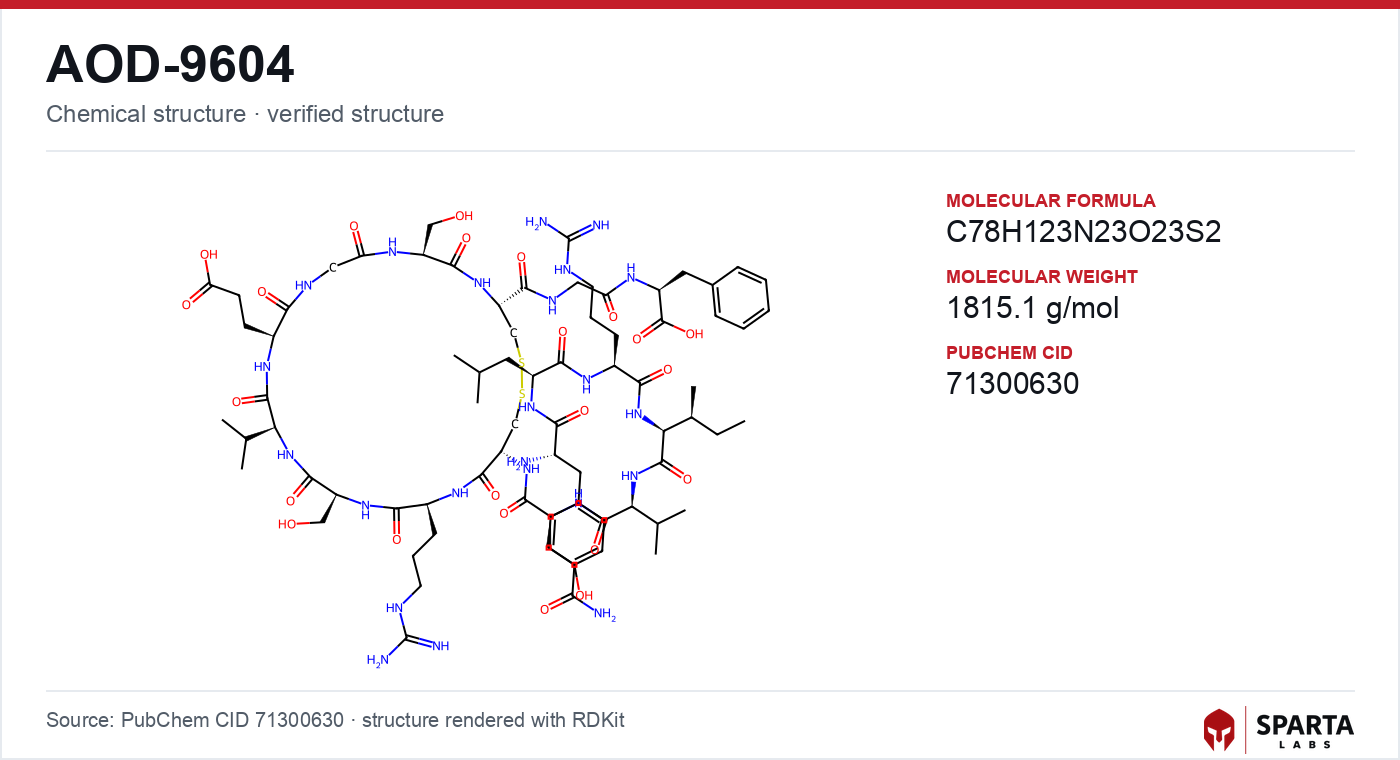
Figure: chemical structure of AOD-9604.
The Monash Question: Can hGH's Actions Be Separated? (1993–1994)
Human growth hormone was long understood to act on adipose tissue in two directions, favoring the breakdown of stored lipid while opposing new lipid synthesis. In the intact hormone these adipose actions travel together with systemic effects, including changes in insulin sensitivity and stimulation of IGF-1, which complicate the use of full-length hGH as a clean tool for studying lipid regulation in isolation. Researchers at Monash University in Melbourne asked whether a discrete structural domain of the hormone might carry the adipose activity by itself.
Wu and Ng addressed this directly in 1993, reporting that a synthetic peptide corresponding to residues 177 to 191 of hGH reproduced the antilipogenic activity of the intact molecule in isolated rat adipose tissue, with a magnitude comparable to the full hormone [1]. That result reframed the C-terminal region as a candidate probe for the lipid axis rather than an inert fragment.
Findings from research models do not establish safety or efficacy in humans. Sparta Labs makes no claims about the use of this compound.
A 1994 in vivo study by Natera, Jiang, and Ng extended the observation into a whole animal, reporting that chronic administration of synthetic hGH 177 to 191 to genetically obese (ob/ob) mice was associated with reduced cumulative body-weight gain and reduced adipose mass relative to controls [2]. These two papers established the preclinical foundation for everything that followed. The strategy of interrogating a single growth-hormone-axis pathway through a defined molecule parallels the contemporaneous lineage of growth-hormone secretagogues such as CJC-1295 with DAC, which pursued the complementary aim of prolonging endogenous GH release rather than isolating a fragment.
Engineering a Stabilized Analogue at Metabolic Pharmaceuticals (mid-1990s–2000)
The native 177 to 191 fragment was a useful demonstration but not, in its raw form, a candidate for oral drug development. Metabolic Pharmaceuticals Pty Ltd, an Australian biotechnology company, licensed the Monash intellectual property and set out to produce a more stable analogue suitable for administration studies. The company added an N-terminal tyrosine residue to the sequence, yielding Tyr-hGH177-191, the molecule assigned the designation AOD9604. An intermediate research compound, AOD9401, was studied in parallel and contributed substantially to the mechanistic literature during this period.
Two publications in 2000 mapped the biochemistry. Heffernan, Jiang, Thorburn, and Ng reported in the American Journal of Physiology that oral administration of AOD9401 to ob/ob mice was associated with reduced body-weight gain, altered adipose lipogenic and lipolytic activity, and acute changes in energy expenditure, evidence that a growth-hormone C-terminal fragment could act after oral delivery in a rodent model [3]. A companion study by Ng and colleagues in the Journal of Molecular Endocrinology examined AOD9401 in Zucker fatty rats and reported enzyme-level effects on hormone-sensitive lipase and acetyl-CoA carboxylase consistent with the dual antilipogenic and lipolytic model developed at Monash [4]. The mechanistic thread these papers open is developed further in the AOD9604 mechanism of action reference.
Characterizing the Compound and Its β3-Adrenergic Link (2001)
A 2001 study by Heffernan and colleagues in Endocrinology examined AOD9604 and the native fragment in obese mice alongside β3-adrenergic receptor knock-out animals, reporting evidence that β3-AR-dependent pathways contribute to the lipolytic activity observed over chronic treatment [5]. In the same year, a related report in the International Journal of Obesity described fat-oxidation and body-weight-associated changes in obese mice from chronic treatment with a modified C-terminal hGH fragment, notably without inducing hyperglycemia or reducing insulin secretion [6]. That metabolic separation, activity on adipose lipid handling without the glucose liabilities of full-length hGH, was the pharmacological differentiation the program had been designed to demonstrate.
Six Controlled Human Trials and the OPTIONS Endpoint (2001–2007)
On the strength of the preclinical dataset, Metabolic Pharmaceuticals advanced AOD9604 into human investigation. Stier, Vos, and Kenley later summarized the clinical program as comprising six randomized, double-blind, placebo-controlled trials, spanning intravenous and oral pilot studies and oral Phase IIb studies [7]. Across those trials the compound's tolerability was reported as comparable to placebo, with no statistically significant effects detected on serum IGF-1, fasting glucose, insulin, HbA1c, cortisol, or thyroid hormones at the levels studied, and no serious adverse events attributed to the compound [7]. In effect the human safety data matched the preclinical prediction that a C-terminal fragment would not carry the IGF-1 and glucose burdens of the whole hormone.
The Phase IIb work culminated in the oral OPTIONS study. As summarized in the same 2013 review, the pre-specified primary endpoint for statistically significant weight change across the dose range and study duration was not met, even as the safety and tolerability picture held [7]. The endpoint outcome, rather than any safety signal, is what redirected the program.
The Pivot from Drug Registration to GRAS (2007–2014)
2007: conclusion of the prescription-drug program. Following the OPTIONS endpoint result, Metabolic Pharmaceuticals concluded its effort to register AOD9604 as a prescription obesity medicine. The decision rested on the efficacy endpoint; the safety profile assembled across the six trials remained intact.
GRAS pathway (US FDA). The clinical and nonclinical safety record was subsequently marshaled in support of a Generally Recognized as Safe (GRAS) determination for AOD9604 as a dietary ingredient, conditional on publication of the underlying safety data [7]. Moré and Kenley fulfilled that publication condition in 2014 with a consolidated nonclinical safety dataset in the Journal of Endocrinology and Metabolism, encompassing chronic rat and monkey toxicology, pharmacokinetic characterization, and genotoxicity assessment [8]. A GRAS determination reflects a safety conclusion for a described food-ingredient use; it is not drug approval for any indication and does not constitute a finding of therapeutic efficacy. The analytical and quality practices applied to research-grade material are described in the AOD9604 sourcing and quality reference, and research-grade AOD9604 from Sparta Labs is supplied with batch documentation for laboratory use.
Anti-Doping Scrutiny and Later Musculoskeletal Work
AOD9604's framing as a growth-hormone-derived agent placed it within the interest of anti-doping regulation, and it has been treated as a prohibited substance under the World Anti-Doping Agency framework governing peptide hormones and growth factors. This regulatory attention is a distinct thread from the food-ingredient GRAS route and reflects the compound's structural origin in the growth hormone molecule rather than any demonstrated performance outcome.
The peer-reviewed literature also extended, later, beyond metabolism. A 2015 study by Kwon, Park, and Lee examined intra-articular AOD9604 administration in a rabbit osteoarthritis model and reported cartilage-related observations in the group receiving AOD9604 together with hyaluronic acid [9]. This is the most recent primary research contribution identified in the AOD9604 literature and moved the compound briefly into musculoskeletal biology, a domain separate from the adipose questions that had defined its development.
Where the Record Stands
The core AOD9604 literature was produced between 1993 and 2015 and has not been followed by additional human clinical trials since the 2007 conclusion of the Metabolic Pharmaceuticals program. AOD9604 continues to appear as a reference compound in discussions of whether the lipolytic and growth-promoting activities of hGH can be dissociated, and the open questions from its development, including definitive receptor identification and the mechanism of oral bioavailability, remain within the broader endocrinology and peptide research literature. Readers tracing the parallel commercial and regulatory histories of other growth-hormone-axis peptides may find the ipamorelin discovery and regulatory history a useful comparison point.
References
-
Wu Z, Ng FM. Antilipogenic action of synthetic C-terminal sequence 177-191 of human growth hormone. Biochemistry and Molecular Biology International. 1993;30(1):187–196. PMID: 8358331.
-
Natera SH, Jiang WJ, Ng FM. Reduction of cumulative body weight gain and adipose tissue mass in obese mice: response to chronic treatment with synthetic hGH 177-191 peptide. Biochemistry and Molecular Biology International. 1994;33(5):1011–1021. PMID: 7987248.
-
Heffernan MA, Jiang WJ, Thorburn AW, Ng FM. Effects of oral administration of a synthetic fragment of human growth hormone on lipid metabolism. American Journal of Physiology – Endocrinology and Metabolism. 2000;279(3):E501–E507. Full text via DOI
-
Ng FM, Sun J, Sharma L, Libinaka R, Jiang WJ, Gianello R. Molecular and cellular actions of a structural domain of human growth hormone (AOD9401) on lipid metabolism in Zucker fatty rats. Journal of Molecular Endocrinology. 2000;25(3):287–298. PMID: 11116208.
-
Heffernan MA, Summers RJ, Thorburn A, Ogru E, Gianello R, Jiang WJ, Ng FM. The effects of human GH and its lipolytic fragment (AOD9604) on lipid metabolism following chronic treatment in obese mice and β3-AR knock-out mice. Endocrinology. 2001;142(12):5182–5189. Full text via DOI
-
Heffernan M, Thorburn AW, Fam B, Summers R, Conway-Campbell B, Waters MJ, Ng FM. Increase of fat oxidation and weight loss in obese mice caused by chronic treatment with human growth hormone or a modified C-terminal fragment. International Journal of Obesity. 2001;25(10):1442–1449. PMID: 11673763.
-
Stier H, Vos E, Kenley D. Safety and tolerability of the hexadecapeptide AOD9604 in humans. Journal of Endocrinology and Metabolism. 2013;3(1–2):7–15. Source: jofem.org
-
Moré MI, Kenley D. Safety and metabolism of AOD9604, a novel nutraceutical ingredient for improved metabolic health. Journal of Endocrinology and Metabolism. 2014;4(3):116–126. Source: jofem.org
-
Kwon DR, Park GY, Lee SC. Effect of intra-articular injection of AOD9604 with or without hyaluronic acid in rabbit osteoarthritis model. Annals of Clinical and Laboratory Science. 2015;45(4):426–432. PMID: 26275694.
Disclaimer. Statements in this article have not been evaluated by the Food and Drug Administration. This compound is not intended to diagnose, treat, cure, or prevent any disease. Sparta Labs sells research-use-only materials. Content is provided for educational and informational purposes only and does not constitute medical advice. Consult a qualified medical professional for any health concerns.
Frequently asked questions
What scientific question led to AOD9604?
AOD9604 traces back to a question studied at Monash University in the early 1990s: whether the fat-related actions of full-length human growth hormone could be separated from its growth-promoting and glucose-related actions. Wu and Ng reported in 1993 that a synthetic fragment corresponding to residues 177 to 191 of hGH reproduced the antilipogenic activity of the whole molecule in isolated rat adipose tissue, which framed the C-terminal region as a candidate research tool.
How does AOD9604 differ structurally from the native hGH fragment?
AOD9604 is the hGH 177 to 191 sequence with an added N-terminal tyrosine residue, giving the designation Tyr-hGH177-191. Metabolic Pharmaceuticals introduced this modification during development of a stabilized analogue. The article discusses the reported rationale for the change with citation.
What was the OPTIONS study and what did it report?
OPTIONS was the oral Phase IIb component of the AOD9604 clinical program conducted by Metabolic Pharmaceuticals. As summarized by Stier, Vos, and Kenley in 2013, the pre-specified primary endpoint for statistically significant weight change across the dose range and study duration was not met, while the compound's tolerability profile remained comparable to placebo. Findings from these trials are described as reported outcomes, not as established results for any use.
What is AOD9604's regulatory status?
After the pharmaceutical development program concluded in 2007, the accumulated safety dataset was submitted in support of a US FDA Generally Recognized as Safe (GRAS) determination for AOD9604 as a dietary ingredient. A GRAS determination reflects a safety conclusion for a described food-ingredient use and is not equivalent to drug approval or a finding of therapeutic efficacy. AOD9604 has also drawn scrutiny under anti-doping regulation.