
AOD9604 Mechanism of Action
A mechanism-focused reference on AOD9604, the tyrosinated hGH 177-191 fragment: why the isolated C-terminal domain reportedly reproduces the fat-metabolizing actions of growth hormone in preclinical models while bypassing the growth-hormone receptor, IGF-1 output, and the diabetogenic effects of the intact hormone.

For research use only. Not for human consumption. This article is educational reference material. It is not medical advice and is not a recommendation to use any substance.
Introduction
AOD9604 is a synthetic hexadecapeptide built from residues 177-191 of human growth hormone (hGH), the disulfide-bridged C-terminal loop of the intact hormone, with an additional tyrosine residue placed at the N-terminus for stability. Its mechanistic interest in the peer-reviewed literature comes from a single question: how can such a short fragment of a large protein reportedly reproduce the fat-metabolizing actions of the whole hormone while leaving behind the hormone's growth-promoting and glucose-disrupting effects? This article summarizes the reported molecular interactions, the enzyme-level and receptor-level observations recorded in preclinical models, and the mechanistic questions that remain open in the literature. A broader account of the full evidence base appears in the AOD9604 published research summary, and the compound's chemistry and classification are covered in the AOD9604 research overview.
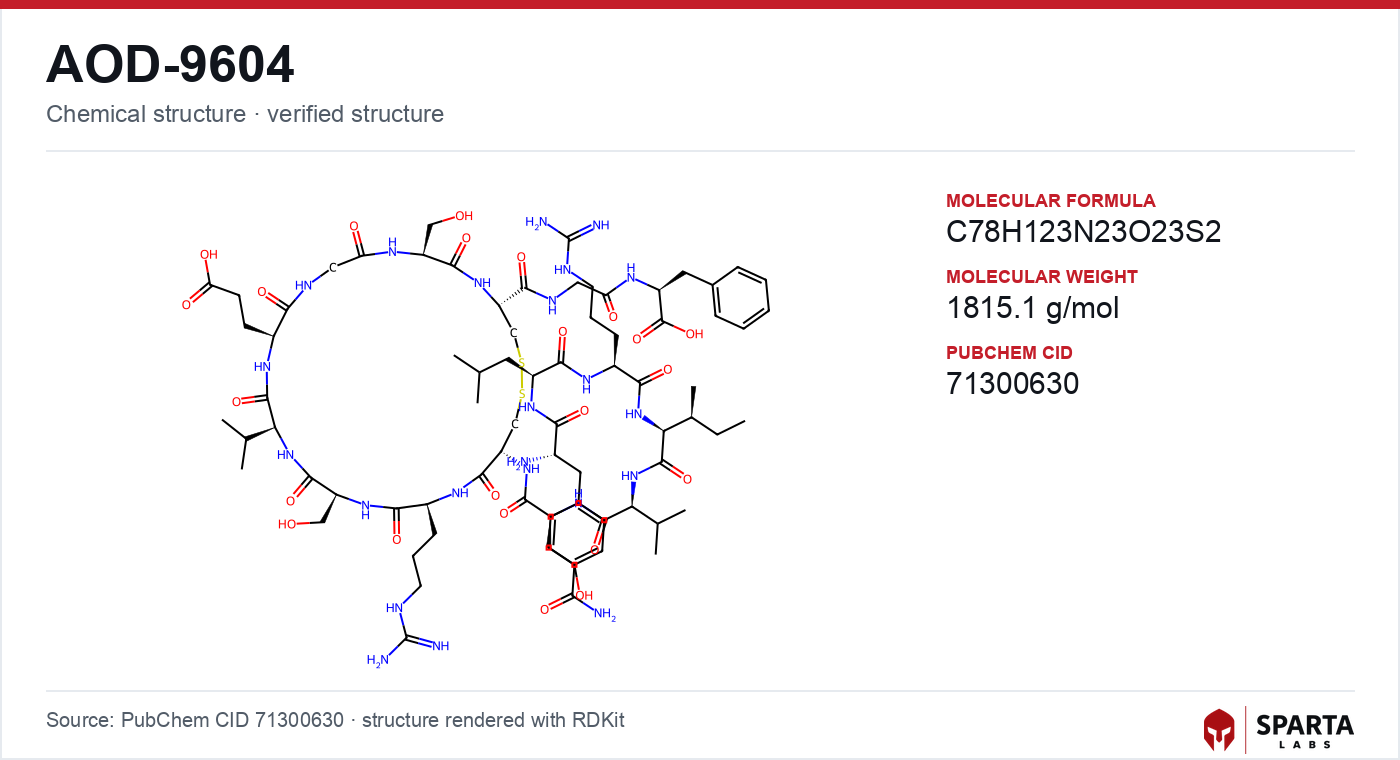
Figure: chemical structure of AOD-9604.
Why a Fragment, Not the Whole Hormone
The mechanistic story of AOD9604 begins with structure-activity work on growth hormone itself. Human growth hormone is a 191-residue, four-helix-bundle protein whose growth-promoting activity depends on binding two copies of the growth hormone receptor (GHR) through discrete surfaces distributed across the folded molecule. The lipid-related activity of the hormone was mapped separately, and a line of research led by F. M. Ng and colleagues localized much of that activity to the C-terminal region. Wu and Ng reported that the isolated synthetic sequence corresponding to hGH residues 177-191 retained antilipogenic activity against isolated rat adipose tissue comparable in magnitude to the intact hormone, while producing no statistically significant lipolytic (glycerol-release) signal in that particular in vitro system [1].
That dissociation is the conceptual foundation of the fragment. If the lipid-modulating information of growth hormone lives largely in a short C-terminal stretch, then a synthetic peptide reproducing that stretch might carry the lipid activity without the receptor-binding architecture responsible for the hormone's mitogenic and diabetogenic effects. AOD9604 is the tyrosine-stabilized realization of that hypothesis.
Findings from research models do not establish safety or efficacy in humans. Sparta Labs makes no claims about the use of this compound.
Signaling Independent of the GH Receptor
A pharmacologically significant feature reported across the AOD9604 literature is its apparent independence from the canonical growth hormone receptor. In rodent studies, treatment with the fragment was not associated with the rise in insulin-like growth factor 1 (IGF-1) that ordinarily accompanies GHR activation [2]. Because IGF-1 elevation is the standard readout of productive GHR signaling, the absence of that response is taken as evidence that AOD9604 does not primarily drive the growth-promoting axis of intact hGH.
This distinction is mechanistically consequential. It implies that the fragment's reported lipid activity arises through a pathway separable from the GHR-JAK2-STAT5 cascade that mediates growth-hormone-induced IGF-1 synthesis in the liver. The identity of the initial receptor or binding partner through which AOD9604 engages adipocytes has not been definitively established in the peer-reviewed literature and is discussed further below.
The Beta3-Adrenergic Receptor as a Downstream Node
The most mechanistically informative published finding for AOD9604 concerns the beta3-adrenergic receptor (beta3-AR), a G-protein-coupled receptor enriched in adipose tissue and classically associated with catecholamine-driven lipolysis. Heffernan and colleagues, publishing in Endocrinology in 2001, used obese mice together with beta3-AR knockout animals to probe the role of this receptor in the chronic effects of both hGH and AOD9604 [3].
The study reported that both compounds were associated with increased beta3-AR messenger RNA expression in adipose tissue over the course of treatment. It further reported that long-term treatment with either compound was not associated with reductions in body weight in the beta3-AR knockout animals, whereas effects were observed in wild-type animals [3]. The authors interpreted this genetic dissociation as evidence that beta3-AR-dependent signaling is a component of the pathway through which chronic treatment influences fat mass in that model.
Importantly, the design positions beta3-AR as a downstream, treatment-inducible node rather than the primary receptor for the peptide. AOD9604 appears to raise beta3-AR expression, and the upregulated receptor population then participates in the lipolytic response over time. This two-tier picture, an unidentified proximal target feeding into an inducible beta3-AR effector arm, frames much of the subsequent mechanistic discussion.
Enzyme-Level Correlates in Adipocytes
Beneath the receptor-level observations sits a set of enzyme-level findings that give the fragment's activity a concrete biochemical footing.
Hormone-sensitive lipase and acetyl-CoA carboxylase
Work on the closely related non-tyrosinated fragment AOD9401 reported that this C-terminal hGH domain was associated with stimulated hormone-sensitive lipase (HSL) activity and inhibited acetyl-CoA carboxylase (ACC) activity in isolated rodent adipose tissue, following a pattern similar to intact hGH [4]. HSL is a principal intracellular lipase that hydrolyzes stored triglyceride into free fatty acids and glycerol; ACC catalyzes the committed, rate-limiting step of de novo fatty-acid synthesis. A simultaneous push on HSL and brake on ACC is internally consistent: it would favor triglyceride breakdown while restraining new fat synthesis.
Lipolysis and lipogenesis as separable readouts
The Wu and Ng in vitro data cited above reported robust antilipogenic activity but no significant acute lipolytic signal in isolated tissue [1], whereas in vivo studies reported markers of lipolysis such as elevated plasma glycerol during treatment [3][5]. The most parsimonious reading in the literature is that the antilipogenic (ACC-inhibiting) and lipolytic (HSL- and beta3-AR-associated) arms are partly separable, with the lipolytic arm depending on the intact tissue context and on the treatment-induced beta3-AR upregulation that an acute in vitro assay would not capture.
Downstream Effects Recorded in Preclinical Models
The whole-animal effects attributed to AOD9604 and related C-terminal fragments in the published preclinical literature include reductions in adipose tissue mass and body-weight gain in obese rodent models under chronic treatment [3][5]. A 2001 study in the International Journal of Obesity reported that both hGH and a C-terminal hGH fragment were associated with reduced body-weight gain, elevated plasma glycerol, and increased in vivo fat oxidation in obese mice relative to controls [5].
A pharmacological point emphasized in that work is that the C-terminal fragment, unlike full-length hGH, was not associated with hyperglycemia or reduced insulin secretion in the animal models studied [5]. Full-length growth hormone is diabetogenic in part through its effect on insulin sensitivity; the reported absence of that liability in the fragment reinforces the central mechanistic claim that AOD9604 reproduces the hormone's lipid-related actions while leaving the glucose-related actions behind.
These observations are confined to preclinical systems. Rodent adipose tissue differs substantially from human adipose tissue in beta3-AR density and regulation, and effects reported in animal models do not establish that equivalent effects occur in humans.
Activity Beyond Adipose Tissue
A 2015 study in the Annals of Clinical and Laboratory Science examined intra-articular administration of AOD9604, alone or with hyaluronic acid, in a rabbit osteoarthritis model, reporting cartilage findings characterized by histopathological and morphological scoring [6]. The study is mechanistically undeveloped: it establishes a tissue-level observation without identifying the molecular pathway responsible. Its relevance to this article is that it raises the possibility that hGH C-terminal fragment activity is not strictly confined to adipocyte lipid handling. Whether that reflects a distinct target, a shared upstream mechanism, or model-specific effects has not been resolved in primary literature.
Open Mechanistic Questions
Several threads remain genuinely unsettled in the peer-reviewed record and shape the current research agenda:
Identity of the proximal receptor. The beta3-AR data characterize that receptor as a downstream, inducible effector [3]. The receptor or binding partner through which AOD9604 first engages the adipocyte, and how that engagement drives beta3-AR upregulation, has not been definitively identified.
Route from signal to enzyme. The HSL-stimulating and ACC-inhibiting patterns [4] have been described phenomenologically, but the intracellular signaling that connects an initial binding event to those enzyme changes has not been fully mapped.
Species translation. The mechanistic corpus is overwhelmingly rodent-derived. Given known interspecies differences in beta3-AR biology, the degree to which the beta3-AR-linked mechanism generalizes to human adipose tissue is an open comparative-physiology question.
For readers situating AOD9604 within the wider growth-hormone-axis research landscape, the mechanism is instructive precisely because it is orthogonal to the secretagogue approach. Ghrelin-receptor agonists such as those discussed in the ipamorelin mechanism of action and GHRP-6 mechanism of action articles act upstream to influence endogenous GH release, whereas AOD9604 is a downstream fragment that reportedly bypasses the GH receptor entirely. Analytical characterization of the peptide as a research input is discussed in the AOD9604 sourcing and quality reference, and material specifications for AOD9604 from Sparta Labs are documented per batch.
References
-
Wu Z, Ng FM. Antilipogenic action of synthetic C-terminal sequence 177-191 of human growth hormone. Biochemistry and Molecular Biology International. 1993;30(1):187-196. PMID: 8358331. PubMed
-
Heffernan MA, Jiang WJ, Thorburn AW, Ng FM. Effects of oral administration of a synthetic fragment of human growth hormone on lipid metabolism. American Journal of Physiology - Endocrinology and Metabolism. 2000;279(3):E501-E507. Full text via DOI PubMed
-
Heffernan M, Summers RJ, Thorburn A, Ogru E, Gianello R, Jiang WJ, Ng FM. The effects of human GH and its lipolytic fragment (AOD9604) on lipid metabolism following chronic treatment in obese mice and beta3-AR knock-out mice. Endocrinology. 2001;142(12):5182-5189. Full text via DOI PubMed
-
Ng FM, Sun J, Sharma L, Libinaka R, Jiang WJ, Gianello R. Metabolic studies of a synthetic lipolytic domain (AOD9604) of human growth hormone. Hormone Research. 2000;53(6):274-278. Full text via DOI PubMed
-
Heffernan M, Thorburn AW, Fam B, Summers R, Conway-Campbell B, Waters MJ, Ng FM. Increase of fat oxidation and weight loss in obese mice caused by chronic treatment with human growth hormone or a modified C-terminal fragment. International Journal of Obesity and Related Metabolic Disorders. 2001;25(10):1442-1449. Full text via DOI PubMed
-
Kwon DR, Park GY. Effect of intra-articular injection of AOD9604 with or without hyaluronic acid in rabbit osteoarthritis model. Annals of Clinical and Laboratory Science. 2015;45(4):426-432. PMID: 26275694. PubMed
Disclaimer. Statements in this article have not been evaluated by the Food and Drug Administration. This compound is not intended to diagnose, treat, cure, or prevent any disease. Sparta Labs sells research-use-only materials. Content is provided for educational and informational purposes only and does not constitute medical advice. Consult a qualified medical professional for any health concerns.
Frequently asked questions
What is the difference between AOD9604 and full-length human growth hormone?
AOD9604 corresponds to only the last 15 residues of the 191-residue human growth hormone molecule (positions 177-191), with an extra N-terminal tyrosine added. Because it lacks the receptor-binding surfaces of the intact hormone, published preclinical studies reported that it does not raise IGF-1 and, unlike full-length hGH, was not associated with hyperglycemia or reduced insulin secretion in the rodent models studied. Researchers have described this separation of the lipid-related actions from the growth-promoting and glucose-related actions as a defining feature of the fragment.
Does AOD9604 act through the growth hormone receptor?
The published preclinical literature indicates it does not appear to signal primarily through the canonical growth hormone receptor (GHR), because studies reported no downstream IGF-1 elevation of the kind that accompanies GHR activation. The beta3-adrenergic receptor has been characterized as a downstream component of the pathway based on knockout-mouse experiments, but the primary receptor or binding partner through which AOD9604 first engages adipose tissue has not been definitively identified.
What role does the beta3-adrenergic receptor play in AOD9604 research?
A 2001 study in Endocrinology reported that both human growth hormone and AOD9604 were associated with increased beta3-adrenergic receptor (beta3-AR) messenger RNA in adipose tissue of obese mice, and that chronic treatment was not associated with body-weight changes in beta3-AR knockout animals. The authors interpreted this as evidence that beta3-AR-dependent signaling contributes to the lipolytic activity observed under long-term treatment conditions in that model.
Which enzymes have been linked to AOD9604's reported effects on fat metabolism?
Studies of AOD9604 and the closely related fragment AOD9401 reported patterns consistent with stimulated hormone-sensitive lipase (HSL), the enzyme that hydrolyzes stored triglyceride, and inhibited acetyl-CoA carboxylase (ACC), a rate-limiting enzyme of fatty-acid synthesis. This combination of increased lipolytic and reduced lipogenic enzyme activity in isolated rodent adipose tissue mirrored the reported actions of intact growth hormone.