
AOD9604: Sourcing, Purity, and Verification Standards
A chemistry-first look at verifying AOD9604: why its modified hGH 177-191 sequence and single disulfide bridge shape the synthesis and analytical methods used to confirm identity and purity. Educational reference.
For research use only. Not for human consumption. This article is educational reference material. It is not medical advice and is not a recommendation to use any substance.
Introduction
AOD9604 is a synthetic hexadecapeptide derived from the C-terminal region of human growth hormone (hGH). Its analytical verification is shaped almost entirely by two structural facts: it is a fragment of a well-characterized native protein rather than a wholly novel sequence, and it carries a single intramolecular disulfide bond. Those two features determine which synthesis route is practical, which impurities are most likely, and which analytical readouts are diagnostic of correct identity. This article approaches sourcing and quality from the chemistry of the molecule outward, rather than from a generic testing checklist. A summary of the compound's published pharmacology, including its human safety characterization, appears in the AOD9604 research overview, and its reported lipolytic mechanism is discussed in the AOD9604 mechanism of action article. The material described here is the AOD9604 offered by Sparta Labs for research applications.
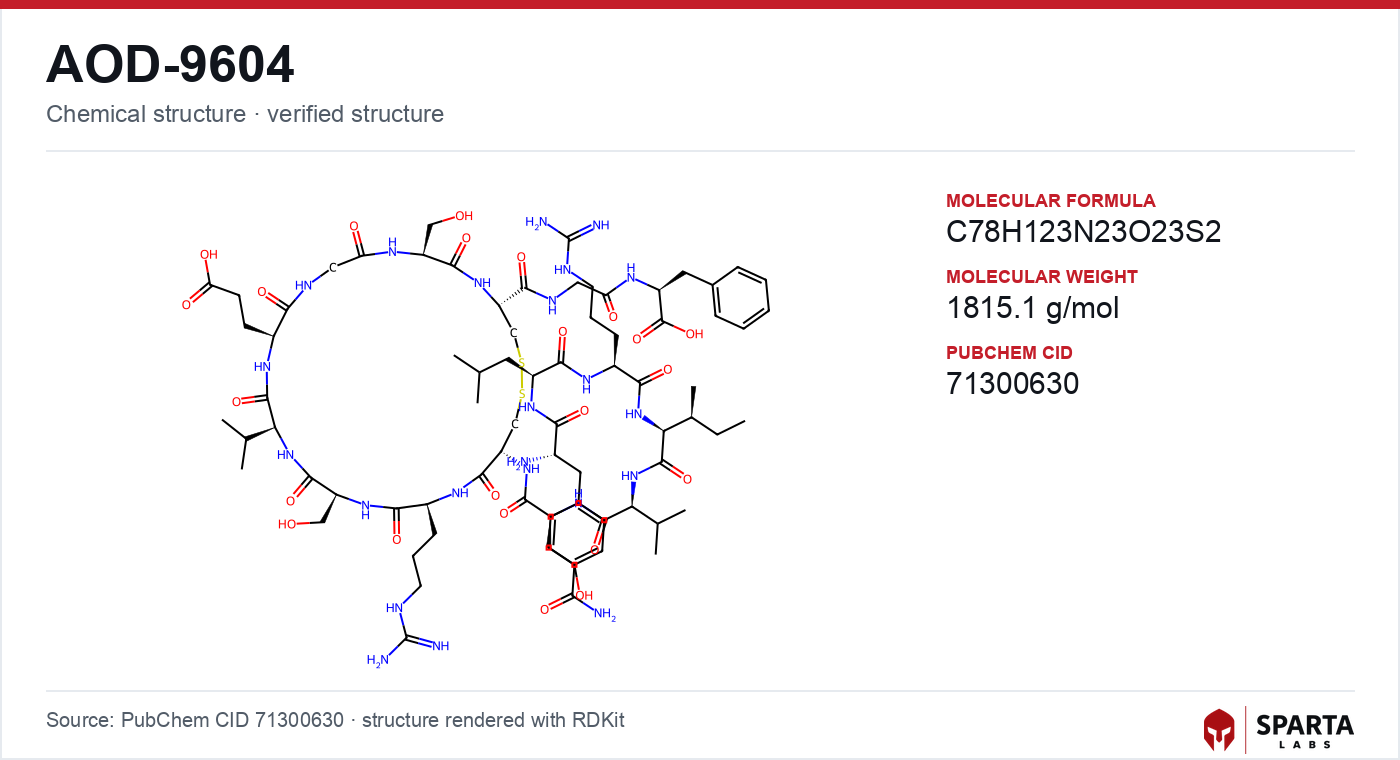
Figure: chemical structure of AOD-9604.
The Sequence Determines the Verification Problem
AOD9604 is defined by the sequence Tyr-Leu-Arg-Ile-Val-Gln-Cys-Arg-Ser-Val-Glu-Gly-Ser-Cys-Gly-Phe, a molecule of approximately 1817 Da in its reduced form. The C-terminal fifteen residues correspond to positions 177-191 of the full-length hGH molecule; the N-terminal tyrosine is an added residue that does not appear in native hGH at that position. This origin was established in the foundational characterization of the compound by Ng and colleagues, who described the synthetic lipolytic domain of human growth hormone and its metabolic profile [1].
Findings from research models do not establish safety or efficacy in humans. Sparta Labs makes no claims about the use of this compound.
Two consequences follow for quality work. First, because the sequence is short and well defined, the analytical target is unambiguous: a batch either matches the theoretical composition or it does not. Second, the presence of two cysteine residues means the molecule exists as chemically distinct oxidized and reduced species, and only the oxidized, disulfide-bridged form corresponds to the structure characterized in the primary literature. Verification must therefore confirm both the primary sequence and the oxidation state, not sequence alone.
Solid-Phase Assembly of a Sixteen-Residue Chain
A peptide of this length is assembled by solid-phase peptide synthesis (SPPS), the method introduced by R. B. Merrifield in 1963 and recognized with the 1984 Nobel Prize in Chemistry [2]. In SPPS, protected amino acid residues are coupled sequentially onto a resin-bound growing chain, after which the completed peptide is deprotected and cleaved from the support. For research-scale peptides up to roughly 50 residues, SPPS remains the standard route, and reviews of large-scale peptide manufacturing describe the coupling, deprotection, and purification chemistry that governs yield and impurity formation [3].
The characteristic by-products of SPPS are truncation sequences (chains missing one or more residues because a coupling step failed) and deletion sequences. These species share much of the target's structure and can chromatograph close to it, which is precisely why identity confirmation cannot rest on chromatographic retention alone. The same SPPS platform is used across the growth-hormone-axis research supply chain, including secretagogues such as those covered in the ipamorelin sourcing and quality article; AOD9604 differs from most of those peptides in requiring an explicit disulfide-closure step.
Closing and Confirming the Disulfide Bridge
After chain assembly and cleavage, the two cysteine residues of AOD9604 must be joined into a single intramolecular disulfide bond by oxidative folding. This is a discrete manufacturing operation rather than an automatic outcome of synthesis, and its completeness is a defined quality attribute. In the disulfide-bridged form the molecule is approximately two mass units lighter than the fully reduced chain, because oxidation removes two hydrogen atoms.
The disulfide constrains the peptide into the loop geometry associated with the growth-hormone C-terminal fragment. Because reduced and oxidized forms are distinct chemical entities, reference-grade material is characterized in its oxidized state, and the analytical package documents that the intended disulfide species predominates. This also has a practical handling implication: reducing agents such as dithiothreitol (DTT), TCEP, or beta-mercaptoethanol will cleave the bond, so buffers used in downstream work are typically confirmed to be free of reductants unless reduction is intended by the experimental design.
Chromatographic Purity and Mass-Spectrometric Identity
Two orthogonal methods carry most of the analytical load. Reversed-phase high-performance liquid chromatography (HPLC) separates the target peptide from synthetic by-products and reports purity as an area percent, the fraction of total ultraviolet-absorbance peak area attributable to the main peak. A widely applied threshold for research-grade peptides is 98 percent or greater by HPLC area, documented on the certificate of analysis with the associated chromatogram.
Mass spectrometry (MS) provides the identity dimension that chromatography cannot. By measuring the molecular mass of the eluted material and comparing it against the value calculated from the sequence, MS distinguishes the correct 16-residue peptide from truncation and deletion products of similar retention, and it reports whether the observed mass matches the oxidized (disulfide-bridged) or reduced form. HPLC establishes how much of the sample is the main component; MS establishes that the main component is, in fact, AOD9604 in the intended oxidation state. Used together, the two methods close the gap that either would leave open alone.
Residual-reagent analysis complements the identity and purity data. Solvents and reagents used in SPPS and cleavage, including trifluoroacetic acid, are assessed so the released material reflects the peptide rather than process residues, and endotoxin testing is applied where the intended research use makes it relevant.
Independent Confirmation and the Certificate of Analysis
Sparta Labs applies a two-stage analytical model in which the synthesis facility's testing is followed by confirmation at an independent laboratory that has no stake in the result. Each batch of AOD9604 is re-tested for HPLC purity and MS identity before release, and batches that do not meet the specified purity and identity criteria on both readings are not made available. This provides two independent measurements against which batch conformance is judged.
The certificate of analysis (COA) records the outcomes for a specific production run: the HPLC area-percent purity with chromatogram available on request, the MS identity confirmation against theoretical mass including disulfide state, the unique batch number linking the document to its synthesis and raw-material records, the manufacturing and expiry dates, and the third-party laboratory and testing date. The COA for each batch is accessible from the product page, and underlying raw data such as chromatogram traces and mass spectra may be requested through customer support.
Storage Behavior of a Disulfide-Bridged Peptide
AOD9604 is supplied lyophilized. Published reviews of protein and peptide pharmaceutical stability describe how removing water suppresses hydrolytic degradation and slows other solution-phase reactions, which is why dry material is generally more stable than the same peptide in solution [4]. General handling practices for lyophilized research peptides include storage at low temperature, limiting freeze-thaw cycling, and protection from light and humidity.
For a disulfide-containing molecule, storage considerations extend beyond hydrolysis. Moisture and trace reductants are the variables most relevant to preserving the oxidized structure over time, and peer-reviewed peptide-stability literature notes that disulfide scrambling and oxidation are among the degradation pathways minimized in the dry state [4]. Peptide-specific solution-stability data for AOD9604 are limited in the published record, so general principles from analytical studies of comparable peptides are the applicable reference. The expiry date on the COA applies to the lyophilized material under the stated storage conditions.
Why Analytical Rigor Aligns With Reproducibility
The published findings on AOD9604 were generated with chemically characterized material, and the human safety data reported by Stier and colleagues likewise rested on defined reference preparations [5]. Reproducing or building on that literature depends on working from material of confirmed sequence, purity, and oxidation state. A preparation carrying substantial truncation impurities or an incompletely closed disulfide would represent a different chemical mixture, and observations made with it could not be cleanly compared against the established record.
Framing sourcing around the molecule's own chemistry, rather than a generic checklist, is the point of this article. For AOD9604, the decisive attributes are correct primary sequence, a confirmed intramolecular disulfide bond, and high chromatographic purity, each documented per batch and independently confirmed. Readers comparing quality practices across the growth-hormone-axis cluster may also find the tesamorelin sourcing and quality and CJC-1295 without DAC sourcing and quality articles useful for context on how synthesis and verification differ across related peptides.
References
-
Ng FM, Sun J, Sharma L, Libinaka R, Jiang WJ, Gianello R. Metabolic studies of a synthetic lipolytic domain (AOD9604) of human growth hormone. Hormone Research. 2000;53(6):274-278. Full text via DOI
-
Merrifield RB. Solid phase peptide synthesis. I. The synthesis of a tetrapeptide. Journal of the American Chemical Society. 1963;85(14):2149-2154. Full text via DOI
-
Andersson L, Blomberg L, Flegel M, Lepsa L, Nilsson B, Verlander M. Large-scale synthesis of peptides. Biopolymers. 2000;55(3):227-250. Full text via DOI<227::AID-BIP30>3.0.CO;2-7
-
Manning MC, Chou DK, Murphy BM, Payne RW, Katayama DS. Stability of protein pharmaceuticals: an update. Pharmaceutical Research. 2010;27(4):544-575. Full text via DOI
-
Stier H, Vos E, Kenley D. Safety and tolerability of the hexadecapeptide AOD9604 in humans. Journal of Endocrinology and Metabolism. 2013;3(1-2):7-15. Full text via DOI
Disclaimer. Statements in this article have not been evaluated by the Food and Drug Administration. This compound is not intended to diagnose, treat, cure, or prevent any disease. Sparta Labs sells research-use-only materials. Content is provided for educational and informational purposes only and does not constitute medical advice. Consult a qualified medical professional for any health concerns.
Frequently asked questions
What is the amino acid sequence of AOD9604, and why does it matter for verification?
AOD9604 corresponds to the C-terminal region of human growth hormone (residues 177-191) with an additional tyrosine at the N-terminus, giving the sequence Tyr-Leu-Arg-Ile-Val-Gln-Cys-Arg-Ser-Val-Glu-Gly-Ser-Cys-Gly-Phe. Because it is a defined 16-residue sequence containing two cysteines, analytical verification must confirm both the correct primary sequence and the intramolecular disulfide bond described in the primary literature. Mass spectrometry and HPLC are the standard methods used to establish this identity.
Why is the disulfide bond in AOD9604 significant for quality assessment?
The two cysteine residues in AOD9604 form a single intramolecular disulfide bridge that constrains the peptide into the loop conformation described in the growth-hormone fragment literature. Oxidative folding to close this bond is a discrete manufacturing step, and its completion is confirmed analytically because a reduced-form molecule differs by two mass units and represents a distinct chemical species. Reference material is therefore characterized in its oxidized, disulfide-bridged state.
How is the identity of a synthetic peptide like AOD9604 confirmed?
Identity is confirmed by mass spectrometry, which measures the molecular mass of the synthesized compound and compares it against the theoretical mass calculated from the sequence. This distinguishes the target peptide from truncation or deletion by-products that can co-elute during chromatography. Reversed-phase HPLC is used alongside mass spectrometry to quantify chromatographic purity as an area-percent value.
Why are lyophilized peptides considered more stable for storage than solutions?
Lyophilization removes water, and published reviews of protein and peptide pharmaceutical stability describe how the absence of water slows hydrolytic degradation and other solution-phase reactions. For a disulfide-containing peptide, minimizing exposure to moisture and reducing agents is relevant to preserving the oxidized structure. General handling practices for lyophilized peptides include low-temperature storage and limiting freeze-thaw cycling.