
CJC-1295 with DAC: Discovery and Regulatory History
How CJC-1295 with DAC emerged from two converging lines of science: the 1982 isolation of GHRH from acromegaly-associated tumors and the albumin bioconjugation chemistry that gave the analog a multi-day circulatory presence. Educational reference.
For research use only. Not for human consumption. This article is educational reference material. It is not medical advice and is not a recommendation to use any substance.
Introduction
CJC-1295 with DAC is a synthetic analog of growth hormone-releasing hormone (GHRH) whose history is best understood as the intersection of two independent research lineages rather than a single invention. One lineage is neuroendocrine: the decades-long effort to isolate and sequence native GHRH, which finally succeeded in 1982. The other is chemical: the development of albumin bioconjugation as a general strategy for lengthening the circulatory presence of small peptides. CJC-1295 with DAC sits where those two lines met in the early 2000s. This article is an educational reference timeline that traces both threads and the regulatory record that followed, current as of the mid-2020s.
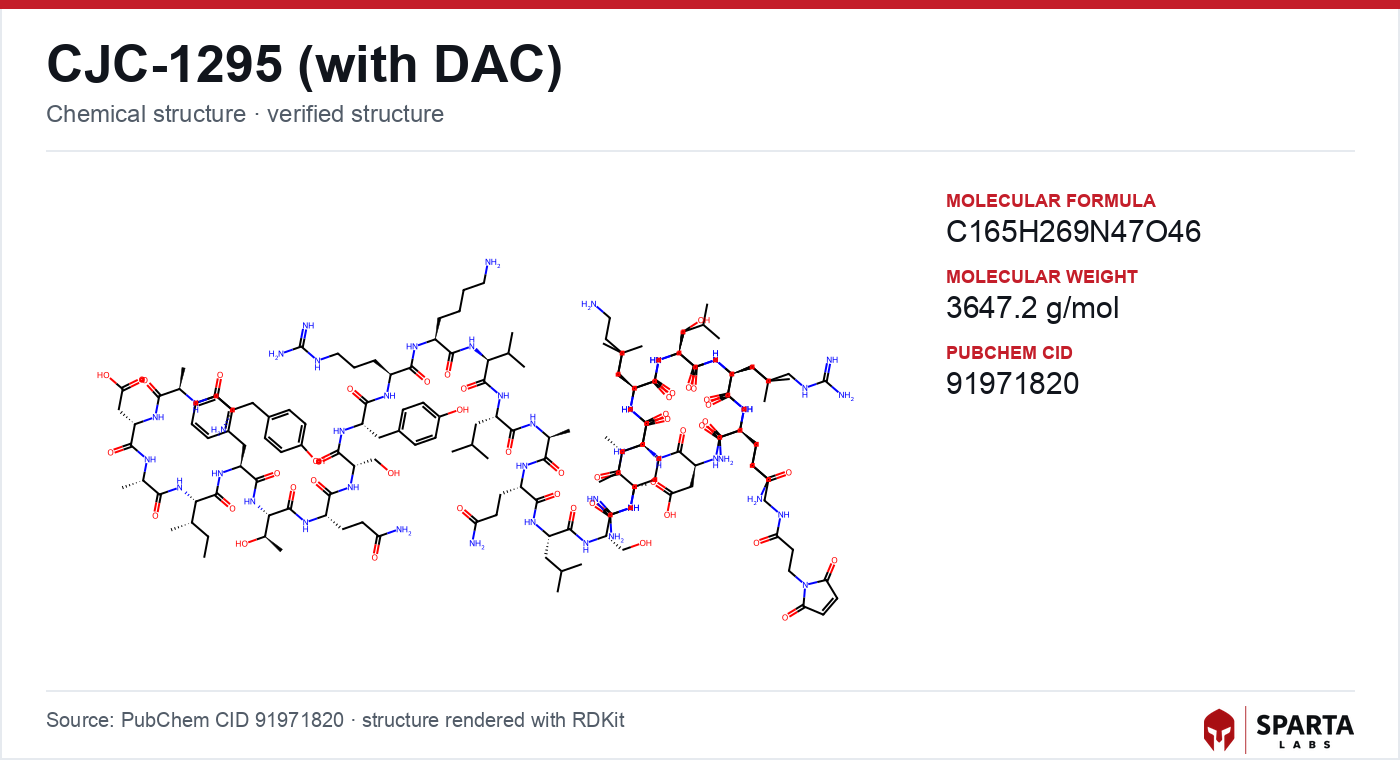
Figure: chemical structure of CJC-1295 (with DAC).
An Elusive Hormone: Why GHRH Took Decades to Isolate
For most of the twentieth century, endocrinologists knew that the hypothalamus released a factor that governed pituitary growth hormone (GH) secretion, but the molecule itself resisted identification. The obstacle was quantity. Hypothalamic neurons produce GHRH in amounts too small to permit the classical isolation-and-sequencing workflow of the era, which required substantial starting material.
The breakthrough came from pathology rather than from the brain. A subset of pancreatic islet tumors associated with acromegaly, the syndrome of GH excess marked by skeletal overgrowth, were found to secrete a GHRH-like factor ectopically and in comparatively large quantities. These tumors provided the abundant source that hypothalamic tissue could not.
In November 1982, Guillemin and colleagues at the Salk Institute reported the isolation of a 44-amino-acid peptide from a human pancreatic tumor associated with acromegaly and demonstrated its GH-releasing activity in Science [1]. A second group working in parallel characterized a structurally related peptide from the same disease context at nearly the same time, and the two reports are jointly credited with establishing the molecular identity of human GHRH. The isolated species was an amidated 44-residue peptide, GHRH(1-44)-NH2; shorter active forms, including GHRH(1-29)-NH2, were characterized subsequently and became the working scaffold for analog chemistry.
Findings from research models do not establish safety or efficacy in humans. Sparta Labs makes no claims about the use of this compound.
The Half-Life Problem That Shaped Every GHRH Analog
Once the sequence was known, the pharmacological problem became obvious. Native GHRH is cleared from circulation very rapidly. Frohman and colleagues characterized the mechanism, reporting that dipeptidyl peptidase IV (DPP-4) cleaves the N-terminus of human GHRH in plasma, generating a truncated and biologically inactive metabolite [2]. This enzymatic vulnerability meant that native GHRH could not sustain receptor engagement long enough to be practical as a research or therapeutic tool.
Two design responses followed, and they define the entire GHRH-analog family. The first was to armor the N-terminus against DPP-4 by substituting the cleavage-susceptible residues. Sermorelin, a GHRH(1-29)-NH2 analog, and later tesamorelin, an N-terminally modified GHRH(1-44) analog, both illustrate the substitution strategy and both reached FDA-approved status in defined contexts. The tetra-substitution pattern that appears in the CJC-1295 backbone belongs to this same tradition of position-specific amino-acid changes intended to preserve receptor agonism while resisting cleavage.
The second response, and the one that distinguishes CJC-1295 with DAC from the shorter-acting members of the class, was to physically tether the peptide to a long-lived carrier in the bloodstream.
Albumin Bioconjugation: The DAC Platform
ConjuChem Inc., a Montreal-based biotechnology company, developed the Drug Affinity Complex (DAC) platform in the early 2000s as a general approach to extending peptide half-life. The chemistry is straightforward in concept. A reactive maleimide group is appended to the therapeutic peptide; once introduced into circulation, that maleimide forms a covalent bond with the free thiol of cysteine-34 on human serum albumin. Albumin is one of the most abundant and long-lived plasma proteins, with a circulatory half-life measured in weeks, and it is too large for rapid renal filtration. Conjugating a small peptide to it was intended to transfer some of that longevity to the peptide.
ConjuChem first applied the DAC concept to a GLP-1 analog, CJC-1131, before turning the same maleimide-albumin strategy toward the GHRH scaffold. The first peer-reviewed characterization of CJC-1295 as a DAC-modified GHRH analog appeared in Endocrinology in 2005 [3]. That report described maleimido-derivatized hGRF(1-29) analogs, evaluated them in vitro and in rat anterior pituitary cell assays, and identified CJC-1295 as the lead compound in the series. It represents the first public disclosure of the compound's identity and design rationale in the scientific literature. Readers tracing the structural relationship between the DAC-bearing and non-conjugated forms may find the companion CJC-1295 without DAC research overview a useful point of comparison.
The Clinical Arc: 2006 Human Studies and a Halted Trial
Human pharmacodynamic data followed quickly. In 2006, Teichman and colleagues reported in the Journal of Clinical Endocrinology and Metabolism that a single administration of CJC-1295 in healthy adults was associated with prolonged elevation of the GH and IGF-1 axis, with a measured compound half-life on the order of several days [4]. The same year, Ionescu and Frohman reported that GH secretion retained its episodic, pulsatile character even under continuous stimulation by the long-acting analog [5]. That pulsatility finding remains a scientifically interesting observation about how the pituitary maintains rhythmic output under sustained receptor input, and it continues to be cited in somatotroph neuroendocrinology.
Alongside the pharmacodynamic reports, ConjuChem registered a Phase 2 clinical trial (ClinicalTrials.gov NCT00267527) evaluating CJC-1295 in a metabolic research population, a context for which the broader GHRH-analog class had an established scientific rationale through the concurrent tesamorelin program. The trial was initiated in 2005 and stopped in 2006; its primary endpoints were not reached, and no peer-reviewed report of its results appeared in the subsequent literature. The compound's clinical development did not advance beyond this point, and CJC-1295 with DAC has not received FDA approval for any therapeutic indication.
From Laboratory to Prohibited List: Anti-Doping and Forensic Identification
A compound that raises the GH/IGF-1 axis inevitably drew the attention of anti-doping authorities. The World Anti-Doping Agency (WADA) placed GHRH and its analogs under Section S2 of its Prohibited List, which covers peptide hormones, growth factors, and related mimetics. This classification applied to CJC-1295 alongside sermorelin, tesamorelin, and the wider analog family, and it created a scientific demand for reliable detection methods.
That demand produced the compound's first forensic appearance in the literature. In 2011, Thevis and colleagues reported the identification of CJC-1295 in an unknown pharmaceutical preparation seized by Norwegian authorities, using liquid chromatography coupled to high-resolution tandem mass spectrometry [6]. The report is notable on two counts: it demonstrated that unambiguous analytical identification of the compound in seized material was feasible, and it documented that CJC-1295 had, by that date, entered the wider research-chemical supply chain well outside any sponsored clinical program.
The 2024 FDA Compounding Review
The most recent formal regulatory engagement with CJC-1295 with DAC came in December 2024, when the FDA convened its Pharmacy Compounding Advisory Committee (PCAC). The committee evaluated several CJC-1295-related substances, including CJC-1295 with DAC (free base) and its acetate and trifluoroacetate salt forms, for potential inclusion on the Section 503A bulk drug substances list that governs what compounding pharmacies may prepare [7]. The review weighed the published evidence base, considerations of clinical need, and compounding-specific factors. Among the outcomes of that process was the FDA's proposed determination that these substances not be added to the 503A Bulks List. This 2024 review stands as the most recent point of contact between CJC-1295 with DAC and a major regulatory authority.
Where the Story Stands Now
In the mid-2020s, CJC-1295 with DAC occupies a well-documented but non-approved position. It has published human pharmacokinetic and pharmacodynamic data, a characterized preclinical profile, and a defined regulatory record, without an approved therapeutic indication. Ongoing scientific interest clusters in two areas: the refinement of analytical detection methods for GHRH analogs, and the use of sustained GHRH-receptor agonism as a pharmacological probe in preclinical models of pituitary somatotroph biology.
The compound also remains a reference point within the broader landscape of GH-axis research tools. Investigators comparing sustained receptor agonism against the pulse-generating chemistry of the growth hormone secretagogue receptor family may consult the parallel histories of ghrelin-mimetic agents such as GHRP-2 and ipamorelin, which act through a distinct receptor pathway. For laboratories evaluating the compound as a research material, CJC-1295 with DAC is available from Sparta Labs as a research-use-only compound with batch-level analytical documentation.
References
-
Guillemin R, Brazeau P, Böhlen P, Esch F, Ling N, Wehrenberg WB. Growth hormone-releasing factor from a human pancreatic tumor that caused acromegaly. Science. 1982;218(4572):585-587. PMID: 6812220. DOI: 10.1126/science.6812220.
-
Frohman LA, Downs TR, Heimer EP, Felix AM. Dipeptidylpeptidase IV and trypsin-like enzymatic degradation of human growth hormone-releasing hormone in plasma. J Clin Invest. 1989;83(5):1533-1540. PMID: 2703532. PMC: PMC303858.
-
Jetté L, Léger R, Thibaudeau K, Benquet C, Robitaille M, Pellerin I, et al. Human growth hormone-releasing factor (hGRF)1-29-albumin bioconjugates activate the GRF receptor on the anterior pituitary in rats: identification of CJC-1295 as a long-lasting GRF analog. Endocrinology. 2005;146(7):3052-3058. PMID: 15817669. DOI: 10.1210/en.2004-1286.
-
Teichman SL, Neale A, Lawrence B, Gagnon C, Castaigne JP, Frohman LA. Prolonged stimulation of growth hormone (GH) and insulin-like growth factor I secretion by CJC-1295, a long-acting analog of GH-releasing hormone, in healthy adults. J Clin Endocrinol Metab. 2006;91(3):799-805. PMID: 16352683. DOI: 10.1210/jc.2005-1536.
-
Ionescu M, Frohman LA. Pulsatile secretion of growth hormone (GH) persists during continuous stimulation by CJC-1295, a long-acting GH-releasing hormone analog. J Clin Endocrinol Metab. 2006;91(12):4792-4797. PMID: 16968793. DOI: 10.1210/jc.2006-1702.
-
Thevis M, Kohler M, Thomas A, Walpurgis K, Schänzer W. Identification of CJC-1295, a growth-hormone-releasing peptide, in an unknown pharmaceutical preparation. Drug Test Anal. 2011;3(1):56-61. PMID: 21204297. DOI: 10.1002/dta.242.
-
US Food and Drug Administration. Pharmacy Compounding Advisory Committee (PCAC) Meeting Briefing Document. December 2024. Available at: Source: fda.gov.
Disclaimer. Statements in this article have not been evaluated by the Food and Drug Administration. This compound is not intended to diagnose, treat, cure, or prevent any disease. Sparta Labs sells research-use-only materials. Content is provided for educational and informational purposes only and does not constitute medical advice. Consult a qualified medical professional for any health concerns.
Frequently asked questions
Why does the history of CJC-1295 begin with tumor tissue?
Native growth hormone-releasing hormone (GHRH) is produced in vanishingly small amounts by hypothalamic neurons, which frustrated efforts to isolate it. The molecular structure was finally solved in 1982 when researchers used pancreatic tumors associated with acromegaly, which secreted GHRH ectopically in far larger quantities. That structural sequence became the scaffold from which every synthetic GHRH analog, including CJC-1295, was later derived.
What does the DAC in CJC-1295 with DAC refer to?
DAC stands for Drug Affinity Complex, a bioconjugation platform developed by ConjuChem Inc. It appends a reactive maleimide group to the peptide, allowing covalent attachment to a free thiol on circulating human serum albumin. Because albumin resists rapid renal clearance, the reported goal of the chemistry was to extend the analog's circulatory residence relative to unmodified GHRH fragments.
Was CJC-1295 with DAC ever studied in humans?
Yes. Two pharmacodynamic studies in healthy adults were published in the Journal of Clinical Endocrinology and Metabolism in 2006, and ConjuChem registered a Phase 2 trial (NCT00267527) in a metabolic research population. That trial was stopped in 2006 without published results reaching its primary endpoints. The compound has not received FDA approval for any therapeutic indication.
How does the history of CJC-1295 with DAC connect to anti-doping science?
The World Anti-Doping Agency classifies GHRH analogs under Section S2 of its Prohibited List. In 2011, researchers reported the forensic identification of CJC-1295 in a seized pharmaceutical preparation using high-resolution mass spectrometry, which documented both that detection was analytically feasible and that the compound had entered the wider research-chemical supply chain.
What was the FDA's 2024 review of CJC-1295 with DAC?
In December 2024, the FDA's Pharmacy Compounding Advisory Committee (PCAC) evaluated several CJC-1295 DAC substances for possible inclusion on the Section 503A bulk drug substances list that governs compounding-pharmacy practice. The FDA's proposed determination was that these substances not be added to the 503A Bulks List. This remains the most recent formal regulatory engagement with the compound.