
AOD9604: A Research Overview
How a 16-residue synthetic peptide isolated the lipid-regulatory tail of human growth hormone: the design logic behind AOD9604, its receptor-independence question, and the six-trial human safety record that shaped its regulatory path.

For research use only. Not for human consumption. This article is educational reference material. It is not medical advice and is not a recommendation to use any substance.
AOD9604: A Research Overview of the hGH 177–191 Lipolytic Fragment
Introduction
AOD9604 (Advanced Obesity Drug 9604) is a synthetic hexadecapeptide reproducing the carboxyl-terminal 177–191 region of human growth hormone (hGH), extended by a single N-terminal tyrosine. It occupies an unusual position in the peptide literature: rather than being discovered as a novel ligand, it was deliberately engineered to answer a structure-function question, namely whether the lipid-regulatory pharmacology of hGH could be uncoupled from the hormone's growth-promoting and insulin-antagonizing activity by reproducing only one structural domain. The compound has been examined in isolated adipocyte assays, rodent and non-human primate models, and a series of human clinical trials, producing one of the more complete safety datasets among synthetic hGH fragments.
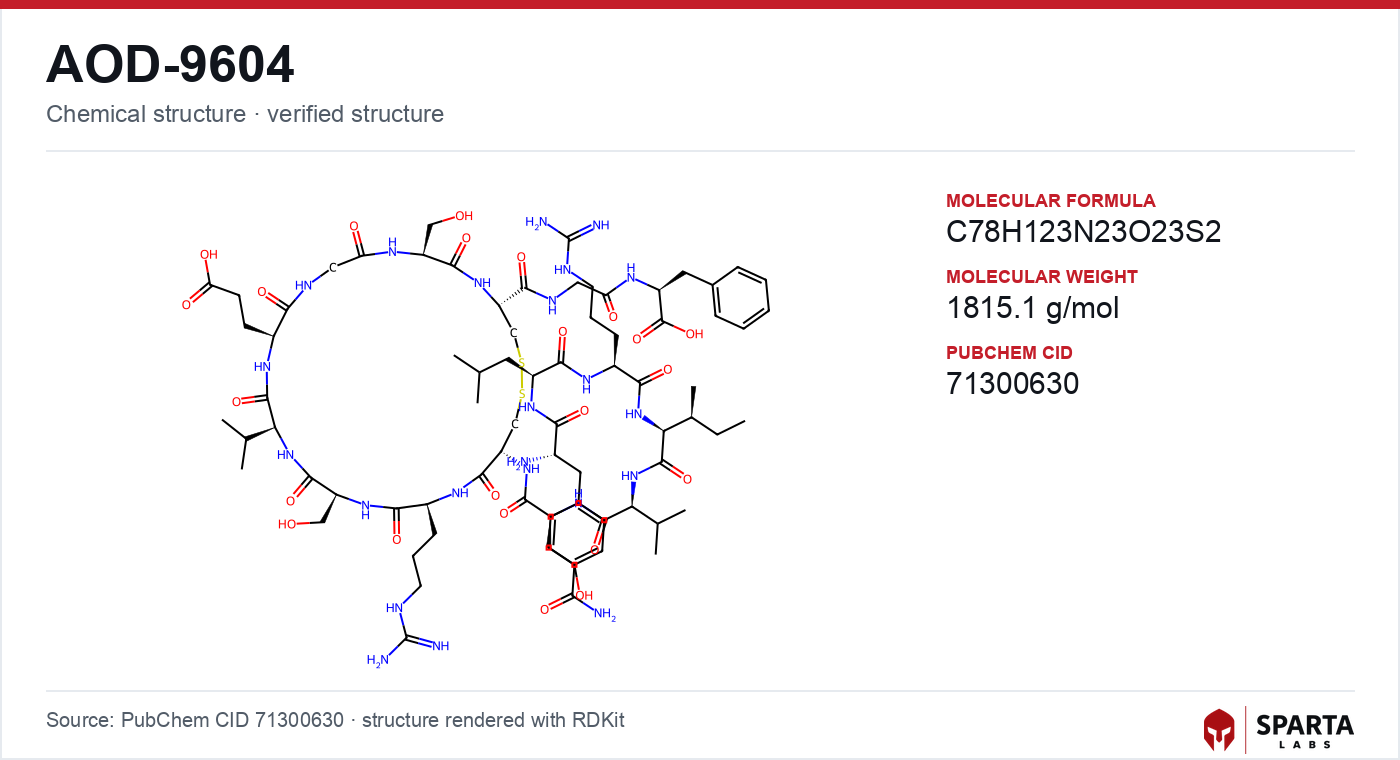
Figure: chemical structure of AOD-9604.
The fragment-isolation premise
Human growth hormone is a 191-residue protein with pleiotropic activity, acting on linear growth, protein synthesis, glucose handling, and lipid metabolism. Full-length hGH engages the GH receptor and drives hepatic IGF-1 output, effects that also carry the liability of insulin resistance and elevated glucose. The research question that gave rise to AOD9604 was whether the antilipogenic activity of the hormone resided in a discrete, transferable sequence that could be reproduced without the receptor-mediated growth axis.
Work by F.M. Ng and colleagues at Monash University in the early 1990s located this activity in the C-terminal region. A 1993 study reported that a synthetic peptide corresponding to residues 177–191 of hGH exhibited antilipogenic activity in isolated rat adipose tissue comparable in magnitude to the intact hormone [1]. A companion 1994 study reported reductions in cumulative body-weight gain and adipose tissue mass in obese (ob/ob) C57BL/6J mice after chronic administration of the same synthetic 177–191 peptide, providing early in vivo support for the fragment premise [2].
Findings from research models do not establish safety or efficacy in humans. Sparta Labs makes no claims about the use of this compound.
Engineering a stabilized analogue
The native 177–191 fragment is 15 residues long. AOD9604 adds a tyrosine at the N-terminus, yielding the 16-residue sequence Tyr-Leu-Arg-Ile-Val-Gln-Cys-Arg-Ser-Val-Glu-Gly-Ser-Cys-Gly-Phe, sometimes written Tyr-hGH(177–191). Published descriptions from the group that developed the analogue characterized the tyrosine addition as a stability modification intended to improve in vivo behavior relative to the unmodified peptide [3].
Two structural features define the molecule. First, an intramolecular disulfide bridge links the two cysteine residues (positions 182 and 189 in full-length hGH numbering), constraining the peptide into a small loop and contributing to conformational stability. Second, the sequence corresponds to a portion of hGH that lies outside the principal receptor-binding surface of the intact hormone. The reported molecular formula is C78H123N23O23S2, with an approximate mass near 1817 Da, and the compound is assembled by solid-phase peptide synthesis. Readers examining how such disulfide-containing sequences are produced and verified may find the AOD9604 sourcing and verification standards article a useful companion.
The receptor-independence question
Because AOD9604 reproduces a non-receptor-binding region of hGH, its pharmacology has been described as operating outside the canonical GH receptor axis. Preclinical work reported that the peptide did not competitively engage the GH receptor and that its metabolic activity in the models examined did not depend on IGF-1 secretion [3,4]. Investigations using β3-adrenoceptor knockout mice examined the contribution of adrenergic signaling to the observed lipid-metabolic effects, probing which pathways the fragment did and did not require [3].
A recurring observation across the preclinical program was that AOD9604, unlike full-length hGH, was not associated with hyperglycemia or measurable changes in insulin secretion in the animal models studied [4]. This apparent separation of lipid-metabolic activity from the glucose-handling liabilities of the parent hormone is the pharmacological signature that motivated the compound's development. The precise molecular target that mediates its activity remains a subject of ongoing published investigation, and a fuller treatment of the proposed pathways appears in the AOD9604 mechanism of action article. AOD9604 is therefore classified in the literature as a synthetic growth-hormone C-terminal fragment with reported lipolytic and antilipogenic activity, rather than as a GH receptor agonist or a member of the glucocorticoid, androgen, insulin, or catecholamine classes.
A distinctive human safety dataset
The feature that most distinguishes AOD9604 within the peptide literature is the breadth of its human tolerability data. A consolidated analysis by Stier, Vos, and Kenley (2013), drawing on six randomized, double-blind, placebo-controlled trials, reported that the peptide's safety and tolerability profile did not differ meaningfully from placebo across the study arms [5]. The authors reported no statistically significant effects on serum IGF-1, fasting glucose, insulin, HbA1c, cortisol, or thyroid hormones at the doses examined, and no serious adverse events attributable to the compound across the clinical program [5].
This clinical characterization was supported by nonclinical toxicology, including chronic studies in rats and cynomolgus monkeys and a standard battery of genotoxicity assays (Ames test, chromosomal aberration assay, and bone marrow micronucleus assay), each reported as negative in the safety literature summarizing the program [6]. These reports describe safety and tolerability endpoints; they do not establish efficacy for any purpose, and the observed absence of hormonal perturbation is consistent with, though not proof of, the receptor-independence hypothesis outlined above.
From clinical program to GRAS determination
AOD9604 advanced through a formal pharmaceutical development program sponsored by Metabolic Pharmaceuticals Pty Ltd, an Australian biotechnology company. The program included a large multicenter study, and while the body-weight endpoints across the full dose range and duration did not meet the pre-specified pharmaceutical primary objective, the development effort generated the extensive safety dataset described above [5].
Following the conclusion of the drug-development phase, the accumulated safety data were submitted in support of a Generally Recognized as Safe (GRAS) determination in the United States for use of AOD9604 as an ingredient in foods, beverages, and dietary supplements [6]. A GRAS determination reflects a safety assessment for a defined use; it is not an endorsement of therapeutic efficacy and does not constitute drug approval. AOD9604 is not approved by the FDA as a drug for any therapeutic indication and does not appear in the FDA's approved drug products database (the Orange Book). Regulatory status varies by jurisdiction, and researchers are responsible for confirming applicable local regulations.
Position within the growth-hormone-axis literature
AOD9604 is frequently discussed alongside other peptides that intersect the growth-hormone system, though it sits at a different mechanistic layer. It is a fragment of the mature hormone itself, distinguishing it from secretagogues that act upstream to influence hormone release. The tesamorelin research overview covers a stabilized growth-hormone-releasing-hormone analogue that operates at the GHRH-receptor level, while the ipamorelin research overview and the CJC-1295 without DAC research overview describe secretagogue and GHRH-analogue chemistry respectively. Placed against these, AOD9604's defining trait is that it reproduces a downstream structural domain of hGH rather than modulating the hormone's secretion.
Research-grade AOD9604 from Sparta Labs is characterized by third-party HPLC purity analysis and mass-spectrometric identity confirmation for each batch, consistent with the disulfide-containing synthetic peptide chemistry described above.
References
-
Wu Z, Ng FM. Antilipogenic action of synthetic C-terminal sequence 177-191 of human growth hormone. Biochemistry and Molecular Biology International. 1993;30(1):187–196. PMID: 8358331. PubMed
-
Natera SH, Jiang WJ, Ng FM. Reduction of cumulative body weight gain and adipose tissue mass in obese mice: response to chronic treatment with synthetic hGH 177-191 peptide. Biochemistry and Molecular Biology International. 1994;33(5):1011–1021. PMID: 7987248. PubMed
-
Heffernan MA, Summers RJ, Thorburn A, Ogru E, Gianello R, Jiang WJ, Ng FM. The effects of human GH and its lipolytic fragment (AOD9604) on lipid metabolism following chronic treatment in obese mice and β3-AR knock-out mice. Endocrinology. 2001;142(12):5182–5189. Full text via DOI
-
Heffernan M, Thorburn AW, Fam B, Summers R, Conway-Campbell B, Waters MJ, Ng FM. Increase of fat oxidation and weight loss in obese mice caused by chronic treatment with human growth hormone or a modified C-terminal fragment. International Journal of Obesity. 2001;25(10):1442–1449. PMID: 11673763. PubMed
-
Stier H, Vos E, Kenley D. Safety and tolerability of the hexadecapeptide AOD9604 in humans. Journal of Endocrinology and Metabolism. 2013;3(1–2):7–15. Journal of Endocrinology and Metabolism
-
Moré MI, Kenley D. Safety and metabolism of AOD9604, a novel nutraceutical ingredient for improved metabolic health. Journal of Endocrinology and Metabolism. 2014;4(3):116–126. Journal of Endocrinology and Metabolism
Disclaimer. Statements in this article have not been evaluated by the Food and Drug Administration. This compound is not intended to diagnose, treat, cure, or prevent any disease. Sparta Labs sells research-use-only materials. Content is provided for educational and informational purposes only and does not constitute medical advice. Consult a qualified medical professional for any health concerns.
Frequently asked questions
What is AOD9604 and where does its sequence come from?
AOD9604 is a synthetic 16-amino-acid peptide corresponding to the C-terminal 177–191 region of human growth hormone (hGH) with an added N-terminal tyrosine. Researchers designed it to isolate the lipid-regulatory pharmacology attributed to that domain of hGH from the hormone's growth-promoting and insulin-antagonizing activity. It has been studied in adipocyte assays, rodent and primate models, and several human trials.
Why was a tyrosine residue added to the native hGH 177–191 fragment?
The native 177–191 sequence contains 15 residues; AOD9604 adds an N-terminal tyrosine to create a 16-residue analogue. Published work by the Metabolic Pharmaceuticals group described this modification as intended to improve in vivo stability relative to the unmodified fragment. The internal disulfide bond between the two cysteine residues also contributes to the molecule's conformational stability.
Does AOD9604 act through the growth hormone receptor?
AOD9604 corresponds to a region of hGH that is distinct from the receptor-binding domain of the intact hormone. Preclinical reports indicated that its lipid-metabolic activity in the models studied did not depend on the canonical GH receptor or on IGF-1 secretion, and that it did not produce the hyperglycemia associated with full-length hGH in those experiments. The precise molecular target remains a subject of published investigation.
What is the regulatory status of AOD9604 in the United States?
AOD9604 is not approved by the FDA as a drug for any indication and does not appear in the Orange Book. Following its pharmaceutical development program, the accumulated safety data were submitted in support of a Generally Recognized as Safe (GRAS) determination for use as a food and dietary-supplement ingredient. A GRAS determination reflects a safety assessment and is not equivalent to drug approval or a statement of efficacy.
How well characterized is the human safety data for AOD9604?
A consolidated analysis by Stier, Vos, and Kenley (2013) summarized six randomized, double-blind, placebo-controlled human trials and reported a tolerability profile that did not differ meaningfully from placebo, with no significant effects on IGF-1, fasting glucose, insulin, HbA1c, cortisol, or thyroid hormones. Supporting nonclinical work included chronic rodent and primate toxicology and standard genotoxicity assays reported as negative. These findings describe safety and tolerability, not efficacy.