
Cagrilintide: Discovery and Regulatory History
How cagrilintide (AM833) grew out of amylin pharmacology, from the peptide's 1987 identification and the non-amyloidogenic analog chemistry behind pramlintide to the acylation strategy and REDEFINE trials that carried it to a 2025 FDA filing.

For research use only. Not for human consumption. This article is educational reference material. It is not medical advice and is not a recommendation to use any substance.
From Islet Amyloid to Once-Weekly Analog
Cagrilintide (development code AM833) is a long-acting acylated amylin analog developed by Novo Nordisk. Its scientific lineage cannot be separated from the study of amylin itself, a pancreatic hormone whose defining chemical liability, a tendency to aggregate into amyloid, was both the reason it was first discovered and the central obstacle every subsequent medicinal chemistry program had to solve. This article traces that lineage as a timeline: the 1987 identification of the peptide, the non-amyloidogenic analog chemistry of the 1990s that produced pramlintide, the acylation strategy that made a once-weekly analog conceivable, and the sequence of clinical and regulatory milestones that carried cagrilintide from a Phase 1b readout to a New Drug Application.
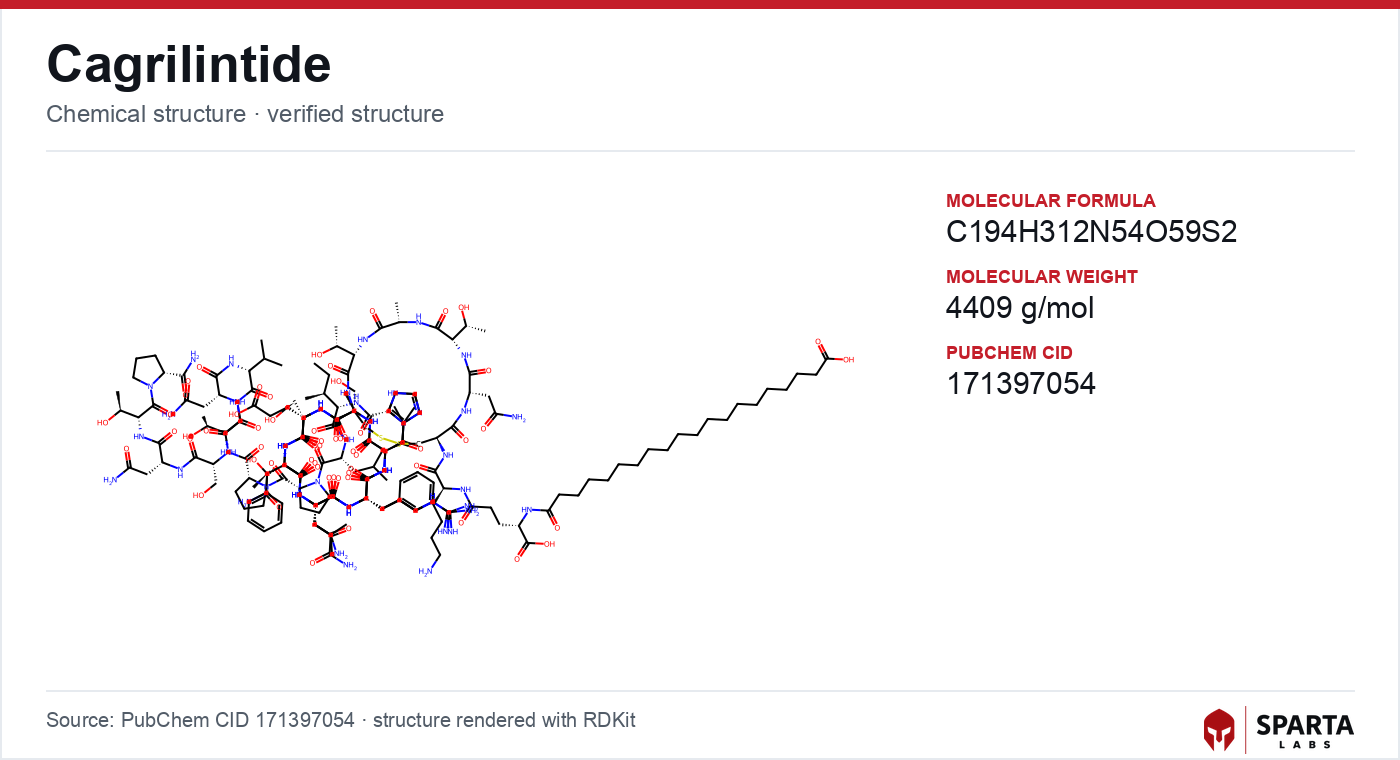
Figure: chemical structure of Cagrilintide.
1987: A Peptide Recovered From Amyloid
The hormone at the root of cagrilintide's pharmacology was first purified in 1987. Cooper and colleagues isolated a novel peptide from amyloid-rich pancreatic tissue obtained at autopsy from individuals with type 2 diabetes, and reported its sequence in the Proceedings of the National Academy of Sciences [1]. The molecule, a 37-amino-acid peptide with structural homology to calcitonin gene-related peptide (CGRP), was identified as the principal constituent of the islet amyloid deposits long observed in type 2 diabetes and was named amylin (also termed islet amyloid polypeptide, or IAPP).
Findings from research models do not establish safety or efficacy in humans. Sparta Labs makes no claims about the use of this compound.
Work in the early 1990s established that amylin is co-secreted with insulin from pancreatic beta cells and that it signals through receptors distributed in the central nervous system and peripheral tissues. Crucially, the same amyloidogenic property that made human amylin identifiable in pancreatic deposits was recognized as the defining formulation problem: the native human sequence aggregates readily, making it unsuitable as a pharmaceutical in its natural form. That recognition set the agenda for the next two decades of analog chemistry.
The Non-Amyloidogenic Sequence Problem
The route around amyloid aggregation came from comparative sequence biology. Investigators observed that rat amylin, which differs from the human peptide at three positions in the amyloidogenic core region, does not readily form fibrils under conditions where the human sequence does. Westermark and colleagues pinpointed residues in the 20–29 segment as central to fibril formation, a finding that gave analog designers a concrete map of which positions to substitute [2]. This structure-based understanding of the amyloidogenic motif is what made a stable, injectable amylin agonist chemically feasible.
2005: Pramlintide Establishes the Class
The first compound to translate that insight into an approved drug was pramlintide, a synthetic analog of human amylin carrying proline substitutions borrowed from the non-amyloidogenic rat sequence. Developed by Amylin Pharmaceuticals, pramlintide received FDA approval in 2005 under the brand name Symlin as an adjunct to mealtime insulin therapy [3]. Its significance for cagrilintide's story is conceptual: pramlintide demonstrated that amylin receptor agonism was pharmaceutically tractable in humans, validating the target class.
Pramlintide also defined the limitation that the next generation would need to overcome. Its short plasma half-life required administration alongside meals, a burden that motivated the search for an analog durable enough for less frequent dosing. In parallel, the same era saw fatty-acid acylation emerge as a general strategy for extending peptide half-life, a chemistry that Novo Nordisk was refining in its GLP-1 program and would later apply to amylin. The evolution of that acylation platform is described in the semaglutide discovery and regulatory history.
2010s: Engineering AM833
Novo Nordisk's amylin program combined the two threads: substitute the amyloidogenic residues to permit stable formulation, and attach a fatty-acid moiety enabling reversible albumin binding to extend circulation time. The medicinal chemistry output of this campaign was disclosed in 2021 by Andreassen and colleagues in the Journal of Medicinal Chemistry, which described how the lead compound, cagrilintide, emerged from structure-activity optimization with a pharmacokinetic profile the authors reported as consistent with once-weekly dosing in preclinical models [4]. The compound had already been advancing through clinical development under the designation AM833 while this chemistry was prepared for publication.
Because cagrilintide and semaglutide share the acylation design philosophy, and because the two were co-developed as a combination, comparisons across the GLP-1 and amylin classes recur throughout the literature. Related structural and pharmacological context appears in the cagrilintide research overview and, for a co-agonist framing of incretin biology, the mazdutide research overview.
Clinical Timeline: Phase 1b to Phase 3
Phase 1b (2021). Enebo and colleagues published the first clinical pharmacology trial of cagrilintide in The Lancet, a randomized controlled study evaluating multiple ascending doses of cagrilintide co-administered with semaglutide in adults with overweight or obesity [5]. The trial reported tolerability and pharmacokinetic data, including a half-life the authors described as consistent with once-weekly dosing, supporting progression to Phase 2. This was the first peer-reviewed disclosure of cagrilintide's human pharmacokinetic profile.
Phase 2 in type 2 diabetes (2023). Frias and colleagues published a randomized, double-blind Phase 2 trial of cagrilintide–semaglutide co-administration in adults with type 2 diabetes, also in The Lancet [6]. It provided the first controlled clinical comparison of the combination against the individual components on body-weight and glycemic parameters, and its results informed the design of the pivotal Phase 3 program.
Phase 3 REDEFINE (2025). The REDEFINE 1 and REDEFINE 2 trials of cagrilintide–semaglutide (marketed under the CagriSema designation) were published in the New England Journal of Medicine in 2025 [7, 8]. REDEFINE 1 enrolled adults with overweight or obesity without type 2 diabetes; REDEFINE 2 enrolled adults with overweight or obesity and type 2 diabetes. These were the first Phase 3 outcome trials for a fixed-combination amylin plus GLP-1 receptor agonist.
Regulatory Milestone: The 2025 NDA
Following the REDEFINE readouts, Novo Nordisk announced in December 2025 the submission of a New Drug Application to the FDA for once-weekly CagriSema for chronic weight management in adults [9]. As a fixed-dose combination pairing a GLP-1 receptor agonist with an amylin receptor agonist, the filing represented a regulatory first for the class in the United States and marked the transition of cagrilintide from investigational analog to a candidate under active FDA review.
Current Research Landscape
Beyond the combination program, cagrilintide continued to be studied as a standalone amylin analog and as a probe of amylin receptor biology. High-resolution structural work published in Nature Communications in 2025 characterized cagrilintide's binding to calcitonin and amylin receptors, giving the field an atomic-level view of how the analog engages its targets [10]. This structural and receptor pharmacology is treated in depth in the cagrilintide mechanism of action article. For researchers evaluating supply and analytical documentation, verification standards for the analog are discussed in the cagrilintide sourcing and quality reference.
The broader significance of cagrilintide's development is that it revived pharmaceutical interest in long-acting amylin pharmacology after nearly two decades in which pramlintide stood alone in the class. Research-grade cagrilintide from Sparta Labs is available for laboratory research with batch documentation.
References
-
Cooper GJS, Willis AC, Clark A, Turner RC, Sim RB, Reid KBM. Purification and characterization of a peptide from amyloid-rich pancreases of type 2 diabetic patients. Proc Natl Acad Sci USA. 1987;84(23):8628–8632. PMID: 3320585. PubMed
-
Westermark P, Engström U, Johnson KH, Westermark GT, Betsholtz C. Islet amyloid polypeptide: pinpointing amino acid residues linked to amyloid fibril formation. Proc Natl Acad Sci USA. 1990;87(13):5036–5040. PMID: 2195544. DOI: 10.1073/pnas.87.13.5036. PubMed
-
US Food and Drug Administration. SYMLIN (pramlintide acetate) injection: prescribing information, NDA 021332. 2005. FDA label
-
Andreassen KV, Feigh M, Hjuler ST, Gydesen S, Christiansen C, Karsdal MA, et al. Development of cagrilintide, a long-acting amylin analogue. J Med Chem. 2021;64(15):11183–11194. DOI: 10.1021/acs.jmedchem.1c00565. Journal
-
Enebo LB, Berthelsen KK, Kankam M, Lund MT, Rubino DM, Satylganova A, et al. Safety, tolerability, pharmacokinetics, and pharmacodynamics of concomitant administration of multiple doses of cagrilintide with semaglutide 2·4 mg for weight management: a randomised, controlled, phase 1b trial. Lancet. 2021;397(10286):1736–1748. PMID: 33894838. DOI: 10.1016/S0140-6736(21)00845-X. PubMed
-
Frias JP, Deenadayalan S, Erichsen L, Knop FK, Lingvay I, Macura S, et al. Efficacy and safety of co-administered once-weekly cagrilintide 2·4 mg with once-weekly semaglutide 2·4 mg in type 2 diabetes: a multicentre, randomised, double-blind, active-controlled, phase 2 trial. Lancet. 2023;402(10403):720–730. PMID: 37364590. DOI: 10.1016/S0140-6736(23)01163-7. PubMed
-
Garvey WT, Blüher M, Osorto Contreras CK, Davies M, Fernández Landó L, Guja C, et al. Coadministered cagrilintide and semaglutide in adults with overweight or obesity (REDEFINE 1). N Engl J Med. 2025. DOI: 10.1056/NEJMoa2502081. Journal
-
Davies MJ, Blüher M, Garvey WT, et al. Cagrilintide–semaglutide in adults with overweight or obesity and type 2 diabetes (REDEFINE 2). N Engl J Med. 2025. DOI: 10.1056/NEJMoa2502082. Journal
-
Novo Nordisk. Novo Nordisk files for regulatory approval of once-weekly CagriSema for chronic weight management. Company announcement. December 2025. Novo Nordisk
-
Deganutti G, Atanasio S, Rujan RM, Reynolds CA, Ludwig C, Cook TM, et al. Structural and dynamic features of cagrilintide binding to calcitonin and amylin receptors. Nat Commun. 2025;16:3389. DOI: 10.1038/s41467-025-58680-y. Journal
Disclaimer. Statements in this article have not been evaluated by the Food and Drug Administration. This compound is not intended to diagnose, treat, cure, or prevent any disease. Sparta Labs sells research-use-only materials. Content is provided for educational and informational purposes only and does not constitute medical advice. Consult a qualified medical professional for any health concerns.
Frequently asked questions
When was cagrilintide discovered?
Cagrilintide (development code AM833) emerged from a Novo Nordisk medicinal chemistry campaign during the 2010s that applied fatty-acid acylation to amylin analog design. Its chemistry was first publicly disclosed by Andreassen and colleagues in the Journal of Medicinal Chemistry in 2021, while the compound was already advancing through clinical development under the AM833 designation.
Who developed cagrilintide?
Cagrilintide was developed by scientists at Novo Nordisk. It built on the company's earlier work with long-acting fatty-acid acylated peptides, the same general strategy used in its GLP-1 program, and the medicinal chemistry report describing it was published by Andreassen and colleagues in 2021.
How does cagrilintide relate to amylin and pramlintide?
Cagrilintide is an analog of amylin, a 37-amino-acid pancreatic hormone first characterized by Cooper and colleagues in 1987. Pramlintide, an earlier amylin analog approved by the FDA in 2005, was the first drug in the class and established that amylin receptor agonism was pharmaceutically tractable. Cagrilintide represents a later, longer-acting analog developed after that proof of concept.
What is the regulatory history of cagrilintide?
Cagrilintide progressed from a Phase 1b trial published in The Lancet in 2021 through a Phase 2 trial in 2023 and the pivotal Phase 3 REDEFINE 1 and REDEFINE 2 trials published in the New England Journal of Medicine in 2025. In December 2025, Novo Nordisk announced the submission of a New Drug Application to the FDA for once-weekly CagriSema, a fixed combination of cagrilintide and semaglutide.
Why was the amyloidogenic property of amylin important to cagrilintide's development?
Native human amylin tends to aggregate into amyloid fibrils, the property by which it was first identified in pancreatic tissue, and this made it unsuitable as a pharmaceutical in its natural form. Comparative sequence studies, including work by Westermark and colleagues pinpointing the residues responsible, guided the substitutions that allowed stable amylin analogs such as pramlintide and later cagrilintide to be formulated.