
Semaglutide: Discovery and Regulatory History
How semaglutide emerged from four decades of GLP-1 science: the 1980s decoding of the proglucagon gene, the DPP-4 degradation problem that defined the field, the fatty-diacid acylation chemistry that extended plasma half-life toward a once-weekly target, and the sequence of FDA authorizations that followed.
For research use only. Not for human consumption. This article is educational reference material. It is not medical advice and is not a recommendation to use any substance.
Introduction
Semaglutide is a synthetic analogue of the human incretin hormone glucagon-like peptide-1 (GLP-1), belonging to the pharmacological class of GLP-1 receptor agonists. Its development is unusual among modern peptides in that the compound is the end point of a documented, four-decade scientific chain: from the sequencing of a gene, through the identification of a physiological hormone, to a specific set of chemical modifications engineered to solve a well-defined pharmacokinetic problem. This article reconstructs that lineage chronologically, treating semaglutide less as a single invention than as the convergence of academic molecular biology and industrial peptide chemistry.
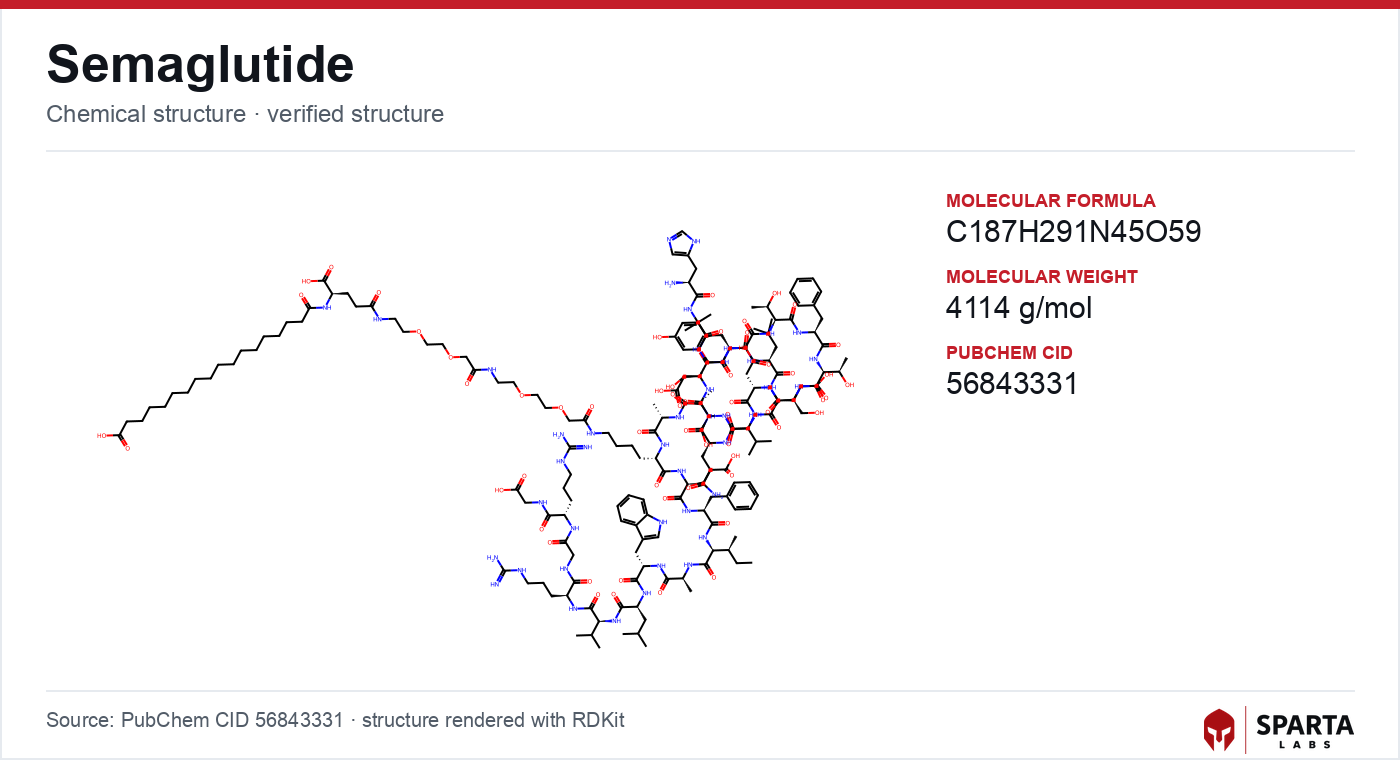
Figure: chemical structure of semaglutide.
Reading a hidden hormone out of the glucagon gene (early 1980s)
The story begins not with GLP-1 but with the gene that encodes it. In the early 1980s, molecular cloning of proglucagon complementary DNA revealed that the glucagon gene carries, downstream of the glucagon coding region, two additional and previously uncharacterized glucagon-like peptide sequences. These were designated GLP-1 and GLP-2. The recognition that a single precursor protein encoded several distinct peptides reframed glucagon biology as a question of tissue-specific processing rather than a single gene product [1].
That framing was confirmed physiologically by work in Copenhagen showing that proglucagon is cleaved differently in intestinal L-cells than in pancreatic alpha-cells: the gut liberates the glucagon-like peptides, while the pancreas liberates glucagon itself [2]. This differential processing pointed to a gut-derived, rather than pancreatic, mediator of the enteroinsular axis, and set the stage for identifying which fragment of the precursor was biologically active.
Locating the active fragment: the incretin identity of GLP-1 (1987)
A recurring difficulty in the early GLP-1 literature was that the full-length peptide predicted from the gene sequence was inert. The resolution came in 1987. Mojsov, Weir, and Habener reported in the Journal of Clinical Investigation that a truncated form, GLP-1(7-37), acted as a potent insulinotropic agent in the perfused rat pancreas at picomolar concentrations, establishing that the physiologically relevant molecule was a processed fragment rather than the intact translation product [3]. Identifying this active N-terminus fixed the molecular identity of the hormone that all later analogues, including semaglutide, would be built to mimic.
Findings from research models do not establish safety or efficacy in humans. Sparta Labs makes no claims about the use of this compound.
In the same year, work from Copenhagen characterized a truncated glucagon-like peptide as an insulin-releasing hormone originating in the distal gut, complementing the fragment-identification work and reinforcing GLP-1's role in the incretin effect: the observation that oral glucose elicits a larger insulin response than an equivalent intravenous glucose load [4]. Together these 1987 reports converted GLP-1 from a sequence inferred from a gene into a characterized endocrine hormone. The broader significance of this incretin biology is discussed in this library's semaglutide research overview.
The degradation problem that defined the field (1990s)
If GLP-1 was such an effective incretin, why was it not itself a drug? The answer, and the organizing engineering problem for the entire GLP-1 analogue field, was reported by Deacon and colleagues in 1995: native GLP-1 is rapidly cleaved by the enzyme dipeptidyl peptidase-4 (DPP-4) at the alanine residue near its N-terminus, producing an N-terminally truncated metabolite as the major circulating species, and is further removed by renal filtration [5]. The circulating persistence of the intact peptide is therefore very short.
Every subsequent structural strategy in the field can be read as an answer to this single finding. Two broad approaches emerged: inhibiting the DPP-4 enzyme (the gliptin drug class) or re-engineering the peptide itself to resist cleavage and clearance. Semaglutide belongs entirely to the second approach.
Acylation and albumin: the liraglutide precedent
The peptide-engineering route matured through the strategy of fatty-acid acylation, developed at Novo Nordisk. Attaching a fatty-acid chain to the peptide backbone promotes reversible, non-covalent binding to circulating serum albumin; the albumin-bound fraction is protected from proteolysis and from rapid renal clearance, functioning as a slow-release depot. This principle produced liraglutide, a GLP-1 analogue bearing a C16 fatty-acid moiety linked through a glutamic acid spacer to a lysine residue of a modified GLP-1(7-37) backbone, with a plasma half-life in the region of a half-day. The discovery and development narrative for liraglutide and its successor was later reviewed by Knudsen and Lau [6].
Liraglutide established both the chemical proof-of-concept for albumin-anchored protraction and the clinical and regulatory template that the next compound would extend. The strategic target for that next compound was explicit: a half-life long enough to move from once-daily toward once-weekly administration. Parallel engineering histories for other long-acting analogues in adjacent classes are covered in the tirzepatide discovery and regulatory history and cagrilintide history articles.
Engineering semaglutide: three modifications to native GLP-1 (2015)
The synthesis and structure-activity characterization of semaglutide were reported by Lau, Bloch, Schäffer, and colleagues at Novo Nordisk in the Journal of Medicinal Chemistry in 2015 [7]. The published account describes an optimization campaign across acyl-chain lengths, linker chemistries, and amino-acid substitutions, converging on a molecule with three defining modifications relative to native GLP-1(7-37):
- Position 8 (Ala to Aib): substitution of alanine with alpha-aminoisobutyric acid, a non-natural amino acid that sterically blocks DPP-4 cleavage at the N-terminus, directly answering the 1995 degradation finding.
- Position 34 (Lys to Arg): substitution of lysine with arginine to remove an unwanted acylation site, so that the fatty-acid chain attaches at a single, defined position.
- Position 26 acylation: a C18 fatty-diacid moiety attached through a linker built from two gamma-glutamic acid spacers and a mini-PEG element, giving substantially higher albumin affinity than the liraglutide design.
The reported outcome was a GLP-1 receptor binding affinity in the sub-nanomolar range together with a markedly extended protraction profile relative to liraglutide, consistent with the once-weekly design target [7]. The interplay of these three modifications with receptor binding and downstream signaling is examined in the semaglutide mechanism of action article.
Regulatory milestones (2017 to 2024)
Clinical development advanced along two parallel formulation tracks: a subcutaneous formulation studied in the SUSTAIN and STEP programs, and an oral tablet formulation using an absorption-enhancer excipient studied in the PIONEER program. The trial evidence underpinning each authorization is summarized in this library's semaglutide published research article; the milestones themselves are as follows.
December 2017. The FDA authorized a subcutaneous formulation of semaglutide for glycemic management in adults with type 2 diabetes mellitus, as an adjunct to diet and exercise. The supporting evidence base included the SUSTAIN-6 cardiovascular outcomes trial reported by Marso and colleagues in 2016, which recorded a statistically significant reduction relative to placebo on its primary composite cardiovascular endpoint [8].
September 2019. The FDA authorized an oral tablet formulation of semaglutide for the same glycemic-management indication, the first orally administered GLP-1 receptor agonist to reach US authorization. The oral program was supported by cardiovascular safety data from the PIONEER 6 trial reported by Husain and colleagues in 2019 [9].
June 2021. A higher-concentration subcutaneous formulation was authorized for chronic weight management in adults meeting specified body-mass-index criteria, in combination with a reduced-calorie diet and physical activity. This authorization drew primarily on the STEP program, including the STEP 1 trial reported by Wilding and colleagues in 2021 [10].
2024. Following the SELECT trial reported by Lincoff and colleagues in 2023, which recorded a statistically significant reduction in the primary cardiovascular composite endpoint in a population with established cardiovascular disease and without diabetes, the FDA authorized an additional cardiovascular risk-reduction indication for the higher-concentration subcutaneous formulation [11]. This extended the compound's evidenced regulatory profile beyond glycemic and weight-management indications.
Compounding and shortage status
Rapid demand growth led the FDA to list certain semaglutide injection products as being in shortage during 2022, a status that under the Federal Food, Drug, and Cosmetic Act governs the scope for pharmacy and outsourcing-facility compounding. The agency subsequently determined that the shortage was resolved, which set the timeline for the conclusion of the associated enforcement-discretion period for compounded semaglutide. This regulatory sequence is one reason the compound features prominently in current discussions of research-material sourcing and documentation, a topic addressed in the semaglutide sourcing and quality article. Research-grade semaglutide from Sparta Labs is supplied with batch-level certificate-of-analysis documentation for investigators working in this area.
Recognition of the research lineage
In 2024, the Albert Lasker Award for Basic Medical Research was awarded jointly to Joel Habener, Svetlana Mojsov, and Lotte Bjerre Knudsen, recognizing respectively the decoding of the proglucagon gene, the identification of the active GLP-1 fragment, and the acylation-based engineering that produced clinically usable long-acting analogues [1][6]. The award is a useful historical marker: it maps almost exactly onto the three chronological turning points of this article, from gene to hormone to engineered molecule, underscoring that semaglutide is best understood as the product of a cumulative scientific lineage rather than a single discovery event.
References
-
Habener JF, Drucker DJ. Glucagon-Like Peptide 1 Therapy: From Discovery to Type 2 Diabetes and Beyond. Endocr Rev. 2023;44(2):349–390. doi:10.1210/endrev/bnac029. PubMed PMID: 36740965. View on PubMed{target="_blank" rel="noopener noreferrer"}
-
Holst JJ. Discovery, characterization, and clinical development of the glucagon-like peptides. J Clin Invest. 2007;117(11):3029–3031. doi:10.1172/JCI34307. View on PubMed{target="_blank" rel="noopener noreferrer"}
-
Mojsov S, Weir GC, Habener JF. Insulinotropin: glucagon-like peptide I (7-37) co-encoded in the glucagon gene is a potent stimulator of insulin release in the perfused rat pancreas. J Clin Invest. 1987;79(2):616–619. doi:10.1172/JCI112855. PubMed PMID: 3543057. View on PubMed{target="_blank" rel="noopener noreferrer"}
-
Holst JJ, Orskov C, Nielsen OV, Schwartz TW. Truncated glucagon-like peptide I, an insulin-releasing hormone from the distal gut. FEBS Lett. 1987;211(2):169–174. doi:10.1016/0014-5793(87)81430-8. PubMed PMID: 3542566. View on PubMed{target="_blank" rel="noopener noreferrer"}
-
Deacon CF, Johnsen AH, Holst JJ. Degradation of glucagon-like peptide-1 by human plasma in vitro yields an N-terminally truncated peptide that is a major endogenous metabolite in vivo. J Clin Endocrinol Metab. 1995;80(3):952–957. doi:10.1210/jcem.80.3.7883856. PubMed PMID: 7883856. View on PubMed{target="_blank" rel="noopener noreferrer"}
-
Knudsen LB, Lau J. The Discovery and Development of Liraglutide and Semaglutide. Front Endocrinol (Lausanne). 2019;10:155. doi:10.3389/fendo.2019.00155. PubMed PMID: 30915025. View on PubMed{target="_blank" rel="noopener noreferrer"}
-
Lau J, Bloch P, Schäffer L, et al. Discovery of the Once-Weekly Glucagon-Like Peptide-1 (GLP-1) Analogue Semaglutide. J Med Chem. 2015;58(18):7370–7380. doi:10.1021/acs.jmedchem.5b00726. PubMed PMID: 26308095. View on PubMed{target="_blank" rel="noopener noreferrer"}
-
Marso SP, Bain SC, Consoli A, et al. Semaglutide and Cardiovascular Outcomes in Patients with Type 2 Diabetes. N Engl J Med. 2016;375(19):1834–1844. doi:10.1056/NEJMoa1607141. PubMed PMID: 27633186. View on PubMed{target="_blank" rel="noopener noreferrer"}
-
Husain M, Birkenfeld AL, Donsmark M, et al. Oral Semaglutide and Cardiovascular Outcomes in Patients with Type 2 Diabetes. N Engl J Med. 2019;381(9):841–851. doi:10.1056/NEJMoa1901118. PubMed PMID: 31185157. View on PubMed{target="_blank" rel="noopener noreferrer"}
-
Wilding JPH, Batterham RL, Calanna S, et al. Once-Weekly Semaglutide in Adults with Overweight or Obesity. N Engl J Med. 2021;384(11):989–1002. doi:10.1056/NEJMoa2032183. PubMed PMID: 33567185. View on PubMed{target="_blank" rel="noopener noreferrer"}
-
Lincoff AM, Brown-Frandsen K, Colhoun HM, et al. Semaglutide and Cardiovascular Outcomes in Obesity without Diabetes. N Engl J Med. 2023;389(24):2221–2232. doi:10.1056/NEJMoa2307563. PubMed PMID: 37952131. View on PubMed{target="_blank" rel="noopener noreferrer"}
Disclaimer. Statements in this article have not been evaluated by the Food and Drug Administration. This compound is not intended to diagnose, treat, cure, or prevent any disease. Sparta Labs sells research-use-only materials. Content is provided for educational and informational purposes only and does not constitute medical advice. Consult a qualified medical professional for any health concerns.
Frequently asked questions
What scientific discoveries led to semaglutide?
Semaglutide traces to the early-1980s decoding of the proglucagon gene by Habener and colleagues, which revealed the glucagon-like peptide sequences GLP-1 and GLP-2. Subsequent work by Mojsov identified the insulinotropic GLP-1(7-37) fragment, and Holst characterized GLP-1 as a physiological incretin. These findings established the receptor target that later analogue programs engineered around.
Why did native GLP-1 need to be re-engineered into semaglutide?
Endogenous GLP-1 is cleaved within minutes by the enzyme dipeptidyl peptidase-4 at its N-terminus and is cleared renally, as reported by Deacon and colleagues in 1995. This short circulating persistence made the unmodified peptide impractical as a pharmaceutical, and overcoming it became the central design problem that acylation chemistry and amino-acid substitution were developed to solve.
How was semaglutide chemically designed?
As published by Lau and colleagues in the Journal of Medicinal Chemistry in 2015, semaglutide carries three modifications relative to native GLP-1(7-37): an alpha-aminoisobutyric acid substitution at position 8 to block DPP-4 cleavage, an arginine substitution at position 34, and a C18 fatty-diacid acyl chain attached through a linker to promote reversible albumin binding. Together these produced a terminal plasma half-life consistent with once-weekly administration.
What are the main FDA regulatory milestones for semaglutide?
A subcutaneous formulation was authorized in December 2017 for glycemic management in type 2 diabetes, followed by an oral tablet formulation in September 2019. A higher-concentration subcutaneous formulation was authorized for chronic weight management in June 2021, and a cardiovascular risk-reduction indication followed the SELECT trial in 2024.
Which scientists were recognized for the discovery underlying semaglutide?
In 2024 the Albert Lasker Award for Basic Medical Research was awarded jointly to Joel Habener, Svetlana Mojsov, and Lotte Bjerre Knudsen for foundational contributions to the discovery of GLP-1 and the development of GLP-1-based therapeutics, recognizing the research lineage that produced semaglutide.