
Tesamorelin: Discovery and Regulatory History
A timeline of tesamorelin: the 1982 isolation of GHRH from pancreatic tumor tissue, the DPP-IV problem that shaped its hexenoyl chemistry, Theratechnologies' LIPO-010/011 trials, FDA approval of Egrifta in 2010, the EMA divergence, and reformulation through 2025. Educational reference.

For research use only. Not for human consumption. This article is educational reference material. It is not medical advice and is not a recommendation to use any substance.
Introduction
Tesamorelin is a stabilized synthetic analog of human growth hormone-releasing hormone (GHRH). Its history is unusual among peptide therapeutics because the molecule sits at the end of a long chain of events that began not with a drug-discovery program but with a diagnostic puzzle: why did certain pancreatic tumors cause acromegaly? Tracing tesamorelin from that 1982 puzzle through the medicinal chemistry that solved the degradation problem, the HIV-lipodystrophy trials that defined its regulatory identity, and the reformulation work continuing into 2025 situates the compound within the broader pharmacology of the growth-hormone axis. This article follows that timeline chronologically and cites the primary literature at each milestone.
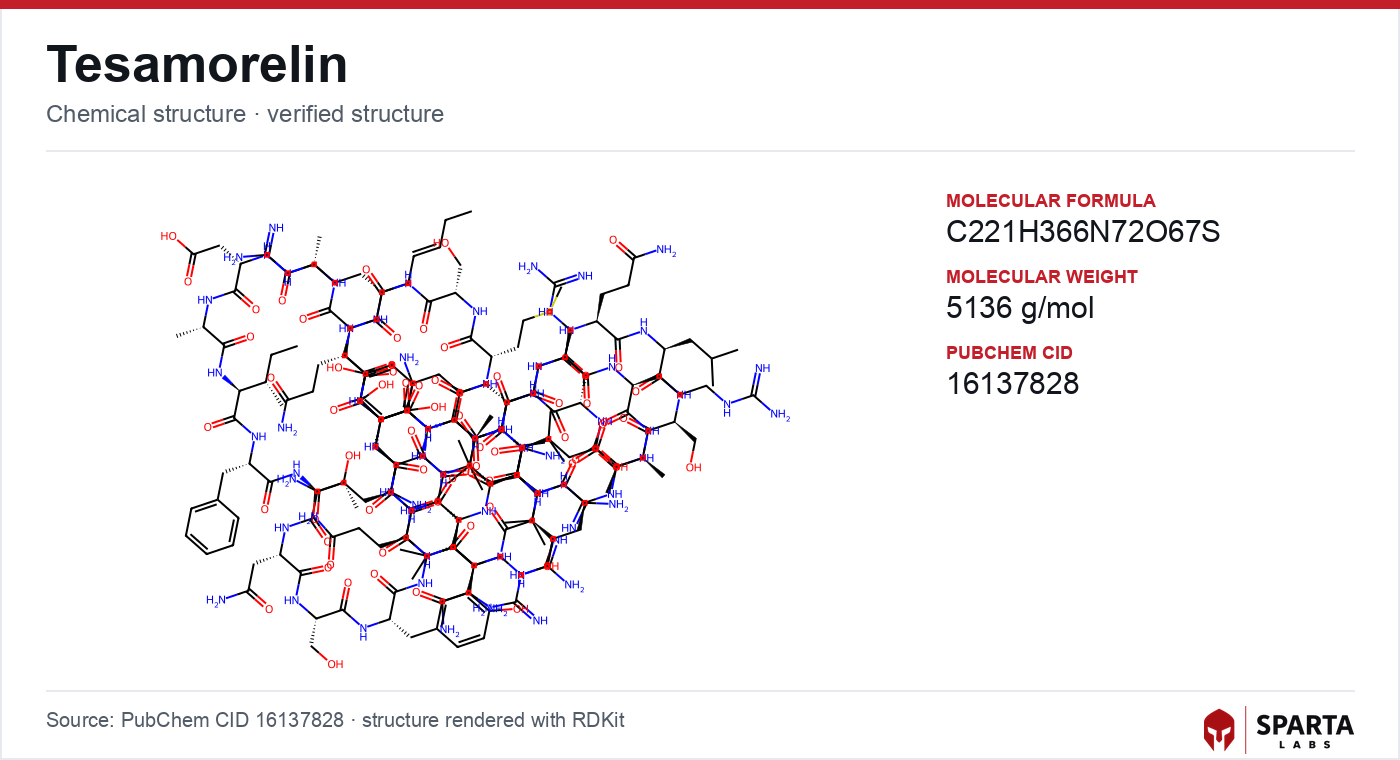
Figure: chemical structure of Tesamorelin.
1982: A Peptide Found in the Wrong Organ
For roughly two decades after physiologists postulated a hypothalamic factor that stimulated pituitary growth-hormone (GH) release, the factor itself resisted isolation. It was produced in vanishingly small quantities by hypothalamic neurons and degraded rapidly once it reached the circulation, so purifying enough material from brain tissue to sequence it proved impractical.
The impasse broke from an unexpected direction. In 1982, Guillemin, Brazeau, Böhlen, Esch, Ling, and Wehrenberg isolated a 44-amino-acid peptide from the pancreatic tumor of a patient with acromegaly, whose pituitary had been chronically driven by tumor-derived ectopic GHRH secretion. They characterized this material as a growth hormone-releasing factor from a human pancreatic tumor that caused acromegaly, and published its complete sequence in Science [1].
Findings from research models do not establish safety or efficacy in humans. Sparta Labs makes no claims about the use of this compound.
Independently and in the same year, Rivier and colleagues isolated a homologous 40-residue peptide from a second acromegalic patient's tumor and reported it in Nature. Hypothalamic GHRH was later confirmed to share the primary sequence of these tumor-derived peptides. The tumors, in effect, over-produced the molecule that had been too scarce to catch in the brain, and thereby handed researchers an accessible source [1]. These findings completed the picture of the two principal hypothalamic regulators of GH secretion, GHRH being stimulatory and somatostatin inhibitory, the latter having been isolated by the same laboratory a decade earlier.
The Degradation Problem That Shaped the Molecule
Once human GHRH(1-44)-NH₂ could be synthesized chemically, its limitation as a drug candidate became apparent almost immediately. Native GHRH is a substrate for dipeptidyl peptidase-IV (DPP-IV), which cleaves the first two N-terminal residues, tyrosine and alanine, to yield GHRH(3-44), a fragment with sharply reduced affinity for the GHRH receptor. The circulating half-life of the intact peptide is measured in minutes, which frustrated any attempt at sustained receptor engagement.
This single enzymatic vulnerability defined the entire subsequent chemistry. Through the late 1980s and 1990s, several groups searched for N-terminal modifications that would resist DPP-IV without abolishing receptor binding. The problem is common to the whole GHRH-analog class, and different laboratories converged on different structural answers to it; the divergent stabilization strategy behind a longer-acting cousin is documented in the CJC-1295 without DAC history and the CJC-1295 with DAC history. Tesamorelin represents one particular solution to the same enzymatic constraint, and the chemistry of that solution is the compound's defining feature. A neutral treatment of its receptor pharmacology appears in the tesamorelin mechanism of action article.
Theratechnologies and the Hexenoyl Cap
Theratechnologies Inc., a Montreal biopharmaceutical company, pursued a GHRH-analog program aimed at an indication where modulation of the GH axis had an established pharmacological rationale. The company's synthetic contribution was specific and elegant: conjugation of a trans-3-hexenoic acid moiety to the alpha-amine of the N-terminal tyrosine of human GHRH(1-44)-NH₂. This hexenoyl cap sits directly over the bond DPP-IV would otherwise attack, sterically impeding cleavage while leaving the receptor-binding face of the peptide intact.
The compound was designated TH9507 in development and later assigned the international nonproprietary name tesamorelin. In preclinical characterization it displayed a meaningfully extended pharmacokinetic profile relative to native GHRH, consistent with the intended resistance to N-terminal degradation. Phase 1 and early phase 2 studies through the late 1990s and early 2000s documented augmentation of GH pulsatility and elevation of insulin-like growth factor-1 (IGF-1) in human subjects, alongside initial safety data supporting advancement to larger trials.
The choice of HIV-associated lipodystrophy as the lead indication rested on prior clinical observation. Multiple groups had characterized blunted GH pulsatility and altered GH–IGF-1 axis activity in patients on long-term antiretroviral therapy, a population in which visceral adiposity accumulation is a recognized clinical feature. That existing physiology, rather than a novel hypothesis, framed the trial design.
LIPO-010, LIPO-011, and FDA Approval
The pivotal regulatory package comprised two large randomized, double-blind, placebo-controlled trials in HIV-infected patients with lipodystrophy, referred to in regulatory documents as LIPO-010 and LIPO-011. Together these enrolled more than 800 patients and supplied the primary efficacy and safety evidence for the marketing application.
Falutz and colleagues published initial findings in the New England Journal of Medicine in December 2007, reporting statistically significant reductions in visceral adipose tissue among tesamorelin recipients relative to placebo over 26 weeks [2]. The full phase 3 dataset, including a safety extension, appeared in the Journal of Acquired Immune Deficiency Syndromes in 2010 [3].
On November 10, 2010, the FDA approved tesamorelin as Egrifta (NDA 022505) for the reduction of excess abdominal fat in HIV-infected adults with lipodystrophy [4]. This was the first regulatory authorization of any GHRH analog in the United States, and the first approved pharmacological agent directed specifically at HIV-associated lipodystrophy.
The Transatlantic Divergence
The same phase 3 evidence produced different outcomes on either side of the Atlantic. During its review around 2011 to 2012, the European Medicines Agency's Committee for Medicinal Products for Human Use issued a negative opinion on the benefit-risk profile within the EU regulatory context, and marketing authorization was not granted in the European Union. Egrifta's geographic approvals have consequently remained principally in the United States and Canada.
The split is a useful illustration of how identical data can be weighed differently under distinct regulatory frameworks, a pattern observed across several specialty pharmaceutical reviews of the same era. It is a feature of the regulatory record rather than of the molecule itself.
Reformulation: 2019 and 2025
Post-approval history for tesamorelin is largely a story of formulation refinement, since the active peptide has not changed. The original 2010 product required a two-vial preparation. In May 2019, the FDA cleared Egrifta SV (Single Vial) via a supplemental application; the more concentrated solution reduced preparation to a single-step process, addressing a practical burden identified in clinical use.
In March 2025, the FDA approved a supplemental biologics license application for Egrifta WR (Weekly Reconstitution), which shifts preparation from a daily to a weekly cadence [4]. These sequential approvals track continued development work by Theratechnologies and mark the most recent milestones in the compound's regulatory timeline.
The Research Program After Approval
Following the 2010 approval, investigation expanded to questions the pivotal trials had not addressed. The Grinspoon laboratory at Massachusetts General Hospital published a mechanistic study of GH-axis pharmacodynamics in healthy men in 2011 [5], characterizing preservation of GH pulsatility during GHRH-receptor agonism and providing a pharmacodynamic framework for later work.
Stanley and colleagues reported a randomized controlled trial in JAMA in 2014 examining tesamorelin's effects on visceral and liver fat in HIV-infected adults [6], which opened a line of hepatic inquiry. A dedicated randomized trial in The Lancet HIV in 2019 described tesamorelin-associated changes in hepatic fat fraction and fibrosis progression relative to placebo in HIV-infected individuals with non-alcoholic fatty liver disease [7]. A separate study in PLOS ONE in 2017 examined metabolic effects in adults with type 2 diabetes and reported no significant worsening of glycemic control at 12 weeks [8], extending the evidence base beyond the HIV setting.
Taken together, the arc from the 1982 GHRH isolation through three decades of medicinal chemistry, controlled trials, and post-approval study makes tesamorelin among the more thoroughly documented GHRH analogs in the peer-reviewed record. Readers seeking a broader orientation may consult the tesamorelin research overview; synthesis and purity-verification standards for research-grade material are detailed in the tesamorelin sourcing and quality article. Research-grade tesamorelin from Sparta Labs is supplied with third-party COA documentation. The related growth-hormone secretagogue class is covered in the ipamorelin research overview and the hexarelin discovery and regulatory history.
References
-
Guillemin R, Brazeau P, Böhlen P, Esch F, Ling N, Wehrenberg WB. Growth hormone-releasing factor from a human pancreatic tumor that caused acromegaly. Science. 1982;218(4572):585-7. PMID: 6812220. DOI: 10.1126/science.6812220
-
Falutz J, Allas S, Blot K, Potvin D, Kotler D, Somero M, et al. Metabolic effects of a growth hormone-releasing factor in patients with HIV. N Engl J Med. 2007;357(23):2359-70. DOI: 10.1056/NEJMoa072375
-
Falutz J, Mamputu JC, Potvin D, Moyle G, Soulban G, Loughrey H, et al. Effects of tesamorelin, a growth hormone-releasing factor, in HIV-infected patients with abdominal fat accumulation: a randomized placebo-controlled trial with a safety extension. J Acquir Immune Defic Syndr. 2010;53(3):311-22. PMID: 20101189
-
U.S. Food and Drug Administration. Summary Review for Regulatory Action: Egrifta (tesamorelin for injection), NDA 022505. Silver Spring: FDA; 2010. Available at: Source: accessdata.fda.gov
-
Stanley TL, Chen CY, Branch KL, Makimura H, Grinspoon SK. Effects of a growth hormone-releasing hormone analog on endogenous GH pulsatility and insulin sensitivity in healthy men. J Clin Endocrinol Metab. 2011;96(1):150-8. PMID: 20943777. DOI: 10.1210/jc.2010-1587
-
Stanley TL, Feldpausch MN, Oh J, Branch KL, Lee H, Torriani M, Grinspoon SK. Effect of tesamorelin on visceral fat and liver fat in HIV-infected patients with abdominal fat accumulation: a randomized clinical trial. JAMA. 2014;312(4):380-9. PMID: 25038355. DOI: 10.1001/jama.2014.8334
-
Stanley TL, Fourman LT, Feldpausch MN, Purdy J, Zheng I, Pan CS, et al. Effects of tesamorelin on non-alcoholic fatty liver disease in HIV: a randomised, double-blind, multicentre trial. Lancet HIV. 2019;6(12):e821-e830. PMID: 31611038. DOI: 10.1016/S2352-3018(19)30338-8
-
Makimura H, Feldpausch MN, Rope AM, Hemphill LC, Torriani M, Lee H, et al. Safety and metabolic effects of tesamorelin, a growth hormone-releasing factor analogue, in patients with type 2 diabetes: A randomized, placebo-controlled trial. PLOS ONE. 2017;12(6):e0179538. PMID: 28632777. DOI: 10.1371/journal.pone.0179538
Disclaimer. Statements in this article have not been evaluated by the Food and Drug Administration. This compound is not intended to diagnose, treat, cure, or prevent any disease. Sparta Labs sells research-use-only materials. Content is provided for educational and informational purposes only and does not constitute medical advice. Consult a qualified medical professional for any health concerns.
Frequently asked questions
Where was the parent molecule of tesamorelin first isolated?
The 44-residue human growth hormone-releasing hormone that tesamorelin is derived from was first isolated in 1982, not from hypothalamic tissue but from the pancreatic tumor of an acromegalic patient. Guillemin and colleagues characterized its full sequence in Science that year, and Rivier's group independently reported a homologous tumor-derived peptide in Nature. The ectopic tumor source made an otherwise intractable hypothalamic peptide accessible for structural work.
What chemical modification distinguishes tesamorelin from native GHRH?
Tesamorelin is human GHRH(1-44)-NH2 carrying a trans-3-hexenoic acid group conjugated to the alpha-amine of its N-terminal tyrosine. Theratechnologies added this hexenoyl cap specifically to sterically block dipeptidyl peptidase-IV, the enzyme that cleaves the first two residues of native GHRH within minutes. The modification was designed to slow degradation while preserving GHRH-receptor binding.
When did the FDA approve tesamorelin and for what?
The FDA approved tesamorelin as Egrifta (NDA 022505) on November 10, 2010, for the reduction of excess abdominal fat in HIV-infected adults with lipodystrophy. It was the first regulatory authorization for any GHRH analog in the United States. Approval rested on the LIPO-010 and LIPO-011 phase 3 trials, which together enrolled more than 800 patients.
Why was tesamorelin not approved in the European Union?
The European Medicines Agency reviewed the same phase 3 dataset around 2011 to 2012, and its Committee for Medicinal Products for Human Use issued a negative opinion on the benefit-risk balance within the EU framework. The marketing authorization was therefore not granted in the European Union. Egrifta's approvals have remained principally in the United States and Canada.
How has the tesamorelin formulation changed since 2010?
The original 2010 product used a two-vial preparation. In May 2019 the FDA cleared Egrifta SV, a more concentrated single-vial formulation, and in March 2025 it cleared Egrifta WR, which shifts preparation from daily to weekly. These supplemental approvals reflect continued formulation work by Theratechnologies rather than changes to the active peptide itself.