
CJC-1295 Without DAC: A Research Overview
An educational overview of CJC-1295 without DAC (Modified GRF 1-29): the four amino acid substitutions that resist DPP-4 cleavage, how it differs from the DAC-bearing variant, and the regulatory history of its GRF(1-29) scaffold.
For research use only. Not for human consumption. This article is educational reference material. It is not medical advice and is not a recommendation to use any substance.
Introduction
CJC-1295 without DAC is a synthetic 29-amino acid peptide that appears in the scientific literature under several designations, including Modified GRF 1-29, Mod GRF 1-29, and tetrasubstituted GRF(1-29). It is an analog of the N-terminal fragment of endogenous growth hormone-releasing hormone (GHRH) and is classified pharmacologically as a growth hormone secretagogue that acts at the GHRH receptor. The compound is defined by two features: four amino acid substitutions relative to the native GRF(1-29) sequence, and the deliberate absence of the albumin-binding Drug Affinity Complex (DAC) found in the related molecule CJC-1295 with DAC. This overview reviews its chemistry, sequence lineage, pharmacological classification, and regulatory record as reported in primary literature and regulatory documents.
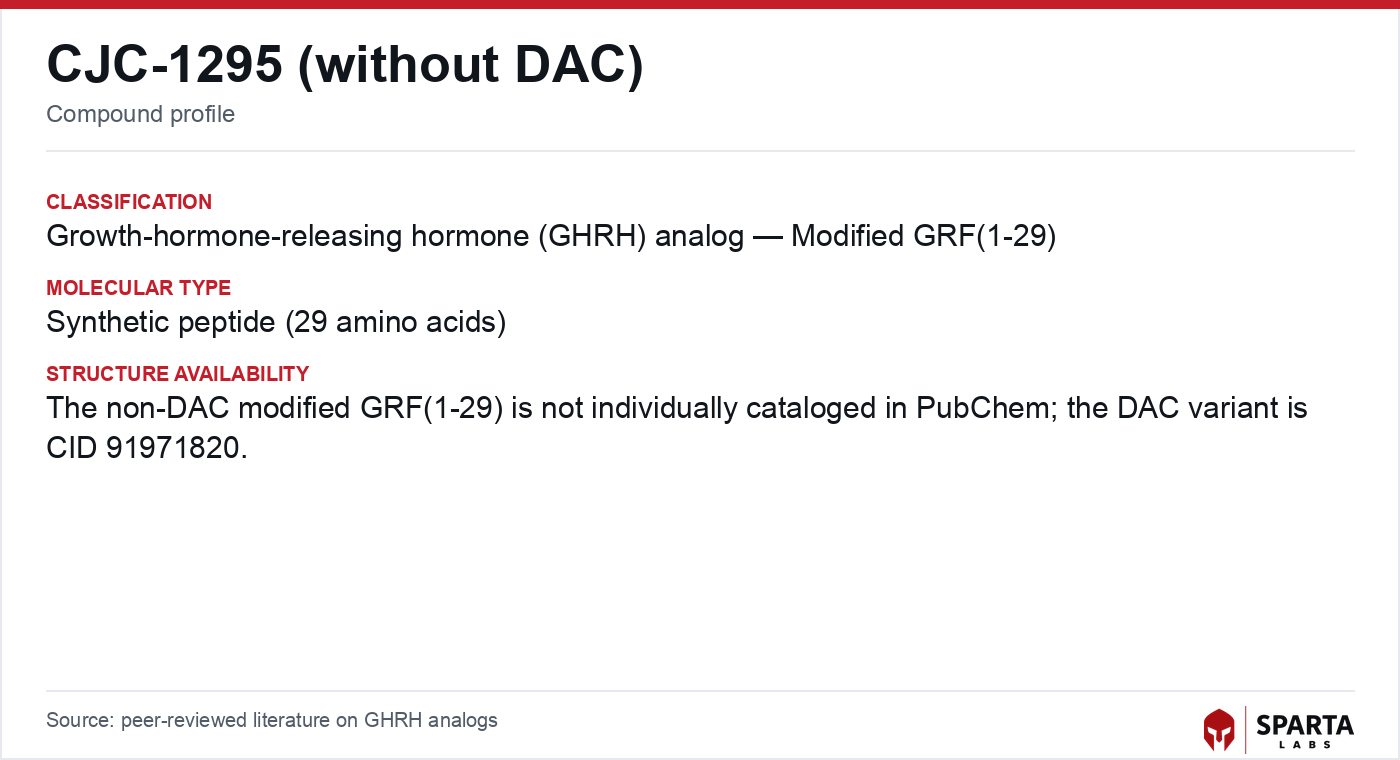
Figure: chemical structure of CJC-1295 (without DAC).
From native GHRH to a 29-residue fragment
Endogenous GHRH is a 44-amino acid peptide first characterized in 1982, when two independent groups isolated growth hormone-releasing factor from pancreatic tumors associated with acromegaly. Guillemin and colleagues identified and synthesized the 44-residue peptide from one such tumor [1], and Rivier and colleagues separately characterized an equivalent releasing factor from a second patient's pancreatic islet tumor [2]. These reports established the primary structure of GHRH and initiated a research program into shorter, synthetically tractable analogs.
Subsequent structure-activity work established that the first 29 residues of GHRH retain the receptor-binding activity of the full-length hormone, with the C-terminal residues beyond position 29 dispensable for engagement of the pituitary GHRH receptor. The resulting 29-amino acid fragment, hGRF(1-29)-NH2, was developed as the synthetic analog sermorelin. A review by Prakash and Goa summarized the pharmacology and clinical evaluation of sermorelin as the biologically active N-terminal fragment of GHRH [3]. CJC-1295 without DAC is a further-engineered descendant of this same 29-residue scaffold.
Findings from research models do not establish safety or efficacy in humans. Sparta Labs makes no claims about the use of this compound.
The proteolysis problem the substitutions address
Native GRF(1-29) is cleared rapidly from plasma, which constrained early interest in the fragment. Frohman and colleagues characterized the enzymatic degradation of human GHRH in plasma and identified dipeptidyl peptidase-4 (DPP-4) as a dominant proteolytic pathway, cleaving the peptide at the N-terminal Tyr1-Ala2 bond to generate a biologically inactive fragment; they also described trypsin-like cleavage contributing to inactivation [4]. This work framed the design objective for the analogs that followed: block the DPP-4 cleavage site and remove other labile positions while preserving the receptor-binding conformation.
The tetrasubstituted GRF(1-29) design that underlies CJC-1295 without DAC is a direct response to that objective. Its four substitutions target the residues most implicated in enzymatic and chemical instability of the parent fragment.
The four substitutions
CJC-1295 without DAC carries four conservative amino acid replacements relative to native hGRF(1-29):
- Position 2 — D-alanine. Substituting the L-alanine at position 2 with its D-enantiomer is the primary modification that interferes with DPP-4 recognition at the N-terminal cleavage bond identified by Frohman and colleagues.
- Position 8 — glutamine. Replacing asparagine reduces susceptibility to a secondary degradation pathway.
- Position 15 — alanine. Substituting glycine contributes to conformational stability of the peptide backbone.
- Position 27 — norleucine. Replacing methionine removes an oxidation-prone residue, improving chemical stability of the isolated peptide.
These are the same four modifications incorporated into the DAC-bearing variant. In both molecules the substitutions confer greater plasma stability than the unmodified precursor. The peptide is produced by solid-phase peptide synthesis, carries an amidated C-terminus, and has a molecular weight of roughly 3,367 daltons as the free base.
What "without DAC" means
The distinguishing feature of this compound is what it lacks. CJC-1295 with DAC appends a lysine-linked maleimidopropionyl group at the C-terminus, enabling the molecule to form a covalent bond in vivo with a free thiol on circulating serum albumin. Jetté and colleagues characterized this albumin-conjugation mechanism and reported that the resulting bioconjugate activated the GRF receptor on the rat anterior pituitary as a long-lasting analog, with a plasma persistence measured in days [5].
CJC-1295 without DAC omits that albumin-binding chemistry entirely. It therefore retains the enzymatic resistance conferred by the four substitutions but does not undergo albumin conjugation, and its plasma persistence is measured in tens of minutes rather than days. This shorter exposure window is the pharmacokinetic property most often examined when the two variants are compared, because it produces a transient rather than sustained profile of GHRH-receptor stimulation. The reported receptor-level pharmacology is reviewed in the CJC-1295 without DAC mechanism of action article.
Pharmacological classification
CJC-1295 without DAC is classified as a growth hormone secretagogue that acts as an agonist at the GHRH receptor (GHRH-R) expressed on anterior pituitary somatotroph cells. This places it in the same receptor class as sermorelin and the closely related analog tesamorelin, and it is mechanistically distinct from secretagogues that act at the growth hormone secretagogue receptor (GHS-R, the ghrelin receptor), such as the ghrelin-mimetic peptide ipamorelin. The two receptor systems engage different signaling pathways, which is why GHRH-R agonists and GHS-R agonists are treated as separate pharmacological categories in the literature. Research-grade CJC-1295 without DAC from Sparta Labs is third-party tested and supplied with a batch-specific Certificate of Analysis.
Regulatory record of the scaffold
The GRF(1-29) scaffold underlying CJC-1295 without DAC has a documented regulatory history through its unmodified predecessor. Sermorelin acetate received FDA approval under the brand name Geref in 1997, indicated for the diagnostic assessment of pituitary growth hormone reserve and for growth failure associated with idiopathic growth hormone deficiency in children. The Geref product was later discontinued, and a 2013 Federal Register determination confirmed that the withdrawal was not for reasons of safety or effectiveness [6].
CJC-1295 without DAC as a distinct modified compound has not received FDA approval for any indication. The compound and related GHRH analogs have remained subjects of regulatory attention within the framework governing compounded bulk drug substances under Section 503A of the Federal Food, Drug, and Cosmetic Act. Sparta Labs supplies this compound for research use only; it is not intended for human therapeutic use.
References
-
Guillemin R, Brazeau P, Böhlen P, Esch F, Ling N, Wehrenberg WB. Growth hormone-releasing factor from a human pancreatic tumor that caused acromegaly. Science. 1982;218(4572):585-587. PMID: 6812220. DOI: 10.1126/science.6812220. PubMed
-
Rivier J, Spiess J, Thorner M, Vale W. Characterization of a growth hormone-releasing factor from a human pancreatic islet tumour. Nature. 1982;300(5892):276-278. PMID: 6292724. DOI: 10.1038/300276a0. PubMed
-
Prakash A, Goa KL. Sermorelin: a review of its use in the diagnosis and treatment of children with idiopathic growth hormone deficiency. BioDrugs. 1999;12(2):139-157. PMID: 18031173. DOI: 10.2165/00063030-199912020-00007. PubMed
-
Frohman LA, Downs TR, Heimer EP, Felix AM. Dipeptidylpeptidase IV and trypsin-like enzymatic degradation of human growth hormone-releasing hormone in plasma. J Clin Invest. 1989;83(5):1533-1540. PMID: 2651468. DOI: 10.1172/JCI114049. PubMed
-
Jetté L, Léger R, Thibaudeau K, Benquet C, Robitaille M, Pellerin I, et al. Human growth hormone-releasing factor (hGRF)1-29-albumin bioconjugates activate the GRF receptor on the anterior pituitary in rats: identification of CJC-1295 as a long-lasting GRF analog. Endocrinology. 2005;146(7):3052-3058. PMID: 15817669. DOI: 10.1210/en.2004-1286. PubMed
-
US Food and Drug Administration. Determination that GEREF (sermorelin acetate) injection was not withdrawn from sale for reasons of safety or effectiveness. Fed Regist. 2013;78(43):14201. Federal Register
Disclaimer. Statements in this article have not been evaluated by the Food and Drug Administration. This compound is not intended to diagnose, treat, cure, or prevent any disease. Sparta Labs sells research-use-only materials. Content is provided for educational and informational purposes only and does not constitute medical advice. Consult a qualified medical professional for any health concerns.
Frequently asked questions
What is CJC-1295 without DAC?
CJC-1295 without DAC, also called Modified GRF 1-29, is a synthetic 29-amino acid analog of the N-terminal fragment of growth hormone-releasing hormone (GHRH). It carries four amino acid substitutions relative to native GRF(1-29) that resist plasma enzymatic degradation, and it is classified as an agonist at the pituitary GHRH receptor.
How does CJC-1295 without DAC differ from CJC-1295 with DAC?
Both molecules share the same four-position tetrasubstituted GRF(1-29) scaffold, but CJC-1295 with DAC adds a C-terminal maleimidopropionyl group that binds covalently to serum albumin, extending plasma persistence to a matter of days. The without-DAC form omits that albumin-binding chemistry, so its plasma persistence is measured in tens of minutes rather than days.
Why does CJC-1295 without DAC have four amino acid substitutions?
The substitutions address the rapid plasma degradation of native GRF(1-29). Frohman and colleagues identified dipeptidyl peptidase-4 as a major cleavage pathway at the N-terminal bond, and the four changes, including a D-alanine at position 2, target that and other labile residues to improve stability while preserving receptor binding.
Is CJC-1295 without DAC FDA approved?
CJC-1295 without DAC has not received FDA approval for any indication. Its unmodified predecessor sermorelin was approved in 1997 under the brand name Geref and later discontinued; a 2013 Federal Register determination noted the withdrawal was not for reasons of safety or effectiveness. Sparta Labs supplies the compound for research use only.
What pharmacological class does CJC-1295 without DAC belong to?
It is a growth hormone secretagogue that acts as an agonist at the GHRH receptor (GHRH-R) on anterior pituitary somatotroph cells. This distinguishes it from secretagogues that act at the ghrelin receptor (GHS-R), such as ipamorelin, which engage a different signaling pathway.