
GHRP-2: Discovery and Regulatory History
A chronological history of GHRP-2 (pralmorelin, KP-102): its origins in enkephalin chemistry, its derivation from the GHRP-6 hexapeptide via D-2-naphthylalanine substitution, and the reverse-pharmacology arc from receptor cloning to ghrelin's discovery.
For research use only. Not for human consumption.
This article is educational reference material. It is not medical advice and is not a recommendation to use any substance.
GHRP-2, known in the pharmacological literature as pralmorelin and by the developmental code KP-102, occupies an unusual position in the history of endocrine chemistry. It was synthesized and characterized as a growth hormone secretagogue years before the receptor it acts on was cloned, and that receptor was itself identified before its natural hormone ligand was known. The compound's history is therefore a case study in "reverse pharmacology," where a synthetic molecule of empirical interest ultimately guided the discovery of an entire endogenous signaling system. This article traces that arc chronologically, from its origins in synthetic opioid chemistry to its regulatory characterization in Japan.
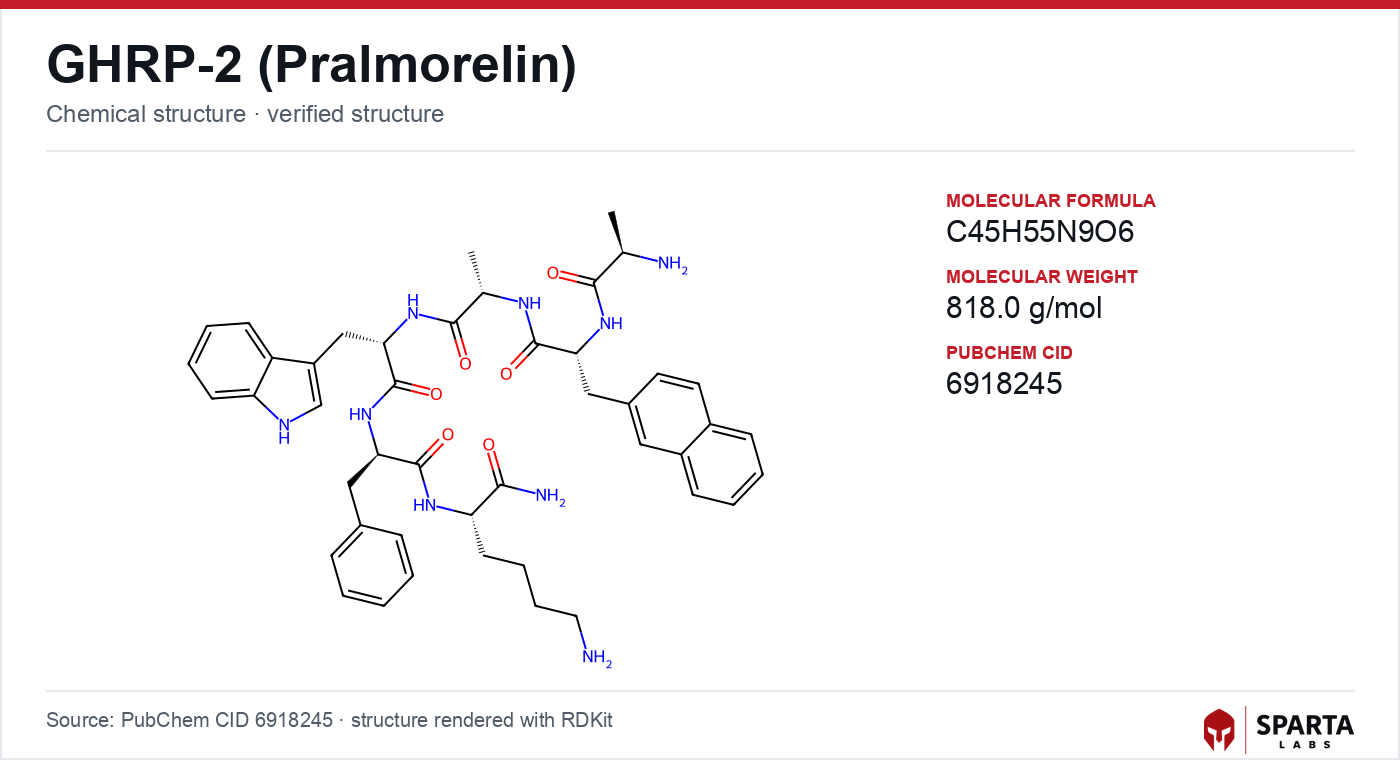
Figure: chemical structure of GHRP-2 (pralmorelin).
From Enkephalin Chemistry to a Novel Secretagogue Pathway
The lineage of GHRP-2 does not begin with growth hormone research at all. It begins in the mid-to-late 1970s with the chemistry of met-enkephalin, an endogenous opioid pentapeptide. Cyril Y. Bowers and colleagues at Tulane University were studying synthetic analogs of this opioid scaffold when they observed something incidental to their original aim: certain modifications produced selective growth-hormone-releasing activity in cultured rat pituitary cells, effectively decoupled from opioid receptor agonism.
This observation was consequential because it implied a previously unrecognized regulatory pathway for growth hormone (GH) release, one distinct from growth-hormone-releasing hormone (GHRH) and somatostatin, the two hypothalamic factors then understood to govern somatotroph activity. In other words, the molecule preceded any model of how it worked.
A structure-activity study published by Bowers and colleagues in Endocrinology in 1980 described a synthetic pentapeptide (Tyr-D-Trp-Gly-Phe-Met-NH2) that produced selective GH release from rat pituitary cultures at low concentrations. The paper emphasized that an aromatic residue at position 2 of the peptide was critical to GH-releasing potency, a structural principle that would guide every subsequent compound in the class [1].
Findings from research models do not establish safety or efficacy in humans. Sparta Labs makes no claims about the use of this compound.
The Hexapeptide Scaffold: GHRP-6 as Parent Structure
The empirical program matured in 1984 with the report of GHRP-6, the first synthetic hexapeptide growth-hormone-releasing peptide, described by Bowers, Momany, Reynolds, and Hong in Endocrinology. GHRP-6 (His-D-Trp-Ala-Trp-D-Phe-Lys-NH2) showed potent in vitro and in vivo GH release across multiple species and became the reference structure from which the wider GHRP family was derived [2].
GHRP-6 matters to GHRP-2's history for a concrete chemical reason: GHRP-2 is not a fresh design but a targeted optimization of the GHRP-6 hexapeptide. The parallel account of the parent compound is developed in the GHRP-6 discovery and regulatory history, which traces the same enkephalin-to-hexapeptide transition from the vantage point of the reference molecule.
Structural Optimization: The D-2-Naphthylalanine Substitution
The step from GHRP-6 to GHRP-2 was a single, deliberate substitution at the position-2 aromatic residue. Where GHRP-6 carries a D-tryptophan at that site, GHRP-2 carries D-2-naphthylalanine (D-2-Nal), giving the sequence D-Ala-D-2-Nal-Ala-Trp-D-Phe-Lys-NH2. This is the molecule that Kaken Pharmaceutical in Japan advanced under the code KP-102.
The rationale for the substitution followed directly from Bowers' 1980 finding about the importance of aromatic character at position 2. The naphthyl ring system presents a larger hydrophobic surface than the indole ring of tryptophan, and the substitution was consistent with improved hydrophobic contact within the peptide's target site [1]. GHRP-2 thus represents the class's structure-activity logic applied to its own reference compound.
This optimization did not happen in isolation. Through the late 1980s and 1990s the secretagogue field diversified rapidly along several tracks. Romano Deghenghi and colleagues developed hexarelin, another position-2-modified hexapeptide, while a separate line of work pursued smaller, more selective peptides that would later include ipamorelin. A wholly distinct GHRH-analog track produced compounds such as tesamorelin through different chemistry and a different regulatory route entirely. GHRP-2 occupies the hexapeptide branch of this expanding family tree.
Reverse Pharmacology, Part One: Cloning the Receptor (1996)
For roughly two decades, the GHRPs were pharmacological orphans in a precise sense: potent, reproducible agonists whose molecular target had not been isolated. That changed in 1996, when Howard and colleagues at Merck Research Laboratories reported the cloning of the growth hormone secretagogue receptor (GHS-R1a) in Science. The work identified the receptor in pituitary and hypothalamic tissue and established it as the molecular target common to the synthetic secretagogues [3].
The cloning reframed GHRP-2 retroactively. A compound characterized for years by empirical dose-response behavior could now be described in rigorous receptor-pharmacology terms, as a full agonist at a defined G-protein-coupled receptor. The receptor itself, however, was still an orphan: it had no known endogenous ligand.
Reverse Pharmacology, Part Two: The Discovery of Ghrelin (1999)
The final inversion came three years later. In 1999, Masayasu Kojima, Kenji Kangawa, and colleagues isolated the natural ligand of GHS-R1a from rat stomach tissue and reported it in Nature. The peptide, named ghrelin, is a 28-amino-acid hormone bearing an unusual octanoyl (acyl) modification and is produced predominantly in the gastric fundus [4].
Ghrelin's discovery closed the loop opened in the 1970s. It established that synthetic secretagogues such as GHRP-2 had, since their inception, been acting as pharmacological mimics of an endogenous hormone whose existence was unknown throughout the compound class's early development. The sequence of events, drug then receptor then natural ligand, is the reverse of the conventional order of endocrine discovery, and it placed GHRP-2 within the physiology of the ghrelin system, a signaling axis with documented roles in GH secretion, appetite, and energy homeostasis. The receptor-level consequences of this arc are examined in the GHRP-2 mechanism of action.
Regulatory Trajectory: KP-102 and Pralmorelin in Japan
The regulatory history of GHRP-2 diverges sharply by geography. In Japan, Kaken Pharmaceutical developed KP-102 as pralmorelin and pursued a diagnostic indication rather than a therapeutic one, centered on GH stimulation testing to assess pituitary somatotroph reserve. Pralmorelin is documented in the endocrinology literature as a GH secretagogue evaluated for this diagnostic application, and Japan is the jurisdiction in which the compound reached national regulatory recognition.
Framing the indication as diagnostic rather than therapeutic is a meaningful historical detail. A single provocative challenge used to assess pituitary reserve is a fundamentally different regulatory proposition from chronic administration for a disease endpoint, and this distinction shaped the compound's development path.
In North America the trajectory was different: development rights were licensed and early-phase clinical evaluation was conducted, but the compound did not advance to a marketing application with the US Food and Drug Administration. As a result, GHRP-2 has no approved status in the United States and remains an investigational and research-use compound in that market.
The Compound in Contemporary Research
GHRP-2 continues to appear across several distinct research literatures rather than a single dominant application:
Ghrelin-receptor pharmacology. GHRP-2 functions as a reference agonist in studies of GHS-R1a behavior, including work on constitutive receptor activity, signaling bias, and the receptor's roles beyond GH release.
Cytoprotection research. A line of preclinical work, reviewed comprehensively by Berlanga-Acosta and colleagues in 2017, has examined cardioprotective and anti-apoptotic observations reported for the GHRP family, together with open questions about whether these effects are GHS-R1a-dependent or involve alternative receptors such as CD36 [5].
Anti-doping analytical science. Because growth hormone secretagogues are prohibited in competitive sport, a dedicated detection literature has developed. Okano and colleagues reported a liquid-chromatography–tandem-mass-spectrometry method for pralmorelin and its urinary metabolites in 2010, representative of the analytical work built around the compound [6]. The synthesis and identity-verification standards relevant to research-grade material are discussed in the GHRP-2 sourcing and quality reference, and a broader survey of the primary literature is collected in the GHRP-2 published research summary.
Researchers comparing analytical reference material can review specifications for GHRP-2 offered by Sparta Labs alongside the published characterization discussed above.
References
-
Bowers CY, Momany F, Reynolds GA, Chang D, Hong A, Chang K. Structure-activity relationships of a synthetic pentapeptide that specifically releases growth hormone in vitro. Endocrinology. 1980;106(3):663–667. PMID: 6109621. DOI: 10.1210/endo-106-3-663. PubMed
-
Bowers CY, Momany FA, Reynolds GA, Hong A. On the in vitro and in vivo activity of a new synthetic hexapeptide that acts on the pituitary to specifically release growth hormone. Endocrinology. 1984;114(5):1537–1545. PMID: 6714155. DOI: 10.1210/endo-114-5-1537. PubMed
-
Howard AD, Feighner SD, Cully DF, Arena JP, Liberator PA, Rosenblum CI, et al. A receptor in pituitary and hypothalamus that functions in growth hormone release. Science. 1996;273(5277):974–977. PMID: 8688086. DOI: 10.1126/science.273.5277.974. PubMed
-
Kojima M, Hosoda H, Date Y, Nakazato M, Matsuo H, Kangawa K. Ghrelin is a growth-hormone-releasing acylated peptide from stomach. Nature. 1999;402(6762):656–660. PMID: 10604470. DOI: 10.1038/45230. PubMed
-
Berlanga-Acosta J, Abreu-Cruz A, García-del Barco Herrera D, Mendoza-Marí Y, Rodríguez-Ulloa A, García-Ojalvo A, et al. Synthetic growth hormone-releasing peptides (GHRPs): a historical appraisal of the evidences supporting their cytoprotective effects. Clin Med Insights Endocrinol Diabetes. 2017;10:1179546817694558. PMID: 28469490. PMCID: PMC5392015. DOI: 10.1177/1179546817694558. PubMed
-
Okano M, Sato M, Kageyama S, Niioka T, Yonezawa K, Suzuki H, et al. Determination of growth hormone secretagogue pralmorelin (GHRP-2) and its metabolite in human urine by liquid chromatography/electrospray ionization tandem mass spectrometry. Rapid Commun Mass Spectrom. 2010;24(14):2046–2056. PMID: 20552695. DOI: 10.1002/rcm.4619. PubMed
Disclaimer. Statements in this article have not been evaluated by the Food and Drug Administration. This compound is not intended to diagnose, treat, cure, or prevent any disease. Sparta Labs sells research-use-only materials. Content is provided for educational and informational purposes only and does not constitute medical advice. Consult a qualified medical professional for any health concerns.
Frequently asked questions
Why is GHRP-2 considered an example of reverse pharmacology?
GHRP-2 was synthesized and characterized as a growth hormone secretagogue years before its molecular target was identified. The receptor GHS-R1a was cloned in 1996, and its endogenous ligand ghrelin was not isolated until 1999. This drug-then-receptor-then-natural-ligand sequence inverts the usual order of endocrine discovery.
How is GHRP-2 structurally related to GHRP-6?
GHRP-2 is a targeted optimization of the GHRP-6 hexapeptide first reported by Bowers and colleagues in 1984. It replaces GHRP-6's position-2 D-tryptophan residue with D-2-naphthylalanine, following the structure-activity principle that an aromatic residue at position 2 is critical to growth-hormone-releasing potency.
What is the connection between GHRP-2 and ghrelin?
Ghrelin, the endogenous ligand for the GHS-R1a receptor, was isolated from rat stomach tissue by Kojima and colleagues in 1999 and reported in Nature. Its discovery retroactively established that synthetic secretagogues such as GHRP-2 had been acting as pharmacological mimics of a natural hormone whose existence was unknown during the compound class's early development.
Is GHRP-2 approved by the FDA?
GHRP-2 (pralmorelin, KP-102) has no approved status with the US Food and Drug Administration. Early-phase clinical evaluation was conducted in North America, but the compound did not advance to a US marketing application and remains an investigational and research-use compound in that market.