
CJC-1295 with DAC: A Research Overview
An educational profile of CJC-1295 with DAC, tracing its albumin-binding Drug Affinity Complex chemistry, the four substitutions that stabilize the GHRH(1-29) scaffold, and its documented ConjuChem research lineage.
For research use only. Not for human consumption. This article is educational reference material. It is not medical advice and is not a recommendation to use any substance.
Introduction
CJC-1295 with DAC is a synthetic analog of growth hormone-releasing hormone (GHRH) distinguished by a covalent albumin-binding modification known as the Drug Affinity Complex (DAC). Where most peptide analogs address short plasma persistence through amino acid substitution alone, CJC-1295 with DAC layers a reactive-chemistry conjugation step on top of a stabilized GHRH scaffold. This article is an educational reference to the compound's molecular identity, the two engineering ideas that define it, its documented research lineage, and its regulatory standing, drawing on primary literature and regulatory records.
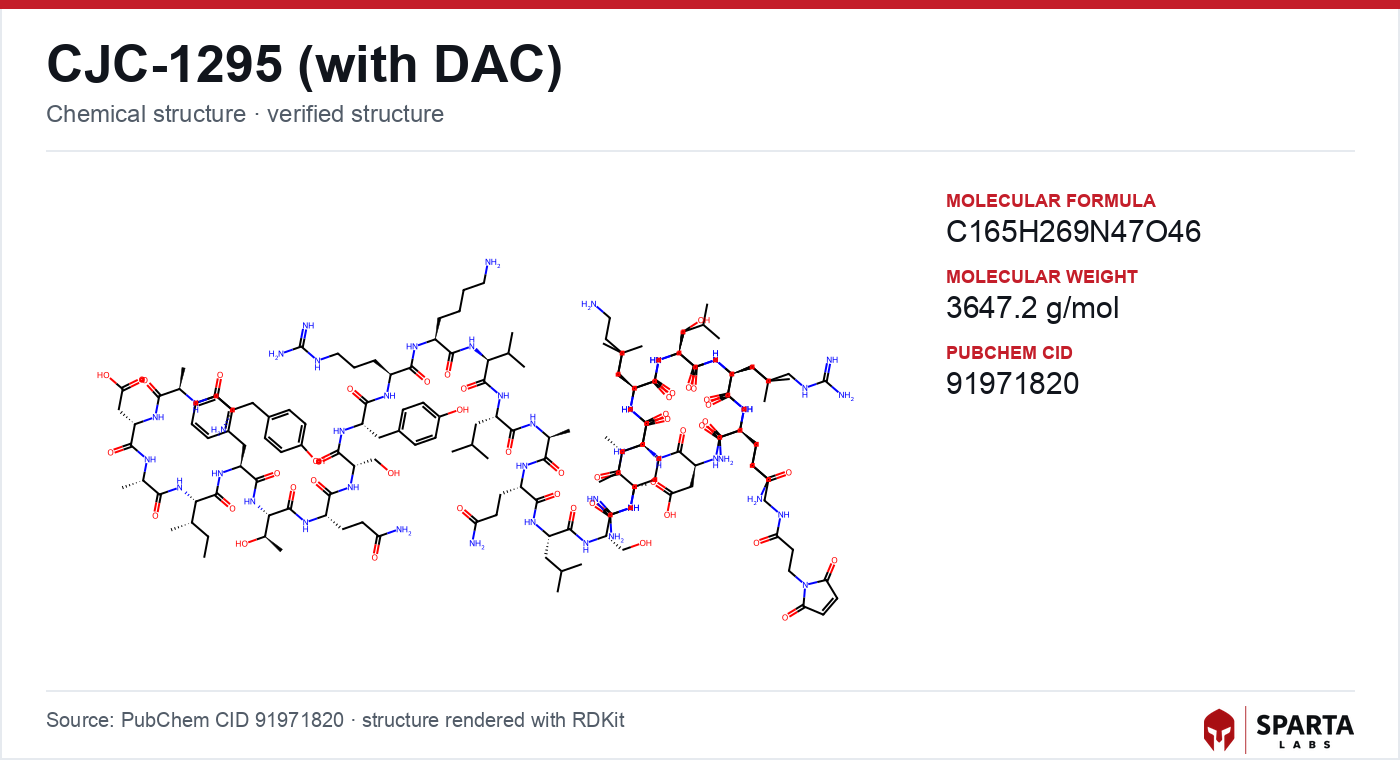
Figure: chemical structure of CJC-1295 (with DAC).
The Half-Life Problem That Shaped the Molecule
Native GHRH is a hypothalamic neuropeptide that acts on somatotroph cells of the anterior pituitary. Its usefulness as a research tool is limited by a short plasma lifetime: full-length GHRH is cleaved rapidly at its N-terminus by dipeptidyl peptidase-4 (DPP-4), which removes the first two residues and converts the peptide to an essentially inactive fragment. Frohman and colleagues characterized this DPP-4 and trypsin-like degradation of human GHRH in plasma in 1989, documenting the proteolytic bottleneck that any durable analog must overcome [1].
Findings from research models do not establish safety or efficacy in humans. Sparta Labs makes no claims about the use of this compound.
Two engineering strategies emerged in response. The first stabilizes the peptide backbone against enzymatic cleavage through targeted substitutions. The second extends residence time by tethering the peptide to a long-lived carrier protein. CJC-1295 with DAC is notable because it combines both approaches in a single molecule, which is why its structure reads differently from that of earlier GHRH analogs such as sermorelin. Readers tracing the broader analog family may find the tesamorelin research overview a useful point of comparison, since tesamorelin pursues the stabilization goal through a distinct N-terminal modification.
The Tetra-Substituted GHRH(1-29) Scaffold
The peptide portion of CJC-1295 is a 30-residue chain derived from the human GHRH(1-29) sequence, the same active fragment that defines sermorelin. Relative to that parent sequence, CJC-1295 introduces four amino acid substitutions intended to resist proteolysis and epimerization. In the conventional numbering these fall at positions 2, 8, 15, and 27, and together they are described in the literature as the tetra-substituted scaffold. The substitution at position 2 is the most consequential for stability because it sits at the DPP-4 cleavage site identified in the Frohman degradation work [1].
This substituted backbone is shared with CJC-1295 without DAC, so the two compounds are chemically identical up to the C-terminus. The point of divergence is the conjugation chemistry described in the next section. A closer treatment of the backbone-only variant and its shorter persistence appears in the CJC-1295 without DAC research overview.
The unconjugated peptide carries the molecular formula C165H269N47O46 and a molecular weight of approximately 3,647 daltons.
Drug Affinity Complex: The Albumin-Conjugation Step
The DAC is what separates CJC-1295 with DAC from every backbone-only GHRH analog. It is an N-epsilon-3-maleimidopropionamide group appended through a lysine residue at the peptide's C-terminus. The maleimide is a thiol-reactive electrophile: once in circulation, it forms a covalent thioether bond with the single free cysteine thiol (Cys34) of human serum albumin. The result is a defined peptide-albumin conjugate rather than a small free peptide, so the active species travels with albumin and shares its slow clearance.
Jetté and colleagues first characterized this bioconjugation chemistry for GHRH analogs in a 2005 Endocrinology paper, which formally identified CJC-1295 as a long-lasting GHRH analog. In rat models the albumin conjugate was reported to activate the GHRH receptor on the anterior pituitary and to show markedly greater in vitro stability against enzymatic degradation than the unconjugated hGRF(1-29) peptide [2]. That paper is the foundational preclinical reference for the compound and the origin of its CJC-1295 designation.
Because the DAC forms its bond after administration, the circulating molecule is effectively an albumin adduct in the ~67 kilodalton range rather than a 3.6 kilodalton peptide. This is the structural basis for the compound's classification among the more durable synthetic GHRH analogs documented in the literature.
Pharmacological Classification
CJC-1295 with DAC is classified as a synthetic GHRH analog and a growth-hormone secretagogue. Its reported activity is mediated at the GHRH receptor, a class B secretin-family G protein-coupled receptor expressed predominantly on anterior pituitary somatotroph cells. This places CJC-1295 with DAC in the same receptor family as sermorelin and tesamorelin, and it acts upstream of the pituitary rather than supplying exogenous growth hormone directly. The receptor-level details are treated in the companion CJC-1295 with DAC mechanism of action article.
The compound should not be conflated with CJC-1295 without DAC, also called Modified GRF(1-29) or Mod-GRF(1-29). The two carry the same four substitutions but differ in the presence of the maleimide-albumin conjugation, and that single structural feature accounts for their distinct pharmacokinetic profiles.
Discovery and Research Lineage
The molecular identity of GHRH was established in 1982, when Guillemin and colleagues isolated a 44-amino acid growth hormone-releasing factor from a human pancreatic tumor associated with acromegaly, reporting its primary sequence and its growth hormone-stimulating activity in Science [3]. That discovery, made alongside parallel work at the Salk Institute, opened the synthetic-analog programs that eventually produced sermorelin, tesamorelin, and the CJC series.
The DAC platform itself was developed by ConjuChem Inc. of Montreal, Canada, a biotechnology company focused on reactive-chemistry approaches to peptide half-life extension. The first peer-reviewed characterization of CJC-1295 as a long-lasting GHRH analog was the 2005 Jetté paper [2]. Human pharmacokinetic and pharmacodynamic data followed in 2006, when Teichman and colleagues reported in the Journal of Clinical Endocrinology and Metabolism that a single administration of CJC-1295 was associated with prolonged elevation of growth hormone and insulin-like growth factor I in healthy adults, consistent with the extended residence time predicted by the albumin-conjugation design [4]. Together the 2005 and 2006 papers form the core primary-literature record for the compound.
Regulatory Status
CJC-1295 with DAC has not received approval from the US Food and Drug Administration or any comparable regulatory authority for any human indication, and it does not appear in the FDA Orange Book as an approved drug product. In December 2024, the FDA Pharmacy Compounding Advisory Committee evaluated CJC-1295-related substances in the context of the Section 503A bulk drug substances list that governs pharmacy compounding [5]. These regulatory events are chronicled in detail in the companion CJC-1295 with DAC discovery and regulatory history.
The World Anti-Doping Agency lists GHRH and its analogs, including CJC-1295, under Section S2 of its Prohibited List (Peptide Hormones, Growth Factors, Related Substances and Mimetics).
CJC-1295 with DAC is studied as a research-use-only material, a status distinct from that of an approved pharmaceutical. Batch analysis practices for research-grade material, including identity confirmation by mass spectrometry and purity assessment by HPLC, are described in the CJC-1295 with DAC sourcing and verification standards reference. Analytical documentation accompanies research-grade CJC-1295 with DAC available from Sparta Labs.
References
-
Frohman LA, Downs TR, Heimer EP, Felix AM. Dipeptidylpeptidase IV and trypsin-like enzymatic degradation of human growth hormone-releasing hormone in plasma. J Clin Invest. 1989;83(5):1533-1540. PMID: 2703532. PubMed.
-
Jetté L, Léger R, Thibaudeau K, Benquet C, Robitaille M, Pellerin I, et al. Human growth hormone-releasing factor (hGRF)1-29-albumin bioconjugates activate the GRF receptor on the anterior pituitary in rats: identification of CJC-1295 as a long-lasting GRF analog. Endocrinology. 2005;146(7):3052-3058. PMID: 15817669. PubMed.
-
Guillemin R, Brazeau P, Böhlen P, Esch F, Ling N, Wehrenberg WB. Growth hormone-releasing factor from a human pancreatic tumor that caused acromegaly. Science. 1982;218(4572):585-587. PMID: 6812220. PubMed.
-
Teichman SL, Neale A, Lawrence B, Gagnon C, Castaigne JP, Frohman LA. Prolonged stimulation of growth hormone (GH) and insulin-like growth factor I secretion by CJC-1295, a long-acting analog of GH-releasing hormone, in healthy adults. J Clin Endocrinol Metab. 2006;91(3):799-805. PMID: 16352683. PubMed.
-
US Food and Drug Administration. Pharmacy Compounding Advisory Committee (PCAC). Meeting materials, December 2024. FDA.
Disclaimer. Statements in this article have not been evaluated by the Food and Drug Administration. This compound is not intended to diagnose, treat, cure, or prevent any disease. Sparta Labs sells research-use-only materials. Content is provided for educational and informational purposes only and does not constitute medical advice. Consult a qualified medical professional for any health concerns.
Frequently asked questions
What is CJC-1295 with DAC?
CJC-1295 with DAC is a synthetic 30-residue analog of growth hormone-releasing hormone (GHRH) built on the GHRH(1-29) sequence. The Drug Affinity Complex (DAC) is a C-terminal maleimide group that forms a covalent bond to circulating serum albumin. In peer-reviewed literature it is classified as a long-acting GHRH analog and growth-hormone secretagogue.
How does the DAC modification differ from CJC-1295 without DAC?
Both molecules share the same four-substitution GHRH(1-29) backbone, but only the DAC form carries the C-terminal maleimidopropionamide-lysine group that conjugates to albumin. CJC-1295 without DAC, also called Modified GRF(1-29), lacks that albumin-binding chemistry, and Teichman and colleagues in 2006 reported a substantially longer circulatory persistence for the conjugated form in healthy adults.
Who developed CJC-1295 with DAC?
The albumin-conjugation platform behind CJC-1295 was developed by ConjuChem Inc. of Montreal, Canada. Jetté and colleagues published the first preclinical characterization of the compound in Endocrinology in 2005, and Teichman and colleagues reported human pharmacokinetic data in the Journal of Clinical Endocrinology and Metabolism in 2006.
Is CJC-1295 with DAC approved by the FDA?
No. CJC-1295 with DAC has not received FDA approval for any human indication and does not appear in the FDA Orange Book. In December 2024 the FDA Pharmacy Compounding Advisory Committee evaluated CJC-1295-related substances in the context of the Section 503A bulk drug substances list. It is handled as a research-use-only compound.
What is the chemical formula and molecular weight of CJC-1295?
The unconjugated CJC-1295 peptide has the molecular formula C165H269N47O46 and a molecular weight of approximately 3,647 daltons. Once the DAC maleimide reacts with a free thiol on serum albumin, the active species circulates as a peptide-albumin conjugate with an effective mass in the range of albumin, roughly 67 kilodaltons.