
CJC-1295 Without DAC: Mechanism of Action
A mechanism review of CJC-1295 without DAC (Mod GRF 1-29): GHRH-receptor pharmacology, the Gαs/cAMP/PKA cascade, and why its four substitutions target DPP-4 metabolism rather than receptor binding. Educational reference.
For research use only. Not for human consumption. This article is educational reference material. It is not medical advice and is not a recommendation to use any substance.
What CJC-1295 Without DAC Is at the Molecular Level
CJC-1295 without DAC, also catalogued as Modified GRF(1-29) or Mod GRF 1-29, is a synthetic 29-amino-acid peptide derived from the N-terminal fragment of human growth hormone-releasing hormone (GHRH). Full-length human GHRH is a 44-residue peptide, but structure-activity work established that the first 29 residues, GRF(1-29), retain essentially the full intrinsic activity of the parent hormone at the GHRH receptor. CJC-1295 without DAC is that 1-29 backbone carrying four deliberate amino-acid substitutions and lacking the drug-affinity-complex (DAC) maleimide group that distinguishes the albumin-binding CJC-1295 with DAC variant.
Understanding the reported mechanism of this peptide therefore means understanding two separate things: the GHRH receptor pharmacology it inherits from native GHRH, and the way its four point mutations change how the molecule is handled by plasma enzymes rather than how it engages the receptor. This article treats those two axes in turn, drawing on the primary endocrinology literature. All findings described derive from in vitro assays and animal models.
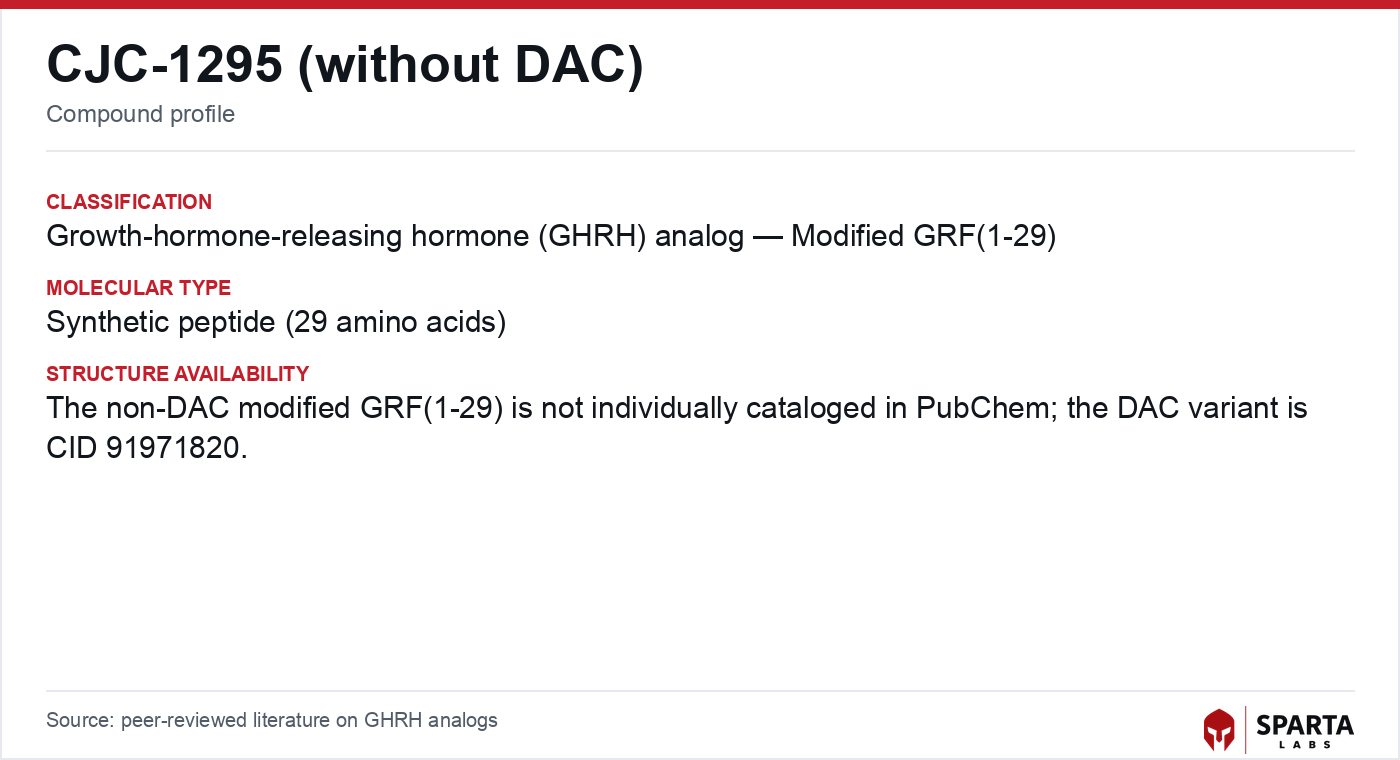
Figure: chemical structure of CJC-1295 (without DAC).
The GHRH Receptor: A Class B GPCR on Pituitary Somatotrophs
The molecular target of the GRF(1-29) scaffold is the GHRH receptor (GHRH-R), a class B (secretin-family) G protein-coupled receptor. The human GHRH-R was cloned and characterized by Mayo in 1992, who reported that expression of the receptor cDNA conferred GHRH-dependent stimulation of cyclic AMP, identifying it as a G protein-coupled receptor coupled to adenylyl cyclase [1]. GHRH-R is expressed predominantly on the somatotroph cells of the anterior pituitary, the cell population responsible for growth hormone (GH) synthesis and storage.
Class B GPCRs share a characteristic architecture: a large extracellular N-terminal domain that captures the C-terminal portion of the peptide ligand, and a seven-transmembrane helical bundle whose extracellular loops engage the ligand's N-terminus to trigger activation. For GHRH-family peptides this "two-domain" binding model means the biological potency of an analog depends heavily on the integrity of its N-terminal residues, which is directly relevant to why the position-2 substitution in CJC-1295 without DAC was chosen with care.
Findings from research models do not establish safety or efficacy in humans. Sparta Labs makes no claims about the use of this compound.
The Gαs / cAMP / PKA Cascade Reported for GHRH Agonism
Following the receptor pharmacology established by Mayo and by subsequent somatotroph physiology studies, GHRH-R is coupled principally to the stimulatory G protein Gαs. Agonist occupancy of GHRH-R is reported to drive Gαs dissociation, activation of adenylyl cyclase, and accumulation of intracellular cyclic adenosine monophosphate (cAMP) [1]. Elevated cAMP activates protein kinase A (PKA), which has two reported consequences in somatotrophs.
The first is transcriptional. PKA phosphorylates the transcription factor CREB (cAMP response element-binding protein), and phosphorylated CREB participates in transcription of the pituitary-specific factor Pit-1 (POU1F1) and of the GH gene itself, supporting GH synthesis over a slower timescale. The second is acute and electrical: GHRH-R activation in somatotrophs is associated with membrane depolarization and calcium entry through voltage-gated calcium channels, and the resulting rise in intracellular calcium is the proximate trigger for exocytosis of pre-formed GH secretory granules. These two arms, slow transcriptional and fast secretory, are the canonical mechanism GHRH analogs inherit.
This Gαs/cAMP-centered pathway is mechanistically separate from the receptor used by the growth-hormone-releasing peptides. Ghrelin-mimetic secretagogues such as GHRP-2 and ipamorelin act at the GH secretagogue receptor (GHS-R1a), a Gq/phospholipase-C-coupled receptor, and their signaling converges on GH release through a distinct second-messenger route. The GHRH-R pathway described here is the one shared across the GRF(1-29) analog family, including tesamorelin.
Why the Four Substitutions Exist: DPP-4 Biochemistry, Not Receptor Tuning
The four substitutions that define CJC-1295 without DAC relative to native GRF(1-29) are D-Ala at position 2, Gln at position 8, Ala at position 15, and Nle (norleucine) at position 27. A central and often-misunderstood point in the mechanism literature is that these changes were engineered to alter the peptide's metabolic fate, not its receptor binding.
The dominant inactivation route for circulating GHRH is enzymatic, not renal. Frohman and colleagues demonstrated in 1989 that dipeptidyl peptidase-4 (DPP-4) cleaves the N-terminal Tyr¹-Ala² bond of plasma GHRH, generating the fragment GHRH(3-29), and reported that this proteolysis is the principal early degradation event for the hormone in plasma [2]. Because GHRH(3-29) has lost the N-terminal residues that the receptor's transmembrane core reads for activation, DPP-4 cleavage is effectively an off-switch.
Substituting the L-alanine at position 2 with its D-enantiomer (D-Ala²) presents DPP-4 with a peptide-bond stereochemistry the enzyme cannot productively process, conferring resistance to this cleavage while preserving the residues the receptor recognizes. The position-27 change from methionine to norleucine removes the sulfur-containing side chain that is vulnerable to oxidation, improving chemical stability without introducing a charge. The positions 8 and 15 substitutions similarly serve stability and manufacturability rather than receptor affinity. The design goal across all four was extended integrity of an otherwise native agonist.
Evidence That the Modified Scaffold Retains Agonist Activity
Whether these stability edits leave receptor activity intact is an empirical question, and the founding characterization paper addressed it directly. Jetté and colleagues (2005) constructed a series of hGRF(1-29) analogs on the same tetrasubstituted backbone and reported that these peptides retained the ability to stimulate GH secretion from cultured rat anterior pituitary cells, while showing improved stability against degradation in plasma relative to the unmodified sequence [3]. The same study characterized the DAC-bearing bioconjugate as a long-lasting analog, but its assays establish that the modified GRF(1-29) core itself is an active GHRH-R agonist independent of any albumin-binding contribution. That result is the specific evidentiary basis for describing CJC-1295 without DAC as a receptor agonist.
The physiological plausibility of GHRH-R agonism restoring GH output was reinforced in a genetic model. Alba and colleagues (2006) studied GHRH knockout mice, animals that lack endogenous GHRH signaling, and reported that administration of a CJC-1295 analog built on this scaffold was associated with growth and body-weight measures within the range of wild-type controls [4]. The authors interpreted the finding as restoration of intermittent pituitary GH stimulation in an otherwise GHRH-deficient background. These are animal-model observations and do not establish any human outcome. The full body of primary studies is surveyed in the CJC-1295 without DAC published research summary, and the compound's classification and lineage are covered in the CJC-1295 without DAC research overview.
Pharmacokinetics Shape the Mechanism: Short-Acting vs Albumin-Bound
Because CJC-1295 without DAC carries no DAC maleimide, it does not form a covalent bond with circulating albumin. The mechanistic consequence is a much shorter plasma residence than the DAC variant: without the albumin depot, the peptide is cleared over minutes to tens of minutes rather than over days. This distinction is the whole reason the two CJC-1295 forms are studied separately even though they engage the same receptor by the same cascade.
Pulsatility is the pharmacodynamic dimension where this matters. Endogenous GH secretion is pulsatile, gated by the interplay of hypothalamic GHRH release and inhibitory somatostatin tone. Ionescu and Frohman (2006) reported that even under continuous GHRH-R agonist exposure from the long-acting DAC form, pulsatile GH secretion persisted in healthy adults, with the intact somatostatin system continuing to shape pulse architecture [5]. That observation, made on the DAC variant, frames a mechanistic question for the shorter-acting without-DAC form: how a transient GHRH-R stimulus interacts with somatostatin gating is an area where dedicated study of this specific molecule would extend the existing data.
Limits of Current Understanding
Several mechanistic parameters remain characterized largely by inference from related analogs rather than by direct measurement on CJC-1295 without DAC. Quantitative human GHRH-R pharmacology for this exact molecule, binding affinity (Ki) and functional potency (EC50), is not extensively reported independently of the broader GRF(1-29) analog literature. The behavior of the shorter-acting peptide against counter-regulatory somatostatin tone, and any signaling engaged at extrapituitary GHRH-R populations, are open questions rather than settled findings.
As with any research-use compound, mechanistic descriptions assembled from in vitro receptor assays and animal studies do not establish a mechanism of action in humans. The receptor-level framework, a DPP-4-resistant GRF(1-29) agonist acting through the Gαs/cAMP/PKA and calcium pathways of pituitary somatotrophs, rests on well-attributed primary literature; the human translation does not. Research-grade CJC-1295 without DAC supplied by Sparta Labs is accompanied by HPLC purity data and mass spectrometry identity confirmation for each batch.
References
-
Mayo KE. Molecular cloning and expression of a pituitary-specific receptor for growth hormone-releasing hormone. Mol Endocrinol. 1992;6(10):1734-1744. PMID: 1333056. DOI: 10.1210/mend.6.10.1333056
-
Frohman LA, Downs TR, Heimer EP, Felix AM. Dipeptidylpeptidase IV and trypsin-like enzymatic degradation of human growth hormone-releasing hormone in plasma. J Clin Invest. 1989;83(5):1533-1540. PMID: 2651468. DOI: 10.1172/JCI114049
-
Jetté L, Léger R, Thibaudeau K, Benquet C, Robitaille M, Pellerin I, et al. Human growth hormone-releasing factor (hGRF)1-29-albumin bioconjugates activate the GRF receptor on the anterior pituitary in rats: identification of CJC-1295 as a long-lasting GRF analog. Endocrinology. 2005;146(7):3052-3058. PMID: 15817669. DOI: 10.1210/en.2004-1286
-
Alba M, Fintini D, Sagazio A, Lawrence B, Castaigne JP, Frohman LA, et al. Once-daily administration of CJC-1295, a long-acting growth hormone-releasing hormone (GHRH) analog, normalizes growth in the GHRH knockout mouse. Am J Physiol Endocrinol Metab. 2006;291(6):E1290-E1294. PMID: 16822960. DOI: 10.1152/ajpendo.00201.2006
-
Ionescu M, Frohman LA. Pulsatile secretion of growth hormone (GH) persists during continuous stimulation by CJC-1295, a long-acting GH-releasing hormone analog. J Clin Endocrinol Metab. 2006;91(12):4792-4797. PMID: 17018654. DOI: 10.1210/jc.2006-1702
Disclaimer. Statements in this article have not been evaluated by the Food and Drug Administration. This compound is not intended to diagnose, treat, cure, or prevent any disease. Sparta Labs sells research-use-only materials. Content is provided for educational and informational purposes only and does not constitute medical advice. Consult a qualified medical professional for any health concerns.
Frequently asked questions
What receptor does CJC-1295 without DAC act on?
CJC-1295 without DAC is a synthetic GRF(1-29) analog that acts at the growth hormone-releasing hormone receptor (GHRH-R), a class B G protein-coupled receptor expressed on anterior-pituitary somatotroph cells. Mayo (1992) cloned this receptor and reported it couples to adenylyl cyclase through a stimulatory G protein. This target is distinct from the GH secretagogue receptor used by ghrelin-mimetic peptides such as GHRP-2 and ipamorelin.
Why does CJC-1295 without DAC carry four amino-acid substitutions?
The D-Ala², Gln⁸, Ala¹⁵ and Nle²⁷ substitutions were engineered to change how the peptide is metabolized rather than how it binds the receptor. Frohman and colleagues (1989) showed dipeptidyl peptidase-4 (DPP-4) inactivates native GHRH by cleaving its N-terminal bond; the D-alanine at position 2 presents a bond geometry DPP-4 cannot process, while the norleucine at position 27 removes an oxidation-prone methionine.
How does GHRH-receptor activation lead to growth hormone release in research models?
In the reported cascade, agonist binding activates the stimulatory G protein Gαs, stimulating adenylyl cyclase and raising intracellular cAMP, which activates protein kinase A. PKA drives CREB-mediated transcription supporting GH synthesis, while associated calcium influx triggers exocytosis of pre-formed GH secretory granules. These are findings from in vitro and animal studies, not established human outcomes.
How does CJC-1295 without DAC differ mechanistically from the DAC version?
Both engage the same GHRH receptor through the same signaling cascade, but the without-DAC form lacks the drug-affinity-complex group that lets the DAC variant bind albumin covalently. Without that albumin depot, CJC-1295 without DAC is cleared over minutes to tens of minutes rather than days, giving it a much shorter pharmacodynamic profile.