
Epithalon: Discovery and Regulatory History
A source-anchored timeline of Epithalon (AEDG): the 1970s Leningrad pineal program, the Epithalamin extract era, the 2017 mass-spectrometry identification of the tetrapeptide, and the 2025 independent-replication turn. Educational reference.
For research use only. Not for human consumption. This article is educational reference material. It is not medical advice and is not a recommendation to use any substance.
Few research compounds carry a documentary trail as long or as unusual as Epithalon (Ala-Glu-Asp-Gly; AEDG). Its published record stretches across more than four decades, spans two political eras of Russian science, and, unusually, records roughly twenty years of experimental activity attributed to a pineal extract before the discrete tetrapeptide at the center of that activity was formally identified. This article reconstructs that trail as a timeline of primary sources, tracing how a bovine pineal fraction studied in Leningrad in the 1970s became, by 2025, a subject of independent replication by unaffiliated laboratories. For the compound's chemistry, classification, and current regulatory standing in a single reference, the Epithalon research overview is the companion document.
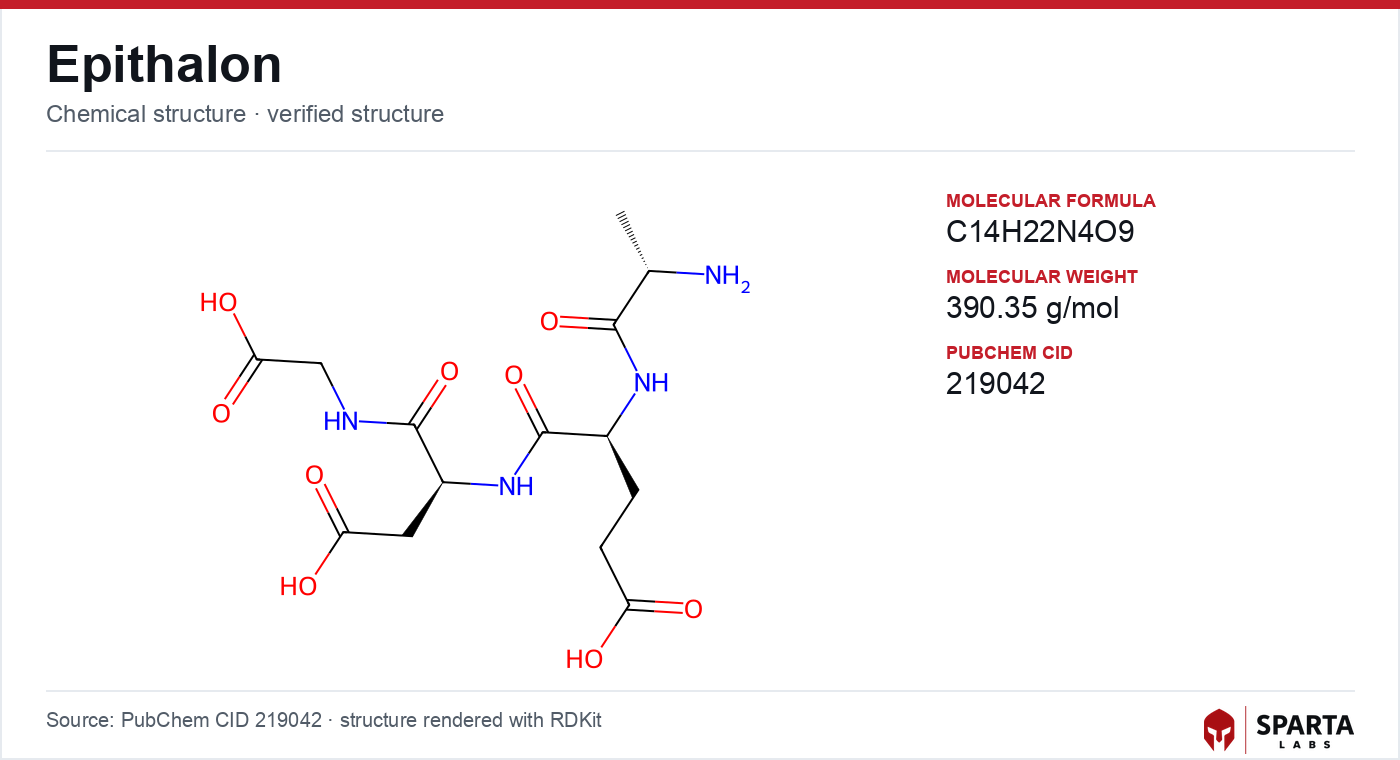
Figure: chemical structure of Epithalon.
A history read backward: extract first, sequence later
Most peptide histories move from structure to function: a sequence is synthesized, then its activity is probed. Epithalon's documented history runs the other way. The biological program that produced it began not with a defined molecule but with an organ-derived polypeptide fraction, and the four-letter sequence now printed on every certificate of analysis was pinned down only in the twenty-first century. Reading the literature in publication order, rather than in the tidy order a textbook might impose, is the clearest way to see why so much of the early Epithalon record is really a record of the parent extract, Epithalamin.
That framing matters for anyone evaluating the compound's provenance. The early lifespan and oncology data cited in later reviews were generated with the extract; the synthetic tetrapeptide inherited those findings by analytical association rather than by having generated them directly. Keeping the two entities distinct is the single most important interpretive habit when working through this literature.
1973–1994: the Leningrad pineal program and the Epithalamin era
The experimental lineage begins at the Military Medical Academy in Leningrad (now St. Petersburg), where Vladimir Kh. Khavinson and Vladimir G. Morozov initiated work on organ-specific peptide complexes in the early 1970s. Their working premise drew on the era's growing interest in the pineal gland as a neuroendocrine regulator acting through melatonin and other secreted factors. Beginning around 1973, the group examined whether polypeptide fractions isolated from bovine pineal tissue could produce measurable, reproducible effects in animal models.
The foundational retrospective for this period is the 1994 review by Anisimov, Khavinson, and Morozov in the Annals of the New York Academy of Sciences, which summarized roughly two decades of Epithalamin experiments [1]. The authors reported that the extract was associated with extended mean and maximum lifespan across several species, reduced spontaneous tumor incidence in multiple mouse strains, and modulation of neuroendocrine parameters.
Findings from research models do not establish safety or efficacy in humans. Sparta Labs makes no claims about the use of this compound.
By the close of this era, the program had a substantial empirical dossier attached to a chemically ill-defined extract. That mismatch, a large body of activity data with no confirmed active principle, set the agenda for everything that followed. The same Soviet-era appetite for neuroactive peptides also produced parallel programs documented in the Selank history, and the pineal-peptide line specifically branched toward related short sequences discussed in the Pinealon research overview.
2001–2004: the synthetic tetrapeptide and the telomerase inflection
The move from extract to defined molecule reflected the broader methodological signature of the Khavinson bioregulator program: isolate the shortest active peptide within a tissue-derived complex, then synthesize it for controlled experiments. Short peptides offer far greater chemical definition and batch reproducibility than heterogeneous extracts, and by the early 2000s the synthetic tetrapeptide Ala-Glu-Asp-Gly, designated Epithalon or Epitalon, had become the working experimental agent.
Three publications anchor this period:
- A 2001 study in Mechanisms of Ageing and Development compared the synthetic thymic tetrapeptide Lys-Glu against the synthetic pineal tetrapeptide AEDG head-to-head in female CBA mice across their natural lifespan, reporting a modest mean-lifespan difference in the AEDG group [5]. This was among the earliest peer-reviewed papers to treat Epithalon as the defined agent rather than as the extract.
- A 2003 in vitro study reported that AEDG addition to telomerase-negative human fetal fibroblast cultures was associated with induced hTERT expression, telomerase activation, and telomere elongation [3]. This is the pivot of the entire narrative: from 2003 onward, most published discussion of Epithalon is framed in the vocabulary of telomere biology rather than pineal endocrinology.
- A 2003 rodent study in Biogerontology examined the synthetic compound in SHR mice, reporting endpoints including a change in the lifespan of the longest-lived survivors and a reduced leukemia incidence [4]; a follow-up 2004 cell-culture report described human fibroblasts continuing division beyond the expected passage limit following telomere elongation [6].
Together these four years converted Epithalon from an extract-derived curiosity into a compound with a specific, testable mechanistic hypothesis attached to a synthetic, reproducible molecule.
2010–2017: consolidation and the identification puzzle solved
The decade after the telomerase inflection produced synthesis rather than new mechanisms. A 2010 review by Anisimov and Khavinson in Biogerontology gathered the rodent, invertebrate, and human observational strands into a single account of the peptide-bioregulation program [7]. But one structural question remained formally open: was AEDG actually the active sequence within the Epithalamin complex, or had the field simply assumed the connection?
That question was resolved in 2017, when Khavinson, Kopylov, and colleagues reported selective reaction monitoring mass spectrometry confirming the presence of the AEDG peptide within the Epithalamin polypeptide complex, published in the Bulletin of Experimental Biology and Medicine [2]. The result closed a loop that had been open since the 1970s: the extract studied for two decades and the tetrapeptide synthesized for two more were, analytically, connected. In a history that ran extract-first, 2017 is the year the sequence finally caught up to the activity.
What makes this timeline unusual
Three features distinguish Epithalon's documentary history from that of most research peptides, and each is worth stating plainly for anyone assessing the literature:
- Inverted discovery order. Activity data preceded structural confirmation by roughly forty years. This is the opposite of the modern norm and means early citations describe the extract, not the synthetic peptide.
- Single-institution concentration. For most of its history the record originated from one program in St. Petersburg. Concentration of a literature within one group is a well-recognized reason to weight independent replication heavily.
- A regulatory position shaped by sibling compounds. Epithalon's standing has been read in part through the trajectory of related Khavinson bioregulators rather than through a clinical program of its own.
Regulatory milestones
Within Russia, the broader Khavinson program produced six peptide-based pharmaceuticals registered as medicines in the Russian Federation, among them Thymalin (a thymic extract) and Cortexin (a cerebral-cortex peptide complex). Those registrations established a regulatory precedent for the peptide-bioregulator class within the Russian system. The synthetic tetrapeptide Epithalon itself did not achieve separate registered pharmaceutical status in Russia within the literature reviewed here.
In the United States, Epithalon has not received FDA approval for any therapeutic indication and is not recognized as an approved drug, biologic, or dietary-supplement ingredient. The compound appeared on the FDA's Category 2 bulk substances list, a designation identifying it as a candidate under compounding-pharmacy review rather than an approval or a rejection. No European Medicines Agency marketing-authorization evaluation of Epithalon has been published, and no Phase I–III trials of the synthetic compound registered on ClinicalTrials.gov have reported results in the peer-reviewed literature reviewed for this article.
2025: the independent-replication turn
The most consequential recent development is not a new mechanism but a change in who is doing the work. Two 2025 publications examined Epithalon from outside the originating institution:
- A narrative review by Araj, Brzezik, Mądra-Gackowska, and Szeleszczuk, authors affiliated with Polish and German institutions, synthesized the published record independently and identified the absence of registered human trials as the field's primary frontier [8].
- An in vitro replication study by Al-dulaimi and colleagues in Biogerontology reported telomere-length effects in normal human breast cell lines and extended observation to cancer cell lines, raising the alternative lengthening of telomeres (ALT) pathway as a possible mechanism in cancer cells distinct from the hTERT-mediated route observed in normal cells [9].
The significance is structural: a literature long concentrated in one program is now being tested and extended by groups with no institutional connection to it. The next steps identified across the current reviews, independent rodent lifetime replication, randomized placebo-controlled human studies using synthetic AEDG, and structural validation of the proposed binding hypotheses, define a concrete agenda for the coming decade.
Researchers assessing the synthetic compound's batch-specific analytical documentation can consult the Epithalon sourcing and quality reference, and those establishing an inventory of the tetrapeptide for laboratory work can review the product listing and specifications on the Epithalon product page.
A note on source provenance
Because so much of the early record is extract-based and single-institution in origin, this timeline weights three categories of source most heavily: the 2017 mass-spectrometry identification paper that anchors the extract-to-peptide link [2], the 2003 telomerase report that defines the modern mechanistic frame [3], and the 2025 independent publications that provide the first substantial arm's-length assessment [8][9]. Readers extending this history should treat pre-2017 activity citations as descriptions of Epithalamin unless the primary source explicitly identifies synthetic AEDG.
References
-
Anisimov VN, Khavinson VKh, Morozov VG. Twenty Years of Study on Effects of Pineal Peptide Preparation: Epithalamin in Experimental Gerontology and Oncology. Ann N Y Acad Sci. 1994;719:483–493. DOI: 10.1111/j.1749-6632.1994.tb56853.x.
-
Khavinson VKh, Kopylov AT, Vas'kovskiy BV, Ryzhak GA, Lin'kova NS. Identification of Peptide AEDG in the Polypeptide Complex of the Pineal Gland. Bull Exp Biol Med. 2017;164(3):308–310. DOI: 10.1007/s10517-017-3922-8. PMID: 29124531.
-
Khavinson VKh, Bondarev IE, Butyugov AA. Epithalon Peptide Induces Telomerase Activity and Telomere Elongation in Human Somatic Cells. Bull Exp Biol Med. 2003;135(6):590–592. DOI: 10.1023/A:1025493705728. PMID: 12937682.
-
Anisimov VN, Khavinson VKh, Popovich IG, Zabezhinski MA, Alimova IN, Rosenfeld SV, et al. Effect of Epitalon on biomarkers of aging, life span and spontaneous tumor incidence in female Swiss-derived SHR mice. Biogerontology. 2003;4(4):193–202. DOI: 10.1023/A:1025114230714.
-
Anisimov VN, Khavinson VKh, Mikhalski AI, Yashin AI. Effect of synthetic thymic and pineal peptides on biomarkers of ageing, survival and spontaneous tumour incidence in female CBA mice. Mech Ageing Dev. 2001;122(1):41–68. DOI: 10.1016/s0047-6374(00)00184-6. PMID: 11163623.
-
Khavinson VKh, Bondarev IE, Butyugov AA, Smirnova TD. Peptide Promotes Overcoming of the Division Limit in Human Somatic Cells. Bull Exp Biol Med. 2004;137(5):503–506. DOI: 10.1023/B:BEBM.0000038164.49947.8c. PMID: 15455129.
-
Anisimov VN, Khavinson VKh. Peptide bioregulation of aging: results and prospects. Biogerontology. 2010;11(2):139–149. DOI: 10.1007/s10522-009-9249-8. PMID: 19830585.
-
Araj SK, Brzezik J, Mądra-Gackowska K, Szeleszczuk Ł. Overview of Epitalon — Highly Bioactive Pineal Tetrapeptide with Promising Properties. Int J Mol Sci. 2025;26(6):2691. DOI: 10.3390/ijms26062691. PMCID: PMC11943447.
-
Al-dulaimi S, Decker A, Abdulaziz M, Al-Qahtani S, Tokalov S. Epitalon increases telomere length in human cell lines through telomerase upregulation or ALT activity. Biogerontology. 2025. DOI: 10.1007/s10522-025-10315-x. PMCID: PMC12411320.
Disclaimer. Statements in this article have not been evaluated by the Food and Drug Administration. This compound is not intended to diagnose, treat, cure, or prevent any disease. Sparta Labs sells research-use-only materials. Content is provided for educational and informational purposes only and does not constitute medical advice. Consult a qualified medical professional for any health concerns.
Frequently asked questions
Why was Epithalon studied as an extract for two decades before its structure was identified?
The Leningrad program began in the 1970s with Epithalamin, a polypeptide fraction isolated from bovine pineal tissue, and characterized its biological activity in animal models long before the active sequence was known. Formal analytical identification of the Ala-Glu-Asp-Gly (AEDG) tetrapeptide within that complex was reported only in 2017 using selective reaction monitoring mass spectrometry. This inversion of the usual discovery order, where empirical activity preceded structural identification, is one of the defining features of the compound's history.
What is the difference between Epithalamin and Epithalon?
Epithalamin is the parent polypeptide complex extracted from bovine pineal gland tissue and studied from the early 1970s. Epithalon (also written Epitalon) is the synthetic tetrapeptide Ala-Glu-Asp-Gly, studied as a discrete defined compound from around 2001 onward. The 2017 mass-spectrometry study reported that AEDG is present as a component of the Epithalamin complex.
When did telomerase become central to Epithalon research?
A 2003 in vitro study by Khavinson and colleagues reported that AEDG addition to human somatic cell cultures was associated with induced hTERT expression and telomere elongation. That publication established the telomerase pathway as the leading mechanistic hypothesis and marks the inflection point after which most subsequent literature framed the compound in telomere-biology terms.
Has Epithalon been approved by the FDA?
Epithalon has not received FDA approval for any therapeutic indication and is not recognized as an approved drug, biologic, or dietary-supplement ingredient in the United States. The synthetic tetrapeptide appeared on the FDA's Category 2 bulk substances list as a candidate under compounding review. This status reflects a pipeline designation rather than an approval or an outright rejection.
How has the Epithalon research field changed recently?
For decades the published record was concentrated within the St. Petersburg institution that originated the program. In 2025, independent groups affiliated with Polish, German, and other institutions published a narrative review and an in vitro replication study, examining and extending the earlier findings without institutional ties to the original program. This shift toward independent replication is the most significant recent change in the field.