
Pinealon: A Research Overview
A neutral, citation-based overview of Pinealon (EDR), the Glu-Asp-Arg tripeptide from the Khavinson bioregulator program: its short-peptide chemistry, cell-penetrating behavior, cytogen classification, and research-use-only regulatory standing.

For research use only. Not for human consumption. This article is educational reference material. It is not medical advice and is not a recommendation to use any substance.
Introduction
Pinealon is a synthetic tripeptide with the sequence Glu-Asp-Arg, abbreviated EDR in single-letter amino-acid code. It is one of the shortest peptides in the Sparta Labs research catalog, and its research interest stems less from any conventional receptor pharmacology than from a specific and unusual hypothesis: that a peptide of only three residues can cross cell membranes, enter the nucleus, and interact directly with DNA. Pinealon originated in the short-peptide bioregulator program directed by Vladimir Kh. Khavinson at the St. Petersburg Institute of Bioregulation and Gerontology, and published studies have examined it largely in cultured neural cells and rodent models of oxidative and ischemic stress. This overview summarizes what the peer-reviewed literature reports about the compound's chemistry, classification, and regulatory standing, without extending beyond those sources.
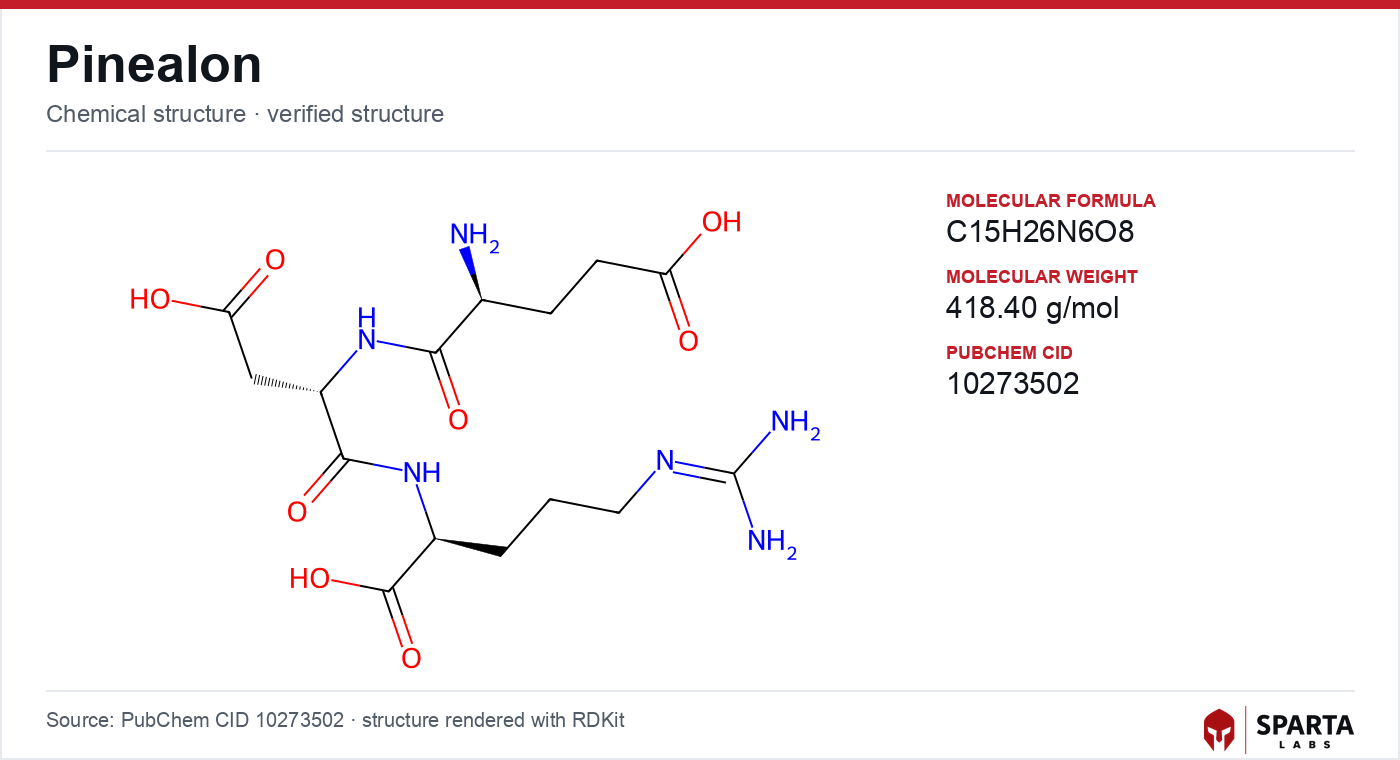
Figure: chemical structure of Pinealon (Glu-Asp-Arg).
Why a Three-Residue Peptide Is Unusual
Most peptides discussed in the research-peptide space are longer chains that fold into defined secondary structures and act on cell-surface receptors. Pinealon sits at the opposite extreme. With only three amino acids, it is too short to form stable helices or sheets, and its behavior is dominated by the chemistry of its individual side chains rather than by any folded conformation.
This size is the single most distinctive feature of the compound. Fedoreyeva and colleagues reported that short fluorescence-labeled peptides of this class penetrated into the nucleus of HeLa cells and interacted in vitro with specific deoxyribooligonucleotide sequences and DNA, a behavior the authors framed as sequence-selective binding to particular nucleotide motifs [1]. That finding is central to why Pinealon is studied at all: it places a very small molecule in a compartment, the nucleus, that larger peptides generally reach only through active transport.
Findings from research models do not establish safety or efficacy in humans. Sparta Labs makes no claims about the use of this compound.
Because entry does not appear to depend on a membrane receptor, Pinealon is not readily described using the vocabulary of classical pharmacology. This distinguishes it from the growth-hormone secretagogues and GLP-1 analogs elsewhere in the library, and it is one reason the Khavinson group developed its own classification language, discussed below. Readers interested in the proposed molecular events themselves may find the companion Pinealon mechanism of action article a closer treatment.
Chemistry and Structure
Pinealon has the chemical name L-glutamyl-L-aspartyl-L-arginine and the sequence Glu-Asp-Arg (EDR). Its CAS registry number is 175175-23-2, its molecular formula is C15H26N6O8, and its approximate molecular weight is 418.4 Da.
The side-chain chemistry is worth reading closely because, in a tripeptide, the side chains largely define the molecule's behavior. Two of the three residues, glutamate and aspartate, carry carboxylate groups that are deprotonated and negatively charged at physiological pH. The third residue, arginine, carries a guanidinium group that is protonated and positively charged across a wide pH range. The result is a small, highly polar, zwitterionic molecule whose net charge at neutral pH is modestly acidic, with the two anionic carboxylates only partially offset by the single cationic guanidinium.
That charge arrangement is relevant to the DNA-interaction hypothesis: the positively charged arginine guanidinium is a common contact point between proteins and the negatively charged phosphate backbone of DNA, while the acidic residues can participate in base-specific hydrogen bonding. The small size and defined side-chain chemistry also make the compound well suited to analytical characterization by mass spectrometry and reversed-phase chromatography, methods described in the Pinealon sourcing and quality reference.
The "Cytogen" Classification and Where It Sits in Pharmacology
Pinealon does not fit neatly into standard international pharmacological taxonomy. It is not characterized as an agonist or antagonist of a defined cell-surface receptor, nor as an ion-channel modulator or enzyme inhibitor. Reflecting this, the Khavinson group introduced its own terminology, grouping short synthetic peptides such as EDR under the headings "cytogens" and "cytomedicines" to denote peptides intended to reflect the tissue-regulatory activity of organ-derived polypeptide complexes [2].
This classification scheme is specific to that research program and is not part of mainstream regulatory or pharmacological nomenclature. In neutral terms, Pinealon is best described in the literature as a peptide bioregulator whose reported in vitro activity has been studied in the context of oxidative stress and cell viability rather than as a member of a conventional drug class. Anisimov and Khavinson's review of the peptide bioregulation program provides the broadest published context for how these compounds were conceived and grouped [2].
Its close relative Epithalon, the tetrapeptide Ala-Glu-Asp-Gly, shares the Glu-Asp motif and the same conceptual framework, and the two are frequently discussed together as members of the pineal-peptide lineage.
Regulatory Status
Pinealon has not been approved by the US Food and Drug Administration (FDA) as a drug for any therapeutic indication, and it does not appear in the FDA Orange Book (Approved Drug Products with Therapeutic Equivalence Evaluations). No marketing-authorization application for Pinealon as a medicinal product has been identified in European Medicines Agency or member-state public regulatory databases.
Much of the primary literature on Pinealon and its sibling peptides originated in Russian-language journals, and some formulations in that research lineage were distributed within Russia in geriatric and neurological research contexts. The precise regulatory categorization of Pinealon under Russian pharmaceutical law is not comprehensively described in Western-accessible English-language documentation. Within the United States, Sparta Labs offers Pinealon strictly as a research-use-only material, and researchers remain responsible for determining the regulations that apply in their own jurisdictions.
Origins in the Khavinson Peptide Program
The EDR sequence emerged from a decades-long research program that began not with a synthetic tripeptide but with polypeptide complexes extracted from animal organ tissue. For the pineal lineage, earlier work characterized a bovine pineal preparation before attention shifted toward identifying and synthesizing the discrete short peptide sequences thought to carry the activity of such extracts [2]. Pinealon represents the defined, synthesizable endpoint of that shift for the pineal branch of the program.
A subsequent body of work examined the isolated tripeptide directly. Khavinson and colleagues reported effects of Pinealon on cell viability and on the accumulation of reactive oxygen species in cultured neural and other cell types, framing the compound as active against oxidative processes in vitro rather than through a receptor-mediated pathway [3]. Later docking and expression analyses elaborated the proposed interaction between EDR and promoter-region DNA as a structural basis for the gene-regulatory hypothesis [4]. The chronological development of these ideas, and the researchers behind them, is set out in the Pinealon discovery and research history article, and the individual studies are summarized in the Pinealon published research reference.
References
-
Fedoreyeva LI, Kireev II, Khavinson VKh, Vanyushin BF. Penetration of short fluorescence-labeled peptides into the nucleus in HeLa cells and in vitro specific interaction of the peptides with deoxyribooligonucleotides and DNA. Biochemistry (Moscow). 2011;76(11):1210–1219. doi: 10.1134/S0006297911110022. PubMed
-
Anisimov VN, Khavinson VKh. Peptide bioregulation of aging: results and prospects. Biogerontology. 2010;11(2):139–149. doi: 10.1007/s10522-009-9249-8. PubMed
-
Khavinson V, Ribakova Y, Kulebiakin K, Vladychenskaya E, Kozina L, Arutjunyan A, Boldyrev A. Pinealon increases cell viability by suppression of free radical levels and activating proliferative processes. Rejuvenation Research. 2011;14(5):535–541. doi: 10.1089/rej.2011.1172. PubMed
-
Khavinson V, Linkova N, Kozhevnikova E, Trofimova S. EDR Peptide: Possible Mechanism of Gene Expression and Protein Synthesis Regulation Involved in the Pathogenesis of Alzheimer's Disease. Molecules. 2020;26(1):159. doi: 10.3390/molecules26010159. PubMed
Disclaimer. Statements in this article have not been evaluated by the Food and Drug Administration. This compound is not intended to diagnose, treat, cure, or prevent any disease. Sparta Labs sells research-use-only materials. Content is provided for educational and informational purposes only and does not constitute medical advice. Consult a qualified medical professional for any health concerns.
Frequently asked questions
What is Pinealon?
Pinealon is a synthetic tripeptide with the amino-acid sequence Glu-Asp-Arg, commonly abbreviated EDR. It emerged from the short-peptide bioregulator research program directed by Vladimir Kh. Khavinson at the St. Petersburg Institute of Bioregulation and Gerontology, and published work has studied it primarily in cultured neural cells and rodent models.
What does the EDR abbreviation mean, and why is a three-letter peptide notable?
EDR is the single-letter amino-acid code for glutamic acid (E), aspartic acid (D), and arginine (R), the three residues that make up Pinealon. A tripeptide is at the small end of the peptide size range, which is scientifically notable because researchers have reported that peptides this short can enter cells and nuclei without the receptor or transporter machinery larger peptides typically require.
How is Pinealon classified pharmacologically?
Published literature describes Pinealon as a peptide bioregulator, and the Khavinson group places it within a self-defined category termed cytogens or cytomedicines. It is not characterized as an agonist of a conventional cell-surface receptor and does not fit standard classes such as G-protein-coupled receptor agonists or enzyme inhibitors, so it sits outside conventional international pharmacological taxonomy.
Is Pinealon approved by the FDA?
No. Pinealon has not received US Food and Drug Administration approval for any therapeutic indication and does not appear in the FDA Orange Book. No marketing-authorization application has been identified in European Medicines Agency public databases. Sparta Labs offers it strictly as a research-use-only material.
How is Pinealon related to Epithalon?
Both Pinealon (EDR) and Epithalon (Ala-Glu-Asp-Gly) come from the same Khavinson pineal-peptide research lineage and share the Glu-Asp motif. Epithalon is a four-residue tetrapeptide while Pinealon is the three-residue tripeptide; the two are frequently discussed together as short bioregulators studied under the same conceptual framework.