
Selank: Discovery and Regulatory History
A source-based history of Selank, the tuftsin-derived heptapeptide developed at Moscow's Institute of Molecular Genetics: how a seconds-lived immunopeptide was re-engineered with a Pro-Gly-Pro tail into a compound that reached Russian registration in 2009, and what the literature published before and after that milestone actually reported.

For research use only. Not for human consumption. This article is educational reference material. It is not medical advice and is not a recommendation to use any substance.
Selank: From Tuftsin to a Registered Russian Peptide
A heptapeptide with an unusual pedigree
Selank (Thr-Lys-Pro-Arg-Pro-Gly-Pro) occupies a specific niche in the history of synthetic regulatory peptides: it is one of the few such compounds to travel the full distance from a university immunology observation, through a Soviet and post-Soviet neuropharmacology program, to formal pharmaceutical registration in Russia. Its story is inseparable from that of tuftsin, the immunopeptide it was built to outlast, and from the Institute of Molecular Genetics in Moscow, where the design work was carried out. This article traces that lineage chronologically, reporting what the published record documents rather than asserting any effect.
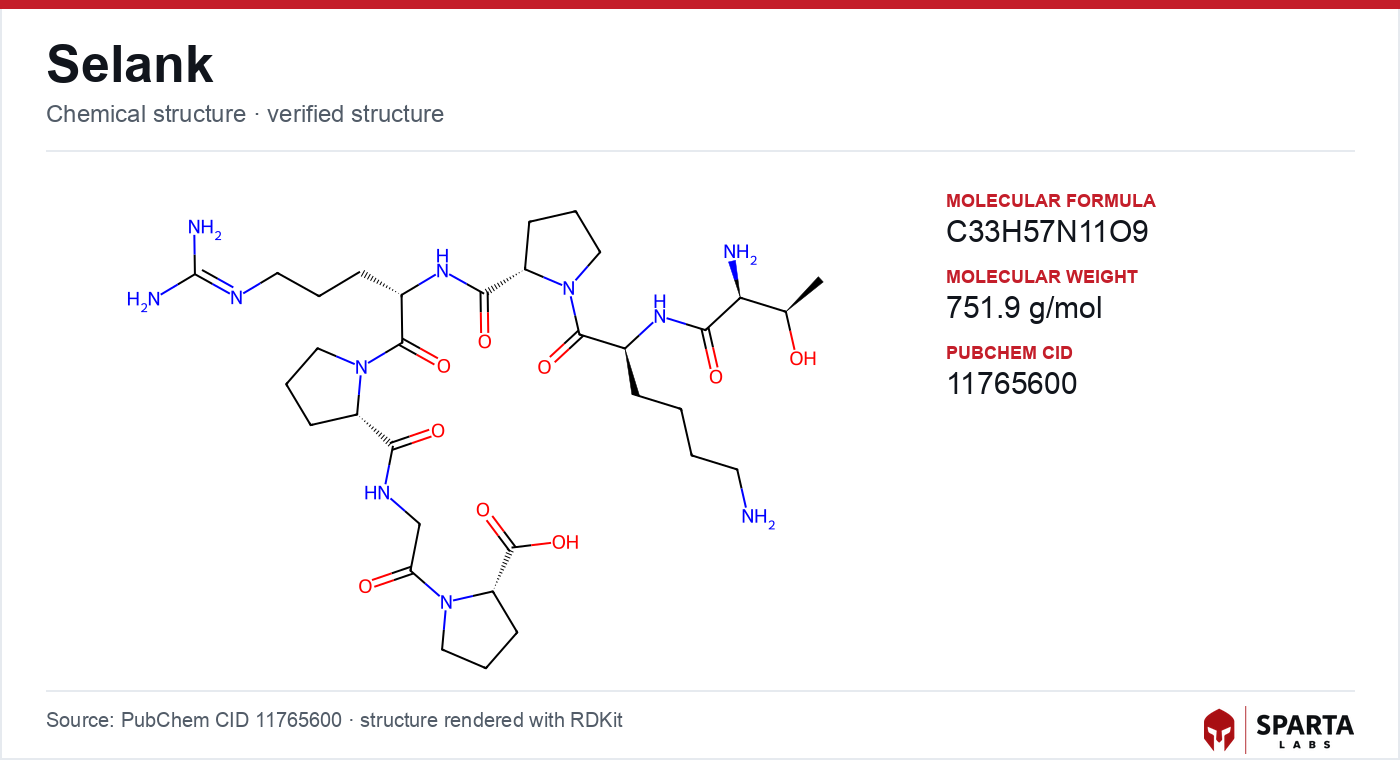
Figure: chemical structure of Selank.
The tuftsin problem, 1970 onward
The design starting point was tuftsin, a naturally occurring tetrapeptide (Thr-Lys-Pro-Arg) first isolated and characterized by Najjar and Nishioka at Tufts University in 1970 and named for their institution [1]. Tuftsin is not a manufactured molecule in origin; it is liberated by proteolytic cleavage from the Fc region of the immunoglobulin G heavy chain, and it was originally reported as a phagocytosis-stimulating peptide.
The property that made tuftsin scientifically interesting also made it pharmacologically awkward. Its half-life in plasma was reported in seconds, because the same peptidase machinery that releases it also rapidly degrades it. For any researcher hoping to study a tuftsin-related sequence acting beyond the immediate vicinity of its release, that instability was the central obstacle. The engineering question that produced Selank was, in essence: how does one keep the tuftsin recognition motif intact while giving the molecule enough metabolic lifetime to be studied as a stable compound?
The Pro-Gly-Pro engineering decision
The answer arrived at in Moscow was to leave the tuftsin tetrapeptide untouched and append a proline-rich tripeptide, Pro-Gly-Pro, to its C-terminus. This is the design choice that defines Selank as a distinct molecule, and it is worth understanding why proline specifically.
Proline is conformationally rigid and its peptide bonds are cleaved poorly by many common endopeptidases and exopeptidases. Flanking a sequence with proline residues is a well-established strategy for slowing enzymatic degradation, and reviews of the Selank program describe the Pro-Gly-Pro tail as substantially extending the heptapeptide's metabolic lifetime relative to bare tuftsin [2]. Notably, the same reviews characterize this extension not merely as an inert protective cap but as a pharmacologically active portion of the molecule in its own right, a point that later mechanistic work returned to repeatedly. Readers interested in how the resulting sequence is described at the receptor and signaling level can consult the companion Selank mechanism of action article.
The Institute of Molecular Genetics program
Selank was synthesized at the Institute of Molecular Genetics of the Russian Academy of Sciences, within the research group associated with Nikolay Myasoedov and Lyudmila Andreeva. The compound was not an isolated project. It emerged from a broader institutional effort to develop drug candidates from natural regulatory-peptide templates, and it ran in parallel with the development of Semax, a synthetic analog of the ACTH(4-10) fragment produced by the same milieu [2].
That parallel is more than a footnote. It reflects a distinctive research philosophy: rather than screening large synthetic libraries, the program took short, biologically meaningful endogenous sequences and modified them minimally to solve a stability or activity problem. Selank (a stabilized tuftsin) and Semax (a stabilized ACTH fragment) are two products of the same method. The heptapeptide was prepared by solid-phase synthesis and characterized chemically before rodent testing, and early behavioral observations in animal models were reported as distinguishing it from both tuftsin and from classical sedating anxiolytics [2].
Pre-registration literature, 1990s to 2000s
Through the 1990s, characterization of Selank accumulated primarily in Russian-language journals, which is one reason the compound was slow to enter the wider international literature. The mechanistic hypothesis that would anchor later interpretation began to take shape during this period: work in this era proposed that Selank could influence the activity of enzymes responsible for degrading endogenous enkephalins, offering a biochemical framework linking the peptide to the opioid signaling system in model systems.
Findings from research models do not establish safety or efficacy in humans. Sparta Labs makes no claims about the use of this compound.
By the early 2000s the international-language footprint began to grow, and the mechanistic and behavioral literature that had developed in Russian became more accessible to non-Russian-reading researchers. This body of preclinical work, rather than any single experiment, is what established the plausibility case that justified moving toward a controlled clinical comparison.
The 2008 clinical study and 2009 registration
The pivotal published human study was reported by Zozulia, Neznamov, and colleagues in Zhurnal Nevrologii i Psikhiatrii in 2008 [3]. It was a parallel-group comparison enrolling subjects with generalized anxiety disorder or neurasthenia, in which Selank was compared against the benzodiazepine medazepam using standardized rating instruments including the Hamilton Anxiety Rating Scale. The authors characterized the anxiolytic profile of the Selank arm as comparable to the medazepam comparator over the study period.
This study is the documentary hinge of Selank's regulatory history. Published sources place Selank's registration with the Russian Federation Ministry of Health in 2009, made available domestically as a nasal solution. That registration is what separates Selank from the large class of research peptides that never left the laboratory, and it is specific to the Russian jurisdiction. Outside Russia, Selank remains an unregistered research compound, with no publicly documented investigational new drug applications before the FDA and no EMA-regulated clinical program on record.
Post-registration molecular research, 2010s
Registration did not close the research file; if anything it prompted more granular molecular work aimed at explaining the clinical observations. Two studies published in Frontiers in Pharmacology are representative of this phase. A 2016 report examined the expression of genes involved in GABAergic neurotransmission in rat brain tissue following Selank administration, describing altered expression across several genes in the pathway [4]. A companion 2017 study applied the same question to cultured IMR-32 human neuroblastoma cells and, notably, did not reproduce the same expression changes seen in vivo [5].
The contrast between those two results is scientifically instructive and is a good example of how the Selank literature refined rather than settled its own mechanistic picture. The in vivo changes without a matching cell-culture signal were interpreted as evidence that the reported effects depend on an intact neural-circuit context rather than a direct action on isolated neurons. That circuit-dependency reading became a recurring theme in subsequent discussion of the compound.
Later directions and current status
Toward the end of the 2010s, investigation branched into pharmacologically adjacent domains. A 2019 study by Laukova and colleagues in the Bulletin of Experimental Biology and Medicine examined Selank's relationship to brain-derived neurotrophic factor content and object-recognition performance in rats subjected to chronic ethanol exposure, reporting altered neurotrophin levels in hippocampus and prefrontal cortex relative to ethanol-only controls [6]. In the same year, a review by Andreeva and Myasoedov synthesized the structural and functional pharmacology of Selank and its fragments, again foregrounding the enkephalin system as a proposed mechanistic hub and the Pro-Gly-Pro extension as an active contributor [2].
A comparable arc, from a Soviet-era institute bench to an extensively studied Russian peptide, can be seen in the history of Pinealon, a compound from the same broad research tradition. Selank itself has also spawned modified derivatives; the N-acetyl Selank amidate history article covers one such analog explored to further tune the parent sequence's properties. Researchers evaluating Selank as a laboratory material, and the analytical standards used to characterize peptide identity and purity, can consult the Selank sourcing and verification standards reference. Selank is also cataloged as a research material on its Selank product page.
References
-
Najjar VA, Nishioka K. "Tuftsin": a natural phagocytosis stimulating peptide. Nature. 1970;228(5272):672–673. Full text via DOI
-
Andreeva LA, Myasoedov NF. Physiological effects of Selank and its fragments. Biology Bulletin. 2019;46(4):390–400. Full text via DOI
-
Zozulia AA, Neznamov GG, Syunyakov TS, Kost NV, Gabaeva MV, Sokolov OIu, Sebentsova EA, Akhromeeva SA, Panchenko LF, Andriushenko AV, Teleshova ES, Shadrina MI, Slominsky PA, Miasoedov NF. Efficacy and possible mechanisms of action of a new peptide anxiolytic selank in the therapy of generalized anxiety disorders and neurasthenia. Zhurnal Nevrologii i Psikhiatrii Imeni S.S. Korsakova. 2008;108(4):38–48. PMID: 18454096. View on PubMed
-
Volkova A, Shadrina M, Kolomin T, Andreeva L, Limborska S, Myasoedov N, Slominsky P. Selank administration affects the expression of some genes involved in GABAergic neurotransmission. Frontiers in Pharmacology. 2016;7:31. Full text via DOI
-
Filatova EV, Kasian AM, Kolomin TA, Rybalkina EY, Alieva AK, Andreeva LA, Limborska SA, Myasoedov NF, Pavlova GV, Slominsky PA, Shadrina MI. GABA, Selank, and olanzapine affect the expression of genes involved in GABAergic neurotransmission in IMR-32 cells. Frontiers in Pharmacology. 2017;8:89. Full text via DOI
-
Laukova M, Alaluf LG, Serova LI, Arango V, Sabban EL. Selank, peptide analogue of tuftsin, protects against ethanol-induced memory impairment by regulating BDNF content in the hippocampus and prefrontal cortex in rats. Bulletin of Experimental Biology and Medicine. 2019;167(5):641–644. Full text via DOI
Disclaimer. Statements in this article have not been evaluated by the Food and Drug Administration. This compound is not intended to diagnose, treat, cure, or prevent any disease. Sparta Labs sells research-use-only materials. Content is provided for educational and informational purposes only and does not constitute medical advice. Consult a qualified medical professional for any health concerns.
Frequently asked questions
What peptide was Selank derived from?
Selank was engineered from tuftsin, a natural tetrapeptide (Thr-Lys-Pro-Arg) first isolated by Najjar and Nishioka at Tufts University in 1970 and cleaved from the Fc region of the immunoglobulin G heavy chain. Because tuftsin is degraded in plasma within seconds, chemists at the Institute of Molecular Genetics extended its C-terminus with a Pro-Gly-Pro tripeptide to produce the more metabolically stable heptapeptide now known as Selank.
Who developed Selank and where?
Selank originated at the Institute of Molecular Genetics of the Russian Academy of Sciences in Moscow, in the group associated with Nikolay Myasoedov and Lyudmila Andreeva. The work formed part of a regulatory-peptide research program at the same institution that also produced Semax, a synthetic ACTH(4-10) analog.
When did Selank become a registered product in Russia?
Published sources place Selank's registration with the Russian Federation Ministry of Health in 2009, following a comparative clinical study reported by Zozulia and colleagues in 2008. Outside Russia the compound holds no approval from the FDA, EMA, or comparable regulators.
Why was the Pro-Gly-Pro extension added to tuftsin?
The flanking proline residues in the Pro-Gly-Pro tail were reported to make the sequence more resistant to peptidase cleavage, giving the heptapeptide a longer metabolic lifetime than tuftsin. Reviews of Selank describe this C-terminal extension as more than a stabilizer, characterizing it as contributing to the compound's neuromodulatory profile in research models.