
Pinealon: Mechanism of Action
A mechanism-focused reference on Pinealon (Glu-Asp-Arg), examining the published hypothesis that this short peptide bioregulator enters the cell nucleus and interacts with gene-promoter DNA rather than signaling through membrane receptors.

For research use only. Not for human consumption. This article is educational reference material. It is not medical advice and is not a recommendation to use any substance.
Introduction
Pinealon is a synthetic tripeptide with the sequence Glu-Asp-Arg, commonly abbreviated EDR after the single-letter codes for its three residues. It belongs to the family of short "peptide bioregulators" investigated primarily by the St. Petersburg Institute of Bioregulation and Gerontology and associated collaborators. What makes Pinealon of distinct mechanistic interest is that the published hypothesis for how it acts does not resemble the receptor-agonist model that describes most peptide pharmacology. Instead, the reported mechanism is built on the premise that a peptide this small can enter the cell nucleus and engage genomic DNA directly. This article summarizes that hypothesis and the peer-reviewed observations offered in support of it. A parallel treatment of the broader literature is available in the Pinealon research overview.
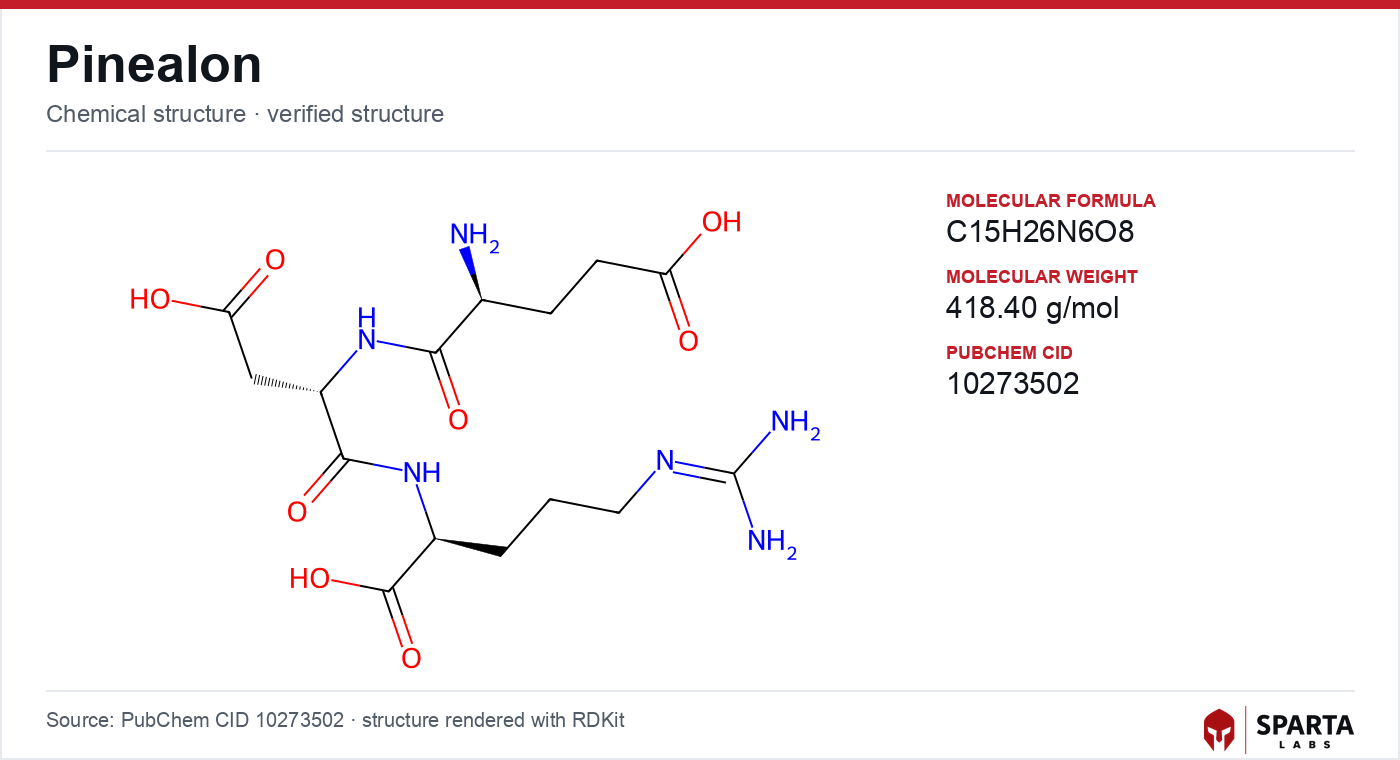
Figure: chemical structure of Pinealon (Glu-Asp-Arg).
Why Size Frames the Whole Mechanism
The mechanistic argument for Pinealon starts with a physical observation rather than a receptor. The EDR tripeptide has a molecular weight of approximately 418 daltons, which places it well below the size at which peptides generally depend on membrane transporters or receptor-mediated endocytosis to enter a cell. In the published model, a molecule this small is proposed to cross the lipid bilayer by passive diffusion. This framing is important because it removes the need to identify a canonical cell-surface receptor and instead shifts the mechanistic question to what the peptide does after it is already inside the cell.
That premise is what separates the reported EDR mechanism from the more familiar peptide-hormone paradigm, in which an extracellular ligand docks to a membrane receptor and triggers an intracellular signaling cascade. Researchers accessing the compound to examine these questions can review batch verification data on the Pinealon product page.
Evidence for Nuclear Penetration
The most direct experimental support for the intracellular premise comes from imaging work on short peptides. A 2011 study by Fedoreyeva, Kireev, Khavinson, and Vanyushin examined the intracellular fate of fluorescein-isothiocyanate-labeled analogs of several short peptides, including the EDR sequence, in HeLa cells [1]. Using fluorescence microscopy, the authors reported that the labeled EDR peptide was detectable in the cytoplasm, nucleus, and nucleolus of live cells following incubation, which they interpreted as evidence of nuclear penetration. The same study characterized in vitro binding of these peptides to synthetic deoxyribooligonucleotides and to purified DNA, and it constructed spatial docking models for peptide-DNA complexes.
Findings from research models do not establish safety or efficacy in humans. Sparta Labs makes no claims about the use of this compound.
Two features of this study anchor the rest of the mechanistic narrative. First, the localization data provide a physical basis for the idea that EDR reaches the nuclear compartment where DNA resides. Second, the in vitro binding assays move the DNA-interaction claim beyond pure computation by testing peptide association with defined nucleotide sequences in a cell-free system. Both remain foundational reference points for the model.
The DNA-Promoter Complementarity Hypothesis
The central and most novel element of the reported mechanism is the proposal that the EDR sequence recognizes specific nucleotide motifs within gene-promoter regions. Khavinson and colleagues used molecular docking to argue that the tripeptide displays complementarity to promoter sequences of several genes relevant to neuronal function and survival [2]. Genes named in this analysis included CASP3 (caspase-3), NES (nestin), GAP43, APOE, SOD2 (superoxide dismutase 2), PPARA, PPARG, and GPX1 (glutathione peroxidase 1) [2]. The interaction is framed as an analogy to antisense-style complementary pairing, in which particular amino acid residues are proposed to correspond to particular nucleotide runs in a promoter.
It is important to read this claim at the correct level of evidence. The complementarity assignments are computational predictions from docking, corroborated in part by the cell-free binding work described above. They describe a candidate mechanism for how a short peptide could exert selective transcriptional influence, and they are the reason the EDR model is discussed in epigenetic terms rather than in classical pharmacological ones.
Reported Gene Targets: Serotonin and Antioxidant Enzymes
Beyond the general docking survey, individual gene systems have been examined more closely. A study of serotonin-pathway regulation reported that docking identified a hexanucleotide motif in the promoter of TPH1, the gene encoding tryptophan hydroxylase 1 and the rate-limiting enzyme of serotonin biosynthesis, as complementary to the EDR sequence [3]. In the same line of work, aging cultures of rat-embryo brain-cortex cells exposed to the EDR peptide were reported to show serotonin immunoreactivity, which the authors interpreted as consistent with promoter-level modulation of TPH1 expression [3].
A separate strand concerns antioxidant defense. In vitro studies in cerebellar granule cells, human neutrophils, and pheochromocytoma-derived PC12 cells reported that exposure to Pinealon was associated with restriction of reactive-oxygen-species accumulation under oxidative stimuli, alongside changes in ERK 1/2 kinase activation and cell-cycle parameters [4]. The authors of the antioxidant work framed the effect as operating through endogenous enzyme systems rather than direct chemical radical scavenging, an interpretation that dovetails with the SOD2 and GPX1 promoter assignments from the docking analysis [2]. Read together, these reports describe how a single proposed DNA-directed mechanism could touch both a neurotransmitter-synthesis gene and antioxidant-enzyme genes.
In Vivo and Cellular Neuronal Findings
Several animal and primary-cell studies have been offered as functional context for the gene-regulatory model. A 2021 study using 5xFAD transgenic mice, a model of amyloid-type pathology, together with primary hippocampal cultures treated with amyloid-beta peptide, reported that the EDR tripeptide was associated with preservation of dendritic-spine measures in the treated cultures and mice relative to untreated controls [5]. In a rat model of prenatal hyperhomocysteinemia, administration of Pinealon to dams on an elevated-methionine diet was associated with differences in offspring performance on spatial-orientation tasks and with altered reactive-oxygen-species and necrotic-cell measures in offspring cerebellar neurons under in vitro oxidative challenge [6]. The investigators attributed these observations to the proposed antioxidant-enzyme upregulation rather than to direct scavenging [6].
Each of these findings is reported as an association within a specific model system, and the authors present them as directionally consistent with the CASP3, SOD2, and GPX1 promoter hypotheses rather than as proof of the DNA-binding mechanism. That distinction matters for how the evidence base is weighed.
How This Contrasts With Membrane-Receptor Peptides
The EDR mechanism reads very differently from that of other short neuropeptides in the same research lineage. Semax, an ACTH(4-10)-derived heptapeptide, is discussed in terms of neurotrophin and BDNF-associated signaling that begins at the cell surface. Pinealon is instead framed around nuclear entry and direct promoter engagement. Among the peptide bioregulators, the closest conceptual relative is Epithalon, another short Khavinson-group peptide for which a comparable DNA-interaction and gene-regulatory hypothesis has been proposed; the two are frequently discussed in parallel, and the reported Epithalon mechanism offers a useful structural comparison of the same experimental logic applied to a different sequence.
Limits of the Current Model
The DNA-promoter-complementarity framework is best characterized as a coherent hypothesis supported by imaging, cell-free binding, and docking data, rather than as a mechanism confirmed at the level of the intact genome. Genome-wide transcriptomic methods such as RNA sequencing and chromatin-immunoprecipitation studies, which would directly test whether EDR alters transcription of the predicted target genes in living neurons, are described in the literature as work still to be done. Human pharmacokinetic data, including plasma half-life and tissue distribution, are likewise absent from the mechanistic picture. The complete bibliographic basis for the observations summarized here is compiled in the Pinealon published research article.
References
-
Fedoreyeva LI, Kireev II, Khavinson VKh, Vanyushin BF. Penetration of short fluorescence-labeled peptides into the nucleus in HeLa cells and in vitro specific interaction of the peptides with deoxyribooligonucleotides and DNA. Biochemistry (Moscow). 2011;76(11):1210–1219. doi:10.1134/S0006297911110022. PMID: 22117548.
-
Khavinson V, Linkova N, Kozhevnikova E, Trofimova S. EDR Peptide: Possible Mechanism of Gene Expression and Protein Synthesis Regulation Involved in the Pathogenesis of Alzheimer's Disease. Molecules. 2021;26(1):159. doi:10.3390/molecules26010159. PMID: 33396470.
-
Khavinson VKh, Lin'kova NS, Tarnovskaya SI, Umnov RS, Elashkina EV, Durnova AO. Short peptides stimulate serotonin expression in cells of brain cortex. Bulletin of Experimental Biology and Medicine. 2014;157(1):77–80. doi:10.1007/s10517-014-2496-y. PMID: 24913561.
-
Khavinson V, Ribakova Y, Kulebiakin K, Vladychenskaya E, Kozina L, Arutjunyan A, Boldyrev A. Pinealon increases cell viability by suppression of free radical levels and activating proliferative processes. Rejuvenation Research. 2011;14(5):535–541. doi:10.1089/rej.2011.1172. PMID: 21978083.
-
Khavinson V, Ilina A, Kraskovskaya N, Linkova N, Kolchina N, Mironova E, Erofeev A, Petukhov M. Neuroprotective Effects of Tripeptides — Epigenetic Regulators in the Mouse Model of Alzheimer's Disease. Pharmaceuticals (Basel). 2021;14(6):515. doi:10.3390/ph14060515. PMID: 34071923.
-
Arutjunyan A, Kozina L, Stvolinskiy S, Bulygina Y, Mashkina A, Khavinson V. Pinealon protects the rat offspring from prenatal hyperhomocysteinemia. International Journal of Clinical and Experimental Medicine. 2012;5(2):179–185. PMID: 22567179. PMCID: PMC3342713.
Disclaimer. Statements in this article have not been evaluated by the Food and Drug Administration. This compound is not intended to diagnose, treat, cure, or prevent any disease. Sparta Labs sells research-use-only materials. Content is provided for educational and informational purposes only and does not constitute medical advice. Consult a qualified medical professional for any health concerns.
Frequently asked questions
How is Pinealon reported to act at the molecular level?
Published work from the Khavinson group proposes that the Glu-Asp-Arg (EDR) tripeptide is small enough to cross the cell membrane by diffusion and enter the nucleus. Once there, molecular-docking studies describe complementarity between the peptide and specific DNA promoter motifs, positioning it as a gene-regulatory hypothesis rather than a classical receptor-agonist model.
Does Pinealon bind a cell-surface receptor?
The reported mechanism does not center on a defined membrane receptor. Fluorescence-microscopy studies in HeLa cells detected labeled EDR peptide in the cytoplasm, nucleus, and nucleolus, and the proposed downstream interaction is direct engagement with genomic DNA rather than receptor-mediated signal transduction.
What is the significance of the EDR sequence being only three amino acids?
At roughly 418 daltons, the EDR tripeptide is far below the size threshold that typically requires transporters or endocytosis for cellular uptake. This small size underlies the published hypothesis of passive diffusion across the lipid bilayer and subsequent nuclear penetration, which is central to its proposed DNA-directed mechanism.
How does the reported Pinealon mechanism differ from that of Semax?
Semax is an ACTH(4-10)-derived heptapeptide whose reported activity involves neurotrophin and BDNF-associated signaling initiated at the cell surface. Pinealon (EDR) is instead described in terms of nuclear entry and direct DNA-promoter interaction. Both emerged from the Russian short-peptide research tradition but represent distinct proposed mechanistic classes.
Is the DNA-binding model for Pinealon established?
No. The DNA-promoter-complementarity model derives largely from molecular docking and in vitro binding assays. Investigators in the field have described genome-wide transcriptomic and chromatin-level confirmation as open work, so the mechanism should be read as a well-documented hypothesis under active investigation.