
Pinealon: Sourcing, Purity, and Verification Standards
A sourcing and quality reference for the tripeptide Pinealon (Glu-Asp-Arg): why an acidic, arginine-terminal sequence shapes its synthesis, purification, analytical verification, and cold-storage stability. Educational reference.
For research use only. Not for human consumption. This article is educational reference material. It is not medical advice and is not a recommendation to use any substance.
Introduction
Pinealon is a synthetic tripeptide with the sequence glutamyl-aspartyl-arginine (Glu-Asp-Arg), commonly abbreviated EDR from the single-letter amino acid code. It belongs to the family of short regulatory peptides investigated by Russian gerontology groups, a lineage it shares with longer members such as Epithalon (Ala-Glu-Asp-Gly). This article describes how Sparta Labs sources, synthesizes, and verifies Pinealon for laboratory research, with the sourcing discussion built around the specific chemistry of a short, acidic, arginine-terminal sequence rather than generic peptide-quality boilerplate. For the broader scientific context of the compound, the Pinealon research overview and discovery and research history provide background on its classification and study record.
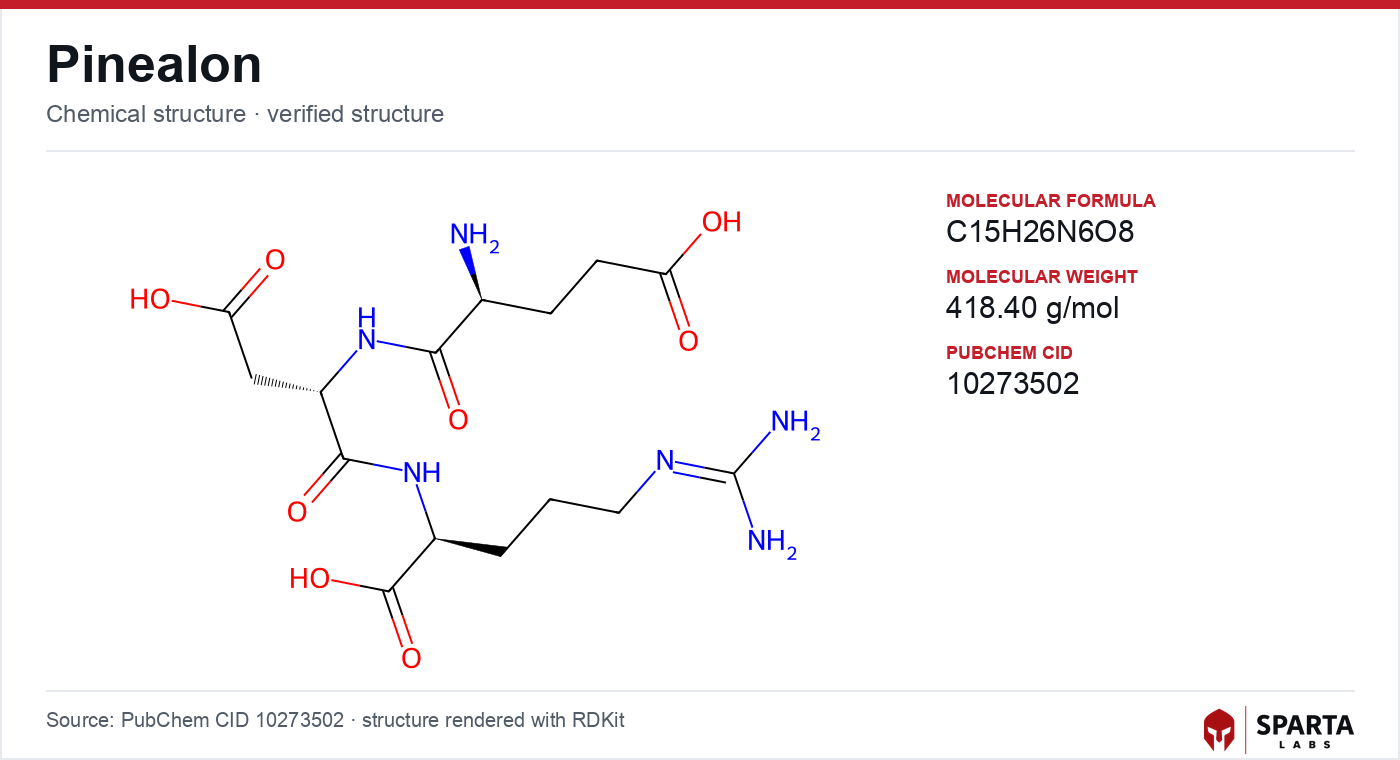
Figure: chemical structure of Pinealon (Glu-Asp-Arg).
What the Sequence Dictates About Synthesis
The composition of Pinealon determines the appropriate manufacturing route. Two of its three residues, glutamic acid and aspartic acid, carry carboxylic acid side chains, and the third, arginine, carries a strongly basic guanidinium side chain. A tripeptide of this length is well suited to solid-phase peptide synthesis (SPPS), the stepwise resin-supported method introduced by Robert Merrifield and recognized with the 1984 Nobel Prize in Chemistry [1]. SPPS assembles the chain one protected residue at a time on an insoluble support, then releases the completed peptide under controlled acidic conditions.
Chain length matters for byproduct control. Deletion and truncation sequences, the most common SPPS impurities, accumulate with each coupling step, so a three-residue target such as Pinealon is intrinsically less prone to these errors than a long polypeptide [2]. The acidic side chains of glutamate and aspartate require orthogonal protecting groups during synthesis to prevent branching or aspartimide formation at the Asp residue, a well-characterized side reaction for aspartyl-containing sequences that manufacturing controls are designed to suppress [2]. Because the sequence is short and chemically tractable, recombinant expression, which is reserved for larger or more complex proteins, is not used. After cleavage from the resin, the crude peptide is purified by preparative high-performance liquid chromatography (HPLC) and lyophilized to a dry powder.
Counterion and Residual-Solvent Considerations
The cleavage and purification chemistry leaves chemical fingerprints that quality control must address, and these are sequence-specific for Pinealon. The basic guanidinium group of the C-terminal arginine readily forms salts with acidic counterions. When trifluoroacetic acid (TFA) is used in cleavage and reversed-phase HPLC, the isolated peptide is typically obtained as a TFA salt unless a counterion-exchange step converts it to an acetate or hydrochloride form. Residual TFA is analytically relevant because it can influence apparent mass, water content, and behavior in downstream assays. Regulatory guidance on synthetic peptides addresses counterion identity, residual organic solvents, and related process impurities as defined quality attributes [3].
For this reason, characterization of Pinealon extends beyond a single chromatographic purity figure. Sparta Labs documents the counterion form and applies residual-solvent controls consistent with published guidance for synthetic peptides [3]. These same principles govern the related short peptides in this cluster; the corresponding standards are described for Epithalon sourcing and quality.
Identity and Purity Verification
Purity for research peptides is quantified by analytical HPLC, which separates species by their interaction with a stationary phase and reports relative abundance from UV absorbance at 214 to 220 nm, the region where the peptide bond absorbs. The commonly cited minimum for research-grade peptides is HPLC purity at or above 98 percent. Sparta Labs applies an internal standard of at least 99 percent HPLC purity for Pinealon.
Chromatographic purity alone does not confirm that the correct molecule is present. Mass spectrometry establishes that the main HPLC peak carries the expected molecular weight. Pinealon corresponds to the molecular formula C15H26N6O8 with a monoisotopic and average mass near 418.4 Da; a species eluting at high purity but presenting an incorrect mass would signal a sequence error, a modification, or a mismatched counterion adduct. Sparta Labs confirms mass-spectrometric identity for every Pinealon batch, pairing the purity chromatogram with a mass spectrum so that identity and purity are documented together rather than inferred from a single measurement.
Endotoxin Testing for Cell-Culture Use
Endotoxin control is particularly relevant for a small neuropeptide that may be introduced into cell-culture systems. Endotoxins are lipopolysaccharides shed from Gram-negative bacteria; they can enter a peptide during processing and can confound cell-based experiments even at low concentrations. The bacterial endotoxins test, as codified in compendial standards, uses the limulus amebocyte lysate reaction to quantify endotoxin burden in endotoxin units per milligram [4]. Where the intended research context involves cultured cells, Sparta Labs includes endotoxin assessment in the verification panel for Pinealon so that this variable is characterized rather than assumed.
Certificates of Analysis and Batch Traceability
A Sparta Labs Certificate of Analysis (COA) for Pinealon records the batch number, manufacturing date, expiry date, HPLC purity result with chromatogram, mass-spectrometric molecular weight with spectrum, counterion form, and, where applicable, endotoxin result. The stated molecular formula and expected molecular weight are printed for cross-reference against the measured mass.
COAs are published per batch and linked directly from the product listing. When a new batch enters inventory, its COA is released at the same time, and archived COAs for prior batches can be requested for inclusion in laboratory records or publication supplementary material. Batch-level traceability means that a documented finding can be associated with a specific verified lot, which supports the documentation expectations of reproducible research. Research-grade Pinealon from Sparta Labs is listed with a batch-specific COA linked from the product page.
Degradation Pathways and Cold-Chain Storage
The residue composition of Pinealon also shapes its stability profile. Peptides containing acidic residues and arginine are subject to defined chemical degradation routes, principally deamidation, hydrolysis, and oxidation, which are accelerated by moisture, elevated temperature, and light. The standard reference literature on peptide and protein pharmaceutical stability catalogs these pathways and the storage variables that govern them [5]. Lyophilized, desiccated material minimizes the water activity that drives hydrolytic and deamidation reactions, which is why short synthetic peptides are supplied and stored as dry powders.
Lyophilized Pinealon is stored frozen, protected from light, in a desiccated environment. Formal stability testing for peptide materials follows established international guidance, which defines how storage conditions and time points establish an expiry date [6]. Sparta Labs assigns an expiry date on each COA on this basis. Reconstituted solutions are inherently less stable than the dry powder, and repeated freeze-thaw cycling is a recognized degradation stress; investigators generally aliquot reconstituted peptide to limit freeze-thaw exposure, though preparation of solutions falls outside the scope of this sourcing reference.
Why Sourcing Discipline Matters for This Compound
The published Pinealon literature is anchored to a defined tripeptide sequence and to material characterized at specific purity levels in the original studies. Reproducibility across laboratories depends on working from material whose identity, purity, counterion, and endotoxin status are documented, because uncharacterized impurities or an unstated salt form introduce variables that complicate comparison with prior work. The same sourcing logic applies across the related Russian short-peptide cluster; the analytical standards for Selank sourcing and quality follow the same identity-plus-purity-plus-stability framework described here.
Sparta Labs publishes a Certificate of Analysis with every batch, applies an internal HPLC standard of at least 99 percent, confirms mass-spectrometric identity, documents the counterion form, and includes endotoxin assessment where the research context warrants it. Verified, well-characterized material is the foundation that lets a Pinealon experiment be compared cleanly against the published record.
References
-
Merrifield RB. Solid phase peptide synthesis. I. The synthesis of a tetrapeptide. Journal of the American Chemical Society. 1963;85(14):2149–2154. doi: 10.1021/ja00897a025. Source: pubs.acs.org
-
Andersson L, Blomberg L, Flegel M, Lepsa L, Nilsson B, Verlander M. Large-scale synthesis of peptides. Biopolymers. 2000;55(3):227–250. doi: 10.1002/1097-0282(2000)55:3<227::AID-BIP40>3.0.CO;2-7. PMID: 11255828. View on PubMed
-
European Medicines Agency. Guideline on Development and Manufacture of Synthetic Peptides. EMA/CHMP/BWP/638271/2023. 2023. Source: ema.europa.eu
-
United States Pharmacopeia. General Chapter <85> Bacterial Endotoxins Test. United States Pharmacopeia and National Formulary (USP-NF). Rockville, MD: United States Pharmacopeial Convention.
-
Manning MC, Chou DK, Murphy BM, Payne RW, Katayama DS. Stability of protein pharmaceuticals: an update. Pharmaceutical Research. 2010;27(4):544–575. doi: 10.1007/s11095-009-0045-6. PMID: 20143256. View on PubMed
-
International Council for Harmonisation. ICH Q1A(R2): Stability Testing of New Drug Substances and Products. 2003. Source: ich.org
Disclaimer. Statements in this article have not been evaluated by the Food and Drug Administration. This compound is not intended to diagnose, treat, cure, or prevent any disease. Sparta Labs sells research-use-only materials. Content is provided for educational and informational purposes only and does not constitute medical advice. Consult a qualified medical professional for any health concerns.
Frequently asked questions
What amino acid sequence defines Pinealon, and how does it affect synthesis?
Pinealon is the tripeptide glutamyl-aspartyl-arginine (Glu-Asp-Arg, abbreviated EDR). Its two acidic residues and one basic arginine residue make it well suited to solid-phase peptide synthesis, the stepwise resin-supported method introduced by Robert Merrifield. Because the chain is only three residues long, it is intrinsically less prone to the deletion and truncation byproducts that accumulate in longer sequences.
Why is the counterion form documented for Pinealon?
The C-terminal arginine of Pinealon carries a basic guanidinium group that forms salts with acidic counterions. When trifluoroacetic acid is used in cleavage and purification, the peptide is typically isolated as a TFA salt unless it is exchanged to another form. Because the counterion can affect apparent mass, water content, and assay behavior, the salt form is recorded as a defined quality attribute alongside purity and identity.
How does Sparta Labs confirm the identity and purity of Pinealon?
Purity is measured by analytical HPLC with UV detection at 214 to 220 nm, and Sparta Labs applies an internal standard of at least 99 percent. Identity is confirmed by mass spectrometry against the expected molecular formula C15H26N6O8 and molecular weight near 418.4 Da. Pairing the chromatogram with a mass spectrum documents identity and purity together rather than inferring both from a single measurement.
Why is endotoxin testing relevant for Pinealon?
Endotoxins are lipopolysaccharides shed from Gram-negative bacteria that can enter a peptide during processing and confound cell-based experiments even at low levels. For a small neuropeptide that may be introduced into cultured cells, endotoxin burden is quantified using the compendial bacterial endotoxins test. Sparta Labs includes endotoxin assessment in the verification panel where the intended research context involves cell culture.
What degradation pathways influence how Pinealon is stored?
Peptides containing acidic residues and arginine are subject to deamidation, hydrolysis, and oxidation, which are accelerated by moisture, heat, and light. Supplying and storing Pinealon as a lyophilized, desiccated powder minimizes the water activity that drives these reactions. Stability testing follows established international guidance, and an expiry date is assigned on each Certificate of Analysis on that basis.