
GHRP-2 Mechanism of Action
A mechanism-focused reference on GHRP-2 (pralmorelin): its D-amino-acid hexapeptide design, agonism at the GHS-R1a ghrelin receptor, the Gq/11-phospholipase C calcium cascade in pituitary somatotrophs, and its documented synergy with GHRH. Educational reference.
For research use only. Not for human consumption. This article is educational reference material. It is not medical advice and is not a recommendation to use any substance.
Introduction
GHRP-2, also known by the developmental name pralmorelin (and the code KP-102), is a synthetic hexapeptide belonging to the growth hormone-releasing peptide (GHRP) family. In the published literature it is classified as a growth hormone secretagogue (GHS) that acts as an agonist at the growth hormone secretagogue receptor type 1a (GHS-R1a), the receptor later identified as the target of the endogenous hormone ghrelin. This article summarizes the reported molecular mechanism of GHRP-2, working outward from its peptide chemistry to receptor coupling, the intracellular signaling cascade in pituitary somatotrophs, and the ancillary pharmacology documented across preclinical and human studies. It is written in a neutral, citation-first register; each mechanistic statement is attributed to primary literature, and the article makes no claims about safety or efficacy in humans.
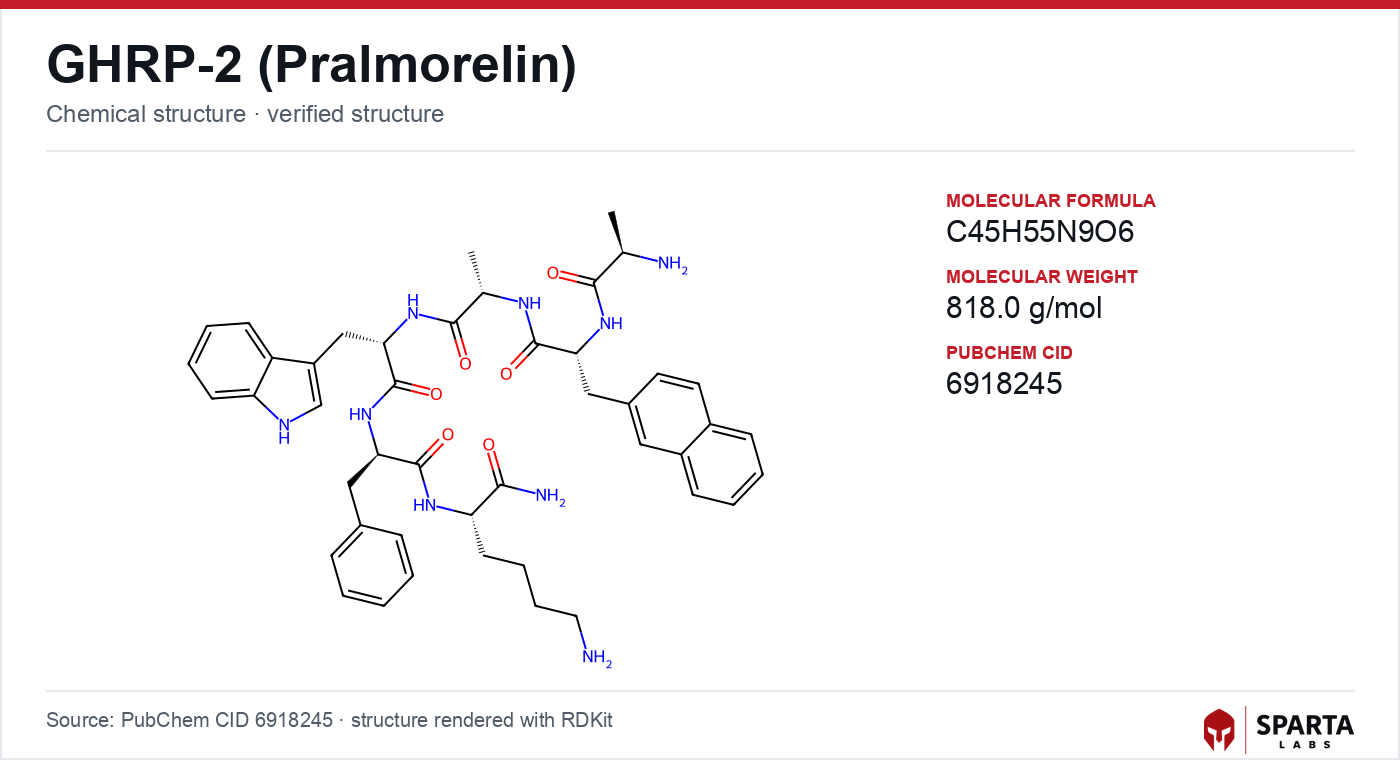
Figure: chemical structure of GHRP-2.
Peptide Chemistry and Structural Design
GHRP-2 is a hexapeptide with the sequence D-alanyl-D-2-naphthylalanyl-alanyl-tryptophyl-D-phenylalanyl-lysinamide (D-Ala-D-2-Nal-Ala-Trp-D-Phe-Lys-NH2), carrying a C-terminal amide. Two features of this sequence are central to understanding its mechanism. First, it incorporates residues in the non-natural D-configuration and a modified aromatic side chain (2-naphthylalanine) that do not appear in the endogenous ligand ghrelin. Second, it is a small, fully synthetic peptide rather than a modification of a native hormone.
This design places GHRP-2 within the medicinal-chemistry lineage that Bowers and colleagues developed from enkephalin-derived growth hormone-releasing peptides, a program that produced a series of increasingly potent secretagogues built on unnatural amino acids to resist enzymatic degradation and optimize receptor engagement [5]. The structural contrast with ghrelin is notable: ghrelin achieves receptor activation through an octanoyl (C8 fatty-acyl) modification on its serine-3 residue, whereas GHRP-2 and the other synthetic GHRPs reach the same receptor through an entirely different chemical scaffold [2]. Sibling compounds in this class, including hexarelin and GHRP-6, share the same core recognition strategy while differing in individual residues.
The GHS-R1a Receptor Target
Deorphanization of the Receptor
The molecular target through which GHRP-2 acts was characterized in 1996, when Howard and colleagues cloned a novel orphan G protein-coupled receptor (GPCR) from human and swine pituitary and hypothalamic tissue and demonstrated that it mediated the growth-hormone-releasing activity of synthetic secretagogues [1]. This receptor, designated GHS-R1a, is a seven-transmembrane-domain GPCR that the authors reported to couple to the Gq/11 family of G proteins and to activate phospholipase C upon agonist binding [1]. The identification of GHS-R1a provided the mechanistic framework within which GHRP-2's pharmacology has been interpreted since.
Findings from research models do not establish safety or efficacy in humans. Sparta Labs makes no claims about the use of this compound.
Identification of the Endogenous Ligand
Because GHS-R1a was an orphan receptor at the time of its cloning, its physiological ligand was unknown. In 1999, Kojima and colleagues isolated ghrelin from rat stomach, a 28-amino-acid peptide bearing an unusual octanoyl modification, and demonstrated that it was the endogenous agonist for GHS-R1a [2]. This discovery reframed the entire GHRP class: synthetic compounds such as GHRP-2 had been acting as pharmacological mimics of a gut-derived hormonal system with roles in growth hormone regulation and energy balance. The GHRP-2 story is therefore inseparable from the broader biology of the ghrelin axis, a context developed further in the GHRP-2 research overview.
Receptor Distribution and Constitutive Activity
GHS-R1a is expressed at high density on somatotroph cells of the anterior pituitary and on neurons of the hypothalamic arcuate nucleus, the two sites most relevant to growth-hormone secretory control. Beyond agonist-driven signaling, Holst and colleagues reported in 2003 that GHS-R1a displays a high level of ligand-independent (constitutive) activity, signaling to a substantial degree even in the absence of an agonist [6]. This intrinsic activity is a distinguishing pharmacological property of the receptor and is relevant to how agonists such as GHRP-2 and inverse agonists are interpreted in receptor-pharmacology studies.
The Intracellular Signaling Cascade
The primary transduction pathway coupling GHRP-2 binding to growth hormone release is the Gq/11-phospholipase C cascade characterized for GHS-R1a [1]. On agonist binding, GHS-R1a activates Gq/11 proteins, which stimulate phospholipase C beta. Phospholipase C hydrolyzes membrane phosphatidylinositol 4,5-bisphosphate (PIP2) into two second messengers: inositol 1,4,5-trisphosphate (IP3) and diacylglycerol (DAG).
IP3 binds receptors on the endoplasmic reticulum, releasing calcium from intracellular stores and producing a transient rise in cytosolic calcium within the somatotroph. This calcium signal is the reported proximal trigger for exocytosis of growth-hormone-containing secretory granules [1]. Diacylglycerol, the second product, activates protein kinase C, contributing an additional arm to the somatotroph response. The selective secretagogue ipamorelin, which shares GHS-R1a as its target, illustrates how compounds engaging the same receptor and cascade can differ in their broader pituitary-hormone profile.
Interaction with GHRH and Somatostatin
GHRP-2 does not act on the growth hormone axis in isolation; its documented pharmacology reflects an interplay with the two classical hypothalamic regulators of growth hormone, GHRH (stimulatory) and somatostatin (inhibitory).
Arvat and colleagues reported in a 1997 human study that the growth hormone response elicited by GHRP-2 exceeded that produced by a maximal dose of GHRH administered alone, and that combining the two produced a supra-additive response [4]. The authors interpreted this synergy as evidence that GHS-R1a and the GHRH receptor interact at multiple levels of the hypothalamic-pituitary axis, and that intact GHRH signaling contributes to the full growth-hormone-releasing profile of GHRPs [4]. This synergistic relationship is one of the most pharmacologically distinctive features of the GHRP class and has shaped how growth-hormone-axis research is designed. Research also indicates that GHRPs can attenuate the inhibitory tone of somatostatin at the pituitary, functionally amplifying secretory output, a property discussed across the GHRP literature [4].
Signaling Beyond Growth Hormone
Because GHS-R1a is expressed in tissue beyond the somatotroph lineage, GHRP-2 has documented effects on other pituitary hormones and on central circuits.
In the same 1997 human comparison, Arvat and colleagues reported that GHRP-2 administration also stimulated prolactin, ACTH, and cortisol secretion in healthy volunteers [4]. The prolactin response was lower than that produced by TRH, while the ACTH and cortisol responses were comparable to those produced by human corticotropin-releasing hormone [4]. The authors attributed these effects to GHS-R1a expression in corticotroph cells and hypothalamic regions relevant to the hypothalamic-pituitary-adrenal axis.
A distinct line of research addresses the ghrelin-like, feeding-related pharmacology of GHRP-2. Laferrère and colleagues reported in 2005, in The Journal of Clinical Endocrinology & Metabolism, that intravenous GHRP-2 infusion in lean healthy male volunteers was associated with an increase in measured food intake relative to saline infusion, consistent with the known orexigenic profile of ghrelin acting through GHS-R1a [7]. The authors characterized GHRP-2 as a tool for investigating ghrelin-mediated appetite signaling in humans. Broader reviews of the class, such as Berlanga-Acosta and colleagues' 2017 historical appraisal, situate these GH-dependent and GH-independent observations within the wider synthetic-GHRP literature [8]. A fuller catalogue of individual studies is compiled in the GHRP-2 published research summary.
Limits of Current Understanding
Several aspects of GHRP-2's mechanism remain incompletely resolved and are worth flagging for researchers.
High-resolution structural data on GHS-R1a in complex with GHRP-2 specifically remain limited. As cryo-electron microscopy of peptide-bound GPCRs advances, such structures would clarify the molecular determinants that distinguish GHRP-2's binding pose from that of ghrelin and from other synthetic secretagogues that share the receptor.
The relative contribution of direct pituitary action versus hypothalamic amplification to GHRP-2's growth-hormone-releasing activity in humans is not fully quantified; the documented synergy with GHRH indicates that both compartments are engaged [4]. Likewise, the GH-independent effects reported for the broader GHRP class continue to be investigated, with the mechanistic dependence on GHS-R1a versus alternative targets remaining an active line of inquiry [8]. Researchers seeking material with batch-specific documentation can review GHRP-2 offered by Sparta Labs, supplied for research use with a Certificate of Analysis.
References
-
Howard AD, Feighner SD, Cully DF, Arena JP, Liberator PA, Rosenblum CI, et al. A receptor in pituitary and hypothalamus that functions in growth hormone release. Science. 1996;273(5277):974–977. PMID: 8688086. DOI: 10.1126/science.273.5277.974
-
Kojima M, Hosoda H, Date Y, Nakazato M, Matsuo H, Kangawa K. Ghrelin is a growth-hormone-releasing acylated peptide from stomach. Nature. 1999;402(6762):656–660. PMID: 10604470. DOI: 10.1038/45230
-
Arvat E, Di Vito L, Maccario M, Broglio F, Boghen MF, Deghenghi R, et al. Effects of GHRP-2 and hexarelin, two synthetic GH-releasing peptides, on GH, prolactin, ACTH and cortisol levels in man. Comparison with the effects of GHRH, TRH and hCRH. Peptides. 1997;18(6):885–891. PMID: 9285939. DOI: 10.1016/s0196-9781(97)00016-8
-
Bowers CY, Momany FA, Reynolds GA, Hong A. On the in vitro and in vivo activity of a new synthetic hexapeptide that acts on the pituitary to specifically release growth hormone. Endocrinology. 1984;114(5):1537–1545. PMID: 6714155. DOI: 10.1210/endo-114-5-1537
-
Holst B, Cygankiewicz A, Jensen TH, Ankersen M, Schwartz TW. High constitutive signaling of the ghrelin receptor—identification of a potent inverse agonist. Mol Endocrinol. 2003;17(11):2201–2210. PMID: 12907757. DOI: 10.1210/me.2003-0069
-
Laferrère B, Abraham C, Russell CD, Bowers CY. Growth hormone releasing peptide-2 (GHRP-2), like ghrelin, increases food intake in healthy men. J Clin Endocrinol Metab. 2005;90(2):611–614. PMID: 15699539. DOI: 10.1210/jc.2004-1585
-
Berlanga-Acosta J, Abreu-Cruz A, García-del Barco Herrera D, Mendoza-Marí Y, Rodríguez-Ulloa A, García-Ojalvo A, et al. Synthetic growth hormone-releasing peptides (GHRPs): a historical appraisal of the evidences supporting their cytoprotective effects. Clin Med Insights Endocrinol Diabetes. 2017;10:1179546817694558. PMID: 28469490. DOI: 10.1177/1179546817694558
Disclaimer. Statements in this article have not been evaluated by the Food and Drug Administration. This compound is not intended to diagnose, treat, cure, or prevent any disease. Sparta Labs sells research-use-only materials. Content is provided for educational and informational purposes only and does not constitute medical advice. Consult a qualified medical professional for any health concerns.
Frequently asked questions
What receptor does GHRP-2 activate, and how was it identified?
GHRP-2 (pralmorelin) is an agonist at the growth hormone secretagogue receptor type 1a (GHS-R1a). This receptor was cloned in 1996 by Howard and colleagues as an orphan G protein-coupled receptor from pituitary and hypothalamic tissue. In 1999 Kojima and colleagues identified ghrelin, an acylated stomach peptide, as its endogenous ligand, establishing that synthetic GHRPs act as pharmacological mimics of the ghrelin system.
How does GHRP-2 trigger growth hormone release at the molecular level?
Published pharmacology describes GHRP-2 binding to GHS-R1a, which couples to Gq/11 proteins and activates phospholipase C. This generates inositol trisphosphate and diacylglycerol, mobilizing intracellular calcium in anterior-pituitary somatotrophs. The rise in cytosolic calcium is the reported trigger for exocytosis of growth-hormone-containing secretory granules.
Why does the GHRP-2 sequence contain D-amino acids?
GHRP-2 (D-Ala-D-2-Nal-Ala-Trp-D-Phe-Lys-NH2) is a synthetic hexapeptide that incorporates non-natural D-configuration and modified aromatic residues. These substitutions distinguish it structurally from ghrelin, which relies on an octanoyl acyl modification. The design reflects the medicinal-chemistry lineage of the GHRP class characterized by Bowers and colleagues.
What is the reported relationship between GHRP-2 and GHRH?
Arvat and colleagues reported in 1997 that growth hormone responses to GHRP-2 in healthy volunteers exceeded those to GHRH alone, describing the combination as supra-additive. Research indicates that the GHS-R1a and GHRH-receptor systems interact at the pituitary and hypothalamic levels, and that intact GHRH signaling contributes to the full GH-releasing profile of GHRPs.
Does GHRP-2 act only on growth hormone pathways?
No. Arvat and colleagues (1997) reported that GHRP-2 also stimulated prolactin, ACTH, and cortisol secretion in human volunteers, attributed to GHS-R1a expression beyond somatotrophs. Separately, Laferrère and colleagues (2005) reported a ghrelin-like orexigenic profile, consistent with GHS-R1a expression in hypothalamic feeding circuits.