
GHRP-2: Sourcing, Purity, and Verification Standards
A sourcing reference for GHRP-2 (pralmorelin): its unnatural D-amino-acid sequence, why chirality and 2-naphthylalanine complicate synthesis, and the analytical methods used to confirm identity and purity. Educational reference.
For research use only. Not for human consumption. This article is educational reference material. It is not medical advice and is not a recommendation to use any substance.
Why GHRP-2 Is an Unusual Peptide to Manufacture
GHRP-2 (pralmorelin) is a synthetic hexapeptide of the growth-hormone secretagogue class, and its sequence is what makes its sourcing and verification a distinctive analytical problem rather than a routine one. Researchers seeking pharmacological background before this manufacturing discussion may consult the GHRP-2 research overview and the GHRP-2 mechanism of action article. The compound's full sequence is D-Ala-D-2Nal-Ala-Trp-D-Phe-Lys-NH2. Three features of that short chain drive nearly everything downstream in synthesis and quality control: it contains three unnatural building blocks (two residues in the D configuration plus a 2-naphthylalanine), it carries a C-terminal amide rather than a free acid, and it contains a tryptophan residue with well-documented chemical liabilities.
Each of these features is a design choice that improved the molecule's resistance to enzymatic degradation, but each also raises the difficulty of making and verifying the material to a defined specification. Quality in a research compound is a methodological variable, not a marketing attribute: when the identity, stereochemistry, or purity of the starting material is uncertain, so is any observation derived from it.
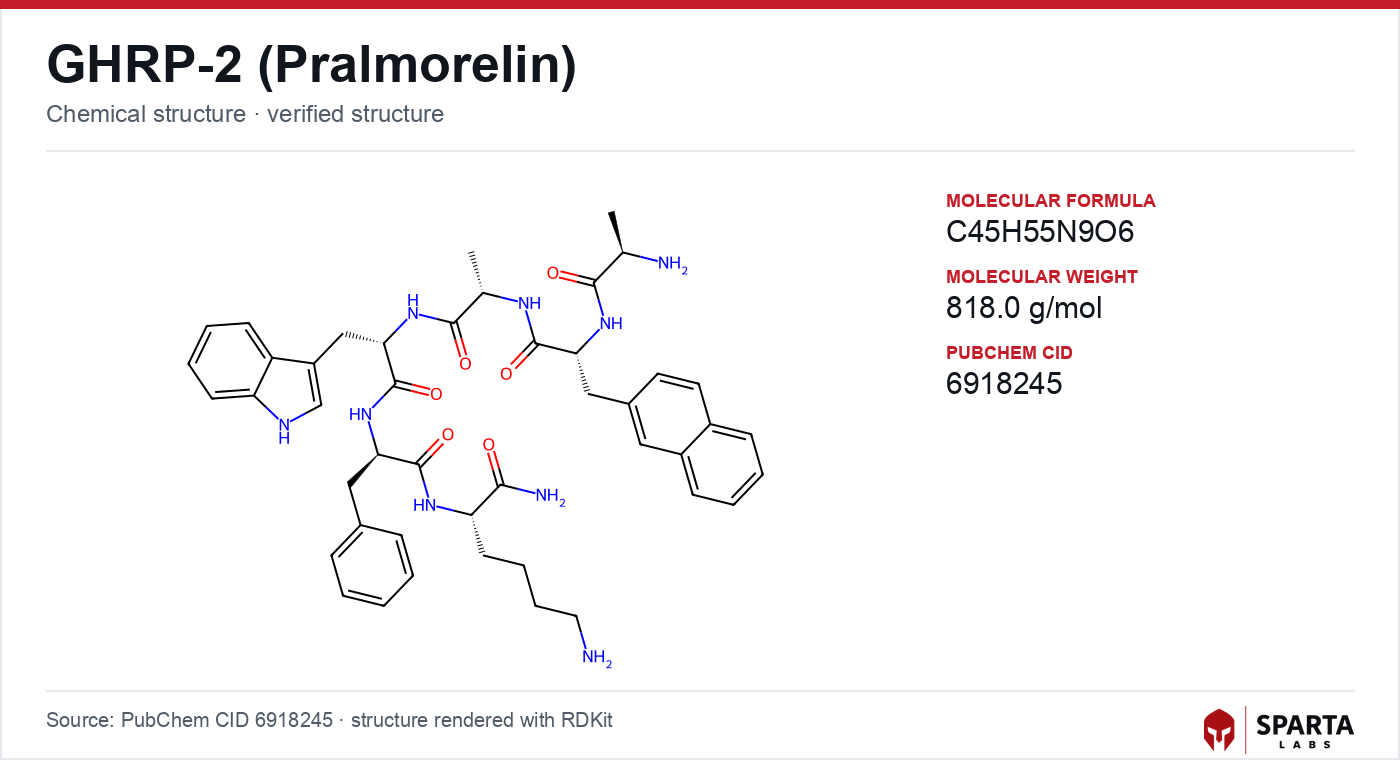
Figure: chemical structure of GHRP-2 (pralmorelin).
Solid-Phase Assembly of an Unnatural Sequence
Like most research- and clinical-grade peptides in this size range, GHRP-2 is assembled by solid-phase peptide synthesis (SPPS), the approach introduced by R. Bruce Merrifield in 1963 and recognized with the 1984 Nobel Prize in Chemistry [1]. In SPPS the chain is built one residue at a time on an insoluble resin support: each amino acid is coupled, the temporary protecting group is removed, and the cycle repeats until the sequence is complete, after which the peptide is cleaved from the resin and its side-chain protecting groups are stripped [2].
For GHRP-2 the resin and the final cleavage chemistry are also what install the C-terminal primary amide. An amide C-terminus is generated by choosing an amide-forming resin (a Rink-amide-type support) so that cleavage releases a -CONH2 terminus rather than a free carboxylic acid. That single structural detail is not cosmetic; the amide and the free acid are distinct chemical species with different masses and different chromatographic behavior, so confirming that the product terminates in an amide is part of confirming that it is GHRP-2 at all.
The two D-configured residues and the 2-naphthylalanine require enantiomerically pure, appropriately protected building blocks. These non-standard derivatives are more expensive and, in the case of the bulky naphthylalanine side chain, can couple more sluggishly, so coupling times and reagent equivalents are optimized to drive each step toward completion and limit deletion sequences (chains missing a residue). Large-scale manufacture of hexapeptides of this kind is well established when the process is properly controlled [2].
Chirality: The Impurity a Mass Spectrometer Can Miss
The single most compound-specific quality issue for GHRP-2 is stereochemistry. During SPPS, the activated amino acid at each coupling step can undergo partial racemization or epimerization, converting a small fraction of a residue to the opposite configuration. The result is a diastereomer: a molecule with the same atoms and the same molecular formula, differing only in the spatial arrangement at one center. Racemization during peptide-bond formation is a recognized and studied side reaction in SPPS, and it is controlled through the choice of coupling reagents, bases, and activation conditions [3].
This matters for verification because a diastereomeric impurity has, to first order, the same molecular mass as the intended compound. Mass spectrometry, which is the primary tool for confirming that a product's measured mass matches the theoretical mass of the pralmorelin sequence, will not necessarily flag it. Distinguishing the correct all-designed-configuration molecule from a stereochemical byproduct therefore relies on separation science: reversed-phase HPLC methods with column chemistry and gradients capable of resolving closely related species, rather than a single generic run. A compound can report a clean mass spectrum and still carry stereochemical impurity that only appropriate chromatography reveals. This is a case where orthogonal analytical methods are not redundant but complementary.
Purity Metrics and What They Do and Do Not Tell You
The headline purity figure for a synthetic peptide is HPLC area-percent purity: the fraction of total UV-absorbance area in an analytical reversed-phase HPLC chromatogram attributable to the target peak. A material reported at 98% purity has 98% of its integrated UV signal in the main peak, with the remainder distributed across resolved impurities. Sparta Labs holds an internal specification of HPLC purity greater than or equal to 98% for GHRP-2, consistent with the quality thresholds routinely applied in the published pralmorelin literature.
Two caveats keep this number honest. First, area percent is a UV-absorbance measure, so it weights species by their chromophores; the tryptophan and naphthylalanine in GHRP-2 absorb strongly, which is favorable for detection but means the figure is method-dependent. Second, as noted above, co-eluting or unresolved impurities, including same-mass diastereomers, may not be counted by a single method. For that reason identity is established by mass spectrometry, run against the theoretical monoisotopic and average masses of the sequence, in parallel with the purity determination rather than in place of it. The same layered logic applies across the growth-hormone secretagogue family, and the analogous standards for a close structural relative are described in the GHRP-6 sourcing and quality reference.
Residual-reagent control rounds out the profile. Trifluoroacetic acid (TFA) is a standard cleavage and ion-pairing reagent in peptide work, and residual TFA is monitored in research-grade material; residual synthesis solvents are removed during drying. For applications involving cell- or tissue-based systems, endotoxin (lipopolysaccharide) content is a further relevant parameter and is assessed as part of the quality process.
Independent Verification and the Documented Value of Characterization
Internal analytical data are necessary but not sufficient on their own, because a laboratory that both manufactures and grades its own material has an interest in the outcome. Independent third-party analysis provides an outside confirmation of identity and purity from a laboratory with no such interest. Sparta Labs works with independent analytical laboratories to run HPLC purity determination and mass-spectrometric identity confirmation on production batches before release, with endotoxin testing added where the intended research application warrants it. The same verification framework is applied across the class; the parallel process for a related secretagogue is documented in the ipamorelin sourcing and quality article.
The general case for rigorous characterization of research peptides is supported by the primary literature. Currier and colleagues, writing in Clinical and Vaccine Immunology in 2008, characterized synthetic peptides obtained from independent suppliers and reported that contaminating peptide sequences present at roughly one percent of total peptide weight were detectable in sensitive cell-based immunological assays, with measurable effects on assay readouts [4].
Findings from research models do not establish safety or efficacy in humans. Sparta Labs makes no claims about the use of this compound.
The methodological lesson from that work is narrow and defensible: biological detection systems can be sensitive to low-abundance impurities that a casual purity check would overlook, which is precisely the argument for identity confirmation, resolving chromatography, and lot-level documentation. It is not a claim about any particular supplier's material, and no such comparative claim is made here.
Lot-Level Documentation: The Certificate of Analysis
Sparta Labs publishes a batch-specific Certificate of Analysis (COA) for each lot of GHRP-2, available on the GHRP-2 product page. The COA reflects the analytical results for the exact production lot shipped rather than a generic representative document, and for GHRP-2 it records:
- HPLC purity — reversed-phase area-percent purity, with the chromatogram available on request
- Mass-spectrometry confirmation — observed molecular mass versus the theoretical mass of the pralmorelin sequence, with the spectrum available on request
- Batch number — a unique identifier tying the record to one production lot
- Manufacturing and expiry dates — production date and a stability-based expiry under recommended storage conditions
- Independent laboratory identification — the outside facility that performed the confirmatory analysis
Because the diastereomer and same-mass-impurity issues discussed above are not visible from a single number, the value of a COA lies partly in the availability of the underlying chromatogram and spectrum, not only the summary figures.
Degradation Chemistry and Storage of the Dry Peptide
After purification, GHRP-2 is lyophilized (freeze-dried) to a white to off-white powder, removing water and residual solvent and yielding a form stable for storage and distribution. The relevant degradation chemistry for this particular sequence is dominated by its tryptophan residue, which is among the amino acids most vulnerable to oxidation and to photodegradation under ultraviolet light. Published reviews of therapeutic-peptide formulation and stability describe why light exposure, oxygen, and repeated freeze-thaw cycles are minimized for peptides bearing such residues, and why cold, dark, sealed storage of the lyophilized form is favored for preservation [5].
Consistent with those principles, lyophilized GHRP-2 is kept cold and protected from light, and sealed vials are allowed to reach ambient temperature before opening to avoid condensing moisture onto the dry powder. The formulation literature also notes that peptide solutions are generally less stable than their dry counterparts and are more sensitive to the freeze-thaw and oxidative pathways above [5]. Sparta Labs ships GHRP-2 in sealed, light-protected vials appropriate to the lyophilized format, with recommended storage conditions stated on the label and the accompanying COA. Structural context for other members of the secretagogue class is available in the hexarelin research overview.
References
-
Merrifield RB. Solid phase peptide synthesis. I. The synthesis of a tetrapeptide. J Am Chem Soc. 1963;85(14):2149–2154. DOI: 10.1021/ja00897a025
-
Andersson L, Blomberg L, Flegel M, Lepsa L, Nilsson B, Verlander M. Large-scale synthesis of peptides. Biopolymers. 2000;55(3):227–250. PMID: 10931439. DOI: 10.1002/1097-0282(2000)55:3<227::AID-BIP50>3.0.CO;2-7
-
Palasek SA, Cox ZJ, Collins JM. Limiting racemization and aspartimide formation in microwave-enhanced Fmoc solid phase peptide synthesis. J Pept Sci. 2007;13(3):143–148. PMID: 17121420. DOI: 10.1002/psc.804
-
Currier JR, Galley LM, Wenschuh H, Morafo V, Ratto-Kim S, Gray CM, et al. Peptide impurities in commercial synthetic peptides and their implications for vaccine trial assessment. Clin Vaccine Immunol. 2008;15(2):267–276. PMID: 18077621. PMC: PMC2238048. DOI: 10.1128/CVI.00284-07
-
Nugrahadi PP, Hinrichs WLJ, Frijlink HW, Schöneich C, Avanti C. Designing formulation strategies for enhanced stability of therapeutic peptides in aqueous solutions: a review. Pharmaceutics. 2023;15(3):935. PMC: PMC10056213. DOI: 10.3390/pharmaceutics15030935
Disclaimer. Statements in this article have not been evaluated by the Food and Drug Administration. This compound is not intended to diagnose, treat, cure, or prevent any disease. Sparta Labs sells research-use-only materials. Content is provided for educational and informational purposes only and does not constitute medical advice. Consult a qualified medical professional for any health concerns.
Frequently asked questions
What makes GHRP-2 harder to synthesize than a natural-sequence peptide?
GHRP-2 (pralmorelin) is a hexapeptide whose sequence contains three unnatural building blocks: two D-configured residues and a 2-naphthylalanine, plus a C-terminal amide. Assembling these by solid-phase peptide synthesis requires enantiomerically pure D-amino-acid derivatives and coupling conditions that minimize racemization, because a single epimerized residue produces a diastereomeric impurity of nearly identical mass. This is why chirality-aware analytical checks are relevant to characterizing the material.
How is the identity of a GHRP-2 batch confirmed analytically?
Identity confirmation typically combines reversed-phase HPLC, which reports purity as the percentage of total UV-absorbance area attributable to the target peak, with mass spectrometry, which compares the observed molecular mass against the theoretical mass of the pralmorelin sequence. Because a same-mass diastereomer will not always separate under a single generic HPLC gradient, orthogonal methods and appropriate column chemistry are relevant to distinguishing the intended compound from stereochemical byproducts.
Why is the tryptophan residue in GHRP-2 relevant to storage?
The GHRP-2 sequence contains a tryptophan residue, which is among the amino acids most susceptible to oxidation and to photodegradation under ultraviolet light. Published formulation-stability reviews describe why light exposure and repeated freeze-thaw cycles are minimized for peptides containing such residues. Lyophilized storage under cold, dark, sealed conditions is discussed in the peptide-formulation literature for this reason.
What does a Sparta Labs Certificate of Analysis for GHRP-2 report?
A batch-specific Certificate of Analysis documents the analytical results for the exact lot shipped, including HPLC area-percent purity, mass-spectrometric identity confirmation against the theoretical mass, the batch number, manufacturing and expiry dates, and the independent laboratory that performed confirmatory testing. It is a lot-specific record rather than a generic representative document.