
GHRP-6: Sourcing, Purity, and Verification Standards
A sequence-specific look at how the hexapeptide GHRP-6 is manufactured and analytically verified, from solid-phase synthesis of its D-residues to HPLC and mass-spectrometry identity confirmation. Educational reference.
For research use only. Not for human consumption. This article is educational reference material. It is not medical advice and is not a recommendation to use any substance.
Why GHRP-6 Is a Distinctive Analytical Target
GHRP-6 is a synthetic hexapeptide with the sequence His-D-Trp-Ala-Trp-D-Phe-Lys-NH2 and an average molecular weight of approximately 873 Da. It belongs to the growth-hormone-releasing peptide (GHRP) family first characterized by Cyril Bowers and colleagues, whose structure-activity work in the 1980s established the small enkephalin-derived peptides that became the reference scaffold for this class [1]. For its pharmacological classification and the receptor literature, the GHRP-6 research overview provides the background context; this article is concerned narrowly with how a molecule of this sequence is manufactured and how its identity and purity are verified.
Findings from research models do not establish safety or efficacy in humans. Sparta Labs makes no claims about the use of this compound.
Two structural features make GHRP-6 more demanding to produce and to analyze than a generic six-residue peptide. First, it carries two D-configured residues, D-tryptophan at position 2 and D-phenylalanine at position 5, rather than the naturally occurring L-forms. Second, its carboxy terminus is an amide (Lys-NH2) rather than a free carboxylic acid. Both features are deliberate design elements of the sequence, and both are properties that a rigorous analytical program must confirm rather than assume.
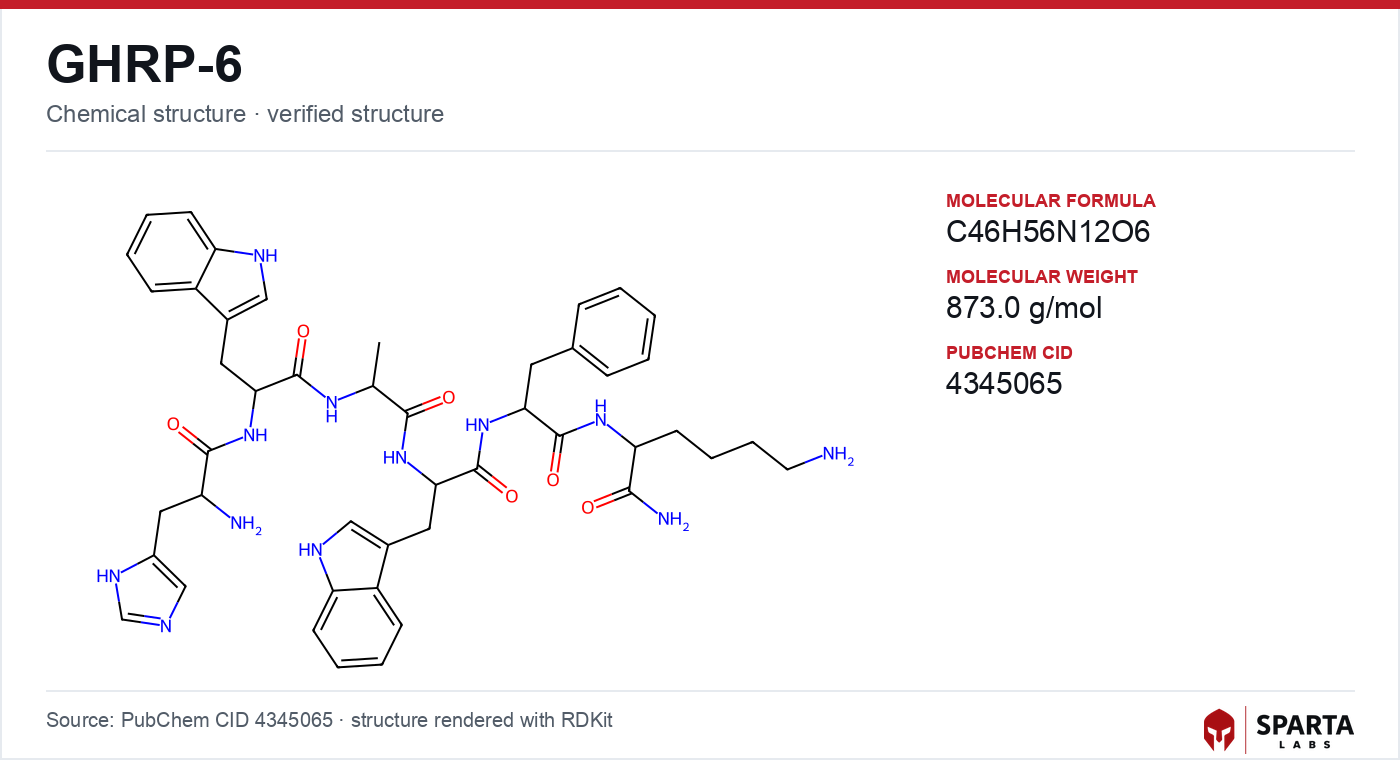
Figure: chemical structure of GHRP-6.
Building the Sequence: Solid-Phase Synthesis of a D-Residue, Amidated Peptide
GHRP-6 is produced by solid-phase peptide synthesis (SPPS), the method introduced by Bruce Merrifield in 1963 in which a peptide chain is assembled residue by residue on an insoluble polymeric support [2]. Each amino acid is added through a protected coupling reaction, temporary protecting groups are removed between couplings, and the completed chain is cleaved from the resin at the end. Research-scale production predominantly uses Fmoc (fluorenylmethyloxycarbonyl) chemistry, the base-labile protecting-group strategy reviewed in detail in the Fmoc SPPS literature [3].
The D-residues in GHRP-6 are incorporated using commercially available enantiopure Fmoc-D-Trp and Fmoc-D-Phe building blocks, coupled by the same chemistry applied to their L-counterparts. The stereochemical fidelity of these positions matters analytically: a partial epimerization or a substituted L-residue would produce a diastereomer with an identical molecular mass but a different three-dimensional structure, which is precisely the kind of impurity that mass measurement alone cannot resolve. This is one reason chromatographic separation is treated as a co-equal test alongside mass spectrometry rather than a formality.
The C-terminal amide is established at the level of resin selection. An amide-forming resin (such as a Rink amide support) yields the Lys-NH2 terminus on cleavage, whereas a standard acid-forming resin would produce the free-acid analogue. Scaling this chemistry reproducibly from milligram research batches to larger production lots follows the process-development principles set out for large-scale peptide manufacture by Andersson and colleagues, including control of coupling efficiency, resin loading, and downstream purification [4]. After cleavage the crude peptide is purified, then precipitated, filtered, and lyophilized to a dry powder.
Confirming Identity: Mass Spectrometry Against the Theoretical Mass
The primary identity test for GHRP-6 is mass spectrometry (MS). The observed molecular ion is compared against the theoretical mass calculated from the His-D-Trp-Ala-Trp-D-Phe-Lys-NH2 formula, and the two must agree within accepted mass-accuracy tolerances. Because stereochemistry does not change mass, MS confirms the atomic composition and the amidation state but does not by itself distinguish the correct diastereomer.
The C-terminal amide is a useful worked example of why mass accuracy is specified carefully. The amide (Lys-NH2) and the corresponding free acid (Lys-OH) differ by roughly 1 Da. An analytical method that could not resolve a 1 Da difference would be unable to detect an incompletely amidated batch. For that reason identity confirmation for amidated peptides such as GHRP-6 is best performed on instrumentation with sufficient resolution to distinguish these closely spaced species. The comparison between GHRP-6 and the closely related GHRP-2 illustrates how small sequence differences within one peptide family translate into distinct target masses that each require independent verification.
Measuring Purity: Reversed-Phase HPLC
Purity is quantified by reversed-phase high-performance liquid chromatography (RP-HPLC). The peptide is separated on a hydrophobic stationary phase under a controlled solvent gradient, and impurities that elute at retention times different from the main peak are resolved from it. The purity figure is the area of the GHRP-6 peak expressed as a percentage of total peak area in the chromatogram.
RP-HPLC is well positioned to detect the diastereomeric and truncated impurities that MS can miss, because these species frequently differ in hydrophobicity and therefore in retention time even when they share a mass. Common process-related impurities in SPPS-derived peptides include deletion sequences (a residue omitted during a failed coupling) and side products from incomplete deprotection; both alter retention behavior and are captured by an adequately developed gradient. Sparta Labs applies an internal purity specification consistent with research-grade practice for synthetic peptides of this class, and pairs the HPLC measurement with MS on every lot so that composition and identity are documented together.
Residual Considerations for a TFA-Cleaved Hexapeptide
SPPS peptides cleaved and purified under acidic conditions are typically isolated as trifluoroacetic acid (TFA) salts unless a salt exchange is performed, and residual purification solvents may also be present at trace levels. These residuals are a standard part of a peptide's analytical profile because they can influence the behavior of a sample in downstream laboratory work if present above expected levels. A quality program therefore treats the salt form and residual content as characterized properties of the material rather than as afterthoughts, alongside the primary purity and identity data.
Stability of a Small Amidated Peptide in Lyophilized Form
GHRP-6 is supplied as a lyophilized (freeze-dried) powder. Lyophilization removes water, which slows the hydrolytic and oxidative degradation pathways that act on peptides in solution, and it is the standard presentation for synthetic peptides intended for storage over time. The general stability behavior of peptide and protein preparations, including the stabilizing effect of the dry state and the roles of temperature, moisture, and light, is reviewed in the pharmaceutical-stability literature [5].
Two residues in GHRP-6 are worth noting from a stability standpoint. Both tryptophan positions are susceptible to oxidation, which is one reason protection from light and from oxidative conditions is a general recommendation for tryptophan-containing peptides. Consistent with the published literature, lyophilized synthetic peptides are generally stored sealed, desiccated, protected from light, and held at low temperature for long-term storage, with the dry state providing substantially greater compositional stability than aqueous solutions [5]. Detailed handling of any reconstituted material is outside the scope of this educational reference.
Batch-Level Documentation and the Certificate of Analysis
Sparta Labs generates a Certificate of Analysis (COA) for each production lot of GHRP-6 from that lot's own analytical results. A batch-specific COA for GHRP-6 records:
- Reversed-phase HPLC purity: the target peak area as a percentage of total peak area
- Mass-spectrometry identity: observed molecular ion versus the theoretical mass of the His-D-Trp-Ala-Trp-D-Phe-Lys-NH2 sequence (approximately 873 Da)
- Batch number: the identifier linking the document to a specific manufacturing lot
- Manufacturing and expiry dates: framing the recommended storage window
Research-grade GHRP-6 supplied by Sparta Labs is accompanied by this batch-specific documentation, accessible from the product page, so that a study's materials section can reference the specific analytical data for the material used. Parallel documentation is maintained for other members of the growth-hormone-secretagogue class, including Hexarelin, and the receptor-level context for how these peptides are studied is summarized in the GHRP-6 mechanism of action reference.
References
-
Bowers CY, Momany FA, Reynolds GA, Hong A. On the in vitro and in vivo activity of a new synthetic hexapeptide that acts on the pituitary to specifically release growth hormone. Endocrinology. 1984;114(5):1537–45. PMID: 6714155. View on PubMed
-
Merrifield RB. Solid phase peptide synthesis. I. The synthesis of a tetrapeptide. J Am Chem Soc. 1963;85(14):2149–54. Full text via DOI
-
Behrendt R, White P, Offer J. Advances in Fmoc solid-phase peptide synthesis. J Pept Sci. 2016;22(1):4–27. PMID: 26785684. View on PubMed
-
Andersson L, Blomberg L, Flegel M, Lepsa L, Nilsson B, Verlander M. Large-scale synthesis of peptides. Biopolymers. 2000;55(3):227–50. PMID: 10880964. View on PubMed
-
Manning MC, Chou DK, Murphy BM, Payne RW, Katayama DS. Stability of protein pharmaceuticals: an update. Pharm Res. 2010;27(4):544–75. PMID: 20143256. View on PubMed
Disclaimer. Statements in this article have not been evaluated by the Food and Drug Administration. This compound is not intended to diagnose, treat, cure, or prevent any disease. Sparta Labs sells research-use-only materials. Content is provided for educational and informational purposes only and does not constitute medical advice. Consult a qualified medical professional for any health concerns.
Frequently asked questions
What makes GHRP-6 more complex to synthesize than a standard hexapeptide?
GHRP-6 (His-D-Trp-Ala-Trp-D-Phe-Lys-NH2) contains two D-configured residues and a C-terminal amide rather than a free carboxyl. Both features are introduced during solid-phase synthesis using enantiopure D-amino acid building blocks and an amide-forming resin. These structural details are also what analytical methods must confirm, because a stereochemical or sequence error can produce a molecule with the same mass but different chromatographic behavior.
How is the identity of GHRP-6 confirmed analytically?
Identity is typically confirmed by mass spectrometry, where the observed molecular ion is compared against the theoretical mass of the His-D-Trp-Ala-Trp-D-Phe-Lys-NH2 sequence (average molecular weight approximately 873 Da). Reversed-phase HPLC provides the complementary purity measurement, reporting the target peak area as a percentage of total peak area. Sparta Labs pairs both methods on every batch.
Why does C-terminal amidation matter for GHRP-6 quality control?
The C-terminal amide distinguishes GHRP-6 from a hypothetical free-acid analogue that differs by roughly 1 Da in mass. Because that mass difference is small, high-resolution mass spectrometry and reversed-phase HPLC are used together so that an incompletely amidated species can be detected and quantified rather than overlooked. Documenting this is part of a batch-specific Certificate of Analysis.
What does a Certificate of Analysis for GHRP-6 contain?
A Sparta Labs Certificate of Analysis is generated from the analytical results of one specific manufacturing lot. For GHRP-6 it reports the reversed-phase HPLC purity figure, the mass-spectrometry identity result against the theoretical mass, the batch number, and the manufacturing and expiry dates. The document is accessible from the product page.
How is lyophilized GHRP-6 stored for research use?
Published stability literature indicates that lyophilized synthetic peptides generally retain compositional integrity when kept sealed, desiccated, protected from light, and held at low temperature for long-term storage. Sparta Labs supplies GHRP-6 in lyophilized form to support this storage profile. Specific handling of reconstituted material is outside the scope of this educational reference.