
GHRP-6 Mechanism of Action
How the published literature describes GHRP-6 at the molecular level: full agonism at the ghrelin receptor GHS-R1a, its distinctive inverted binding orientation resolved by cryo-EM, the Gq/PLC calcium cascade in pituitary somatotrophs, and its separate CD36 scavenger-receptor interactions.
For research use only. Not for human consumption. This article is educational reference material. It is not medical advice and is not a recommendation to use any substance.
Introduction
GHRP-6 (His-D-Trp-Ala-Trp-D-Phe-Lys-NH2) is a synthetic hexapeptide and the founding member of the growth hormone-releasing peptide (GHRP) family. Its pharmacology is unusual among small peptides in that the published literature describes engagement of two structurally unrelated receptors: the growth hormone secretagogue receptor type 1a (GHS-R1a), also known as the ghrelin receptor, and CD36, a class B scavenger receptor. This article summarizes the reported molecular interactions of GHRP-6 and the intracellular events described downstream of them, drawing on peer-reviewed primary literature and review articles. For the wider chemical and classification context, see the GHRP-6 research overview; for a study-by-study account of the preclinical and human data, see the GHRP-6 published research summary.
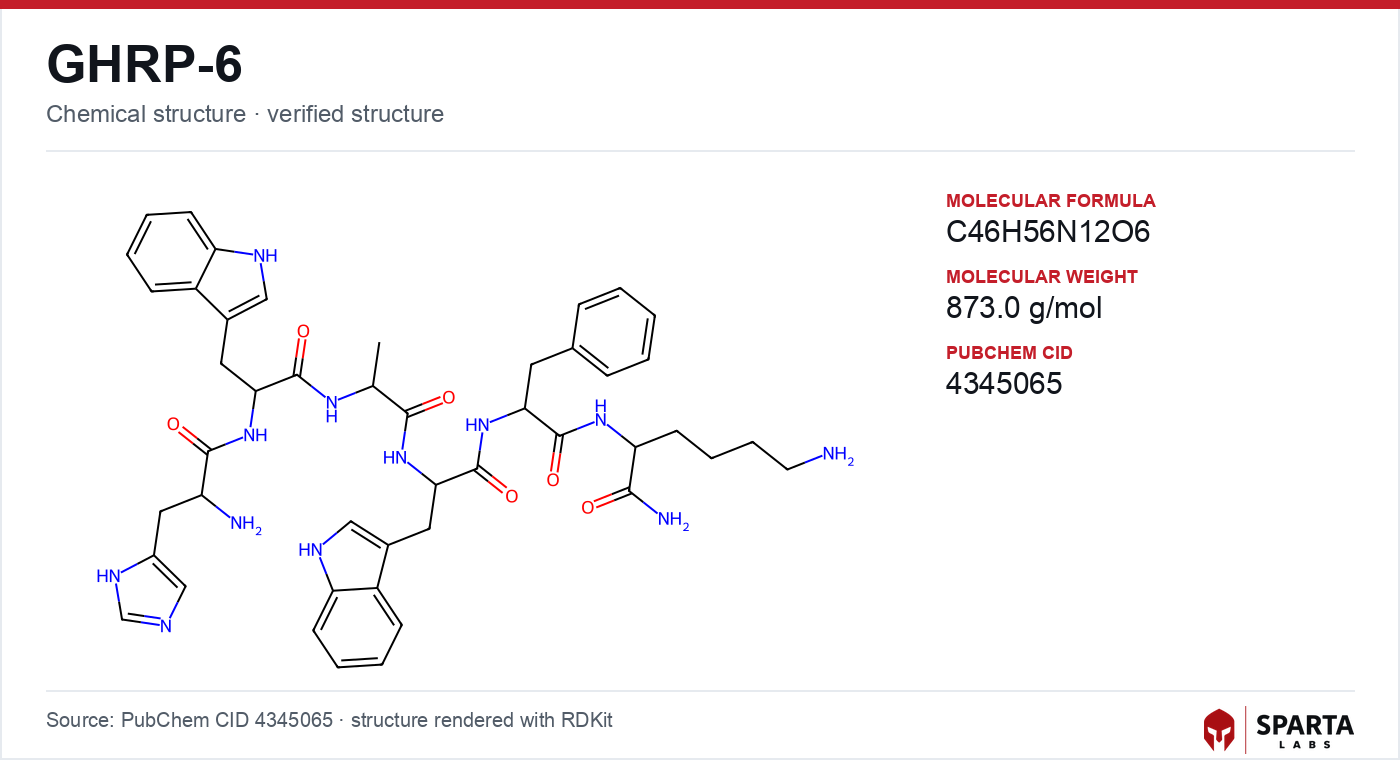
Figure: chemical structure of GHRP-6.
A Peptide That Preceded Its Own Receptor
One of the defining features of GHRP-6 is that it was characterized years before its molecular target was known. Bowers and colleagues reported in 1984 that this synthetic hexapeptide acted on the pituitary to release growth hormone through a route distinct from growth hormone-releasing hormone (GHRH) [1]. For more than a decade the receptor responsible was described only functionally as an orphan target. Howard and colleagues reported its molecular cloning in Science in 1996, identifying a seven-transmembrane G protein-coupled receptor and naming it the growth hormone secretagogue receptor [2]. The endogenous ligand was identified three years later when Kojima and colleagues isolated ghrelin from stomach tissue and reported it as the natural agonist of the same receptor [3]. GHRP-6 therefore occupies an unusual position in pharmacology: a laboratory compound that helped reveal an entire endogenous signaling axis.
Findings from research models do not establish safety or efficacy in humans. Sparta Labs makes no claims about the use of this compound.
The Ghrelin Receptor GHS-R1a
GHS-R1a is a class A (rhodopsin-like) GPCR of 364 to 366 amino acids that is highly conserved across species [2]. Gnanapavan and colleagues mapped its messenger RNA distribution in humans and reported expression concentrated in the hypothalamus and anterior pituitary, with lower-level transcripts detected across a range of peripheral tissues [4]. This distribution frames GHRP-6 as a peptide acting principally at the level of the hypothalamic-pituitary axis, with the potential for additional peripheral engagement that later research has examined.
A property of GHS-R1a repeatedly noted in the literature is its high constitutive, or ligand-independent, activity. Pantel and colleagues reported that a loss-of-function mutation impairing GHS-R1a constitutive signaling co-segregated with familial short stature, evidence that the receptor's basal tone contributes to endogenous growth hormone secretion independently of ligand occupancy [5]. Against this baseline of constitutive activity, an agonist such as GHRP-6 is described as driving the receptor from its already-active resting state toward fuller activation.
How GHRP-6 Sits in the Binding Pocket
The most detailed structural account of GHRP-6 engagement came from a 2022 cryo-electron microscopy study by Zhao and colleagues, who resolved GHS-R1a in complex with ghrelin and with synthetic agonists [6]. The authors reported that GHRP-6 and ghrelin occupy the same orthosteric pocket, formed by transmembrane helices two through seven and extracellular loops two and three, yet adopt strikingly different orientations. Ghrelin threads its acylated N-terminus deep into the helical bundle. GHRP-6, by contrast, was resolved in an inverted pose in which its C-terminal region penetrates the bundle while its histidine-bearing N-terminus faces the extracellular vestibule [6].
This inverted binding mode is a compound-specific structural feature rather than a general property of the receptor. Researchers have proposed it as a candidate explanation for why a short synthetic hexapeptide and a longer acylated hormone can both fully activate the same receptor while producing measurably different signaling profiles. The structure provides a physical framework for signaling-bias hypotheses that earlier functional studies could only infer.
From Receptor Occupancy to a Calcium Signal
Once GHRP-6 occupies GHS-R1a, the receptor couples primarily to the Gaq/11 class of heterotrimeric G proteins. Smith and colleagues reviewed the peptidomimetic regulation of growth hormone secretion and described the canonical cascade in pituitary somatotrophs [7]. Gaq/11 activates phospholipase C-beta, which cleaves the membrane lipid phosphatidylinositol 4,5-bisphosphate into two second messengers: inositol 1,4,5-trisphosphate (IP3) and diacylglycerol (DAG). IP3 releases calcium from endoplasmic-reticulum stores, while DAG activates protein kinase C (PKC) isoforms [7].
The reported signal does not rely on internal calcium stores alone. The published somatotroph literature describes a response requiring both intracellular mobilization and extracellular calcium entry, consistent with PKC-dependent gating of plasma-membrane calcium channels [7]. The combined rise in cytosolic calcium from both sources is the proximal event described for exocytosis of growth hormone from somatotroph secretory granules. At the hypothalamic level, GHRP-6 has additionally been reported to interact with the GHRH and somatostatin systems, with the early literature describing synergy between GHRP-6 and GHRH that yielded pituitary GH responses in animal models exceeding the sum of either agent alone [1].
The Second Target: CD36
Distinct from its GPCR pharmacology, GHRP-6 has been reported to bind CD36, a class B scavenger receptor expressed on macrophages, monocytes, adipocytes, and endothelial cells. Berlanga-Acosta and colleagues characterized CD36 as a pharmacologically relevant target for the GHRP family and proposed that this interaction, rather than GHS-R1a signaling, underlies cytoprotective and antifibrotic observations reported in animal tissue models [8]. Because CD36 is a scavenger receptor rather than a G protein-coupled receptor, the downstream biology described for it, including modulation of inflammatory-mediator expression, is mechanistically separate from the pituitary GH-releasing pathway.
This two-receptor picture is what most clearly distinguishes GHRP-6 mechanistically from more selective secretagogues. The observations attributed to CD36 engagement derive from research models and are described here strictly as reported preclinical results, without any implication of a human outcome.
Signaling Bias and Constitutive Activity
Two threads from the sections above intersect in current mechanistic discussion. First, GHS-R1a's high constitutive activity means that ligand effects are layered on top of a receptor that is already partially active [5]. Second, the inverted binding orientation of GHRP-6 relative to ghrelin offers a structural basis for biased signaling, in which different ligands at the same receptor preferentially engage different downstream pathways [6]. Together these features frame GHRP-6 not as a simple on-switch but as a modulator of an already-dynamic receptor system. Functional validation of how the 2022 structural data map onto pathway-level bias remains an area of ongoing research.
Where GHRP-6 Sits Among the Growth Hormone Secretagogues
GHRP-6 defined a pharmacological class that later expanded to include GHRP-2, hexarelin, and ipamorelin. These peptides share GHS-R1a agonism but differ in receptor selectivity and in reported secondary activity. Ipamorelin is often described as a more selective GHS-R1a agonist, and its signaling has been characterized with overlapping methods; the ipamorelin mechanism of action article covers that profile. The closely related GHRP-2 mechanism of action and hexarelin mechanism of action articles describe how sequence variation within the family is reported to alter potency and off-target engagement. Placing GHRP-6 against these relatives clarifies which features are shared across the class and which, such as its particular CD36 interaction and inverted binding pose, are specific to this hexapeptide.
Open Mechanistic Questions
Several questions raised by the published record remain unresolved. The pharmacological consequences of GHRP-6's inverted binding orientation for pathway-level signaling bias were only recently made structurally tractable and await functional confirmation [6]. The relative contribution of GHS-R1a versus CD36 to the compound's overall reported profile appears to vary by tissue and cell type and has not been systematically dissected. Much of the mechanistic data derives from rodent and other animal models, and the extent to which these observations translate to human biology is itself an open research question rather than an established fact.
References
-
Bowers CY, Momany FA, Reynolds GA, Hong A. On the in vitro and in vivo activity of a new synthetic hexapeptide that acts on the pituitary to specifically release growth hormone. Endocrinology. 1984;114(5):1537–45. PMID: 6714155. View on PubMed
-
Howard AD, Feighner SD, Cully DF, Arena JP, Liberator PA, Rosenblum CI, et al. A receptor in pituitary and hypothalamus that functions in growth hormone release. Science. 1996;273(5277):974–7. PMID: 8688086. View on PubMed
-
Kojima M, Hosoda H, Date Y, Nakazato M, Matsuo H, Kangawa K. Ghrelin is a growth-hormone-releasing acylated peptide from stomach. Nature. 1999;402(6762):656–60. PMID: 10604470. View on PubMed
-
Gnanapavan S, Kola B, Bustin SA, Morris DG, McGee P, Fairclough P, et al. The tissue distribution of the mRNA of ghrelin and subtypes of its receptor, GHS-R, in humans. J Clin Endocrinol Metab. 2002;87(6):2988. PMID: 12050285. View on PubMed
-
Pantel J, Legendre M, Cabrol S, Hilal L, Hajaji Y, Morisset S, et al. Loss of constitutive activity of the growth hormone secretagogue receptor in familial short stature. J Clin Invest. 2006;116(3):760–8. PMID: 16511602. View on PubMed
-
Zhao LH, Yin Y, Yang D, Liu B, Gu L, Ren Y, et al. Molecular recognition of an acyl-peptide hormone and activation of ghrelin receptor. Nat Commun. 2022;13(1):4476. PMID: 35918329. View on PubMed
-
Smith RG, Van der Ploeg LH, Howard AD, Feighner SD, Cheng K, Hickey GJ, et al. Peptidomimetic regulation of growth hormone secretion. Endocr Rev. 1997;18(5):621–45. PMID: 9331547. View on PubMed
-
Berlanga-Acosta J, Guillén-Nieto G, Rodríguez-Rodríguez N, Bringas-Vega ML, García-del-Barco-Herrera D, Berlanga-Saez JO, et al. Synthetic Growth Hormone-Releasing Peptides (GHRPs): A Historical Appraisal of the Evidences Supporting Their Cytoprotective Effects. Mediators Inflamm. 2017;2017:9274040. PMID: 28458470. View on PubMed
Disclaimer. Statements in this article have not been evaluated by the Food and Drug Administration. This compound is not intended to diagnose, treat, cure, or prevent any disease. Sparta Labs sells research-use-only materials. Content is provided for educational and informational purposes only and does not constitute medical advice. Consult a qualified medical professional for any health concerns.
Frequently asked questions
What receptor does GHRP-6 activate?
GHRP-6 acts as a full agonist at the growth hormone secretagogue receptor type 1a (GHS-R1a), the same receptor later found to bind the endogenous hormone ghrelin. GHS-R1a is a class A G protein-coupled receptor expressed most heavily in the hypothalamic arcuate nucleus and the anterior pituitary. Its identity was established through receptor cloning reported in Science in 1996 and reinforced by the 1999 discovery of ghrelin.
Why is GHRP-6 described as binding differently from ghrelin?
A 2022 cryo-electron microscopy study by Zhao and colleagues reported that GHRP-6 and ghrelin share the same orthosteric pocket in GHS-R1a but adopt opposite orientations. Ghrelin threads its acylated N-terminus deep into the transmembrane bundle, while GHRP-6 was resolved in an inverted pose with its C-terminus pointing into the bundle. Researchers have proposed this orientational difference as a structural basis for differences in downstream signaling between the two ligands.
What is the second receptor target reported for GHRP-6?
Beyond GHS-R1a, published literature describes GHRP-6 interacting with CD36, a class B scavenger receptor found on macrophages, monocytes, adipocytes, and endothelial cells. Berlanga-Acosta and colleagues characterized CD36 as a pharmacologically relevant binding partner and proposed it as the basis for cytoprotective observations in animal models that are distinct from the pituitary GH-releasing pathway.
What intracellular signaling has been reported for GHRP-6?
At GHS-R1a, GHRP-6 couples primarily to Gaq/11, which activates phospholipase C-beta and generates the second messengers IP3 and diacylglycerol. Published somatotroph literature describes IP3-driven calcium release from intracellular stores together with protein kinase C-gated extracellular calcium entry. This combined rise in cytosolic calcium is the proximal event described for growth hormone exocytosis in pituitary cells.
How does GHRP-6 relate to other growth hormone secretagogues?
GHRP-6 was the first of the synthetic growth hormone-releasing peptides, characterized by Bowers and colleagues in 1984, and it defined the pharmacological class that later included GHRP-2, hexarelin, and ipamorelin. These peptides share GHS-R1a agonism but differ in receptor selectivity and reported off-target activity. Comparative signaling work across the class remains an active area in the published literature.