
Ipamorelin: Mechanism of Action
A mechanism-focused review of ipamorelin at the GHS-R1a receptor: the Gq/phospholipase C pathway, calcium-triggered somatotroph exocytosis, and the pharmacological selectivity reported by its discoverers. Educational reference.
For research use only. Not for human consumption. This article is educational reference material. It is not medical advice and is not a recommendation to use any substance.
Introduction
Ipamorelin is a synthetic pentapeptide agonist at the growth hormone secretagogue receptor subtype 1a (GHS-R1a), the class A G protein-coupled receptor (GPCR) that also serves as the cognate receptor for the peptide hormone ghrelin. Interest in ipamorelin's molecular pharmacology stems from a specific published observation: it was characterized by its discoverers as a growth hormone (GH) secretagogue with a comparatively narrow hormonal profile relative to earlier growth-hormone-releasing peptides (GHRPs). This article traces the reported mechanism from the receptor itself through the intracellular cascade that couples receptor engagement to GH release, then examines the selectivity data that define the compound in the literature and the questions that remain open. A broader bibliographic treatment is collected in the ipamorelin published research summary, and the compound's classification is set out in the ipamorelin research overview.
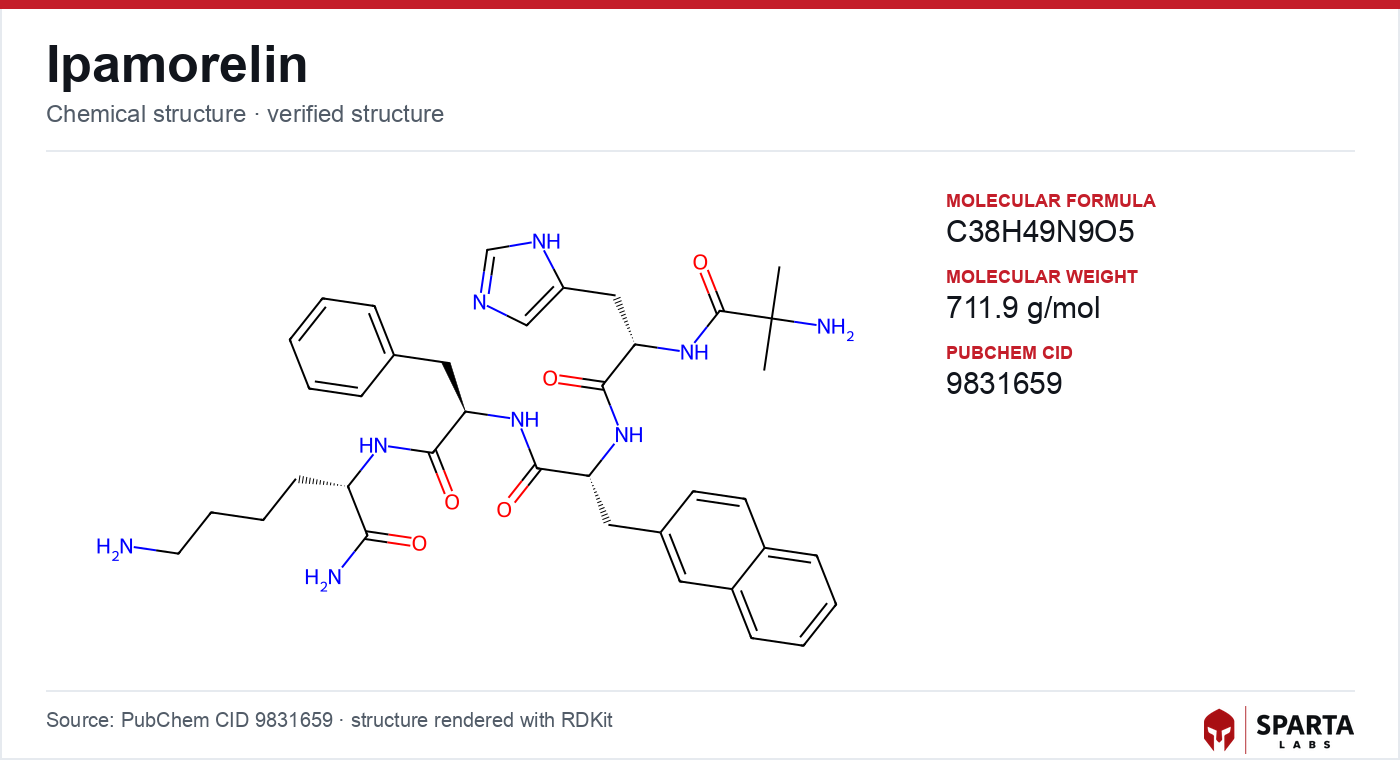
Figure: chemical structure of Ipamorelin.
A Receptor Found Before Its Ligand
The mechanistic story of ipamorelin is unusual because the receptor it targets was identified through synthetic secretagogues before the endogenous ligand was known. Howard and colleagues (1996) cloned GHS-R from pituitary and hypothalamic tissue using a synthetic GH secretagogue as the molecular probe, establishing the receptor as a distinct GPCR that mediates secretagogue-induced GH release [1]. At that point the natural agonist remained unidentified. It was not until Kojima and colleagues (1999) isolated ghrelin from stomach tissue, an acylated 28-residue peptide, that GHS-R1a acquired a recognized endogenous ligand [2].
Findings from research models do not establish safety or efficacy in humans. Sparta Labs makes no claims about the use of this compound.
This sequence matters for interpreting ipamorelin. The receptor was defined pharmacologically by the compounds that activate it, which is why the class is named for its secretagogue function rather than for ghrelin. Ipamorelin belongs to the synthetic branch of that lineage, alongside peptides such as those discussed in the GHRP-6 research overview and the GHRP-2 research overview. GHS-R1a itself is a class A GPCR expressed across pituitary somatotrophs, hypothalamic nuclei, and additional peripheral tissues, and Yin, Li, and Zhang (2014) reviewed the receptor's signaling and regulation in detail [3].
From Receptor Engagement to GH Exocytosis
Ipamorelin's proximate output in research models is the release of GH from pituitary somatotroph cells, and the intracellular route linking receptor engagement to that release has been characterized primarily at the level of the receptor's canonical signaling.
Yin et al. (2014) described the dominant intracellular signaling of GHS-R1a as proceeding through the G-alpha-q (Gaq) protein subunit and phospholipase C (PLC) [3]. Activated PLC hydrolyzes the membrane phospholipid phosphatidylinositol 4,5-bisphosphate (PIP2) into two second messengers: inositol 1,4,5-trisphosphate (IP3) and diacylglycerol (DAG). IP3 mobilizes calcium (Ca2+) from intracellular endoplasmic reticulum stores, while DAG activates protein kinase C (PKC). On the basis of this body of literature, the resulting elevation of cytosolic Ca2+ is understood to be the proximate trigger for GH exocytosis from the somatotroph.
Yin et al. also noted that GHS-R1a can recruit additional signaling branches, including the MAPK (ERK1/2), PI3K/AKT, and AMPK pathways, with the relative engagement of each appearing to depend on cell type and experimental conditions [3]. Ipamorelin-specific contributions to these secondary branches have not been comprehensively resolved in the primary literature; most detailed pathway-level mapping was performed with ghrelin itself or with other GHS-R1a agonists, so extrapolation to ipamorelin should be treated as inference rather than direct observation.
Raun and colleagues (1998), in the paper that first characterized ipamorelin, reported that it released GH from primary rat pituitary cells in vitro with potency and efficacy in the range of established GHRP-class peptides, and that intravenous administration in conscious swine produced GH responses consistent with pituitary secretion [4]. Their pharmacological profiling with receptor antagonists indicated that ipamorelin acts through a GHRP-like (GHS) receptor rather than through the growth-hormone-releasing-hormone (GHRH) receptor, placing it firmly on the GHS-R1a arm of GH regulation.
The Selectivity That Defines Ipamorelin
The single most cited pharmacological feature of ipamorelin is the hormonal profile reported by Raun et al. (1998). In conscious swine, at concentrations more than 200-fold above the dose that half-maximally released GH, the compound did not significantly alter circulating ACTH, cortisol, prolactin, luteinizing hormone (LH), follicle-stimulating hormone (FSH), or thyroid-stimulating hormone (TSH) [4]. On this basis the authors described ipamorelin as a selective GH secretagogue, contrasting it with earlier GHRPs that were reported to co-elevate adrenocorticotropic and other pituitary hormones.
The structural origin of this profile was probed by Ankersen and colleagues (1998), who conducted structure-activity work on a series of GH-releasing peptides derived from the ipamorelin scaffold [5]. Their study described how backbone modifications and physicochemical alterations to the pentapeptide framework modulated in vitro GH-releasing potency in primary rat pituitary cells, consistent with the interpretation that the geometry of receptor engagement, rather than mere affinity, shapes functional output. That the ipamorelin scaffold could be tuned across a range of potencies while preserving GH-releasing activity supported the view that its behavior is a property of the specific ligand-receptor interaction.
For comparative context on how a structurally distinct member of the same pharmacological class engages GHS-R1a, the hexarelin mechanism of action article discusses another synthetic secretagogue in the GHRP lineage. Peptide material characterized for such receptor-level and structure-activity investigations, including research-grade ipamorelin, is typically verified by reversed-phase HPLC and mass spectrometry before use.
Open Questions in GHS-R1a Pharmacology
Several aspects of ipamorelin's mechanism remain active areas of inquiry in the published literature rather than settled fact.
The precise molecular basis for the reported selectivity, that is, why ipamorelin releases GH without proportionately activating the hypothalamic-pituitary-adrenal axis at pharmacological concentrations, has not been fully resolved. Candidate explanations discussed for GHS-R1a agonists in general include differential coupling among G protein isoforms, functionally selective (biased) agonism in which a ligand favors certain downstream branches over others, and pharmacokinetic contributions. Systematic testing of these mechanisms specifically for ipamorelin represents a remaining research frontier.
GHS-R1a is also notable for unusually high constitutive, ligand-independent activity. Holst and colleagues (2003) characterized this basal signaling and reported that the receptor exhibits substantial agonist-independent activation in expression systems, a property with implications for how synthetic agonists layer their effects onto an already-active receptor [6]. How ipamorelin's engagement intersects with this constitutive tone, and with the receptor's reported capacity to form heterodimers with other GPCRs, has not been specifically characterized for this compound and remains an open question for the receptor class more broadly.
Finally, translation from research models to human physiology is a recognized constraint across the entire GHS-R1a agonist literature. Species differences in GH secretory pattern, pulsatility, and feedback regulation among rodents, swine, and humans mean that the mechanistic findings summarized here inform, but do not establish, receptor-level events in human subjects. The ipamorelin published research summary catalogs the underlying studies in more detail.
References
-
Howard AD, Feighner SD, Cully DF, Arena JP, Liberator PA, Rosenblum CI, et al. A receptor in pituitary and hypothalamus that functions in growth hormone release. Science. 1996;273(5277):974-7. PMID: 8688086. DOI: 10.1126/science.273.5277.974
-
Kojima M, Hosoda H, Date Y, Nakazato M, Matsuo H, Kangawa K. Ghrelin is a growth-hormone-releasing acylated peptide from stomach. Nature. 1999;402(6762):656-60. PMID: 10604470. DOI: 10.1038/45230
-
Yin Y, Li Y, Zhang W. The growth hormone secretagogue receptor: its intracellular signaling and regulation. Int J Mol Sci. 2014;15(3):4837-55. PMID: 24651458. DOI: 10.3390/ijms15034837
-
Raun K, Hansen BS, Johansen NL, Thøgersen H, Madsen K, Ankersen M, et al. Ipamorelin, the first selective growth hormone secretagogue. Eur J Endocrinol. 1998;139(5):552-61. PMID: 9849822. DOI: 10.1530/eje.0.1390552
-
Ankersen M, Johansen NL, Madsen K, Hansen BS, Raun K, Nielsen KK, et al. A new series of highly potent growth hormone-releasing peptides derived from ipamorelin. J Med Chem. 1998;41(19):3699-704. PMID: 9733495. DOI: 10.1021/jm9801962
-
Holst B, Cygankiewicz A, Jensen TH, Ankersen M, Schwartz TW. High constitutive signaling of the ghrelin receptor: identification of a potent inverse agonist. Mol Endocrinol. 2003;17(11):2201-10. PMID: 12907757. DOI: 10.1210/me.2003-0069
Disclaimer. Statements in this article have not been evaluated by the Food and Drug Administration. This compound is not intended to diagnose, treat, cure, or prevent any disease. Sparta Labs sells research-use-only materials. Content is provided for educational and informational purposes only and does not constitute medical advice. Consult a qualified medical professional for any health concerns.
Frequently asked questions
What receptor does ipamorelin act on?
Ipamorelin is a synthetic pentapeptide agonist at the growth hormone secretagogue receptor subtype 1a (GHS-R1a), a class A G protein-coupled receptor. GHS-R1a is the same receptor engaged by the endogenous hormone ghrelin, and it is expressed in pituitary somatotrophs and the hypothalamus among other tissues.
What signaling pathway is reported for ipamorelin at GHS-R1a?
Review literature on GHS-R1a describes signaling that proceeds predominantly through the Gaq protein and phospholipase C. Phospholipase C hydrolyzes PIP2 into IP3 and diacylglycerol, and the IP3-driven rise in intracellular calcium is characterized as the proximate trigger for growth hormone release from pituitary somatotroph cells.
Why is ipamorelin described as a selective growth hormone secretagogue?
Raun and colleagues (1998), who first characterized the compound, reported that in conscious swine ipamorelin did not significantly alter ACTH, cortisol, prolactin, LH, FSH, or TSH at concentrations far above the dose that released growth hormone. This narrow hormonal profile is the pharmacological feature most frequently cited to distinguish ipamorelin from earlier GHRP-class peptides.
How does ipamorelin differ from ghrelin at the receptor?
Both ipamorelin and ghrelin act as agonists at GHS-R1a, but ghrelin is a 28-residue acyl-modified peptide hormone while ipamorelin is a synthetic pentapeptide designed from growth-hormone-releasing-peptide scaffolds. Structure-activity work by Ankersen and colleagues (1998) traced how the pentapeptide framework retains receptor engagement, and the two ligands are reported to share the same downstream Gq/phospholipase C signaling.
What aspects of ipamorelin's mechanism remain unresolved?
The structural basis for its reported hormonal selectivity, the degree to which it exhibits biased (functionally selective) agonism, and how it interacts with the high constitutive activity of GHS-R1a described by Holst and colleagues (2003) have not been fully characterized for this compound. Species differences in growth-hormone secretory patterns also limit direct extrapolation from research models to human physiology.