
Ipamorelin: Published Research
A source-by-source survey of ipamorelin's peer-reviewed literature, traced from the 1998 Novo Nordisk discovery papers through the ghrelin-mimetic gastrointestinal program and a phase 2 postoperative-ileus trial. Educational reference.

For research use only. Not for human consumption. This article is educational reference material. It is not medical advice and is not a recommendation to use any substance.
Introduction
Ipamorelin (development code NNC 26-0161) is a synthetic pentapeptide that acts as an agonist at the growth hormone secretagogue receptor type 1a (GHS-R1a), the same receptor targeted by the endogenous hormone ghrelin. Since its first characterization in 1998, it has accumulated a peer-reviewed literature that is unusual among growth hormone secretagogues for two reasons: it originates almost entirely from a single industrial discovery program at Novo Nordisk, and its most advanced clinical translation addressed gastrointestinal motility rather than the growth-hormone axis that defined its pharmacology. This article surveys that literature source by source, following its actual chronological and thematic arc rather than a generic study inventory. The receptor pharmacology underlying these reports is treated separately in the ipamorelin mechanism of action article, and the compound's classification and lineage are covered in the ipamorelin research overview. All findings below are attributed to their source studies; no meta-analytic conclusions are drawn.
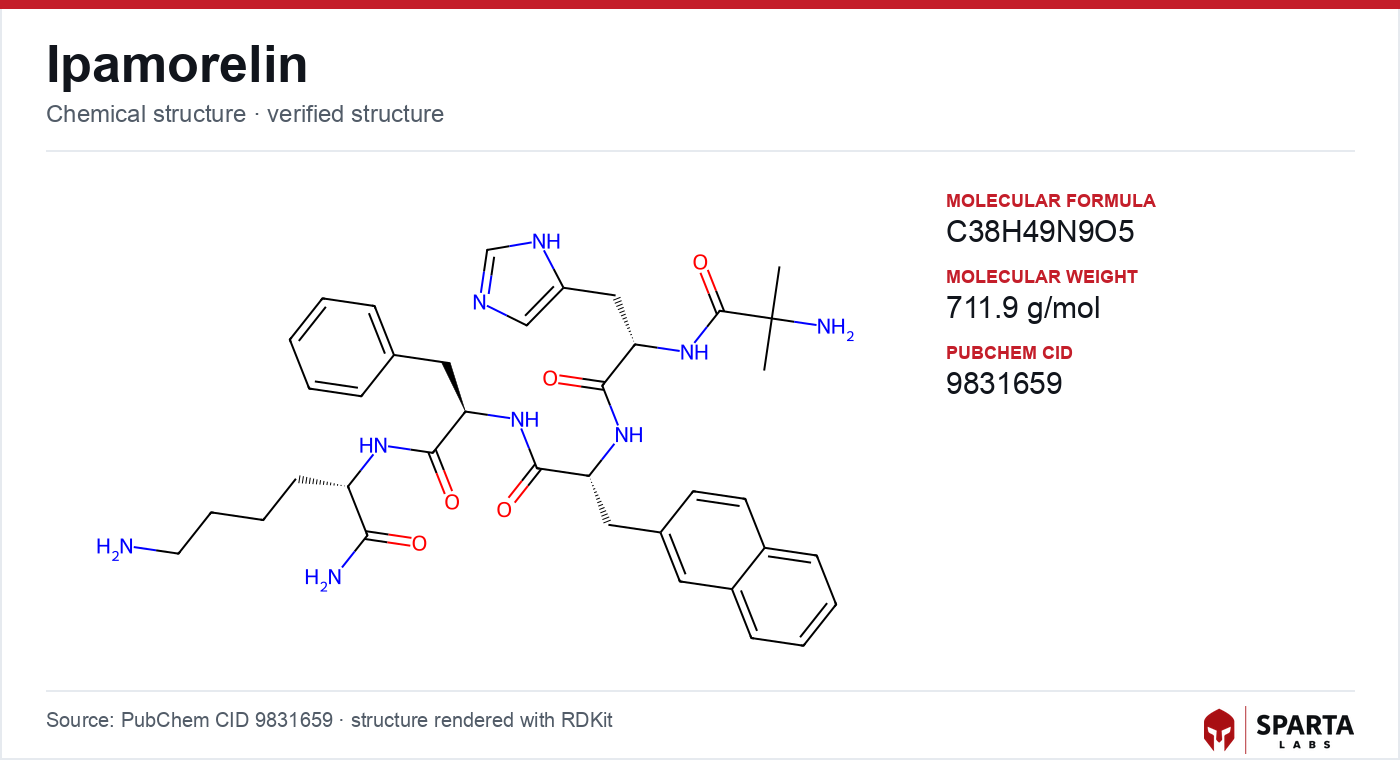
Figure: chemical structure of Ipamorelin.
A Single-Origin Discovery Lineage (1998)
Unlike peptides whose literature grew from many independent laboratories, the foundational ipamorelin papers trace to one coordinated medicinal-chemistry effort. The defining report is Raun and colleagues (1998), which introduced ipamorelin as a novel pentapeptide characterized across in vitro and in vivo systems [1]. In primary rat anterior pituitary cell cultures, ipamorelin released growth hormone (GH) with an ED₅₀ in the low nanomolar range, a potency the authors described as comparable to GHRP-6, one of the earliest peptidyl secretagogues. In conscious swine, a model chosen because porcine GH secretory pulsatility more closely resembles human patterns than rodent physiology does, the authors reported robust GH pulses following administration.
Findings from research models do not establish safety or efficacy in humans. Sparta Labs makes no claims about the use of this compound.
Published in the same year, Ankersen and colleagues (1998) reported structure-activity relationship (SAR) work built on the ipamorelin scaffold [2]. The authors described backbone modifications and incorporation of a peptidomimetic fragment that produced a series of secretagogue compounds with retained potency and altered physicochemical properties. That paper is significant to the corpus less for any single analog than for establishing ipamorelin as a productive template for generating GHS chemical diversity, positioning it within a broader research program alongside peptides such as GHRP-2 and hexarelin.
The Selectivity Signature That Defined the Corpus
The observation cited most often in downstream ipamorelin literature is hormonal selectivity. Raun and colleagues reported that at doses more than 200-fold above the in vivo ED₅₀ for GH release, ipamorelin did not significantly alter plasma levels of ACTH, cortisol, follicle-stimulating hormone, luteinizing hormone, prolactin, or thyroid-stimulating hormone in the swine model [1]. On the basis of this profile the authors described the compound as a selective growth hormone secretagogue, and subsequent papers repeatedly cited that selectivity as its distinguishing pharmacological feature.
It is worth noting what the selectivity finding is and is not. It is a reported association in swine at the pharmacological doses tested; it is not a demonstration of an equivalent profile in humans, for which the compound's GH and hormonal responses have not been published. The distinction matters when interpreting the corpus, because much of the compound's later characterization proceeded on the assumption that its neuroendocrine effects would remain narrow.
The Pharmacokinetic and Physicochemical Thread
Johansen and colleagues (1998) characterized comparative pharmacokinetics of ipamorelin alongside GHRP-2 and GHRP-6 in rats [3]. The study reported that ipamorelin displayed systemic plasma clearance roughly five-fold lower than GHRP-6 and was eliminated primarily through urinary rather than biliary routes. The authors also evaluated nasal absorption, contributing route-specific data that fed into the wider multi-route characterization of peptidyl secretagogues. This pharmacokinetic thread is one of the few in the corpus that directly compared ipamorelin with its structural relatives under matched conditions.
A related SAR observation from Ankersen and colleagues connects here: modifications to the pentapeptide backbone were reported to change physicochemical behavior while preserving secretagogue activity [2], the kind of property tuning that pharmacokinetic studies then quantified. For readers tracing how these molecules were prepared and how analytical identity is verified, the ipamorelin sourcing and quality article discusses synthesis and characterization standards.
From the Growth-Hormone Axis Toward Tissue Physiology
Following the discovery-era work, several studies extended ipamorelin research beyond somatotroph pharmacology into downstream and peripheral tissue effects.
Johansen and colleagues (1999) investigated longitudinal bone growth in rats, measuring tibial growth rate over a 15-day administration period [4]. The study reported that administration was associated with a dose-dependent increase in longitudinal bone growth rate and body weight gain, findings the authors interpreted as consistent with GH-mediated downstream actions.
Malmlöf and colleagues (1999) examined whether the synthetic glucocorticoid methylprednisolone would blunt GH responsiveness to ipamorelin in rats [5]. The report indicated that glucocorticoid-treated animals retained acute GH responses to both ipamorelin and growth-hormone-releasing hormone, and a second experimental arm using chronic catheterization was associated with attenuated body-weight loss and elevated IGF-1 relative to methylprednisolone alone. The authors framed these as exploratory preclinical observations.
Jiménez-Reina and colleagues (2002) turned to somatotroph biology directly, studying pituitary cells in young female rats after 21 days of administration using immunohistochemical and morphometric analysis together with in vitro GH-release assays from harvested cells [6]. Reported findings included increased secretory-granule density and altered GH content and responsiveness in vitro, which the authors interpreted as adaptive somatotroph remodeling under sustained GHS-R1a stimulation.
Adeghate and Ponery (2004) reported the first published examination of ipamorelin in pancreatic tissue, using isolated fragments from normal and streptozotocin-diabetic rats [7]. In that in vitro preparation, ipamorelin was reported to evoke insulin secretion from both normal and diabetic tissue, with attenuation under calcium-channel blockade and adrenergic antagonism, leading the authors to propose calcium-channel and adrenergic pathway involvement. These pancreatic observations remain isolated in the literature and have not been extended in intact-animal or clinical settings.
The Ghrelin-Mimetic Gastrointestinal Program
The most sustained translational thread in the ipamorelin literature concerns gastrointestinal motility, a physiologically coherent direction given that GHS-R1a signaling participates in gastric and colonic function.
Venkova and colleagues (2009) evaluated ipamorelin in a rodent postoperative ileus (POI) model in which rats underwent laparotomy and intestinal manipulation, with colonic transit assessed by a proximal-colon dye marker [8]. Single-dose intravenous administration was associated with reduced time to first bowel movement, and a repetitive-administration arm was associated with changes in cumulative fecal output, food intake, and body-weight gain relative to vehicle controls.
Greenwood-Van Meerveld and colleagues (2012) extended this line to gastric function using in vivo and ex vivo preparations in a rodent postoperative model [9]. In vivo, administration was associated with restoration of gastric emptying that had been delayed by abdominal surgery. In isolated gastric strips, surgical manipulation was associated with suppressed contractile responses to acetylcholine and electrical field stimulation, and both ipamorelin and natural ghrelin were reported to normalize those responses. The authors attributed the effect to GHS-R1a-mediated activation of cholinergic excitatory neurons in the enteric nervous system, framing it as mechanistic support for the gastrointestinal research direction.
The Phase 2 Postoperative-Ileus Trial (2014)
The gastrointestinal program reached its most advanced published stage in a human clinical trial. Beck and colleagues (2014), on behalf of the Ipamorelin 201 Study Group, reported a multicenter, double-blind, placebo-controlled, proof-of-concept phase 2 study in 117 patients undergoing small- or large-bowel resection with primary anastomosis [10]. Participants received intravenous ipamorelin or placebo twice daily beginning on postoperative day 1 for up to seven days.
The study reported that ipamorelin was well tolerated, with adverse-event rates similar between groups. Median time to tolerating a solid meal was 25.3 hours in the ipamorelin group and 32.6 hours in the placebo group, a directional difference of 7.3 hours that did not reach statistical significance (p = 0.15) on the primary composite gastrointestinal endpoint in this proof-of-concept cohort [10]. The authors highlighted the tolerability data and the directional trend while acknowledging the endpoint was not met at significance. The trial's principal contribution to the corpus is a body of human safety and pharmacological data in a surgical population for a ghrelin-receptor agonist.
Species Translation and Open Questions
Interpreting the ipamorelin literature requires attention to the models it rests on. GH secretory patterns, GHS-R1a expression distribution, and pituitary feedback differ across rodents, swine, and humans, and these differences are recognized considerations when extrapolating the preclinical findings [1][3]. The selectivity signature, the bone-growth data, and the pancreatic observations all derive from animal systems and have not been reproduced in published human studies.
Several specific gaps stand out. Human data on ipamorelin's GH-releasing activity, hormonal selectivity, and pharmacokinetics in healthy subjects have not been published; the clinical record is confined to the postoperative-ileus population. The pancreatic insulin-secretion findings (Adeghate and Ponery, 2004) and the rat bone-growth findings (Johansen, 1999) each remain single-study observations without cross-species or mechanistic follow-up. Researchers comparing ipamorelin's pharmacokinetic behavior with longer-acting GH-axis peptides may also consult the CJC-1295 without DAC research overview and the ipamorelin discovery and regulatory history for regulatory context. Batch-specific analytical documentation for ipamorelin from Sparta Labs is available for investigators sourcing material for preclinical work.
References
-
Raun K, Hansen BS, Johansen NL, Thøgersen H, Madsen K, Ankersen M, et al. Ipamorelin, the first selective growth hormone secretagogue. Eur J Endocrinol. 1998;139(5):552-61. PMID: 9849822. DOI: 10.1530/eje.0.1390552. PubMed
-
Ankersen M, Johansen NL, Madsen K, Hansen BS, Raun K, Nielsen KK, et al. A new series of highly potent growth hormone-releasing peptides derived from ipamorelin. J Med Chem. 1998;41(19):3699-704. PMID: 9733495. DOI: 10.1021/jm9801962. PubMed
-
Johansen PB, Hansen KT, Andersen JV, Johansen NL. Pharmacokinetic evaluation of ipamorelin and other peptidyl growth hormone secretagogues with emphasis on nasal absorption. Xenobiotica. 1998;28(11):1083-92. PMID: 9879640. DOI: 10.1080/004982598238976. PubMed
-
Johansen PB, Nowak J, Skjaerbaek C, Flyvbjerg A, Andreassen TT, Wilken M, et al. Ipamorelin, a new growth-hormone-releasing peptide, induces longitudinal bone growth in rats. Growth Horm IGF Res. 1999;9(2):106-13. PMID: 10373343. DOI: 10.1054/ghir.1999.9998. PubMed
-
Malmlöf K, Johansen PB, Haahr PM, Wilken M, Oxlund H. Methylprednisolone does not inhibit the release of growth hormone after intravenous injection of a novel growth hormone secretagogue in rats. Growth Horm IGF Res. 1999;9(6):445-50. PMID: 10629165. DOI: 10.1054/ghir.1999.0128. PubMed
-
Jiménez-Reina L, Cañete R, de la Torre MJ, Bernal G. Influence of chronic treatment with the growth hormone secretagogue ipamorelin, in young female rats: somatotroph response in vitro. Histol Histopathol. 2002;17(3):707-14. PMID: 12168778. DOI: 10.14670/HH-17.707. PubMed
-
Adeghate E, Ponery AS. Mechanism of ipamorelin-evoked insulin release from the pancreas of normal and diabetic rats. Neuroendocrinol Lett. 2004;25(6):403-6. PMID: 15665799. PubMed
-
Venkova K, Mann W, Nelson R, Greenwood-Van Meerveld B. Efficacy of ipamorelin, a novel ghrelin mimetic, in a rodent model of postoperative ileus. J Pharmacol Exp Ther. 2009;329(3):1110-6. PMID: 19289567. DOI: 10.1124/jpet.108.149211. PubMed
-
Greenwood-Van Meerveld B, Tyler K, Mohammadi E, Pietra C. Efficacy of ipamorelin, a ghrelin mimetic, on gastric dysmotility in a rodent model of postoperative ileus. J Exp Pharmacol. 2012;4:149-55. PMID: 27186127. DOI: 10.2147/JEP.S35396. PubMed
-
Beck DE, Sweeney WB, McCarter MD; Ipamorelin 201 Study Group. Prospective, randomized, controlled, proof-of-concept study of the ghrelin mimetic ipamorelin for the management of postoperative ileus in bowel resection patients. Int J Colorectal Dis. 2014;29(12):1527-34. PMID: 25331030. DOI: 10.1007/s00384-014-2030-8. PubMed
Disclaimer. Statements in this article have not been evaluated by the Food and Drug Administration. This compound is not intended to diagnose, treat, cure, or prevent any disease. Sparta Labs sells research-use-only materials. Content is provided for educational and informational purposes only and does not constitute medical advice. Consult a qualified medical professional for any health concerns.
Frequently asked questions
Who first characterized ipamorelin, and when?
Ipamorelin (coded NNC 26-0161) was first described in a 1998 European Journal of Endocrinology paper by Raun and colleagues at Novo Nordisk. That study reported nanomolar growth-hormone-releasing potency in primary rat pituitary cells and robust GH pulses in conscious swine. It also introduced the selectivity framing that later literature repeatedly cited.
What is distinctive about the ipamorelin research corpus compared with other GHS peptides?
Two features recur across the literature. The 1998 discovery paper reported that GH release occurred without significant change in ACTH, cortisol, or other pituitary hormones at doses far above the GH threshold in swine. Separately, the compound's later translational research concentrated on gastrointestinal motility rather than the growth-hormone axis, culminating in a postoperative-ileus phase 2 trial.
What did the phase 2 postoperative-ileus trial report?
Beck and colleagues (2014) published a multicenter, double-blind, placebo-controlled phase 2 proof-of-concept study in 117 bowel-resection patients. Ipamorelin was reported to be well tolerated, with adverse-event rates similar between groups. The reported difference on the primary gastrointestinal endpoint (median time to tolerating a solid meal, 25.3 versus 32.6 hours) did not reach statistical significance.
Why did much of the ipamorelin research shift toward gastrointestinal models?
Ipamorelin acts as a ghrelin-receptor (GHS-R1a) agonist, and ghrelin signaling participates in gastric and colonic motility through enteric cholinergic pathways. Rodent postoperative-ileus studies by Venkova (2009) and Greenwood-Van Meerveld (2012) reported associations with restored transit and normalized contractile responses, which the authors framed as the rationale for subsequent clinical investigation of the ghrelin-mimetic mechanism.
What are the main gaps in the published ipamorelin literature?
Human data are limited to the postoperative-ileus patient population; the GH-releasing and selectivity findings come from rodent and swine models and have not been published for healthy human subjects. Early observations on pancreatic insulin secretion and longitudinal bone growth in rats were also not extended to additional species or intact-animal follow-up.