
Melanotan-2: A Research Overview
An educational overview of Melanotan-2 (MT-II): its lactam-bridged cyclic heptapeptide architecture, non-selective melanocortin receptor classification, University of Arizona discovery lineage, and role as the structural ancestor of bremelanotide.

For research use only. Not for human consumption. This article is educational reference material. It is not medical advice and is not a recommendation to use any substance.
What Melanotan-2 Is
Melanotan-2 (MT-II; also written Melanotan II) is a synthetic cyclic heptapeptide that functions as a non-selective agonist across most of the melanocortin receptor family. It emerged from a structure-activity program at the University of Arizona led by Victor J. Hruby and Mac E. Hadley, whose objective was a conformationally constrained, enzymatically stable analog of alpha-melanocyte-stimulating hormone (α-MSH). Because native α-MSH is degraded within minutes in plasma, an analog that held a fixed bioactive shape offered a more tractable probe for dissecting melanocortin pharmacology. MT-II occupies a specific place in the peptide-chemistry literature: it is both a widely used laboratory reference agonist and the direct structural ancestor of an approved drug. This overview treats its molecular identity, receptor pharmacology classification, discovery lineage, and regulatory standing, and points to companion articles on its reported mechanism of action and published research literature.
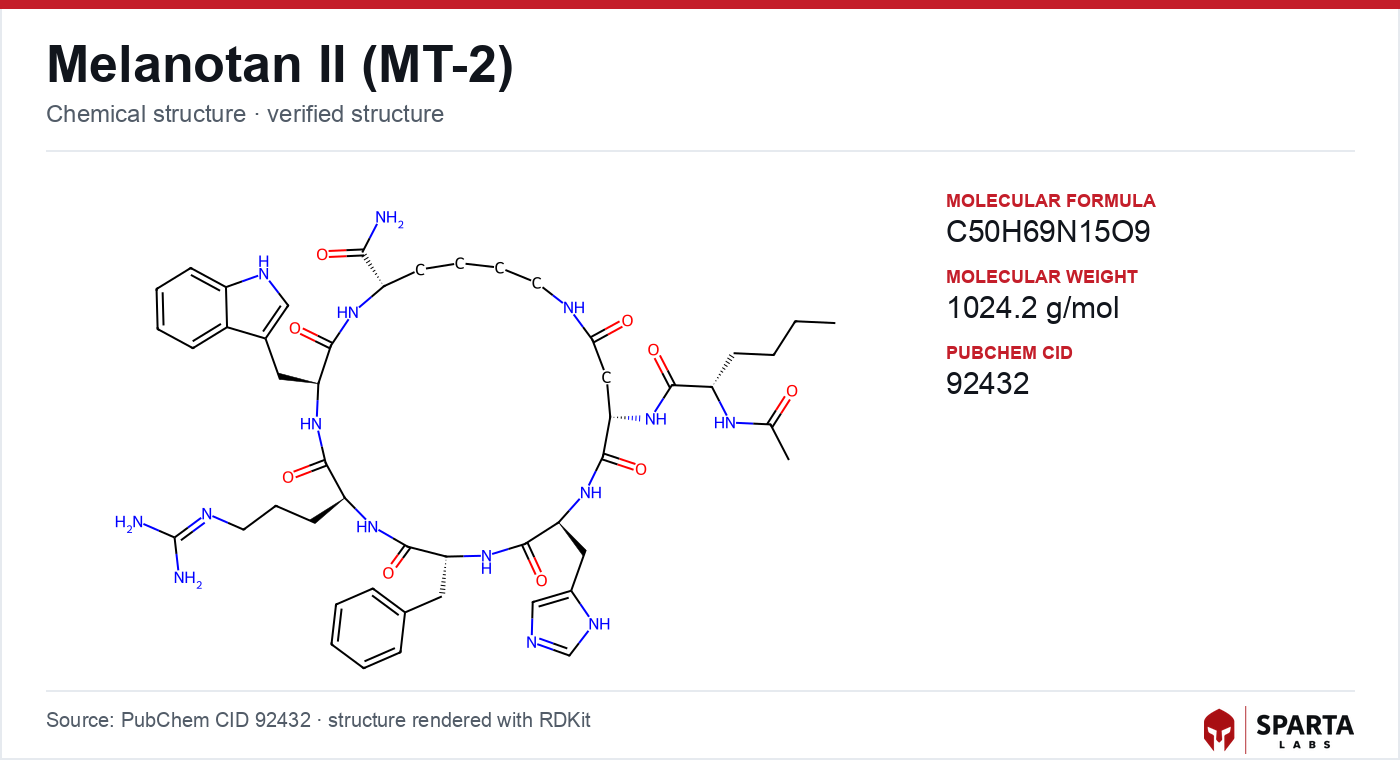
Figure: chemical structure of Melanotan II.
The Melanocortin System MT-II Was Built to Probe
To place MT-II in context, the receptor family it engages is worth describing on its own terms. The melanocortin peptides — α-MSH, β-MSH, γ-MSH, and adrenocorticotropic hormone (ACTH) — are all cleavage products of a single precursor protein, proopiomelanocortin (POMC). They signal through five G-protein-coupled receptors, MC1R through MC5R, each with a distinct tissue distribution: MC1R on melanocytes, MC2R restricted to the ACTH response in the adrenal cortex, MC3R and MC4R concentrated in the central nervous system, and MC5R in exocrine tissue [1].
The molecular cloning of this receptor family in 1992 by Mountjoy, Robbins, Mortrud, and Cone reframed melanocortin research from a hormone-centric to a receptor-centric discipline, and it created immediate demand for well-characterized agonists that could be applied across the newly identified subtypes [2]. MT-II was one of the tools that met that demand. Because α-MSH shares a conserved core pharmacophore — the His-Phe-Arg-Trp tetrapeptide — across the receptor family, an analog that stabilized this core in an active conformation could interrogate several receptors at once, which is precisely the property that made MT-II useful.
Cyclic Architecture and the Bioactive Conformation
MT-II is a cyclic heptapeptide with the sequence Ac-Nle4-c[Asp5-His6-D-Phe7-Arg8-Trp9-Lys10]-NH2, closed by a lactam bridge between the side chains of the aspartate at position 5 and the lysine at position 10 [3]. That lactam is the defining engineering decision. Rather than searching for potency by adding residues, the Arizona group removed degrees of freedom: by tethering the backbone into a ring, they locked the His-Phe-Arg-Trp pharmacophore into a conformation compatible with receptor binding, an approach known as conformational constraint.
Several substitutions distinguish MT-II from the parent α-MSH sequence, and each serves a specific chemical purpose:
- Norleucine at position 4 replaces methionine, eliminating a sulfur atom vulnerable to oxidation and metabolic turnover.
- D-phenylalanine at position 7 inverts the stereochemistry of a native L-residue, which both raises receptor affinity and blunts recognition by proteases that read L-configured backbones.
- The Asp5–Lys10 lactam bridge imposes the cyclic topology that fixes the active conformation.
- N-terminal acetylation and C-terminal amidation cap the peptide termini against exopeptidase cleavage.
The combined effect is a compact scaffold that resists the enzymatic degradation that limits native α-MSH. A preparative solution-phase route to MT-II, using orthogonal protecting groups and carbodiimide-mediated lactamization, was reported by Ryakhovsky and colleagues in 2008, demonstrating that the molecule could be assembled at scale without preparative chromatography [4]. Solid-phase peptide synthesis remains the more common laboratory route, and the analytical and purity considerations that follow from either method are treated in the sourcing and quality reference.
Pharmacological Classification: A Pan-Melanocortin Agonist
MT-II is classified as a non-selective melanocortin receptor agonist, with reported agonist activity at MC1R, MC3R, MC4R, and MC5R [1]. It does not appreciably engage MC2R, consistent with the observation that the ACTH receptor requires the full 39-residue ACTH sequence for recognition rather than the compact melanocortin core. At each receptor it engages, MT-II couples to the stimulatory G-protein (Gs), driving adenylyl cyclase activation and intracellular cyclic AMP (cAMP) accumulation [5].
This breadth is both the strength and the limitation of MT-II as a research tool. Its lack of subtype selectivity meant researchers could activate the melanocortin axis broadly, then attribute specific downstream effects to individual receptors using selective antagonists or genetically modified models rather than relying on the agonist itself to discriminate. As subtype-selective probes became available, MT-II retained a role as a reference full agonist against which newer, more selective ligands could be benchmarked.
From Laboratory Tool to Structural Ancestor of Bremelanotide
The Arizona program built on more than a decade of α-MSH structure-activity work stretching back into the 1970s and 1980s. MT-II's characterization as a high-potency cyclic agonist in the early 1990s was followed by a pilot phase I evaluation published by Dorr, Lines, Levine, Brooks, Xiang, Hruby, and Hadley in Life Sciences in 1996, which described MT-II pharmacodynamics in human research subjects under controlled conditions [3].
Findings from research models do not establish safety or efficacy in humans. Sparta Labs makes no claims about the use of this compound.
A 2006 review in Peptides by Hadley and Dorr traced the historical arc of MT-II and related melanocortin therapeutics, situating the compound within a translational lineage that ran from bench probe toward clinical candidate [6]. The clearest expression of that lineage is bremelanotide: a truncated MT-II analog in which the N-terminal norleucine is removed and a C-terminal hydroxyl replaces the amide. That structural relationship — one compound serving as the medicinal-chemistry starting point for another — is a recurring case study in melanocortin drug discovery, and it is discussed further in the companion PT-141 (bremelanotide) research overview.
Regulatory Standing
MT-II has not received approval from the United States Food and Drug Administration (FDA), the European Medicines Agency (EMA), or equivalent bodies in other major jurisdictions for any indication. It carries no approved human-use labeling and is handled as a research-use-only material.
Its structural descendant followed a different path. Bremelanotide (marketed as Vyleesi) received FDA approval in June 2019 under NDA 210557 for hypoactive sexual desire disorder in premenopausal women, establishing a regulatory precedent for melanocortin receptor agonism as a druggable mechanism [7]. The contrast is a useful reminder that a molecule's status as a research reagent is independent of the regulatory success of chemically related agents. Research-grade Melanotan-2 from Sparta Labs is produced by solid-phase peptide synthesis and characterized by third-party HPLC and mass spectrometry; the batch-verification workflow is detailed in the sourcing and quality reference.
References
-
Gantz I, Fong TM. The melanocortin system. Am J Physiol Endocrinol Metab. 2003;284(3):E468-74. PMID: 12556347. DOI: 10.1152/ajpendo.00524.2002. PubMed
-
Mountjoy KG, Robbins LS, Mortrud MT, Cone RD. The cloning of a family of genes that encode the melanocortin receptors. Science. 1992;257(5074):1248-51. PMID: 1325670. DOI: 10.1126/science.1325670. PubMed
-
Dorr RT, Lines R, Levine N, Brooks C, Xiang L, Hruby VJ, Hadley ME. Evaluation of melanotan-II, a superpotent cyclic melanotropic peptide in a pilot phase-I clinical study. Life Sci. 1996;58(20):1777-84. PMID: 8637402. DOI: 10.1016/0024-3205(96)00160-9. PubMed
-
Ryakhovsky VV, Khachiyan GA, Kosovova NF, Isamiddinova EF, Ivanov AS. The first preparative solution phase synthesis of melanotan II. Beilstein J Org Chem. 2008;4:39. PMID: 19043625. DOI: 10.3762/bjoc.4.39. PubMed
-
Sharma S, Garfield AS, Shah B, Kleyn P, Numao S, Costello DA, et al. Current mechanistic and pharmacodynamic understanding of melanocortin-4 receptor activation. Molecules. 2019;24(10):1892. PMID: 31100979. DOI: 10.3390/molecules24101892. PubMed
-
Hadley ME, Dorr RT. Melanocortin peptide therapeutics: historical milestones, clinical studies and commercialization. Peptides. 2006;27(4):921-30. PMID: 16412534. DOI: 10.1016/j.peptides.2005.01.029. PubMed
-
Kingsberg SA, Clayton AH, Portman D, Williams LA, Krop J, Jordan R, et al. Bremelanotide for the treatment of hypoactive sexual desire disorder: two randomized phase 3 trials. Obstet Gynecol. 2019;134(5):899-908. PMID: 31599840. DOI: 10.1097/AOG.0000000000003500. PubMed
Disclaimer. Statements in this article have not been evaluated by the Food and Drug Administration. This compound is not intended to diagnose, treat, cure, or prevent any disease. Sparta Labs sells research-use-only materials. Content is provided for educational and informational purposes only and does not constitute medical advice. Consult a qualified medical professional for any health concerns.
Frequently asked questions
What is Melanotan-2 (MT-II)?
Melanotan-2 is a synthetic cyclic heptapeptide classified as a non-selective melanocortin receptor agonist. It was developed at the University of Arizona by the Hruby and Hadley research group as a conformationally constrained, enzymatically stable analog of alpha-melanocyte-stimulating hormone (α-MSH). It has been widely used as a laboratory reference agonist for the melanocortin system.
What makes the structure of Melanotan-2 distinctive?
MT-II has the sequence Ac-Nle4-c[Asp5-His6-D-Phe7-Arg8-Trp9-Lys10]-NH2, closed by a lactam bridge between aspartate-5 and lysine-10. This cyclic constraint fixes the His-Phe-Arg-Trp pharmacophore in an active conformation, while a norleucine substitution, a D-phenylalanine, and capped termini add resistance to enzymatic degradation relative to native α-MSH.
Which melanocortin receptors does Melanotan-2 engage?
Published literature reports agonist activity at MC1R, MC3R, MC4R, and MC5R, coupling to the stimulatory Gs protein and cyclic AMP accumulation. It does not appreciably engage MC2R, the ACTH receptor, which requires the full 39-residue ACTH sequence for recognition.
How is Melanotan-2 related to bremelanotide (PT-141)?
Bremelanotide is a truncated analog of MT-II in which the N-terminal norleucine is removed and a C-terminal hydroxyl replaces the amide. This structural relationship is cited in the literature as an example of a research-tool compound serving as the medicinal-chemistry starting point for an eventually approved drug; bremelanotide received FDA approval in 2019.
Is Melanotan-2 approved by the FDA?
Melanotan-2 has not received approval from the FDA, the EMA, or equivalent regulators in other major jurisdictions for any indication. It carries no approved human-use labeling and is classified as a research-use-only material.