
Mazdutide: Discovery and Regulatory History
How mazdutide traveled from oxyntomodulin biology to an engineered GLP-1R/GCGR dual agonist: the proglucagon lineage, the two-name Lilly-Innovent development split, and the twin 2025 NMPA approvals. Educational reference.

For research use only. Not for human consumption.
This article is educational reference material. It is not medical advice and is not a recommendation to use any substance.
From a Gut Hormone to a Dual-Receptor Peptide
Mazdutide (development codes IBI362 and LY3305677) is a synthetic peptide characterized in the literature as a dual agonist of the glucagon-like peptide-1 receptor (GLP-1R) and the glucagon receptor (GCGR). Its story is unusual among modern metabolic peptides because it did not begin as a laboratory abstraction. The molecule descends conceptually from oxyntomodulin, a naturally occurring intestinal peptide that human physiology already uses to engage both of those receptors at once. This article traces that lineage from the endocrinology that framed the dual-receptor idea, through the engineering choices that turned a short-lived hormone into a long-acting research compound, to the split-territory development program that produced two regulatory approvals in China during 2025.
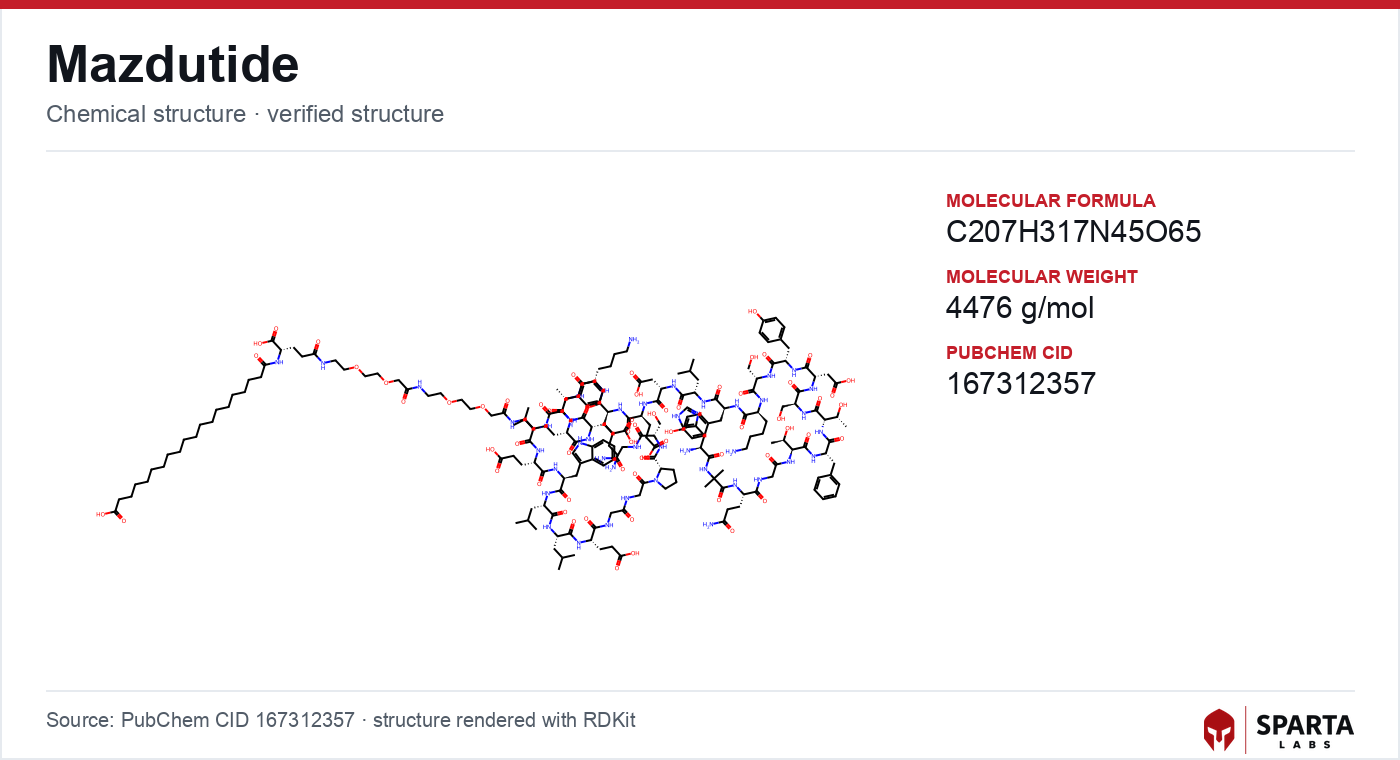
Figure: chemical structure of Mazdutide.
The Endocrine Groundwork: Two Receptors, One Proglucagon Gene
The scientific premise behind mazdutide rests on a genetic curiosity. Glucagon, GLP-1, and oxyntomodulin are all encoded by a single gene, proglucagon, and are liberated by tissue-specific post-translational processing. In the pancreatic alpha cell, processing yields glucagon; in intestinal L cells, the same precursor yields GLP-1 and oxyntomodulin. That shared origin meant that once each receptor was characterized, the possibility of a single molecule addressing more than one of them became a natural research question rather than a leap.
Glucagon was historically framed as the counter-regulatory partner to insulin. A review by Habegger and colleagues in Nature Reviews Endocrinology (2010) consolidated a broader account of glucagon receptor signaling, describing reported roles in hepatic energy and lipid metabolism that extended the hormone's characterization beyond glucose counter-regulation [1]. That reframing supplied part of the rationale for revisiting the glucagon receptor as a metabolic pharmacology target rather than a hazard to be avoided.
GLP-1 supplied the other half. Holst's synthesis of GLP-1 physiology in Physiological Reviews (2007) described the peptide as a glucose-dependent stimulator of insulin secretion produced by intestinal L cells, the foundation on which an entire class of GLP-1 receptor agonists was later built [2]. Mazdutide inherits this incretin arm; what distinguishes it is the deliberate retention of glucagon receptor activity alongside it.
Oxyntomodulin: The Natural Template
Oxyntomodulin is a 37-amino-acid proglucagon product co-secreted with GLP-1 after nutrient ingestion, and it engages both GLP-1R and GCGR in its native form. It is, in effect, a naturally occurring dual agonist, and it is the pharmacological template from which engineered analogs in this class are conceptually derived.
The pivotal early human evidence came from Wynne and colleagues, whose randomized, double-blind, placebo-controlled study in Diabetes (2005) reported that subcutaneous oxyntomodulin administration in overweight and obese participants was associated with changes in body weight and appetite relative to placebo, alongside measured differences in energy expenditure [3]. This was the clinical demonstration that a molecule engaging both receptors behaved differently from a selective incretin agent.
Findings from research models do not establish safety or efficacy in humans. Sparta Labs makes no claims about the use of this compound.
Native oxyntomodulin, however, was pharmacologically impractical as a durable research tool. Its circulating half-life is on the order of minutes, reflecting rapid inactivation by dipeptidyl peptidase-4 and related peptidases. That fragility is precisely the problem that later engineering set out to solve, and it explains why the dual-agonist concept sat dormant as a therapeutic idea for years after the biology was understood.
Turning the Concept Into a Molecule
The transition from oxyntomodulin biology to a usable dual-receptor peptide required preclinical validation that co-agonism produced distinct effects. Day and colleagues, publishing in Nature Chemical Biology (2009), described a rationally designed glucagon/GLP-1 co-agonist and reported metabolic outcomes in diet-induced obese rodent models that differed from those of selective GLP-1R agonism [4]. This work is frequently cited as the proof of principle that engineered co-agonists could reproduce and extend the oxyntomodulin effect in a stable molecular format.
Mazdutide itself was originated within Eli Lilly and Company's metabolic peptide pipeline under the designation LY3305677. Its structure follows a well-established durability strategy for peptide research agents: conjugation of a fatty-acid side chain through a linker, which promotes reversible binding to circulating albumin and thereby extends the plasma residence time far beyond that of the native hormone. The engineering objective was to preserve the dual-receptor pharmacology of oxyntomodulin while replacing its minutes-long half-life with one compatible with infrequent administration. The chemical and analytical characteristics of the research-grade compound are detailed in the mazdutide sourcing and quality reference, and its reported receptor pharmacology is described in the mazdutide mechanism of action article.
A Molecule With Two Names: The Lilly–Innovent Split
One reason mazdutide's paper trail can appear confusing is that the same compound carries two development codes. In 2019, Innovent Biologics, a biopharmaceutical company based in Suzhou, China, obtained rights from Eli Lilly to develop, manufacture, and commercialize the compound in China, where it was redesignated IBI362. Eli Lilly retained rights outside China, where the LY3305677 designation persisted.
This split produced a distinctive development topology. Chinese-population clinical data were generated under the Innovent program, while ex-China development proceeded separately under Lilly. Publications from the two arms therefore reference the same molecule under different codes, and the regulatory pathways advanced on separate timelines. For a researcher tracing the literature, recognizing that IBI362, LY3305677, and mazdutide denote one compound is essential to reconstructing the record without double-counting or missing studies.
The First Human Data
Published human pharmacology for the compound emerged from the Innovent program. Ji and colleagues reported a randomized, placebo-controlled, multiple-ascending-dose phase 1b study of IBI362 (LY3305677) in Chinese adults with overweight or obesity in eClinicalMedicine (2021), the first published clinical characterization of the peptide across ascending cohorts [5]. A companion phase 1b investigation in Chinese patients with type 2 diabetes was published by Jiang and colleagues in Nature Communications (2022), extending the early human dataset into a second research population [6].
These phase 1b reports established the compound's initial clinical profile and set the stage for the larger, endpoint-driven programs that followed. Notably, the first-in-human data for a Lilly-originated molecule appeared through a Chinese development partner, an inversion of the more familiar pattern in which multinational sponsors lead early-phase work in Western populations.
GLORY and DREAMS: Naming the Late-Stage Programs
The late-stage clinical program adopted two named study families that map onto mazdutide's two candidate indications. The GLORY series addressed chronic weight management in adults with overweight or obesity, while the DREAMS series addressed glycemic control in adults with type 2 diabetes. This bifurcation mirrors the dual-receptor rationale itself: the incretin arm anchors the diabetes program, while the combined incretin and glucagon activity underpins the weight-management program.
The naming convention matters for literature retrieval because trial acronyms, rather than the compound codes, often index the phase 3 results. A researcher scanning for late-stage mazdutide data who searches only on "IBI362" or "LY3305677" may miss records catalogued under GLORY or DREAMS. The broader research context for this multi-receptor design space, including related dual-hormone compounds, is outlined in the mazdutide research overview and, for a neighboring amylin-based agent, the cagrilintide history article.
Two Approvals in One Year: The NMPA Milestones
Mazdutide's regulatory record is anchored in China. A New Drug Application for the chronic weight management indication was accepted for review by China's National Medical Products Administration (NMPA), and on June 27, 2025, the NMPA granted approval for mazdutide, marketed in China under the brand name Xinermei, for chronic weight management in adults with overweight or obesity accompanied by at least one weight-related comorbidity [7]. This authorization is documented as the first approval of a GCG/GLP-1 dual receptor agonist for a weight-management indication.
A second approval followed the same year. On September 19, 2025, the NMPA granted authorization for mazdutide for glycemic control in adults with type 2 diabetes inadequately controlled despite lifestyle intervention [8]. Two approvals in distinct indications within a single calendar year reflect the parallel structure of the GLORY and DREAMS programs reaching the regulator in close succession. Batch-specific Certificate of Analysis documentation for the research form of the compound is provided on the mazdutide product page.
As of this writing, mazdutide has not received approval from the US Food and Drug Administration or the European Medicines Agency. Both remain active regulatory frontiers rather than completed milestones, and the ex-China development managed under the LY3305677 designation is the pathway most relevant to any future authorization outside China.
Where the Compound Sits in the Wider Landscape
Mazdutide belongs to a broader wave of multi-receptor incretin research. Its dual GLP-1R/GCGR design occupies the space between selective GLP-1 receptor agonists and triple-receptor agents that add a third target such as the glucose-dependent insulinotropic polypeptide (GIP) receptor. This positioning is clearest when mazdutide is read alongside the tirzepatide history, which traces a GLP-1/GIP dual agonist, and the retatrutide history, which follows a GLP-1/GIP/glucagon triple agonist. Together these timelines chart how the field has explored combinations of the same small set of metabolic receptors.
The enduring significance of mazdutide's history is that it closed a loop opened decades earlier. The dual-receptor effect first observed with a fragile natural hormone was reproduced in a stable, engineered peptide and carried through a full clinical program to regulatory authorization. For the research community, the record is a case study in how endocrine physiology, medicinal chemistry, and split-territory development can converge on a single molecule known by more than one name.
References
-
Habegger KM, Heppner KM, Geary N, Bartness TJ, DiMarchi R, Tschöp MH. The metabolic actions of glucagon revisited. Nat Rev Endocrinol. 2010;6(12):689-697. PMID: 21060334. DOI: 10.1038/nrendo.2010.187. PubMed
-
Holst JJ. The physiology of glucagon-like peptide 1. Physiol Rev. 2007;87(4):1409-1439. PMID: 17928588. DOI: 10.1152/physrev.00034.2006. PubMed
-
Wynne K, Park AJ, Small CJ, Patterson M, Ellis SM, Murphy KG, et al. Subcutaneous oxyntomodulin reduces body weight in overweight and obese subjects: a double-blind, randomized, controlled trial. Diabetes. 2005;54(8):2390-2395. PMID: 16046306. DOI: 10.2337/diabetes.54.8.2390. PubMed
-
Day JW, Ottaway N, Patterson JT, Gelfanov V, Smiley D, Gidda J, et al. A new glucagon and GLP-1 co-agonist eliminates obesity in rodents. Nat Chem Biol. 2009;5(10):749-757. PMID: 19668196. DOI: 10.1038/nchembio.209. PubMed
-
Ji L, Jiang H, Shi W, Wang H, Cheng Z, Pan T, et al. IBI362 (LY3305677), a weekly-dose GLP-1 and glucagon receptor dual agonist, in Chinese adults with overweight or obesity: a randomised, placebo-controlled, multiple ascending dose phase 1b study. eClinicalMedicine. 2021;40:101088. PMCID: PMC8374649. DOI: 10.1016/j.eclinm.2021.101088. PubMed
-
Jiang H, Pang S, Zhang Y, Liu J, Chen Y, Yang L, et al. A phase 1b randomised controlled trial of a glucagon-like peptide-1 and glucagon receptor dual agonist IBI362 (LY3305677) in Chinese patients with type 2 diabetes. Nat Commun. 2022;13(1):3613. PMCID: PMC9232612. DOI: 10.1038/s41467-022-31328-x. PubMed
-
Innovent Biologics, Inc. Innovent announces mazdutide, first dual GCG/GLP-1 receptor agonist, received approval from China's NMPA for chronic weight management. Press release. June 27, 2025. Announcement
-
Innovent Biologics, Inc. Innovent announces mazdutide received approval from China's NMPA for glycemic control in adults with type 2 diabetes. Press release. September 19, 2025. Announcement
Disclaimer. Statements in this article have not been evaluated by the Food and Drug Administration. This compound is not intended to diagnose, treat, cure, or prevent any disease. Sparta Labs sells research-use-only materials. Content is provided for educational and informational purposes only and does not constitute medical advice. Consult a qualified medical professional for any health concerns.
Frequently asked questions
What is the scientific origin of mazdutide?
Mazdutide descends conceptually from oxyntomodulin, a naturally occurring 37-amino-acid proglucagon product that engages both the GLP-1 receptor and the glucagon receptor. Human proof-of-concept for this dual-receptor activity was reported by Wynne and colleagues in Diabetes (2005), and Day and colleagues later described an engineered glucagon/GLP-1 co-agonist in Nature Chemical Biology (2009).
Why does mazdutide have two development codes?
Mazdutide was originated at Eli Lilly under the designation LY3305677. In 2019, Innovent Biologics obtained rights to develop and commercialize it in China, where it was redesignated IBI362, while Lilly retained rights outside China. As a result the same molecule appears in the literature under both codes and the name mazdutide.
What are the GLORY and DREAMS trials?
GLORY and DREAMS are the two named late-stage clinical program families for mazdutide. The GLORY series addressed chronic weight management in adults with overweight or obesity, and the DREAMS series addressed glycemic control in adults with type 2 diabetes, mapping onto the compound's two candidate indications.
What is the regulatory status of mazdutide?
China's NMPA granted approval for mazdutide for chronic weight management on June 27, 2025, and a second approval for glycemic control in type 2 diabetes on September 19, 2025. As of this writing the compound has not been approved by the US FDA or the European Medicines Agency.
How does mazdutide differ from tirzepatide and retatrutide?
Mazdutide is a dual agonist of the GLP-1 and glucagon receptors. Tirzepatide is a dual GLP-1/GIP agonist, and retatrutide is a triple GLP-1/GIP/glucagon agonist. All three explore combinations drawn from the same small set of metabolic receptors, differing in which receptors they engage.