
Retatrutide: Discovery and Regulatory History
Retatrutide (LY3437943) traced through the discovery timelines of its three parent hormones — glucagon, GIP, and GLP-1 — the unimolecular co-agonist chemistry that unified them, and its clinical development record. Educational reference.

For research use only. Not for human consumption. This article is educational reference material. It is not medical advice and is not a recommendation to use any substance.
Introduction
Retatrutide (development code LY3437943) is an investigational synthetic peptide developed by Eli Lilly and Company and classified pharmacologically as a single molecule that engages three receptors simultaneously: the glucagon receptor (GCGR), the glucose-dependent insulinotropic polypeptide receptor (GIPR), and the glucagon-like peptide-1 receptor (GLP-1R). Unlike compounds whose stories begin with a single discovery event, retatrutide sits at the convergence of three separate hormone-discovery timelines that unfolded across roughly seven decades of endocrinology. This history article traces those three lineages, then follows how the peptide chemistry that unified them progressed from proof-of-concept co-agonists into a registered clinical program.
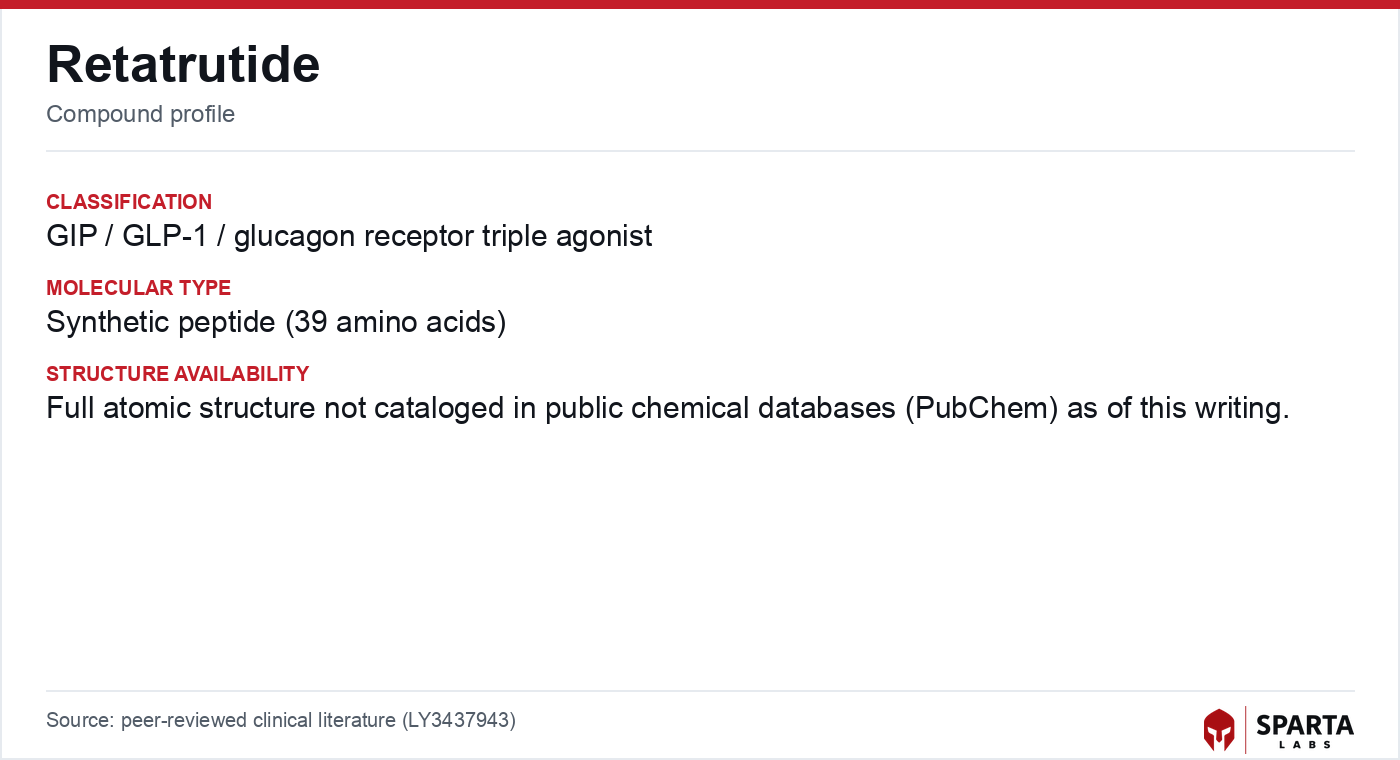
Figure: chemical structure of Retatrutide.
Three Hormones, Three Timelines
Retatrutide's design cannot be understood without the sequence in which its three target hormones entered the scientific record. Each was isolated by a different group, in a different decade, for a different physiological question.
Glucagon (1920s isolation, 1955 crystallization)
Glucagon was the earliest of the three to be recognized. Its hyperglycemic activity was noted in the 1920s alongside the isolation of insulin, but a purified, crystalline preparation was not obtained until Staub, Sinn, and Behrens reported the purification and crystallization of glucagon from pancreatic extracts in 1955, establishing it as a discrete polypeptide distinct from insulin.[1] Subsequent work over the following decades characterized glucagon's role in hepatic glucose output through glycogenolysis and gluconeogenesis, and the eventual molecular cloning of the glucagon receptor provided the pharmacological framework later exploited by GCGR-containing multi-agonists.
GIP (early 1970s)
Glucose-dependent insulinotropic polypeptide was characterized in the early 1970s as a gut-derived peptide that stimulates insulin secretion under hyperglycemic conditions. Its identification as a hormone secreted by intestinal K cells in response to nutrient ingestion made it one of the two classical incretin hormones. The later cloning and expression of the human GIP receptor enabled the receptor-pharmacology studies that would eventually inform GIPR-targeting peptide design.
GLP-1 (1980s)
Glucagon-like peptide-1 was the last of the three to be defined, emerging from molecular studies of the proglucagon gene in the 1980s. Investigators established that tissue-specific processing of proglucagon in intestinal L cells yields GLP-1, a glucose-dependent insulinotropic peptide. A pivotal pharmacological bridge came from an unrelated source: exendin-4, a peptide isolated from the venom of the Gila monster (Heloderma suspectum), was shown to be a potent, protease-resistant GLP-1 receptor agonist,[2] furnishing the chemical proof-of-concept for a durable GLP-1R agonist and seeding the entire incretin-therapeutics field.
Findings from research models do not establish safety or efficacy in humans. Sparta Labs makes no claims about the use of this compound.
From Single Targets to Unimolecular Co-Agonism
Through the 2000s, incretin pharmacology advanced one receptor at a time. Exenatide, a synthetic form of exendin-4, became the first GLP-1 receptor agonist to reach the US market in 2005, followed by longer-acting acylated or fusion-based GLP-1R agonists. The parallel history of retatrutide diverges from this single-receptor path with a conceptual shift published in the early 2010s: the idea that one peptide could be engineered to engage multiple metabolic receptors at once.
Finan and colleagues reported a unimolecular dual GIP/GLP-1 co-agonist that produced metabolic effects in rodent and primate models exceeding those of the individual agonists, providing the foundational demonstration that balanced multi-receptor engagement in a single peptide was chemically achievable.[3] The same research lineage extended the concept to a triple agonist: Finan and colleagues subsequently described a single peptide integrating GIP, GLP-1, and glucagon receptor activity, reporting metabolic effects in obese rodent models and establishing the triple-agonist scaffold as a distinct pharmacological category.[4] These reports reframed glucagon receptor agonism, historically associated with raising blood glucose, as a component that could be balanced within an incretin backbone rather than avoided.
The connective tissue between this academic proof-of-concept and retatrutide was Eli Lilly's own dual-agonist program, which produced tirzepatide, a GIP/GLP-1 receptor agonist that supplied clinical validation for unimolecular multi-receptor pharmacology. Layering glucagon receptor agonism onto that validated dual scaffold produced LY3437943.
LY3437943 Enters the Clinical Record
The compound's formal entry into the peer-reviewed clinical literature came in 2022. Urva, Coskun, and colleagues reported a phase 1b, multicenter, double-blind, placebo-controlled, randomized, multiple-ascending-dose trial of LY3437943 in adults with type 2 diabetes, published in The Lancet.[5] The report characterized the pharmacokinetic profile as consistent with once-weekly administration and provided the first human safety and pharmacodynamic data for the molecule. This publication marks the transition point at which retatrutide's history stops being a story about its three parent hormones and becomes a story about the compound itself.
Phase 2: A Rapid Multi-Population Data Package
Retatrutide's phase 2 program accumulated an unusually broad published record in a compressed window, extending across three distinct research populations.
Jastreboff, Kaplan, Frías, and colleagues reported a 48-week phase 2 double-blind, randomized, placebo-controlled trial in adults with obesity or overweight in the New England Journal of Medicine in 2023 (registered as NCT04881760).[6] In the same year, Rosenstock, Frías, Jastreboff, and colleagues reported a phase 2 randomized, double-blind, placebo- and active-controlled trial in adults with type 2 diabetes in The Lancet, using dulaglutide as an active comparator.[7] The following year, Sanyal, Kaplan, Frías, and colleagues extended the compound's published profile to a third population and a distinct tissue endpoint, reporting a phase 2a trial in metabolic dysfunction-associated steatotic liver disease (MASLD) in Nature Medicine.[8]
The chemistry lineage of the earlier discovery period ran alongside the clinical program throughout: readers tracing how a single peptide can occupy three receptors may find the pharmacology context in the companion retatrutide mechanism of action article, while the broader development picture is summarized in the retatrutide research overview.
Phase 3 Registration and Current Investigational Status
Following the phase 2 data package, Eli Lilly registered a phase 3 program spanning multiple metabolic indications. The obesity-focused trials were organized under the TRIUMPH program, and the type 2 diabetes trials under the TRANSCEND program, with additional registered studies examining populations such as adults with obesity and knee osteoarthritis. This registration footprint reflects an investigational scope that spans several distinct research questions rather than a single indication.
As of this writing, retatrutide remains an investigational compound. It has not received regulatory approval from the FDA or any comparable authority for any therapeutic indication, and its safety and efficacy in humans are still the subject of ongoing controlled trials. Its position in the broader class can be contrasted with related incretin-based investigational peptides such as mazdutide and cagrilintide, each of which follows a distinct receptor-pharmacology and development history. Research-grade retatrutide from Sparta Labs is supplied for laboratory investigational use with third-party analytical documentation.
References
-
Staub A, Sinn L, Behrens OK. Purification and crystallization of glucagon. J Biol Chem. 1955;214(2):619-632. PMID: 14367373. PubMed
-
Eng J, Kleinman WA, Singh L, Singh G, Raufman JP. Isolation and characterization of exendin-4, an exendin-3 analogue, from Heloderma suspectum venom. Further evidence for an exendin receptor on dispersed acini from guinea pig pancreas. J Biol Chem. 1992;267(11):7402-7405. PMID: 1313797. PubMed
-
Finan B, Ma T, Ottaway N, Müller TD, Habegger KM, Heppner KM, et al. Unimolecular dual incretins maximize metabolic benefits in rodents, monkeys, and humans. Sci Transl Med. 2013;5(209):209ra151. PMID: 24174327. DOI: 10.1126/scitranslmed.3007218. PubMed
-
Finan B, Yang B, Ottaway N, Smiley DL, Ma T, Clemmensen C, et al. A rationally designed monomeric peptide triagonist corrects obesity and diabetes in rodents. Nat Med. 2015;21(1):27-36. PMID: 25485909. DOI: 10.1038/nm.3761. PubMed
-
Urva S, Coskun T, Loh MT, Du Y, Thomas MK, Gurbuz S, et al. LY3437943, a novel triple GIP, GLP-1, and glucagon receptor agonist in people with type 2 diabetes: a phase 1b, multicentre, double-blind, placebo-controlled, randomised, multiple-ascending dose trial. Lancet. 2022;400(10366):1869-1881. PMID: 36354040. DOI: 10.1016/S0140-6736(22)02033-5. PubMed
-
Jastreboff AM, Kaplan LM, Frías JP, Wu Q, Du Y, Gurbuz S, et al. Triple-hormone-receptor agonist retatrutide for obesity — a phase 2 trial. N Engl J Med. 2023;389(6):514-526. PMID: 37366315. DOI: 10.1056/NEJMoa2301972. PubMed
-
Rosenstock J, Frías JP, Jastreboff AM, Du Y, Lou J, Gurbuz S, et al. Retatrutide, a GIP, GLP-1 and glucagon receptor agonist, for people with type 2 diabetes: a randomised, double-blind, placebo and active-controlled, parallel-group, phase 2 trial conducted in the USA. Lancet. 2023;402(10401):529-544. PMID: 37385280. DOI: 10.1016/S0140-6736(23)01053-X. PubMed
-
Sanyal AJ, Kaplan LM, Frías JP, Brouwers B, Wu Q, Thomas MK, et al. Triple hormone receptor agonist retatrutide for metabolic dysfunction-associated steatotic liver disease: a randomized phase 2a trial. Nat Med. 2024;30(7):2037-2048. PMID: 38858523. DOI: 10.1038/s41591-024-03018-2. PubMed
Disclaimer. Statements in this article have not been evaluated by the Food and Drug Administration. This compound is not intended to diagnose, treat, cure, or prevent any disease. Sparta Labs sells research-use-only materials. Content is provided for educational and informational purposes only and does not constitute medical advice. Consult a qualified medical professional for any health concerns.
Frequently asked questions
What are the origins of retatrutide's three receptor targets?
Retatrutide engages the glucagon, GIP, and GLP-1 receptors, three targets discovered across separate timelines. Glucagon was crystallized as a distinct polypeptide in 1955, GIP was characterized as an incretin hormone in the early 1970s, and GLP-1 was defined through proglucagon gene studies in the 1980s. Retatrutide's design brings all three receptor pharmacologies into a single peptide.
How did the triple-agonist concept behind retatrutide develop?
The concept grew out of unimolecular co-agonist chemistry published in the early 2010s. Researchers first reported a single peptide combining GIP and GLP-1 receptor activity, then extended it to a triple agonist adding glucagon receptor activity. Eli Lilly's dual GIP/GLP-1 agonist tirzepatide provided the validated scaffold onto which glucagon receptor activity was added to yield LY3437943.
When did retatrutide enter the clinical literature?
LY3437943 first appeared in the peer-reviewed clinical record in 2022, with a phase 1b multiple-ascending-dose trial in adults with type 2 diabetes published in The Lancet. Phase 2 trial reports followed in the New England Journal of Medicine and The Lancet in 2023, and a phase 2a MASLD trial appeared in Nature Medicine in 2024.
Is retatrutide an approved drug?
No. As of this writing retatrutide remains an investigational compound and has not received FDA approval or approval from any comparable authority for any therapeutic indication. Its safety and efficacy in humans are still under study in ongoing controlled clinical trials.