
MOTS-c: Published Research
A structured survey of the peer-reviewed MOTS-c literature, organized by the three molecular mechanisms uncovered since its 2015 discovery as a mitochondrial-derived peptide: folate-AICAR-AMPK signaling, stress-induced nuclear translocation, and CK2 binding, alongside exercise and human observational data.

For research use only. Not for human consumption. This article is educational reference material. It is not medical advice and is not a recommendation to use any substance.
Introduction
MOTS-c (mitochondrial open reading frame of the 12S rRNA-c) is a 16-amino-acid peptide encoded within the mitochondrial genome rather than the nuclear genome, a property that placed it in the emerging category of mitochondrial-derived peptides when it was first characterized in 2015. Since that initial report, the peer-reviewed literature has expanded along a distinctive arc: rather than a single mechanism, three separable molecular activities have been described in sequence across the past decade, alongside a smaller set of human observational measurements. This article organizes the published record by that mechanistic arc and attributes each finding to its source investigation. No independent claims are made by Sparta Labs. Broader pharmacological framing is covered in the MOTS-c mechanism of action article, and discovery context in the MOTS-c research overview.
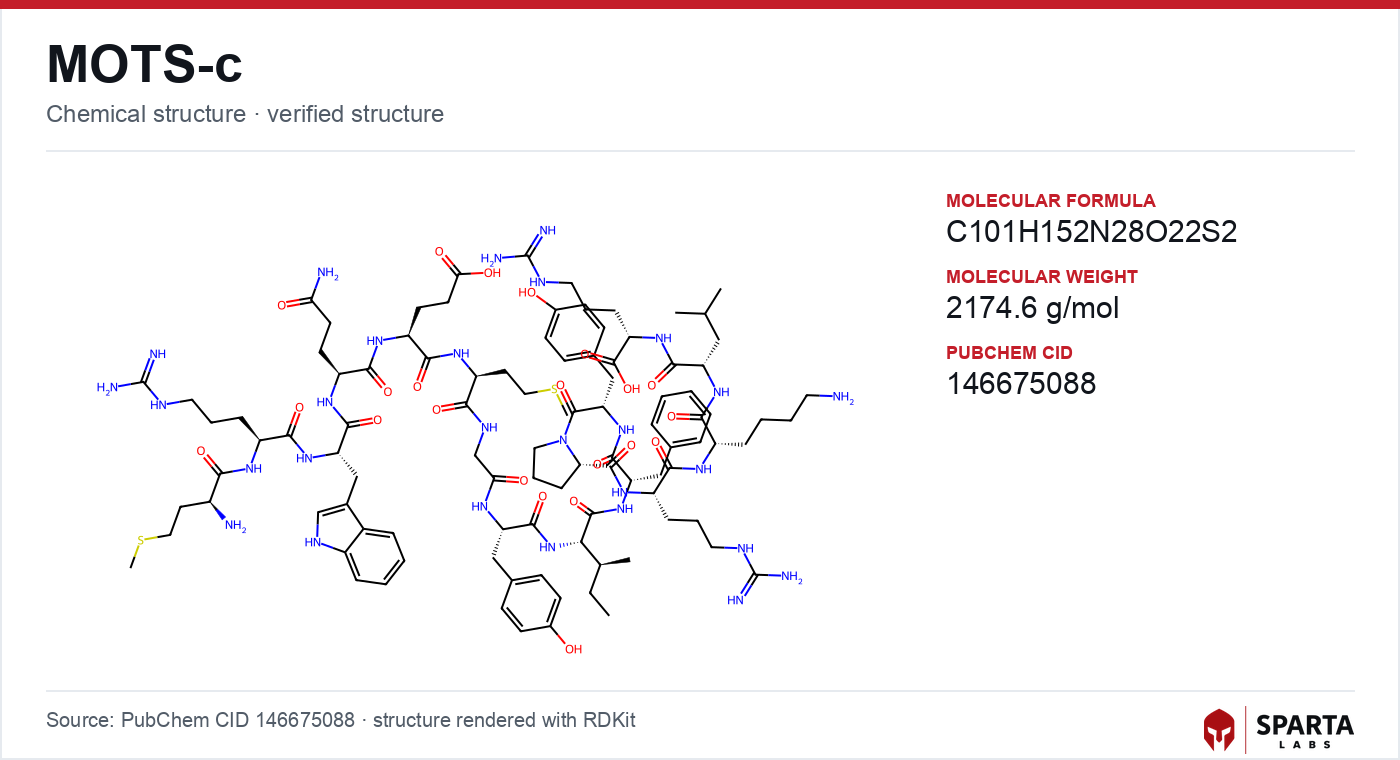
Figure: chemical structure of MOTS-c.
What the Literature Covers, and What It Does Not
Before summarizing findings, it is worth mapping the shape of the evidence. Published MOTS-c work falls into three tiers. The largest tier is mechanistic cell-culture work in human and rodent lines (HEK293, primary myocytes, adipocytes, alveolar epithelial and immune cell types). The second tier is rodent physiology using diet-induced obesity, genetic obesity, aging, radiation, and exercise paradigms. The third and smallest tier is human observational data: cross-sectional measurements of endogenous MOTS-c in plasma and skeletal muscle biopsy material, plus one acute exercise study.
A notable gap defines the field. As reflected in the current literature, interventional human pharmacology of exogenously administered MOTS-c has not been reported in peer-reviewed form. The existing record is therefore a preclinical and observational foundation rather than a clinical one, and every finding below should be read in that light.
Mechanism One: Folate-AICAR-AMPK Signaling (2015)
The foundational study by Lee, Zeng, Drew, Sallam, and colleagues at the University of Southern California and the National Institute on Aging identified MOTS-c from a systematic screen of mitochondrial short open reading frames and published it in Cell Metabolism [1]. In HEK293 cell culture, synthetic MOTS-c produced a large accumulation of endogenous AICAR, an intermediate consistent with inhibition of the folate cycle. AMPK activation, a central sensor of cellular energy state, was observed in both HEK293 cells and mouse skeletal muscle following peripheral administration.
Findings from research models do not establish safety or efficacy in humans. Sparta Labs makes no claims about the use of this compound.
Across normal-chow, high-fat-diet, and genetically obese (ob/ob) rodent models, MOTS-c-treated animals displayed altered glucose tolerance, adiposity, and insulin tolerance outcomes relative to vehicle controls, with effects dependent on intact skeletal muscle AMPK signaling. The authors characterized these strictly as preclinical findings and did not extend conclusions to human therapeutic potential. This paper established the peptide's first mechanistic identity as a metabolic regulator acting through a folate-AICAR-AMPK axis.
A 2019 Physiological Reports study from the same research group used plasma metabolomics in mice to describe the systemic footprint of MOTS-c administration [2]. Sphingolipid, monoacylglycerol, and dicarboxylate metabolism pathways were reported at lower levels in treated animals relative to controls. The authors noted that these pathways are elevated in published metabolomics of obese and diabetic rodent models, and proposed a link to the insulin-sensitivity observations of the 2015 study while identifying causality as a matter for future work.
Mechanism Two: Stress-Induced Nuclear Translocation (2018)
A 2018 Cell Metabolism paper by Kim, Son, Benayoun, and Lee reported a second, structurally distinct activity [3]. Under glucose restriction, serum deprivation, and oxidative stress, MOTS-c was observed translocating from the cytoplasm to the nucleus, with nuclear accumulation detectable within roughly 30 minutes of stress induction. In the nucleus, the peptide was reported to associate with antioxidant response element (ARE) sequences and to interact with the transcription factor NRF2. RNA-sequencing showed differential expression of a broad stress-response gene set in treated versus control cells, and pharmacological AMPK inhibition attenuated the nuclear localization.
The authors framed this as mitochondrial-to-nuclear retrograde communication, and it stands as one of the earlier demonstrations that a mitochondrially encoded molecule participates directly in nuclear gene regulation under stress. This mechanism connects MOTS-c to the same NRF2-centered oxidative-stress machinery studied for other mitochondrially oriented compounds; the SS-31 (Elamipretide) research overview discusses a separate peptide investigated in adjacent mitochondrial contexts.
A 2024 Antioxidants paper extended the NRF2 thread into a rodent radiation-induced pneumonitis model [4]. Treated animals showed lower lung injury scores and reduced inflammatory and oxidative markers relative to irradiated controls; addition of the NRF2 pathway inhibitor ML385 blunted these effects, and irradiated alveolar epithelial cells replicated the NRF2-dependence in vitro. All observations were in animal or cell models, and the authors identified human relevance as a direction for future investigation.
Mechanism Three: Direct CK2 Binding and Human Genetics (2024)
The most recent mechanistic identity was reported in a 2024 iScience study by Zhu, Qian, Joly, Lu, Mehta, Cohen, and Lee [5]. Using pull-down assays and cell-free kinase systems, the authors reported direct binding of MOTS-c to casein kinase 2 (CK2). The reported effect was tissue-divergent: CK2 activity was described as increased in muscle but suppressed in adipose tissue, attributed to differing CK2-interacting protein partners at each site.
The study also identified a naturally occurring human sequence variant, K14Q MOTS-c, with reduced CK2 binding. In a genotyped cohort, male carriers showed a statistically higher association with sarcopenia and type 2 diabetes in an age- and physical-activity-dependent manner. The authors interpreted this as the strongest human genetic evidence reported to date linking endogenous MOTS-c-CK2 signaling to musculoskeletal and metabolic phenotypes. This variant is an important detail for researchers, because it anchors an otherwise cell-culture-heavy mechanism to a human genetic observation.
Exercise, Aging, and Skeletal Muscle
A 2021 Nature Communications publication by Reynolds, Lai, Woodhead, and colleagues, including Cohen and Lee, examined MOTS-c in relation to exercise and age in both mouse models and human subjects [6]. In mouse experiments, MOTS-c administration was associated with higher grip-strength and running-capacity outcomes across young, middle-aged, and old animals relative to vehicle controls, with several parameters described as showing larger differences in older animals.
The human arm of the study followed 10 healthy young men through an acute stationary cycling bout. Skeletal muscle biopsy analysis reported an approximately 11.9-fold rise in intramuscular MOTS-c expression and an approximately 1.6-fold rise in circulating plasma levels. The authors described these findings as consistent with a role for endogenous MOTS-c in physiological adaptation to exercise. Because this arm measured endogenous responses rather than administered peptide, it is best read as evidence about MOTS-c biology in humans rather than about any intervention.
Human Observational Data on Circulating Levels
Independent groups have published cross-sectional analyses of endogenous MOTS-c in human cohorts. An early observational report by Fuku and colleagues described age-related patterns in MOTS-c levels and raised a hypothesis linking mitochondrial 12S rRNA (MT-RNR1) variation to longevity phenotypes, framing MOTS-c as a candidate player in exceptional longevity that subsequent genetic research has continued to investigate [7].
These human measurements are hypothesis-generating rather than confirmatory. They characterize how endogenous MOTS-c varies across age and physiology, which informs the design of future interventional studies but does not establish effects of administered peptide. The interplay between endogenous cellular energy metabolism and mitochondrial signaling is a shared theme with related library material, including the NAD+ published research summary.
Synthesis and Open Questions
The MOTS-c literature is unusual in that its three reported mechanisms, folate-AICAR-AMPK activation, stress-induced NRF2-linked nuclear gene regulation, and CK2 binding, were uncovered in sequence rather than at once, and their integration is not yet fully resolved. A 2023 review by Wan and colleagues in the Journal of Translational Medicine synthesizes these strands and frames the field's priorities: reconciling the three mechanisms, identifying any cell-surface uptake pathway that could explain tissue selectivity, and moving from observational human data toward interventional pharmacokinetics [8].
Researchers assembling material for work in these directions can review current batch documentation on the MOTS-c product page. For a structured account of how the peptide was discovered and how its research context developed, the MOTS-c discovery and regulatory history article provides a complementary timeline.
References
-
Lee C, Zeng J, Drew BG, Sallam T, Martin-Montalvo A, Wan J, Kim SJ, Mehta H, Hevener AL, de Cabo R, Cohen P. The mitochondrial-derived peptide MOTS-c promotes metabolic homeostasis and reduces obesity and insulin resistance. Cell Metab. 2015 Mar 3;21(3):443–454. doi: 10.1016/j.cmet.2015.02.009. PMID: 25738459. View on PubMed
-
Kim SJ, Miller B, Mehta HH, Xiao J, Wan J, Arpawong TE, Yen K, Cohen P. The mitochondrial-derived peptide MOTS-c is a regulator of plasma metabolites and enhances insulin sensitivity. Physiol Rep. 2019 Jul;7(13):e14171. doi: 10.14814/phy2.14171. PMID: 31318170. View on PubMed
-
Kim KH, Son JM, Benayoun BA, Lee C. The mitochondrial-encoded peptide MOTS-c translocates to the nucleus to regulate nuclear gene expression in response to metabolic stress. Cell Metab. 2018 Sep 4;28(3):516–524.e7. doi: 10.1016/j.cmet.2018.06.015. PMID: 29983246. View on PubMed
-
Zhang Y, Huang J, Zhang Y, Jiang F, Li S, He S, Sun J, Chen D, Tong Y, Pang Q, Wu Y. The mitochondrial-derived peptide MOTS-c alleviates radiation pneumonitis via an Nrf2-dependent mechanism. Antioxidants (Basel). 2024 May 17;13(5):613. doi: 10.3390/antiox13050613. PMID: 38790718. View on PubMed
-
Zhu Z, Qian M, Joly JH, Lu R, Mehta HH, Cohen P, Lee C. MOTS-c modulates skeletal muscle function by directly binding and activating CK2. iScience. 2024 Oct 19;27(11):111215. doi: 10.1016/j.isci.2024.111215. PMID: 39559755. View on PubMed
-
Reynolds JC, Lai RW, Woodhead JST, Joly JH, Mitchell CJ, Cameron-Smith D, Lu R, Cohen P, Graham NA, Benayoun BA, Merry TL, Lee C. MOTS-c is an exercise-induced mitochondrial-encoded regulator of age-dependent physical decline and muscle homeostasis. Nat Commun. 2021 Jan 20;12(1):470. doi: 10.1038/s41467-020-20790-0. PMID: 33473109. View on PubMed
-
Fuku N, Pareja-Galeano H, Zempo H, Alis R, Arai Y, Lucia A, Hirose N. The mitochondrial-derived peptide MOTS-c: a player in exceptional longevity? Aging Cell. 2015 Dec;14(6):921–923. doi: 10.1111/acel.12389. PMID: 26332820. View on PubMed
-
Wan W, Zhang L, Lin Y, Rao X, Wang X, Hua F, Ying J. Mitochondria-derived peptide MOTS-c: effects and mechanisms related to stress, metabolism and aging. J Transl Med. 2023 Jan 20;21(1):36. doi: 10.1186/s12967-023-03885-2. PMID: 36670507. View on PubMed
Disclaimer. Statements in this article have not been evaluated by the Food and Drug Administration. This compound is not intended to diagnose, treat, cure, or prevent any disease. Sparta Labs sells research-use-only materials. Content is provided for educational and informational purposes only and does not constitute medical advice. Consult a qualified medical professional for any health concerns.
Frequently asked questions
Where did MOTS-c come from, and why is it unusual among peptides?
MOTS-c is a mitochondrial-derived peptide: it is encoded within the mitochondrial 12S rRNA (MT-RNR1) region rather than the nuclear genome, and was characterized by Lee and colleagues in a 2015 Cell Metabolism study. This origin makes it one of a small set of short peptides translated from short open reading frames inside mitochondrial DNA, which is part of why it drew broad research interest in metabolic and aging biology.
What are the main molecular mechanisms reported for MOTS-c in the literature?
Three mechanisms have been described across separate papers. The 2015 discovery study reported folate-cycle and AICAR-associated AMPK activation. A 2018 Cell Metabolism study reported stress-induced translocation of MOTS-c to the nucleus, where it was observed interacting with NRF2 and antioxidant response element sequences. A 2024 iScience study reported direct binding to casein kinase 2 (CK2). These are attributed findings from research models, not established human effects.
Has MOTS-c been studied in humans?
Published human data are observational. Groups have measured endogenous circulating and intramuscular MOTS-c across age groups, and an acute cycling study measured endogenous MOTS-c responses to exercise in a small cohort of healthy young men. As reflected in the current literature, interventional human pharmacology of administered MOTS-c has not been reported in peer-reviewed form.
What did the 2021 Reynolds et al. study report about MOTS-c and exercise?
The 2021 Nature Communications study examined MOTS-c in relation to exercise and age in mouse models and included an acute cycling bout in ten healthy young men. Skeletal muscle biopsy analysis reported an approximately 11.9-fold rise in intramuscular MOTS-c expression and an approximately 1.6-fold rise in circulating plasma levels. The authors framed these as consistent with a role for endogenous MOTS-c in physiological adaptation to exercise.