
N-Acetyl Semax Amidate: A Research Overview
How dual terminal modification distinguishes N-Acetyl Semax Amidate from Semax: acetylation and amidation chemistry, ACTH(4-10) lineage, melanocortin classification, and US regulatory status. Educational reference.
For research use only. Not for human consumption. This article is educational reference material. It is not medical advice and is not a recommendation to use any substance.
Introduction
N-Acetyl Semax Amidate (Ac-Met-Glu-His-Phe-Pro-Gly-Pro-NH₂) is a synthetic heptapeptide belonging to the family of analogs built on the adrenocorticotropic hormone fragment ACTH(4–10). It preserves the seven-residue backbone of Semax and modifies only the two chain ends. This article approaches the compound through the specific structural question that defines it: what changes when both termini of a Semax-type peptide are chemically protected, and how that places the molecule within melanocortin pharmacology and US regulatory context. The framing throughout is descriptive rather than evaluative, consistent with reporting published literature.
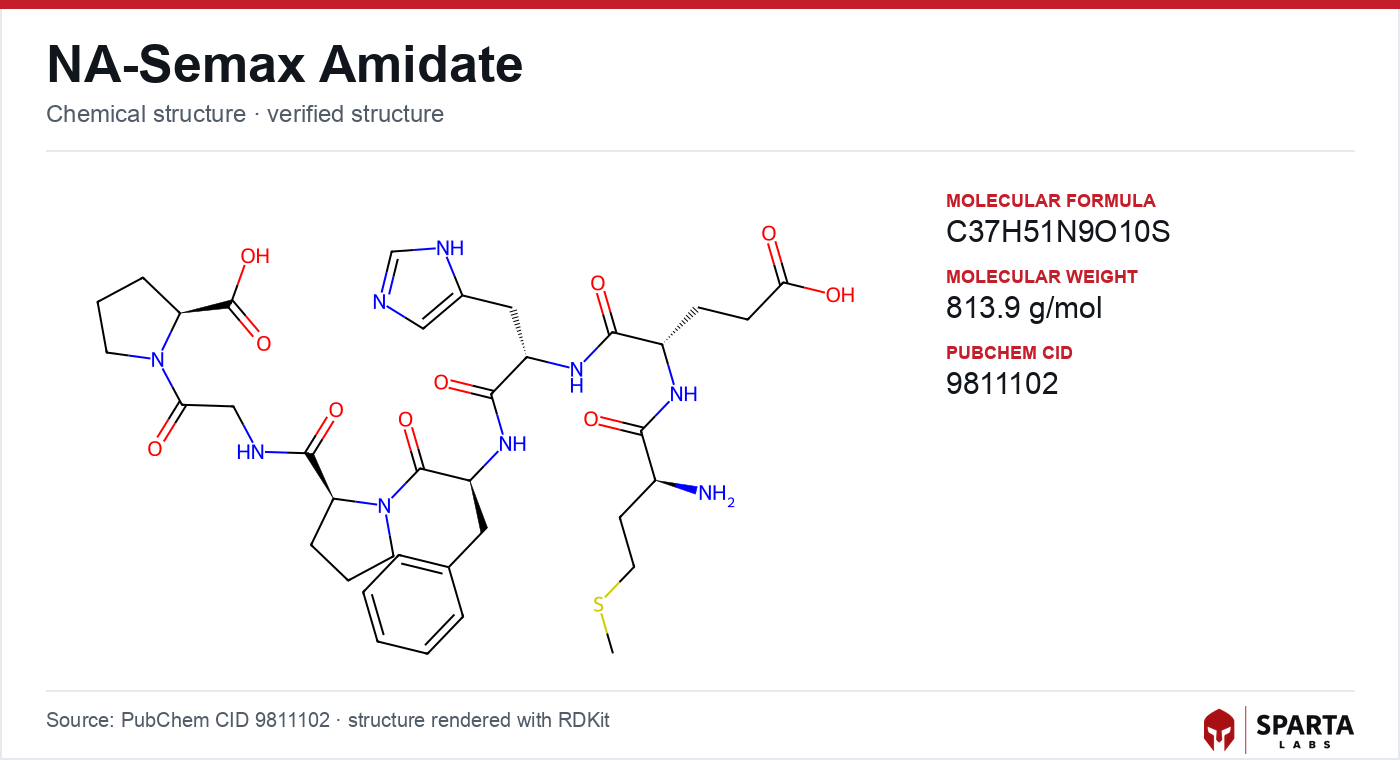
Figure: chemical structure of NA-Semax Amidate.
From ACTH to a Terminally Protected Heptapeptide
The scientific lineage of this compound runs through several decades of work on fragments of adrenocorticotropic hormone (ACTH), a 39-residue peptide processed from the proopiomelanocortin (POMC) precursor. Investigators observed in the mid-twentieth century that certain sub-sequences of ACTH retained behavioral and neurotrophic activity in animal models while lacking the adrenal steroidogenic action of the full hormone. The seven-residue span Met-Glu-His-Phe-Pro-Gly-Pro — ACTH(4–10) — became a focal point of that inquiry [1].
Semax was developed on this scaffold in the 1980s under the direction of Nikolai F. Myasoedov and Igor P. Ashmarin at the Institute of Molecular Genetics of the Russian Academy of Sciences and Moscow State University. It was designed by appending Pro-Gly-Pro to the ACTH(4–10) core to slow degradation of the parent fragment [1]. N-Acetyl Semax Amidate takes a different structural approach to the same stability problem: rather than extending the chain, it caps the existing termini. The compound sits alongside other analogs from the same Russian neuropeptide tradition, such as N-Acetyl Selank Amidate, which applies an analogous terminal-modification strategy to a distinct parent sequence.
The Chemistry of Dual Terminal Modification
The defining feature of N-Acetyl Semax Amidate is that its seven-residue sequence is identical to Semax, while both chain ends are chemically altered. Each modification changes a different reactive group.
N-terminal acetylation
The free alpha-amino group of the N-terminal methionine is replaced by an acetyl group (CH₃CO–). Beyond removing the positively charged amino terminus, this modification has documented consequences for how the peptide interacts with biologically relevant metals. Magrì and colleagues (2016) characterized the copper(II) and zinc(II) coordination chemistry of Semax and its N-acetylated form, reporting that acetylation shifts the coordination geometry at the copper center away from the arrangement observed with free Semax and alters the peptide's metal-binding behavior at physiological pH [2].
Findings from research models do not establish safety or efficacy in humans. Sparta Labs makes no claims about the use of this compound.
Because the imidazole side chain of the histidine residue and the peptide-bond nitrogens participate in metal coordination, the state of the N-terminus is one determinant of the overall binding mode. Acetylation is therefore relevant not only to enzymatic stability but to the compound's coordination chemistry as characterized in that work [2].
C-terminal amidation
The carboxyl group of the C-terminal proline is converted to a primary amide (–NH₂). C-terminal amidation is a naturally occurring post-translational modification found across many endogenous neuropeptides and is generally associated with resistance to carboxypeptidase-mediated cleavage [3]. Applying it here removes the peptide's C-terminal negative charge and blocks a recognition site for carboxyl-directed proteases.
Combined effect on backbone stability
Together, the two modifications cap the substrate features that exopeptidases recognize at each end of the chain. Shevchenko and colleagues (2006) reported that intact Semax is subject to rapid enzymatic processing following intranasal administration in rats, with the tripeptide Pro-Gly-Pro accumulating as a metabolite; terminally protected variants are understood to resist a subset of those initial cleavage events [3]. The molecular weight of N-Acetyl Semax Amidate is approximately 870 daltons, consistent with the Semax heptapeptide backbone plus the acetyl and amide groups. Manufacturing and analytical considerations for this class of terminally modified peptides are discussed further in the N-Acetyl Semax Amidate sourcing and verification overview.
Placement Within Melanocortin Pharmacology
N-Acetyl Semax Amidate is classified as a synthetic melanocortin peptide analog. The melanocortin system comprises five G-protein-coupled receptor subtypes (MC1R through MC5R) that respond to peptide ligands processed from POMC, a family that includes ACTH, alpha-melanocyte-stimulating hormone (α-MSH), and related fragments [1]. Within this system, ACTH(4–10) is regarded as a minimal pharmacophore that retains receptor-recognition features while lacking the extended sequence required for adrenal steroidogenesis.
A structurally important point follows from the fragment boundaries: the minimal ACTH sequence associated with corticosteroid-stimulating activity spans roughly residues 1–24, well outside the 4–10 window represented here [1]. On that basis, the ACTH(4–10) scaffold is not expected to engage the steroidogenic branch of ACTH pharmacology at research concentrations.
Levitskaya and colleagues (2005) examined how modifications to the N-terminal region relate to activity across a series of Semax analogs in rat learning models, reporting that the residue at position 1 of the heptapeptide — methionine in native Semax — was important for retention of the nootropic-like activity measured in those assays, and that certain acyl modifications of the methionine amino terminus modified the observed behavioral profile relative to the parent peptide [4]. Readers examining the mechanistic literature more closely may find the N-Acetyl Semax Amidate mechanism-of-action overview a useful companion, while the Semax research overview documents the parent compound in detail.
Regulatory Status in the United States
N-Acetyl Semax Amidate is offered in the United States as a research-use-only material. It is not authorized for human use and is not approved for any clinical indication in the United States or the European Union.
The regulatory picture differs for the parent compound. Unmodified Semax received registration from the Russian Ministry of Health for select cerebrovascular indications and has been dispensed in Russian clinical settings, one of the few ACTH-fragment analogs to reach national regulatory registration. That status is specific to Russia and to the unmodified formulation; it does not extend to the N-acetyl amidate variant, nor does it confer equivalence under US or EU frameworks.
Within the US compounding context, Semax (free base and acetate forms) appeared among the bulk drug substances considered under Section 503A of the Federal Food, Drug, and Cosmetic Act and was placed on the agenda of the Pharmacy Compounding Advisory Committee for evaluation of possible inclusion on the 503A Bulk Drug Substances List. The N-acetyl amidate variant is not separately named in that proceeding [5]. Research-grade N-Acetyl Semax Amidate supplied for laboratory use is documented through independent analytical characterization prior to release; that documentation speaks to identity and purity, not to any authorized human use.
Notes on the Compound's Research History
The published record specific to N-Acetyl Semax Amidate is narrower than that of Semax itself. Its scientific context is set by the broader structure-activity program on ACTH(4–10) analogs pursued from the 1980s onward, which systematically varied terminal chemistry and residue composition to characterize the determinants of stability and activity [1][4]. The 2016 coordination-chemistry study by Magrì and colleagues is a notable data point that specifically synthesized and examined the N-acetylated form, advancing understanding of how the acetylated terminus changes interaction with copper and zinc [2]. Structural and pharmacological investigation of this compound class continues in the current literature, and a fuller timeline is set out in the N-Acetyl Semax Amidate discovery and research history article.
References
-
Koroleva SV, Myasoedov NF. Semax as a Universal Drug for Therapy and Research. Biol Bull. 2018;45(6):589–600. DOI: 10.1134/S1062359018060055. Full text via DOI
-
Magrì A, Munzone A, Peana M, Medici S, Zoroddu MA, Hansson Ö, et al. Influence of the N-Terminus Acetylation of Semax, a Synthetic Analog of ACTH(4-10), on Copper(II) and Zinc(II) Coordination and Biological Properties. J Inorg Biochem. 2016;164:59–69. PMID: 27586814. DOI: 10.1016/j.jinorgbio.2016.08.013. View on PubMed
-
Shevchenko KV, Nagaev IY, Alfeeva LY, Andreeva LA, Kamenskii AA, Levitskaya NG, et al. Kinetics of Semax Penetration into the Brain and Blood of Rats after Its Intranasal Administration. Russ J Bioorg Chem. 2006;32(1):57–62. DOI: 10.1134/S1068162006010055. Full text via DOI
-
Levitskaya NG, Sebentsova EA, Andreeva LA, Alfeeva LY, Kamenskiy AA, Myasoedov NF. Effect of Modification of the N-Terminal Region of Semax on the Expression of Its Nootropic Effect. Biol Bull. 2005;32(4):381–386. DOI: 10.1007/s10525-005-0116-0. Full text via DOI
-
US Food and Drug Administration. Pharmacy Compounding Advisory Committee — Advisory Committee Calendar. Available at: FDA PCAC
Disclaimer. Statements in this article have not been evaluated by the Food and Drug Administration. This compound is not intended to diagnose, treat, cure, or prevent any disease. Sparta Labs sells research-use-only materials. Content is provided for educational and informational purposes only and does not constitute medical advice. Consult a qualified medical professional for any health concerns.
Frequently asked questions
What is N-Acetyl Semax Amidate?
N-Acetyl Semax Amidate (Ac-Met-Glu-His-Phe-Pro-Gly-Pro-NH₂) is a synthetic heptapeptide derived from the ACTH(4–10) fragment. It carries the same seven-residue backbone as Semax but adds an N-terminal acetyl group and a C-terminal primary amide, placing it within the synthetic melanocortin peptide family studied in the ACTH-fragment research tradition.
How does N-Acetyl Semax Amidate differ from Semax?
The two share an identical core sequence, Met-Glu-His-Phe-Pro-Gly-Pro. N-Acetyl Semax Amidate differs only at its termini: the free N-terminal amino group is acetylated and the free C-terminal carboxyl is converted to a primary amide. Published coordination-chemistry work reports that N-terminal acetylation alters how the peptide binds copper(II) and zinc(II) relative to unmodified Semax.
Why do researchers add acetyl and amide groups to peptides like this?
N-terminal acetylation and C-terminal amidation are common medicinal-chemistry modifications. Acetylation blocks the free amino group that aminopeptidases recognize, and amidation is a naturally occurring modification associated with resistance to carboxypeptidase cleavage. Investigators study such terminal-protected analogs to characterize how backbone chemistry relates to metabolic stability and structure–activity relationships.
Is N-Acetyl Semax Amidate FDA approved?
No. N-Acetyl Semax Amidate is not approved by the FDA for any clinical indication and is offered in the United States as a research-use-only material. The parent compound Semax holds Russian Ministry of Health registration for select cerebrovascular indications, but that status is specific to the unmodified formulation and Russian jurisdiction and does not extend to this variant.
What receptor family is N-Acetyl Semax Amidate associated with?
It is classified as a synthetic melanocortin peptide analog. The melanocortin system comprises five G-protein-coupled receptor subtypes (MC1R–MC5R) that respond to ligands processed from the proopiomelanocortin (POMC) precursor, including ACTH and α-MSH. ACTH(4–10), the scaffold for this compound, is regarded as a minimal melanocortin pharmacophore that lacks the full ACTH steroidogenic sequence.