
Selank: Published Research
A structured survey of the peer-reviewed Selank literature, from its tuftsin origins through enkephalinase pharmacology, GABAergic gene-expression studies, hippocampal transcriptomics, and the comparative clinical trial behind its Russian registration.

For research use only. Not for human consumption. This article is educational reference material. It is not medical advice and is not a recommendation to use any substance.
Introduction
Selank (Thr-Lys-Pro-Arg-Pro-Gly-Pro) is a synthetic heptapeptide derived from the immunoactive tetrapeptide tuftsin, developed at the Institute of Molecular Genetics of the Russian Academy of Sciences (IMG RAS). Its published research corpus is unusual in shape: it is concentrated within a comparatively small network of Russian laboratories, spans roughly three decades, and combines rodent behavioral pharmacology with molecular-genetic and transcriptomic methods that were characteristic of that institute's program. This article summarizes the peer-reviewed literature that is available in English or as English-language translations indexed in PubMed, organized by the experimental lineage of the work rather than by generic section headings.
For a plain-language account of the compound's chemistry and classification, see the Selank research overview; for the receptor-level and enzymatic reasoning behind the studies below, see the Selank mechanism of action article.
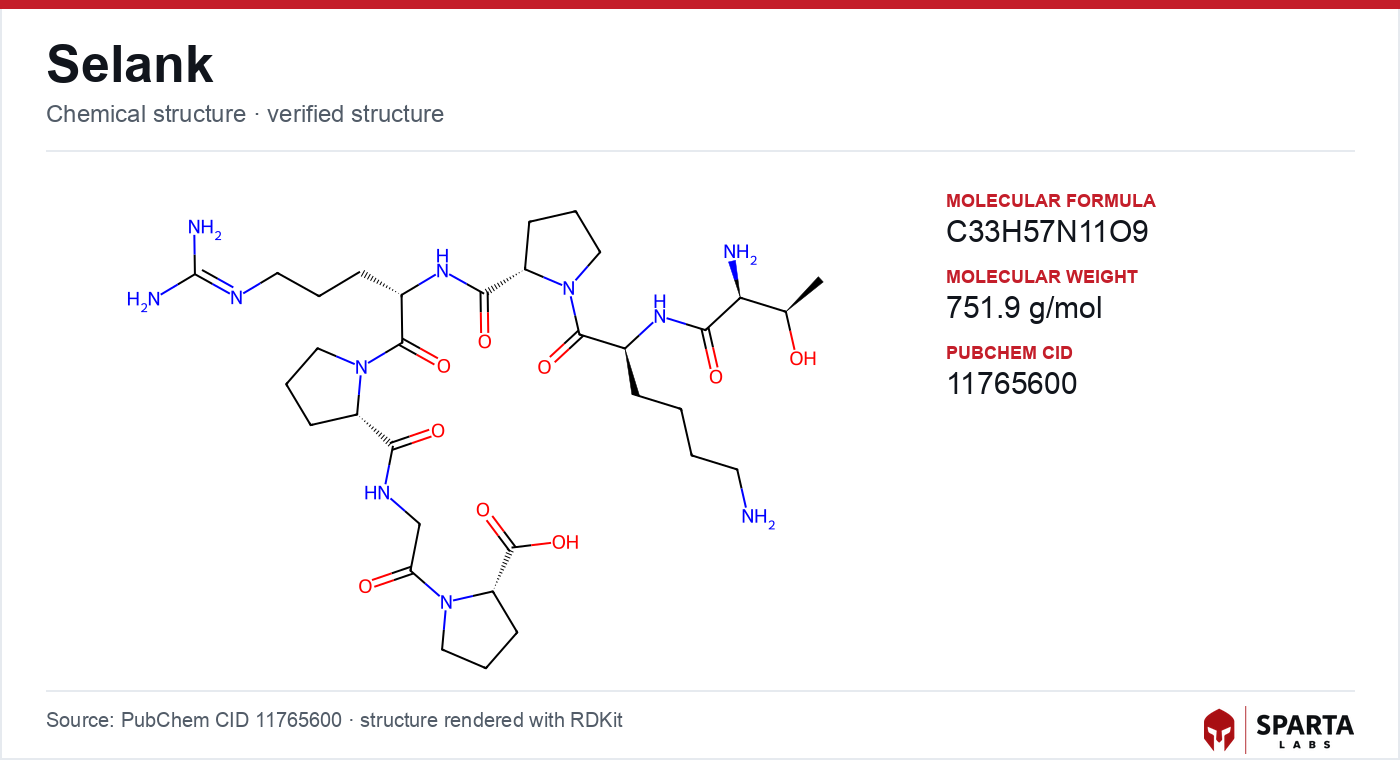
Figure: chemical structure of Selank.
The Tuftsin Lineage and Why It Shapes the Literature
Selank's research program is inseparable from tuftsin, the Thr-Lys-Pro-Arg tetrapeptide identified as a phagocytosis-stimulating fragment of the immunoglobulin heavy chain. Selank appends a Pro-Gly-Pro tripeptide to the tuftsin core, a modification introduced specifically to slow enzymatic degradation of the parent sequence. A 2003 comparative study by Semenova and colleagues in Neuroscience and Behavioral Physiology placed Selank alongside other tuftsin-family peptides across rodent conflict-stress paradigms, framing the compound as one member of a designed peptide series rather than an isolated discovery [1]. This lineage explains two features of the downstream literature: the recurring interest in immunomodulatory gene expression (inherited from tuftsin's immunological pedigree) and the emphasis on enzymatic stability and peptidase interaction.
Behavioral Pharmacology in Stress and Learning Models
The earliest sustained line of Selank research used classical rodent behavioral paradigms. A 2003 study by Kozlovskii and Danchev in Neuroscience and Behavioral Physiology examined a conditioned active avoidance reflex in rats selected for initially poor learning ability, reporting that repeated pre-training administration was associated with a higher rate of correct solutions relative to vehicle controls, with the observed magnitude characterized as comparable to the reference nootropic piracetam in the same model [2].
Findings from research models do not establish safety or efficacy in humans. Sparta Labs makes no claims about the use of this compound.
Later work introduced combination designs. A 2017 study by Kasian and colleagues in Behavioural Neurology examined Selank together with diazepam in rats subjected to unpredictable chronic mild stress, using the elevated plus maze as the anxiety readout [3]. The authors reported that combined administration returned anxiety-indicator values toward pre-stress baseline more completely than either compound alone, and characterized the interaction as additive rather than synergistic [3]. A 2022 report by Konstantinopolsky and colleagues in the Bulletin of Experimental Biology and Medicine examined Selank in a naloxone-precipitated morphine-withdrawal model, describing an attenuation of the aggregate withdrawal index relative to untreated controls and connecting the observation to the compound's proposed enkephalinergic profile [4].
Enkephalinase Interaction as a Mechanistic Anchor
A distinctive and frequently cited thread concerns Selank's effect on the enzymes that degrade endogenous opioid peptides. A 2001 publication by Semenova and colleagues in Eksperimental'naia i Klinicheskaia Farmakologiia reported that Selank inhibited enzymatic hydrolysis of plasma enkephalin in a concentration-dependent manner in vitro [5]. The authors advanced enkephalinase inhibition as a candidate mechanism linking the peptide's biochemistry to the behavioral observations in anxiety paradigms. This proposal became a recurring interpretive anchor across the subsequent literature and is one reason later behavioral work, such as the morphine-withdrawal study above, was framed in enkephalinergic terms.
GABAergic Gene Expression: Two Complementary Systems
A second mechanistic thread used molecular-genetic methods to probe GABAergic neurotransmission. A 2016 study by Volkova and colleagues in Frontiers in Pharmacology applied quantitative PCR to rat brain tissue after Selank administration, reporting altered expression of a subset of GABA-A receptor subunit and transporter genes in cortical tissue and interpreting the pattern as indirect modulation rather than direct receptor action [6].
A 2017 companion study by Filatova and colleagues in Frontiers in Pharmacology applied an 84-gene GABAergic expression panel to IMR-32 human neuroblastoma cells and reported no statistically significant expression changes in that monoculture system [7]. Rather than treating the null result as contradictory, the authors read the two studies together: the in vivo effect appeared to depend on intact neural-circuit context absent from an isolated cell line. The pairing is methodologically instructive, illustrating how a negative in vitro finding can constrain the interpretation of a positive in vivo one.
Hippocampal Transcriptomics and Neurotrophin Regulation
Beyond targeted GABAergic panels, the IMG RAS group characterized broader transcriptional responses. A 2014 cDNA microarray study by Dolotov and colleagues in Neuroscience and Behavioral Physiology reported that acute Selank administration was associated with greater than two-fold mRNA changes across a set of genes in rat hippocampal tissue, with a distribution skewed toward plasma-membrane and ion-transport proteins, while a repeated-administration schedule produced a smaller set of changes [8]. These transcriptomic datasets served as a substrate for later pathway-level interpretation of the compound's molecular pharmacology.
Immunomodulatory Gene Expression
Consistent with the tuftsin ancestry, part of the literature examines peripheral immune-related gene expression. A 2011 study by Ershov and colleagues in Peptides profiled inflammation-related gene expression in murine spleen at six and 24 hours after Selank administration, reporting the most pronounced mRNA changes among a defined set of immune-signaling genes [9]. This work situates Selank's activity outside the central nervous system alone and reconnects the compound to the immunological context of its parent tetrapeptide.
The Comparative Clinical Trial
The principal published clinical investigation is a 2008 parallel-group study by Zozulia, Neznamov, and colleagues in Zhurnal Nevrologii i Psikhiatrii imeni S.S. Korsakova [10]. The trial enrolled 62 subjects with generalized anxiety disorder or neurasthenia, allocating them between Selank and the benzodiazepine medazepam over a 14-day observation window. Outcomes on the Hamilton Anxiety Rating Scale, the Zung Self-Rating Anxiety Scale, and the Clinical Global Impression scale were characterized by the authors as comparable between the two arms, and the report noted a serum leu-enkephalin correlate consistent with the enkephalinase hypothesis advanced in the preclinical work [10]. This trial is the evidentiary basis most often cited in connection with the compound's Russian regulatory registration.
Reading the Corpus Critically
Two structural features of this literature warrant attention from a research reader. First, authorship overlaps heavily across studies, with a small set of investigators recurring as senior authors; independent replication outside the originating network is limited. Second, direct receptor-binding data, such as radioligand-displacement measurements at defined GABA-A subunit combinations or opioid-receptor subtypes, remain sparse relative to the volume of gene-expression and behavioral work, and human pharmacokinetic characterization, including bioavailability and metabolite profiling, is thin in the Western literature. A 2019 review by Andreeva and Myasoedov in Biology Bulletin synthesizes the physiological findings for Selank and its fragments and is a useful entry point to the primary sources [11].
Comparable interpretive caveats apply to other compounds emerging from the same Russian research tradition, including the closely related N-Acetyl Selank Amidate and the pineal-derived Epithalon, each of which carries an active academic program alongside limited independent human data. Research-use-only material corresponding to the compound discussed here is catalogued on the Selank product page.
References
-
Semenova TP, Kozlovskaya MM, Zuikov AV, Kozlovskiy II, Myasoedov NF. Selank and short peptides of the tuftsin family in the regulation of adaptive behavior in stress. Neuroscience and Behavioral Physiology. 2003;33(9):853–860. Full text via DOI PMID: 12154572.
-
Kozlovskii II, Danchev ND. The optimizing action of the synthetic peptide Selank on a conditioned active avoidance reflex in rats. Neuroscience and Behavioral Physiology. 2003;33(7):639–643. Full text via DOI PMID: 14552529.
-
Kasian AM, Kolomin TA, Andreeva LA, Bondarenko ON, Myasoedov NF, Slominsky PA, Shadrina MI. Peptide Selank enhances the effect of diazepam in reducing anxiety in unpredictable chronic mild stress conditions in rats. Behavioural Neurology. 2017;2017:5091027. Full text via DOI PMC5322660.
-
Konstantinopolsky MA, Chernyakova IV, Poletaeva II, Zhukova II, Andreeva LA, Myasoedov NF. Selank, a peptide analog of tuftsin, attenuates aversive signs of morphine withdrawal in rats. Bulletin of Experimental Biology and Medicine. 2022;173(5):581–584. Full text via DOI PMID: 36322304.
-
Semenova TP, Kozlovskaya MM, Zakharova NM. The inhibitory effect of Selank on enkephalin-degrading enzymes as a possible mechanism of its anxiolytic activity. Eksperimental'naia i Klinicheskaia Farmakologiia. 2001;64(2):3–6. PMID: 11550013. View on PubMed
-
Volkova A, Shadrina M, Kolomin T, Andreeva L, Limborska S, Myasoedov N, Slominsky P. Selank administration affects the expression of some genes involved in GABAergic neurotransmission. Frontiers in Pharmacology. 2016;7:31. Full text via DOI PMC4757669.
-
Filatova EV, Kasian AM, Kolomin TA, Rybalkina EY, Alieva AK, Andreeva LA, Limborska SA, Myasoedov NF, Pavlova GV, Slominsky PA, Shadrina MI. GABA, Selank, and olanzapine affect the expression of genes involved in GABAergic neurotransmission in IMR-32 cells. Frontiers in Pharmacology. 2017;8:89. Full text via DOI PMID: 28293190.
-
Dolotov OV, Sebentsova EA, Sourina MM, Malygina TR, Serebriakova EV, Andreeva LA, Alfeeva LYu, Grivennikov IA, Myasoedov NF. Changes in the transcription profile of the hippocampus in response to administration of the tuftsin analog Selank. Neuroscience and Behavioral Physiology. 2014;44(8):852–861. Full text via DOI PMID: 24450168.
-
Ershov FI, Mezentseva MV, Baidakova GV, Suetina IA, Troitskaia NN, Andreeva LA, Myasoedov NF. Expression of inflammation-related genes in mouse spleen under tuftsin analog Selank. Peptides. 2011;32(7):1553–1558. Full text via DOI
-
Zozulia AA, Neznamov GG, Syunyakov TS, Kost NV, Gabaeva MV, Sokolov OIu, Sebentsova EA, Akhromeeva SA, Panchenko LF, Andriushenko AV, Teleshova ES, Shadrina MI, Slominsky PA, Miasoedov NF. Efficacy and possible mechanisms of action of a new peptide anxiolytic selank in the therapy of generalized anxiety disorders and neurasthenia. Zhurnal Nevrologii i Psikhiatrii imeni S.S. Korsakova. 2008;108(4):38–48. PMID: 18454096.
-
Andreeva LA, Myasoedov NF. Physiological effects of Selank and its fragments. Biology Bulletin. 2019;46(4):390–400. Full text via DOI
Disclaimer. Statements in this article have not been evaluated by the Food and Drug Administration. This compound is not intended to diagnose, treat, cure, or prevent any disease. Sparta Labs sells research-use-only materials. Content is provided for educational and informational purposes only and does not constitute medical advice. Consult a qualified medical professional for any health concerns.
Frequently asked questions
What kind of research has been published on Selank?
The Selank literature spans roughly three decades and was produced predominantly at the Institute of Molecular Genetics of the Russian Academy of Sciences. It combines rodent behavioral pharmacology, in vitro enkephalinase studies, GABAergic and hippocampal gene-expression work, immune-related gene profiling, and a comparative clinical trial. Most studies share an overlapping authorship network.
Why is Selank often described in relation to tuftsin?
Selank is a synthetic heptapeptide built on the tuftsin tetrapeptide core (Thr-Lys-Pro-Arg) with an added Pro-Gly-Pro sequence intended to slow enzymatic degradation. Published comparative work has studied Selank alongside other tuftsin-family peptides, and its recurring interest in immune-related gene expression reflects tuftsin's immunological origins.
What did the published GABAergic gene-expression studies report?
A 2016 study in Frontiers in Pharmacology reported altered expression of certain GABA-A receptor subunit and transporter genes in rat cortical tissue, interpreted as indirect modulation. A 2017 companion study found no significant changes in an isolated IMR-32 cell line, which the authors read as evidence that the in vivo effect depends on intact neural-circuit context.
What clinical evidence exists for Selank?
The principal published clinical investigation is a 2008 parallel-group trial by Zozulia, Neznamov, and colleagues that enrolled 62 subjects and compared Selank against the benzodiazepine medazepam over 14 days. Anxiety-scale outcomes were characterized by the authors as comparable between the two arms.
What are the main gaps in the Selank literature?
Direct receptor-binding data, such as radioligand-displacement studies at defined GABA-A subunit combinations or opioid-receptor subtypes, remain sparse. Human pharmacokinetic characterization is limited in the Western literature, and independent replication outside the originating research network is also limited.