
N-Acetyl Semax Amidate: Mechanism of Action
A mechanism-focused reading of N-Acetyl Semax Amidate through the ACTH(4-10) melanocortin lineage: terminal modification chemistry, neurotrophin transcription, and monoaminergic modulation in the published Semax literature. Educational reference.

For research use only. Not for human consumption. This article is educational reference material. It is not medical advice and is not a recommendation to use any substance.
Introduction
N-Acetyl Semax Amidate (Ac-Met-Glu-His-Phe-Pro-Gly-Pro-NH₂) is a terminally modified member of the Semax family of synthetic heptapeptides, a lineage derived from the ACTH(4–10) fragment of adrenocorticotropic hormone. It carries the same seven-residue core as Semax but adds two chemical modifications the parent peptide lacks: an acetyl cap at the N-terminus and an amide at the C-terminus. This article reads the reported mechanism of this compound through the published pharmacology of its lineage, attributing each finding to the exact molecule examined in the cited source rather than assuming that observations transfer identically across the family. Because most primary data were generated on Semax and, less frequently, on mono-acetylated N-acetyl Semax, the sections below foreground where terminal modification is known to matter and where it remains uncharacterized.
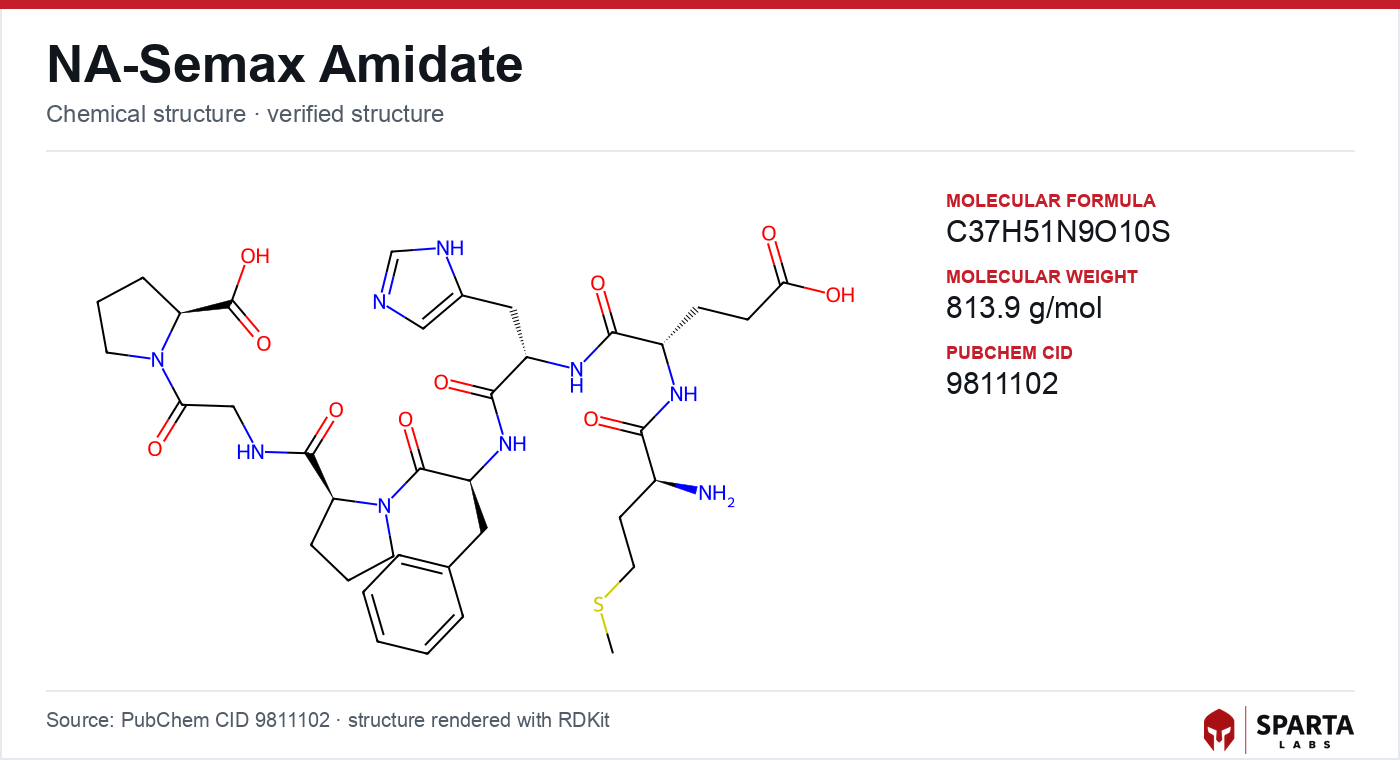
Figure: chemical structure of NA-Semax Amidate.
The ACTH(4–10) Pharmacophore Lineage
The Semax core sequence traces to ACTH(4–10), the heptapeptide fragment Met-Glu-His-Phe-Arg-Trp-Gly of the pituitary hormone ACTH. In the melanocortin literature, ACTH(4–10) is described as a minimal fragment retaining recognition for the melanocortin receptor family while lacking the steroidogenic potency of full-length ACTH. The melanocortin system comprises five G-protein-coupled receptors, MC1R through MC5R, encoded by distinct genes and expressed across brain, immune, and peripheral tissues.
Semax substitutes the C-terminal Pro-Gly-Pro tripeptide for the native Arg-Trp residues, a change that markedly slows enzymatic degradation while preserving central activity in rodent models. Understanding this pharmacophore is a useful entry point before examining the compound's chemistry and classification in the N-Acetyl Semax Amidate research overview, and it situates the peptide alongside directly melanocortin-targeting analogs discussed in the Melanotan-2 mechanism of action article, which engage the same receptor family from a different structural starting point.
What the Dual Terminal Modification Changes
The defining feature of N-Acetyl Semax Amidate relative to Semax is that both peptide termini are capped. This distinction is not cosmetic, and one of its consequences has been measured directly.
Magrì and colleagues (2016) examined how N-terminal acetylation alters the metal-coordination behavior of the Semax peptide. They reported that N-acetyl Semax formed a CuN3O chromophore at physiological pH, distinct from the CuN4 chromophore of unmodified Semax, because acetylation removes the free N-terminal amine that Semax otherwise uses as a copper-anchoring donor. The same study observed that the copper-mediated cytoprotective activity of unmodified Semax in SH-SY5Y neuroblastoma cells was specifically attributable to that free terminal amine, and was not reproduced when the amine was blocked [1].
Findings from research models do not establish safety or efficacy in humans. Sparta Labs makes no claims about the use of this compound.
This is the clearest compound-specific mechanistic result in the literature: acetylation is expected to remove a copper-chelation-dependent activity while leaving other, non-amine-dependent interactions of the core sequence available. C-terminal amidation, separately, neutralizes the terminal carboxyl, altering the molecule's net charge and its susceptibility to carboxypeptidase cleavage. The combined effect is a peptide with a different charge state, hydrophilicity, and enzymatic-stability profile than either Semax or the mono-acetylated variant, which is why the two forms are treated as pharmacologically non-identical throughout this article.
Reported Interactions With Neurotrophin Signaling
Among the most extensively studied interactions of the Semax family is its reported relationship to brain-derived neurotrophic factor (BDNF) and nerve growth factor (NGF) signaling in rodent brain tissue.
Dolotov and colleagues (2003) reported that a single administration of Semax to rats was associated with a measurable rise in BDNF mRNA across multiple brain regions in vivo, including hippocampus, frontal cortex, and hypothalamus [2]. A subsequent study by the same group (2006) characterized the protein-level response, reporting elevated BDNF protein in the rat basal forebrain, an increase in BDNF exon III mRNA, and increased phosphorylation of TrkB, the high-affinity BDNF receptor tyrosine kinase, in the hippocampus. The authors also reported that tritium-labeled Semax displayed specific, saturable binding in basal-forebrain membrane preparations, a pattern they interpreted as consistent with melanocortin receptor engagement, and that the BDNF response was anatomically localized rather than uniform across the brain [3].
Shadrina, Kolomin and colleagues (2010) examined the temporal dynamics of both BDNF and NGF gene expression in rat hippocampus, frontal cortex, and retina using real-time PCR across time points from 20 minutes to 24 hours. They described the overall pattern as multidirectional and region-dependent rather than a single uniform change, with distinct time-of-onset differences between regions [4]. Taken together, these reports frame the neurotrophin interaction attributed to Semax as regionally selective and time-resolved, a nuance that is easy to lose in shorter summaries and is examined study by study in the N-Acetyl Semax Amidate published research article.
Neurotrophin Receptor Transcription Under Ischemic Conditions
A distinct branch of the literature examined neurotrophin-receptor gene transcription in rodent focal-ischemia models. Dmitrieva, Skvortsova, Myasoedov and colleagues (2010) reported that Semax was associated with activated transcription of BDNF and the neurotrophin-receptor genes TrkC and TrkA at three hours following permanent middle cerebral artery occlusion in rats, with NGF transcription elevated at later time points. The C-terminal metabolite Pro-Gly-Pro, a documented degradation product of Semax, showed partially overlapping but non-identical effects on the same genes, which the authors read as evidence that the intact sequence and its metabolite are pharmacologically distinct in this context [5]. This metabolite distinction is one reason terminal stability, and therefore terminal modification, is mechanistically relevant to the family.
Monoaminergic and Cholinergic Modulation
Beyond neurotrophins, the Semax family has been examined for interactions with monoaminergic and cholinergic systems in rodents.
Kolomin and colleagues (2006) measured neurochemical parameters in rat striatum following Semax administration, reporting a rise in the tissue content of the serotonin metabolite 5-hydroxyindoleacetic acid (5-HIAA) and, in a co-administration paradigm, a modulatory influence on the dopaminergic response to a stimulant challenge [6]. Grivennikov, Dolotov, Zolotarev, Andreeva, Myasoedov and colleagues (2008) examined dissociated cultures of rat basal-forebrain cholinergic neurons and reported that Semax was associated with greater cholinergic-neuron survival and elevated choline acetyltransferase activity relative to untreated controls, with the effect described as selective for the cholinergic phenotype at the concentration tested [7]. These findings are attributed specifically to Semax; whether the dual-modified variant reproduces them in matched systems has not been independently established.
Transcriptome- and Proteome-Wide Characterization
Two systems-level studies broadened the mechanistic picture beyond individual candidate genes. Medvedeva and colleagues (2014) conducted a genome-wide transcriptional analysis of rat brain following permanent middle cerebral artery occlusion and reported Semax-associated changes across immune-response and vascular-system gene networks, including immunoglobulin- and chemokine-encoding transcripts and endothelial-migration-associated genes [8]. Sudarkina, Filippenkov and colleagues (2021) used mass-spectrometry proteomics to characterize protein-expression changes in rat brain following ischemia-reperfusion with and without Semax, identifying a set of differentially associated proteins that the authors described as spanning apoptotic, inflammatory, and synaptic-plasticity categories at the proteome level [9]. Both are hypothesis-generating systems analyses in ischemia models and are reported here as observed associations, not as demonstrations of any outcome.
Limits of Current Understanding
Two gaps define the frontier for this specific compound. First, the melanocortin receptor subtype responsible for the neurotrophin and neurotransmitter effects attributed to Semax has not been resolved; subtype-selective antagonist studies are the natural tool to close that gap. Second, and specific to N-Acetyl Semax Amidate, the copper-coordination work of Magrì and colleagues establishes that N-terminal acetylation removes one measurable activity of the parent peptide, yet a matched, side-by-side receptor-pharmacology comparison of the fully N-acetylated, C-amidated peptide against Semax has not been reported. Until that comparison exists, mechanistic statements about the dual-modified molecule are best read as inferences from lineage rather than direct measurements.
Researchers comparing terminally modified analogs across peptide families may find the parallel with the acetylated Selank variant instructive, discussed in the N-Acetyl Selank Amidate mechanism of action article, and the parent-compound context in the Semax mechanism of action article. Research-grade N-Acetyl Semax Amidate from Sparta Labs is batch-verified by independent mass spectrometry and HPLC analysis.
References
-
Magrì A, Munzone A, Peana M, Medici S, Zoroddu MA, Hansson Ö, et al. Influence of the N-terminus acetylation of Semax, a synthetic analog of ACTH(4-10), on copper(II) and zinc(II) coordination and biological properties. J Inorg Biochem. 2016;164:59–69. PMID: 27586814. DOI: 10.1016/j.jinorgbio.2016.08.013. PubMed
-
Dolotov OV, Seredenina TS, Levitskaya NG, Rozyczka J, Engele J, Andreeva LA, et al. The heptapeptide SEMAX stimulates BDNF expression in different areas of the rat brain in vivo. Dokl Biol Sci. 2003;391:293–295. DOI: 10.1023/A:1025177812262.
-
Dolotov OV, Karpenko EA, Inozemtseva LS, Seredenina TS, Levitskaya NG, Rozyczka J, et al. Semax, an analogue of adrenocorticotropin (4–10), binds specifically and increases levels of brain-derived neurotrophic factor protein in rat basal forebrain. J Neurochem. 2006;97(Suppl 1):82–86. DOI: 10.1111/j.1471-4159.2006.03658.x.
-
Shadrina MI, Kolomin TA, Agapova TY, Dolotov OV, Grivennikov IA, Slominsky PA, et al. Comparison of the temporary dynamics of NGF and BDNF gene expression in rat hippocampus, frontal cortex, and retina under Semax action. J Mol Neurosci. 2010;41(1):30–35. PMID: 19662538. DOI: 10.1007/s12031-009-9270-z. PubMed
-
Dmitrieva VG, Povarova OV, Skvortsova VI, Limborska SA, Myasoedov NF, Dergunova LV. Semax and Pro-Gly-Pro activate the transcription of neurotrophins and their receptor genes after cerebral ischemia. Cell Mol Neurobiol. 2010;30(1):71–79. PMID: 19633950. DOI: 10.1007/s10571-009-9432-0. PubMed
-
Kolomin T, Shadrina M, Slominsky P, Limborska S, Myasoedov N. Semax, an ACTH(4-10) analogue with nootropic properties, activates dopaminergic and serotoninergic brain systems in rodents. Neurochem Res. 2006;31(3):285–292. PMID: 16362768. DOI: 10.1007/s11064-005-8826-8. PubMed
-
Grivennikov IA, Dolotov OV, Zolotarev YA, Andreeva LA, Myasoedov NF, et al. Effects of behaviorally active ACTH(4-10) analogue — Semax on rat basal forebrain cholinergic neurons. Restor Neurol Neurosci. 2008;26(1):35–43. PMID: 18431004. PubMed
-
Medvedeva EV, Dmitrieva VG, Povarova OV, Limborska SA, Skvortsova VI, Myasoedov NF, et al. The peptide Semax affects the expression of genes related to the immune and vascular systems in rat brain focal ischemia: genome-wide transcriptional analysis. BMC Genomics. 2014;15:228. PMID: 24661604. DOI: 10.1186/1471-2164-15-228. PubMed
-
Sudarkina OY, Filippenkov IB, Stavchansky VV, Denisova AE, Gubsky LV, Limborska SA, et al. Brain protein expression profile confirms the protective effect of the ACTH(4–7)PGP peptide (Semax) in a rat model of cerebral ischemia–reperfusion. Int J Mol Sci. 2021;22(12):6179. PMID: 34201112. DOI: 10.3390/ijms22126179. PubMed
Disclaimer. Statements in this article have not been evaluated by the Food and Drug Administration. This compound is not intended to diagnose, treat, cure, or prevent any disease. Sparta Labs sells research-use-only materials. Content is provided for educational and informational purposes only and does not constitute medical advice. Consult a qualified medical professional for any health concerns.
Frequently asked questions
What does the acetyl and amidate modification change in N-Acetyl Semax Amidate?
The parent Semax sequence carries a free N-terminal amine and a free C-terminal carboxyl. N-Acetyl Semax Amidate caps both ends, adding an acetyl group at the N-terminus and an amide at the C-terminus. Magri and colleagues (2016) reported that N-terminal acetylation shifts the copper-coordination geometry of the peptide from a CuN4 to a CuN3O chromophore, because acetylation removes the free amine that Semax otherwise uses to chelate copper. Terminal capping is also generally documented to alter peptide charge state and resistance to exopeptidase cleavage.
Is N-Acetyl Semax Amidate the same as Semax?
No. It shares the ACTH(4-10)-derived heptapeptide core of Semax but adds two terminal chemical modifications that Semax lacks. Most of the published mechanistic literature was generated on Semax and, less often, mono-acetylated N-acetyl Semax rather than the fully N-acetylated, C-amidated variant. The cited findings are therefore attributed to the specific molecule tested in each source rather than assumed to transfer identically.
What receptor system is associated with the Semax peptide family?
Semax and other ACTH(4-10)-derived analogs are discussed in the literature in relation to the melanocortin receptor family, a set of five G-protein-coupled receptors (MC1R through MC5R). ACTH(4-10) is described as a minimal melanocortin pharmacophore. The specific receptor subtype responsible for the neurotrophin and neurotransmitter changes attributed to Semax has not been definitively resolved in the published work.
What has research reported about Semax and BDNF?
Dolotov and colleagues (2006) reported that Semax administration was associated with a region-selective rise in BDNF protein in the rat basal forebrain, an increase in BDNF exon III mRNA, and increased TrkB phosphorylation in the hippocampus. Earlier work by the same group (2003) reported elevated BDNF mRNA across several rat brain regions. These are in-vivo rodent findings attributed to Semax and do not establish any effect in humans.
Has the fully amidated variant been characterized independently?
Direct, matched-system characterization of N-Acetyl Semax Amidate is limited in the peer-reviewed literature relative to Semax itself. The copper-coordination work by Magri and colleagues (2016) is the clearest source specifically addressing how N-terminal acetylation changes one measurable property of the molecule. Comparative receptor pharmacology of the dual-modified peptide remains an open area of investigation.