
Pinealon: Discovery and Research History
A history of Pinealon (Glu-Asp-Arg, EDR): how a Soviet-era pineal extract program produced Epithalamin, then resolved into the defined tripeptide whose nuclear-localization and cell-viability record anchors the English-language literature from 2011 onward.

For research use only. Not for human consumption. This article is educational reference material. It is not medical advice and is not a recommendation to use any substance.
From Pineal Extracts to a Three-Letter Sequence
Pinealon (Glu-Asp-Arg; abbreviated EDR after the single-letter codes for its three residues) has an unusual documented origin among short synthetic peptides. It did not arise from a single discovery paper describing a novel isolate. Instead, the EDR tripeptide is a late, defined product of a long research lineage that began with crude polypeptide extracts of animal pineal tissue and gradually resolved into individual short amino-acid sequences. Reconstructing Pinealon's history therefore means reconstructing the arc of the Russian "peptide bioregulator" research program associated with Vladimir Kh. Khavinson and colleagues, and then locating where within that arc the discrete EDR sequence acquired its own characterization record [1].
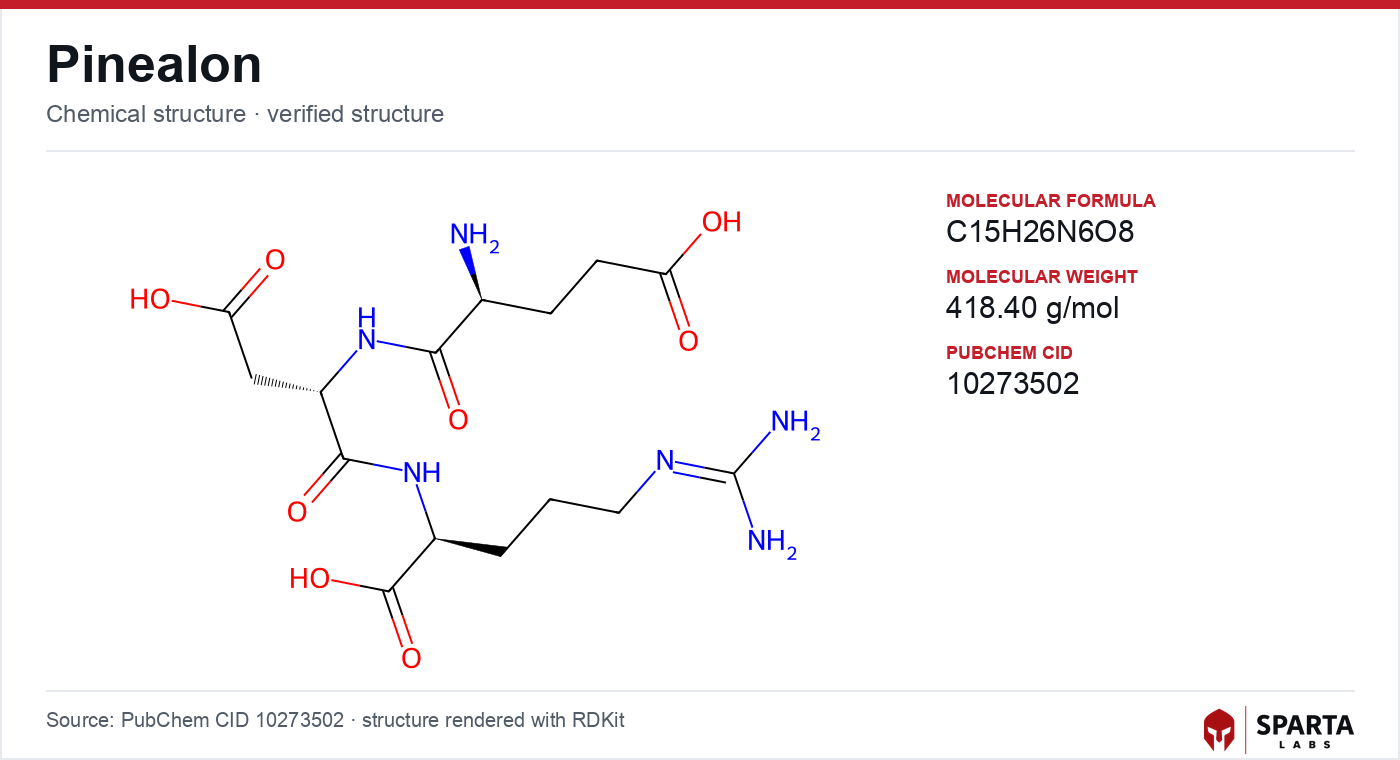
Figure: chemical structure of Pinealon (Glu-Asp-Arg, EDR).
The Extract Era: Epithalamin and the Pineal Program
The intellectual foundation of Pinealon lies in Soviet-era biomedical work of the 1970s and 1980s on low-molecular-weight peptide complexes prepared from bovine organ tissue. The review by Anisimov and Khavinson published in Biogerontology in 2010 documents this program as a decades-long effort examining peptide preparations derived from the pineal gland (epiphysis cerebri), thymus, and other tissues, and reports rodent studies from within the program associated with altered lifespan parameters in treated animal populations [1].
Findings from research models do not establish safety or efficacy in humans. Sparta Labs makes no claims about the use of this compound.
From pineal tissue, the extraction and fractionation methodology of this era yielded a polypeptide preparation designated Epithalamin, a complex mixture rather than a single defined molecule. Epithalamin is the "parent" material in the sense that mattered historically: it demonstrated that pineal-derived peptide fractions were a tractable subject of study, and it set the stage for the later analytical question of which specific short sequences within such fractions carried measurable activity. That analytical question is what eventually produced named tripeptides and tetrapeptides.
Resolving the Complex: Defined Peptides Enter the Literature
The methodological pivot from complex extracts to individual synthetic peptides is the hinge of this history. As peptide synthesis and characterization became routine, the pineal lineage split into two peptides that each accumulated their own English-language documentation. The tetrapeptide Epithalon (Ala-Glu-Asp-Gly; AEDG) became the more prominent of the pair in aging and pineal-function research, examined in contexts including melatonin regulation in aged primates. Pinealon (EDR) emerged as the shorter tripeptide studied primarily in neuroprotection-oriented cell and rodent systems.
A study by Goncharova, Vengerin, Khavinson, and Lapin published in Experimental Gerontology in 2005 examined pineal peptides, in that instance the AEDG tetrapeptide, and reported altered hormonal parameters including melatonin secretion patterns in aging rhesus macaques [2]. This work is relevant to Pinealon's history not because it studied EDR directly, but because it illustrates the translational milieu, the primate models and endocrine endpoints, out of which the neighboring EDR tripeptide's own characterization was framed. Readers tracing the shared pineal lineage can compare the two sequences through the Epithalon research overview.
The EDR Sequence Acquires Its Own Record
Pinealon's transition from "a tripeptide named within the program" to "a compound with a discrete experimental profile in indexed journals" is documented most concretely by two 2011 papers, which is why 2011 functions as the practical anchor date in the EDR literature.
The paper by Fedoreyeva, Kireev, Khavinson, and Vanyushin in Biochemistry (Moscow) in 2011 reported that short fluorescence-labeled peptides, including the EDR sequence, were detectable within the nuclei of HeLa cells, and described in vitro interactions between the peptides and deoxyribonucleotide sequences [3]. This nuclear-penetration observation supplied the empirical starting point for the later gene-regulation hypothesis that subsequent publications from the group elaborated. Its methodological detail, fluorescence microscopy localization plus in vitro binding assays, gave the EDR sequence a mechanistic vocabulary distinct from the extract era.
In the same year, the study by Khavinson and colleagues in Rejuvenation Research provided the first detailed English-language description of Pinealon's in vitro effects, reporting observations on reactive-oxygen-species accumulation, cell viability, and proliferative markers across cell systems [4]. This paper marks the point at which "Pinealon" enters the Western peer-reviewed record as a named, characterized entity rather than an item in a Russian-language program summary. For a structured account of the reported cellular interactions themselves, see the Pinealon mechanism of action article.
The Gene-Regulation Chapter and 5xFAD Models
From the mid-2010s onward, published work on the EDR sequence shifted toward molecular-docking descriptions of possible peptide–DNA interactions and toward in vivo rodent models, extending the record beyond cell culture.
A 2021 paper by Khavinson, Linkova, and colleagues in Molecules discussed the EDR peptide in the context of gene-expression and protein-synthesis regulation, framing the earlier nuclear-localization findings within an Alzheimer's-disease research context [5]. In Pharmaceuticals the same year, Khavinson and colleagues reported neuroprotection-oriented observations for short "epigenetic regulator" tripeptides in a 5xFAD transgenic mouse model of Alzheimer's disease [6]. These two 2021 papers represent the most recent well-documented tier of the EDR record and show the program's characteristic pattern: a hypothesis first seeded in a cell-culture localization study, then pursued through docking and genetic-model work a decade later.
Where Pinealon Sits in the Broader Peptide Landscape
Pinealon's history is best understood as one branch of a wider Russian short-peptide research tradition that also produced ACTH-fragment and other tissue-derived sequences. That tradition includes compounds such as Semax, which descends from a separate ACTH(4-10)-related lineage rather than the pineal one, illustrating how several distinct organ- and hormone-derived families were pursued in parallel under a common methodological philosophy. Placing Pinealon beside these neighbors clarifies what is specific to it: a pineal origin, a tripeptide identity, and a documentation record centered on nuclear localization and cell-viability endpoints.
As a research compound, Pinealon's status reflects a preclinical position in the scientific development cycle, with a record spanning in vitro systems and rodent models but no approved human indication. A fuller account of its chemistry and classification is available in the Pinealon research overview, and the Pinealon product page lists current batch verification data for researchers acquiring the compound.
References
-
Anisimov VN, Khavinson VKh. Peptide bioregulation of aging: results and prospects. Biogerontology. 2010;11(2):139–149. doi:10.1007/s10522-009-9249-8. PMID: 19830585. PubMed
-
Goncharova ND, Vengerin AA, Khavinson VKh, Lapin BA. Pineal peptides restore the age-related disturbances in hormonal functions of the pineal gland and the pancreas. Experimental Gerontology. 2005;40(1–2):51–57. doi:10.1016/j.exger.2004.10.004. PMID: 15664732. PubMed
-
Fedoreyeva LI, Kireev II, Khavinson VKh, Vanyushin BF. Penetration of short fluorescence-labeled peptides into the nucleus in HeLa cells and in vitro specific interaction of the peptides with deoxyribooligonucleotides and DNA. Biochemistry (Moscow). 2011;76(11):1210–1219. doi:10.1134/S0006297911110022. DOI
-
Khavinson V, Ribakova Y, Kulebiakin K, Vladychenskaya E, Kozina L, Arutjunyan A, Boldyrev A. Pinealon increases cell viability by suppression of free radical levels and activating proliferative processes. Rejuvenation Research. 2011;14(5):535–541. doi:10.1089/rej.2011.1172. DOI
-
Khavinson V, Linkova N, Kozhevnikova E, Trofimova S. EDR peptide: possible mechanism of gene expression and protein synthesis regulation involved in the pathogenesis of Alzheimer's disease. Molecules. 2021;26(1):159. doi:10.3390/molecules26010159. PMID: 33396470. PubMed
-
Khavinson V, Ilina A, Kraskovskaya N, Linkova N, Kolchina N, Mironova E, Erofeev A, Petukhov M. Neuroprotective effects of tripeptides — epigenetic regulators in the mouse model of Alzheimer's disease. Pharmaceuticals (Basel). 2021;14(6):515. doi:10.3390/ph14060515. PMID: 34071923. PubMed
Disclaimer. Statements in this article have not been evaluated by the Food and Drug Administration. This compound is not intended to diagnose, treat, cure, or prevent any disease. Sparta Labs sells research-use-only materials. Content is provided for educational and informational purposes only and does not constitute medical advice. Consult a qualified medical professional for any health concerns.
Frequently asked questions
What does the name Pinealon (EDR) refer to?
Pinealon is a synthetic tripeptide with the sequence glutamic acid–aspartic acid–arginine (Glu-Asp-Arg), abbreviated EDR from the single-letter amino-acid codes. The name reflects its lineage in pineal-gland (epiphysis) peptide research within the Russian peptide bioregulator program. It is studied as a defined short peptide rather than as a tissue extract.
How is Pinealon related to Epithalamin and Epithalon?
Epithalamin was a complex polypeptide preparation extracted from bovine pineal tissue in the earlier extract era of the program. As methods advanced, researchers resolved such preparations into individual defined peptides, including the tetrapeptide Epithalon (AEDG) and the tripeptide Pinealon (EDR). Pinealon thus represents the shorter, defined-sequence branch of the same pineal research lineage.
When did Pinealon acquire its own research record?
While the underlying program spans decades, the EDR tripeptide's discrete characterization is anchored by two 2011 papers: one in Biochemistry (Moscow) reporting nuclear penetration in HeLa cells and in vitro DNA interactions, and one in Rejuvenation Research describing in vitro effects on reactive-oxygen-species accumulation and cell viability. These marked its entry into the indexed English-language literature as a named compound.
Who conducted the primary research on Pinealon?
The core Pinealon literature comes from Vladimir Kh. Khavinson and collaborators associated with the St. Petersburg peptide bioregulator research program, published in journals including Biochemistry (Moscow), Rejuvenation Research, Molecules, and Pharmaceuticals. The program originated in Soviet-era organ-peptide research and later transitioned into peer-reviewed academic publication.