
Melanotan-2: Sourcing, Purity, and Verification Standards
Melanotan-2 is a cyclic lactam heptapeptide whose fixed ring and D-Phe7 substitution shape how identity and purity are verified. This reference covers its synthesis, HPLC/MS characterization, and lyophilized stability considerations for research use. Educational reference.

For research use only. Not for human consumption. This article is educational reference material. It is not medical advice and is not a recommendation to use any substance.
Introduction
Melanotan-2 (MT-II) is a synthetic cyclic heptapeptide classified pharmacologically as a non-selective melanocortin receptor agonist. What distinguishes it as a sourcing subject is not that it is a peptide, but that it is a conformationally constrained one: its research-relevant behavior derives from a fixed side-chain-to-side-chain lactam ring and a deliberately inverted stereocenter. Those two design choices, made when the parent chemistry was engineered, dictate almost everything about how a batch of MT-II must be characterized and stored. This article walks through the compound's synthetic origin, the analytical questions its architecture creates, and the verification and stability practices Sparta Labs applies to material prepared for research use. Batch-specific certificates of analysis are available directly from the Melanotan-2 product page.
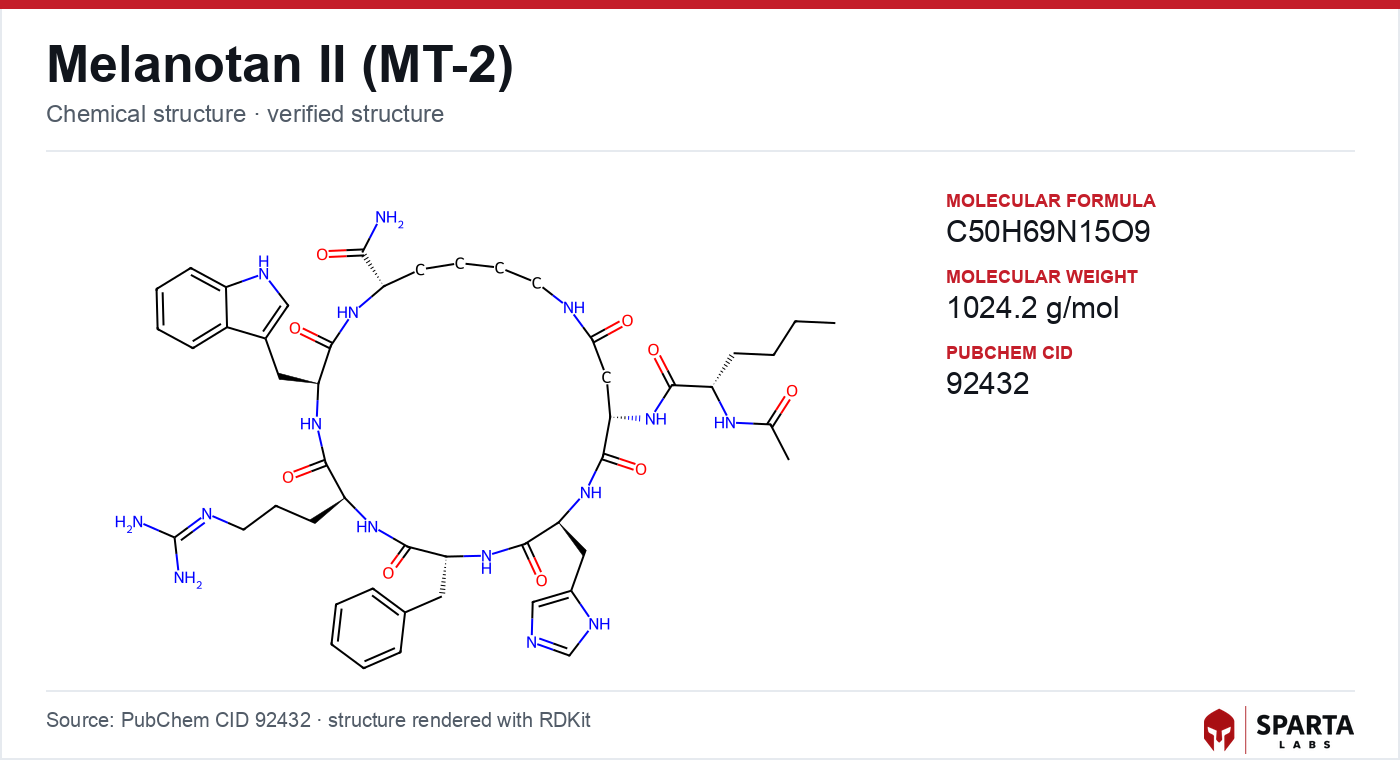
Figure: chemical structure of Melanotan II.
The Molecule Being Sourced
MT-II has the sequence Ac-Nle-cyclo[Asp-His-D-Phe-Arg-Trp-Lys]-NH2, with an acetylated N-terminus, a C-terminal amide, and a lactam bridge closing the ring between the Asp side-chain carboxyl and the Lys side-chain amine. Its molecular formula is C50H69N15O9 and its monoisotopic mass is near 1024 Da. Three structural facts drive the entire quality discussion that follows:
- The lactam bridge converts a flexible linear chain into a macrocycle. Confirming that this ring actually closed, rather than leaving linear or oligomeric side products, is a distinct analytical task.
- The D-phenylalanine at position 7 is a non-natural stereocenter. Any L-Phe contaminant arising from epimerization is a diastereomer with an identical molecular mass.
- The tryptophan and histidine residues are chemically reactive sites, tryptophan toward oxidation in particular, which is why storage conditions are not an afterthought but part of the specification.
The conformational-constraint strategy behind MT-II traces to work by Victor Hruby and colleagues on cyclic lactam melanotropin analogues, in which introducing a covalent side-chain bridge and a D-amino acid was used to rigidify the melanocortin pharmacophore and confer resistance to enzymatic breakdown [1]. Readers interested in how that architecture relates to receptor engagement will find it developed in the Melanotan-2 mechanism of action article, and its scientific lineage in the discovery and research history reference.
Synthesis Route and Where Impurities Come From
MT-II is assembled by solid-phase peptide synthesis (SPPS), the method introduced by R.B. Merrifield in 1963, in which a peptide chain is built stepwise on an insoluble resin using protected amino-acid building blocks before cleavage and global deprotection [2]. For a cyclic peptide, chain assembly is only the first stage: an on-resin or solution-phase lactamization step must then form the intramolecular Asp-to-Lys amide bond using orthogonally protected side chains so the ring closes at the intended positions rather than elsewhere.
The first preparative solution-phase synthesis of MT-II specifically was reported by Ryakhovsky and colleagues in the Beilstein Journal of Organic Chemistry in 2008, who demonstrated a reproducible route using an orthogonal protection strategy and carbodiimide-mediated cyclization [3]. Their account is useful for sourcing because it maps precisely where the difficult steps sit: incomplete couplings generate deletion sequences, imperfect cyclization can leave linear precursor or head-to-tail dimers, and the reactive residues invite oxidation. General large-scale peptide manufacturing considerations, including coupling efficiency and epimerization risk, were reviewed by Andersson and colleagues in Biopolymers, and those same parameters govern the impurity profile of any research-grade cyclic peptide [4].
Findings from research models do not establish safety or efficacy in humans. Sparta Labs makes no claims about the use of this compound.
The Analytical Problem MT-II Poses
Because the impurities above are structurally close to the target, verification cannot rely on a single technique. Two orthogonal measurements answer two different questions.
Reversed-phase HPLC: resolving what mass cannot
High-performance liquid chromatography separates species by their interaction with a hydrophobic stationary phase, and purity is expressed as target-peak area relative to total integrated peak area at a defined wavelength. HPLC is the tool that can, in principle, separate the intended peptide from a same-mass diastereomer produced by epimerization at the D-Phe7 center, because the two differ in three-dimensional shape and therefore in retention, even though a mass spectrometer would report them as identical. This is why method development, not just running a gradient, matters for a compound carrying a designed stereocenter. The peptide research community broadly treats a high reversed-phase purity threshold as the baseline for research-grade material; Sparta Labs applies a minimum HPLC purity standard of at least 98% for MT-II.
Mass spectrometry: confirming identity and ring closure
Mass spectrometry confirms that the dominant chromatographic peak carries the expected molecular weight of the cyclic peptide. The value here is complementary to HPLC: a purity percentage says nothing about which molecule the main peak is, whereas an observed protonated molecular ion matching the theoretical mass corroborates that the material is the intended sequence and that cyclization removed the expected mass of water relative to the linear precursor. The role of electrospray-ionization mass spectrometry in characterizing peptide identity and molecular mass has been described in the analytical literature, which frames orthogonal chromatography-mass-spectrometry characterization as the standard for confirming a synthetic peptide's structure [5]. Residual-solvent screening additionally covers trifluoroacetic acid introduced during synthesis and cleavage, and any residual organics from the cleavage cocktail.
From Analysis to Certificate
Independent analytical work is what converts a quality statement into a document. Sparta Labs submits MT-II batches to third-party contract analytical laboratories for HPLC and mass-spectrometry analysis, kept organizationally separate from manufacturing so that the party certifying quality is not the party producing the material. The resulting reports become the data underlying a Certificate of Analysis (COA) issued for each batch.
Each MT-II COA documents HPLC purity as a percentage with the corresponding chromatogram, mass-spectrometry confirmation of the molecular weight as observed versus theoretical, the batch number, the manufacturing date, and recommended storage conditions. The batch number is the traceability anchor: if an analytical question arises during research, the COA provides the documented quality baseline for the exact material in hand, and researchers publishing methods can cite the batch and its parameters. The same verification framework applied to the structurally related melanocortin agonist bremelanotide is documented in the PT-141 sourcing and quality reference, and a copper-peptide contrast on the same analytical standards appears in the GHK-Cu sourcing and quality article.
Lyophilized Form and Storage Rationale
MT-II is supplied in lyophilized (freeze-dried) form. Removing water from the peptide matrix suppresses hydrolysis and microbial growth and substantially extends shelf life relative to solution-phase material. The stability behavior of peptide and protein pharmaceuticals, including the protective role of the dried state and the degradation pathways that dominate on rehydration, was reviewed comprehensively by Manning and colleagues in Pharmaceutical Research [6].
For lyophilized MT-II, storage at low temperature in a sealed, desiccated, light-protected environment is indicated by the chemistry of the molecule itself: cold and darkness limit oxidation of the reactive tryptophan residue, and desiccation preserves the dried matrix that confers the shelf life in the first place. Peptide-formulation science further identifies repeated freeze-thaw cycling of reconstituted material as a recognized driver of physical degradation and aggregation, which is why minimizing such cycles is a general handling consideration for constrained peptides like this one [6].
Why the Chemistry-First View Matters for Sourcing
The through-line of this article is that MT-II's quality requirements are not generic peptide boilerplate; they fall directly out of two engineering decisions in the molecule, a covalent ring and an inverted stereocenter, plus two reactive residues. Those features are precisely why orthogonal HPLC-and-MS characterization, rather than either technique alone, is the appropriate verification standard, and why storage conditions are specified rather than assumed. A documented evidentiary baseline, purity by HPLC, identity by mass spectrometry, independent third-party analysis, and a batch-specific COA, gives researchers a defensible basis for attributing observed effects to the intended compound rather than to a same-mass impurity or a degradation product. Comparable sourcing context can be reviewed alongside the Melanotan-2 research overview.
References
-
Al-Obeidi F, Castrucci AM, Hadley ME, Hruby VJ. Potent and prolonged acting cyclic lactam analogues of alpha-melanotropin: design based on molecular dynamics. J Med Chem. 1989;32(12):2555-61. PMID: 2555512. DOI: 10.1021/jm00132a010
-
Merrifield RB. Solid phase peptide synthesis. I. The synthesis of a tetrapeptide. J Am Chem Soc. 1963;85(14):2149-54. DOI: 10.1021/ja00897a025
-
Ryakhovsky VV, Khachiyan GA, Kosovova NF, Isamiddinova EF, Ivanov AS. The first preparative solution phase synthesis of melanotan II. Beilstein J Org Chem. 2008;4:39. PMID: 19043625. DOI: 10.3762/bjoc.4.39
-
Andersson L, Blomberg L, Flegel M, Lepsa L, Nilsson B, Verlander M. Large-scale synthesis of peptides. Biopolymers. 2000;55(3):227-50. PMID: 11074411. DOI: 10.1002/1097-0282(2000)55:3<227::AID-BIP50>3.0.CO;2-7
-
Loo JA. Electrospray ionization mass spectrometry: a technology for studying noncovalent macromolecular complexes. Int J Mass Spectrom. 2000;200(1-3):175-86. DOI: 10.1016/S1387-3806(00)00298-0
-
Manning MC, Chou DK, Murphy BM, Payne RW, Katayama DS. Stability of protein pharmaceuticals: an update. Pharm Res. 2010;27(4):544-75. PMID: 20143256. DOI: 10.1007/s11095-009-0045-6
Disclaimer. Statements in this article have not been evaluated by the Food and Drug Administration. This compound is not intended to diagnose, treat, cure, or prevent any disease. Sparta Labs sells research-use-only materials. Content is provided for educational and informational purposes only and does not constitute medical advice. Consult a qualified medical professional for any health concerns.
Frequently asked questions
What makes Melanotan-2 harder to verify analytically than a linear peptide?
MT-II is a cyclic lactam heptapeptide containing a side-chain-to-side-chain bridge between Asp and Lys plus a D-configured phenylalanine at position 7. Both features create verification tasks a linear peptide does not have: confirming that lactam ring closure actually occurred and confirming the correct stereochemistry. Orthogonal analysis by HPLC and mass spectrometry is used to address these questions together rather than relying on a single measurement.
Why is the D-phenylalanine in Melanotan-2 relevant to quality?
The D-Phe7 substitution was introduced in the parent melanotropin chemistry to resist enzymatic degradation and to fix the peptide backbone into a defined conformation. Because a D- and L-amino acid pair are diastereomers, an epimerized impurity has the same molecular mass as the intended compound and must be resolved chromatographically rather than by mass alone. This is why HPLC method design, not just a mass-spectrometry molecular-weight check, is central to characterizing MT-II.
How is the purity of research-grade Melanotan-2 typically expressed?
Purity is most commonly reported as reversed-phase HPLC peak-area percentage: the area of the target peptide peak relative to the total integrated peak area at a defined detection wavelength. A separate mass-spectrometry measurement confirms that the main peak corresponds to the expected molecular weight of the cyclic peptide. The two measurements answer different questions, which is why credible documentation reports both.
Why is Melanotan-2 supplied in lyophilized form and stored cold?
Lyophilization removes water from the peptide matrix, which slows hydrolysis and prevents microbial growth, extending shelf life relative to a solution. Cold, desiccated, light-protected storage additionally limits oxidation of the tryptophan residue, a recognized reactive site in the sequence. Peptide-formulation reviews describe freeze-thaw cycling of reconstituted material as a known source of physical degradation and aggregation.