
PT-141 (Bremelanotide): A Research Overview
From a melanotan-II side product to the first approved melanocortin agonist: an educational reference on PT-141 (bremelanotide) chemistry, MC4R pharmacology, and its regulatory record.

For research use only. Not for human consumption. This article is educational reference material. It is not medical advice and is not a recommendation to use any substance.
An unusual origin: the peptide that came from a metabolite
PT-141, known generically as bremelanotide, occupies a distinctive place among synthetic melanocortin peptides because of how it was found rather than designed. Where most drug candidates are built forward from a target, bremelanotide was identified working backward from an earlier compound. Investigators studying the cyclic alpha-melanocyte-stimulating hormone (alpha-MSH) analog melanotan II observed a breakdown product carrying a free C-terminal carboxylic acid in place of the parent amide, and that side product itself displayed melanocortin receptor activity [1].
This lineage gives bremelanotide two identities at once: a research-grade cyclic heptapeptide of interest for melanocortin pharmacology, and the active pharmaceutical ingredient later approved in the United States as Vyleesi. This overview treats the compound as an educational reference subject, covering its chemistry, its melanocortin receptor pharmacology as reported in the literature, and its documented regulatory record.
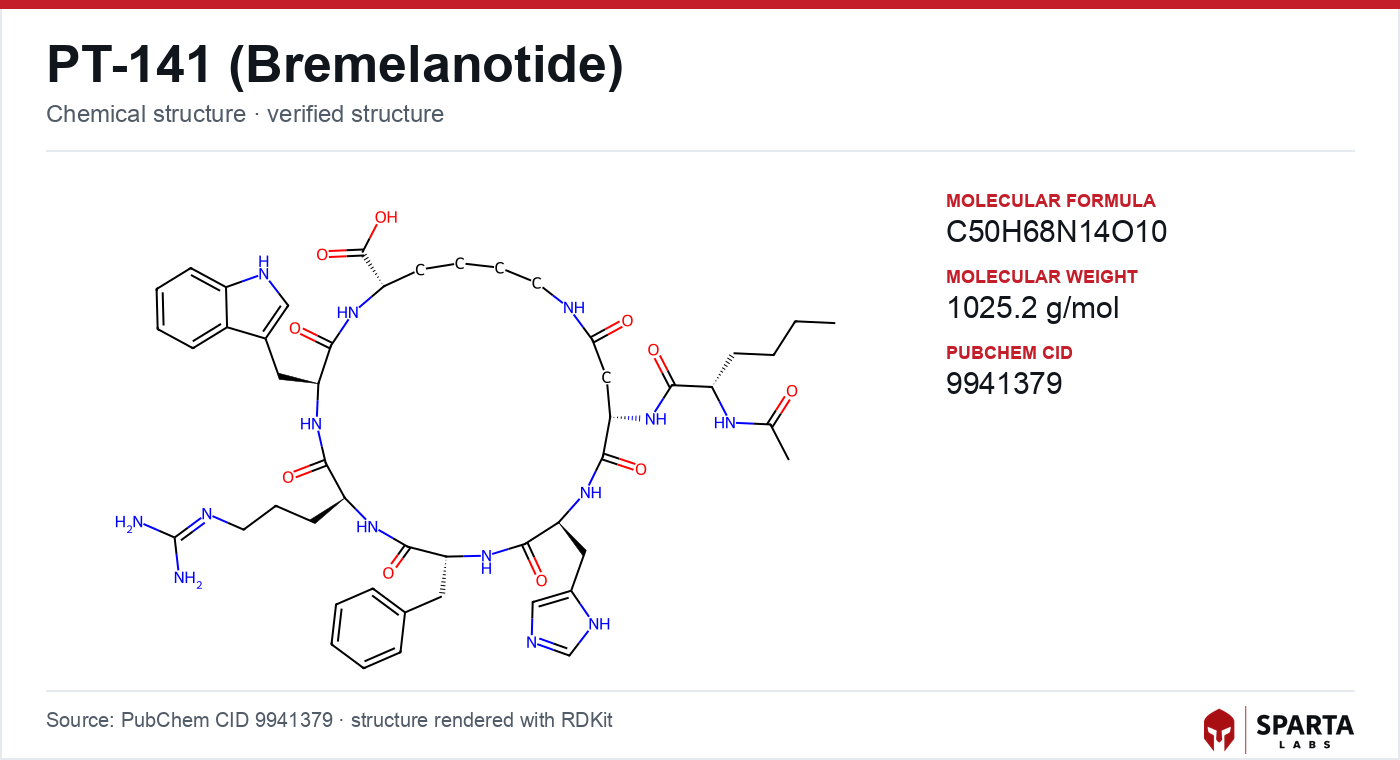
Figure: chemical structure of PT-141.
The lactam heptapeptide scaffold
Bremelanotide is a cyclic heptapeptide with the sequence Ac-Nle-cyclo[Asp-His-D-Phe-Arg-Trp-Lys]-OH. The ring is closed by an amide (lactam) bond formed between the side-chain carboxyl of the aspartate residue and the side-chain amine of the lysine residue, producing a constrained macrocycle rather than a linear chain. The molecular formula is C50H68N14O10 and the reported molecular weight is approximately 1025 daltons [1].
Two structural features recur throughout the melanocortin-analog literature and both are present here. The first is the His-D-Phe-Arg-Trp core, a conserved message sequence shared with native alpha-MSH; the substitution of D-phenylalanine for the natural L-isomer at that position is a classic modification associated with resistance to enzymatic cleavage in this analog family [1]. The second is the macrocyclic constraint itself, which reduces conformational freedom and was a defining design strategy of the melanotropin program from which this scaffold descends. The single terminal difference from melanotan II, an acid where melanotan II carries an amide, is the feature that separates the two peptides. A closer treatment of the melanotan lineage appears in the Melanotan-2 research overview.
Non-selective melanocortin receptor pharmacology
The melanocortin system comprises endogenous peptides derived from proopiomelanocortin, principally adrenocorticotropin and the melanocyte-stimulating hormones, acting on five G protein-coupled receptors designated MC1R through MC5R. These receptors govern processes including pigmentation, steroidogenesis, energy balance, inflammation, and central neuroendocrine signaling [2].
Molinoff and colleagues (2003), reporting in Annals of the New York Academy of Sciences, characterized bremelanotide (then designated PT-141) as a synthetic melanocortin agonist and situated it within this receptor family [1].
Findings from research models do not establish safety or efficacy in humans. Sparta Labs makes no claims about the use of this compound.
The published pharmacology describes bremelanotide as a non-selective agonist across multiple melanocortin subtypes, with activity at MC3R and MC4R most frequently emphasized in the neuroscience literature. This receptor engagement is central rather than peripheral in emphasis: MC4R is broadly distributed through the hypothalamus, limbic structures, and brainstem. The physiological importance of that receptor is underscored by genetic work; Huszar and colleagues (1997), publishing in Cell, reported that targeted disruption of the melanocortin-4 receptor gene in mice was associated with an obese phenotype, establishing MC4R as a node in central energy homeostasis [3]. The distinction between a centrally acting melanocortin agonist and a peripherally acting vasodilator such as a phosphodiesterase-5 inhibitor is a recurring framing in reviews of this compound. Receptor-level detail is developed further in the PT-141 mechanism of action article.
From melanotropin chemistry to a clinical candidate
The intellectual roots of bremelanotide lie in melanotropin chemistry: cyclic and conformationally constrained analogs of alpha-MSH developed to probe receptor selectivity and to resist enzymatic degradation. Hadley and Dorr (2006), writing in Peptides, chronicled the historical arc of melanocortin peptide therapeutics from these foundational analogs through their commercial development, tracing the path along which the melanotan scaffolds gave rise to later clinical candidates [4].
Palatin Technologies advanced bremelanotide from that scaffold through clinical development. The regulatory and discovery timeline is treated in depth in the PT-141 discovery and regulatory history article. Because bremelanotide acts on the same neuroendocrine machinery studied for other reproductive-axis peptides, it is frequently discussed alongside compounds such as oxytocin; a parallel entry is the oxytocin research overview.
The RECONNECT trials and the Vyleesi approval
Bremelanotide reached a regulatory milestone uncommon for this peptide class. On June 21, 2019 the US Food and Drug Administration approved it under the brand name Vyleesi (NDA 210557) for one specific indication in premenopausal women, making it the first melanocortin receptor agonist approved for any therapeutic use [5].
The approval rested on the RECONNECT program, two identically designed phase 3 randomized, placebo-controlled trials. Kingsberg and colleagues (2019), reporting in Obstetrics and Gynecology, described the pooled results across the two studies and the validated questionnaire instruments used for the co-primary endpoints [6]. As reported in the FDA label, the approved product is administered subcutaneously; the label also carries precautionary language regarding transient blood-pressure elevation, consistent with the known cardiovascular pharmacology of melanocortin agonism [5]. Bremelanotide is not approved for men, for postmenopausal women, or for any use outside its single labeled indication.
Research-grade PT-141 offered by Sparta Labs is characterized by independent third-party HPLC and mass spectrometry for identity and purity and is supplied strictly for laboratory research. It is not the approved Vyleesi drug product and is not intended for human use. A summary of the primary studies discussed here is compiled in the PT-141 published research article.
References
-
Molinoff PB, Shadiack AM, Earle D, Diamond LE, Quon CY. PT-141: a melanocortin agonist for the treatment of sexual dysfunction. Ann N Y Acad Sci. 2003;994:96-102. PMID: 12851302. DOI: 10.1111/j.1749-6632.2003.tb03167.x. PubMed
-
Cone RD. Studies on the physiological functions of the melanocortin system. Endocr Rev. 2006;27(7):736-749. PMID: 17077189. DOI: 10.1210/er.2006-0034. PubMed
-
Huszar D, Lynch CA, Fairchild-Huntress V, Dunmore JH, Fang Q, Berkemeier LR, et al. Targeted disruption of the melanocortin-4 receptor results in obesity in mice. Cell. 1997;88(1):131-141. PMID: 9019399. DOI: 10.1016/S0092-8674(00)81865-6. PubMed
-
Hadley ME, Dorr RT. Melanocortin peptide therapeutics: historical milestones, clinical studies and commercialization. Peptides. 2006;27(4):921-930. PMID: 16412534. DOI: 10.1016/j.peptides.2005.01.029. PubMed
-
US Food and Drug Administration. Vyleesi (bremelanotide injection) prescribing information. NDA 210557. Approved June 21, 2019. accessdata.fda.gov
-
Kingsberg SA, Clayton AH, Portman D, Williams LA, Krop J, Jordan R, et al. Bremelanotide for the treatment of hypoactive sexual desire disorder: two randomized phase 3 trials. Obstet Gynecol. 2019;134(5):899-908. PMID: 31599840. DOI: 10.1097/AOG.0000000000003500. PubMed
Disclaimer. Statements in this article have not been evaluated by the Food and Drug Administration. This compound is not intended to diagnose, treat, cure, or prevent any disease. Sparta Labs sells research-use-only materials. Content is provided for educational and informational purposes only and does not constitute medical advice. Consult a qualified medical professional for any health concerns.
Frequently asked questions
How does PT-141 differ chemically from melanotan II?
Bremelanotide (PT-141) shares the cyclic lactam heptapeptide scaffold of melanotan II but carries a free C-terminal carboxylic acid where melanotan II has a C-terminal amide. The published lineage describes bremelanotide as a metabolite-derived analog of that earlier alpha-MSH mimetic. This single terminal change is the defining structural distinction between the two peptides.
Which melanocortin receptors does bremelanotide act on?
Published pharmacology characterizes bremelanotide as a non-selective agonist across several melanocortin receptor subtypes, with activity at MC3R and MC4R most frequently emphasized in the neuroscience literature. MC4R is broadly expressed in the hypothalamus and other central nervous system regions. Sparta Labs makes no claims about the use of this compound.
Is PT-141 (bremelanotide) an FDA-approved drug?
Bremelanotide was approved by the US FDA in June 2019 under the brand name Vyleesi (NDA 210557) for one specific indication in premenopausal women. The label describes a subcutaneous route. Research-grade material sold for laboratory use is not the approved drug product and is not for human use.
What was the RECONNECT program?
RECONNECT refers to the two identically designed phase 3 randomized, placebo-controlled trials reported by Kingsberg and colleagues in Obstetrics and Gynecology in 2019 that supported the Vyleesi New Drug Application. The trials enrolled premenopausal women and assessed co-primary endpoints on validated questionnaire instruments.
Why is bremelanotide studied as a centrally acting peptide?
Because MC3R and MC4R are concentrated in central nervous system structures such as the hypothalamus, the melanocortin literature frames bremelanotide as acting through central rather than peripheral vascular pathways. This distinguishes its reported pharmacology from that of phosphodiesterase-5 inhibitors, which are described as peripheral vasodilators.