
Retatrutide Mechanism of Action
A mechanism-focused review of retatrutide (LY3437943): its deliberately unbalanced potency across the GIP, GLP-1, and glucagon receptors, the Gs-adenylyl cyclase-cAMP signaling shared by all three class B GPCRs, and the cryo-EM structural basis of triple engagement. Educational reference.

For research use only. Not for human consumption. This article is educational reference material. It is not medical advice and is not a recommendation to use any substance.
Retatrutide Mechanism of Action: Unbalanced Triple-Receptor Agonism
What Distinguishes Retatrutide Pharmacologically
Retatrutide (development code LY3437943) is an investigational, single-chain acylated synthetic peptide that the peer-reviewed literature classifies as a simultaneous agonist at three distinct class B1 G protein-coupled receptors: the glucose-dependent insulinotropic polypeptide receptor (GIPR), the glucagon-like peptide-1 receptor (GLP-1R), and the glucagon receptor (GCGR). It sits within a lineage of incretin-based molecules that began with mono-agonists, progressed to dual GIP/GLP-1 agonists, and reached triple-receptor engagement with this compound.
The feature that separates retatrutide from earlier molecules in that lineage is not simply the number of receptors it binds, but the unbalanced potency it exhibits across them. In the discovery report by Coskun, Urva, Roell and colleagues (2022), retatrutide displayed high agonist potency at the GIPR relative to the other two targets, while engaging GLP-1R and GCGR at lower relative potencies compared with their respective native ligands [1]. This article summarizes the reported receptor pharmacology, the intracellular signaling shared by the three targets, and the structural context that helps rationalize the potency differences. It reports what has been published; it draws no independent conclusions about clinical utility.
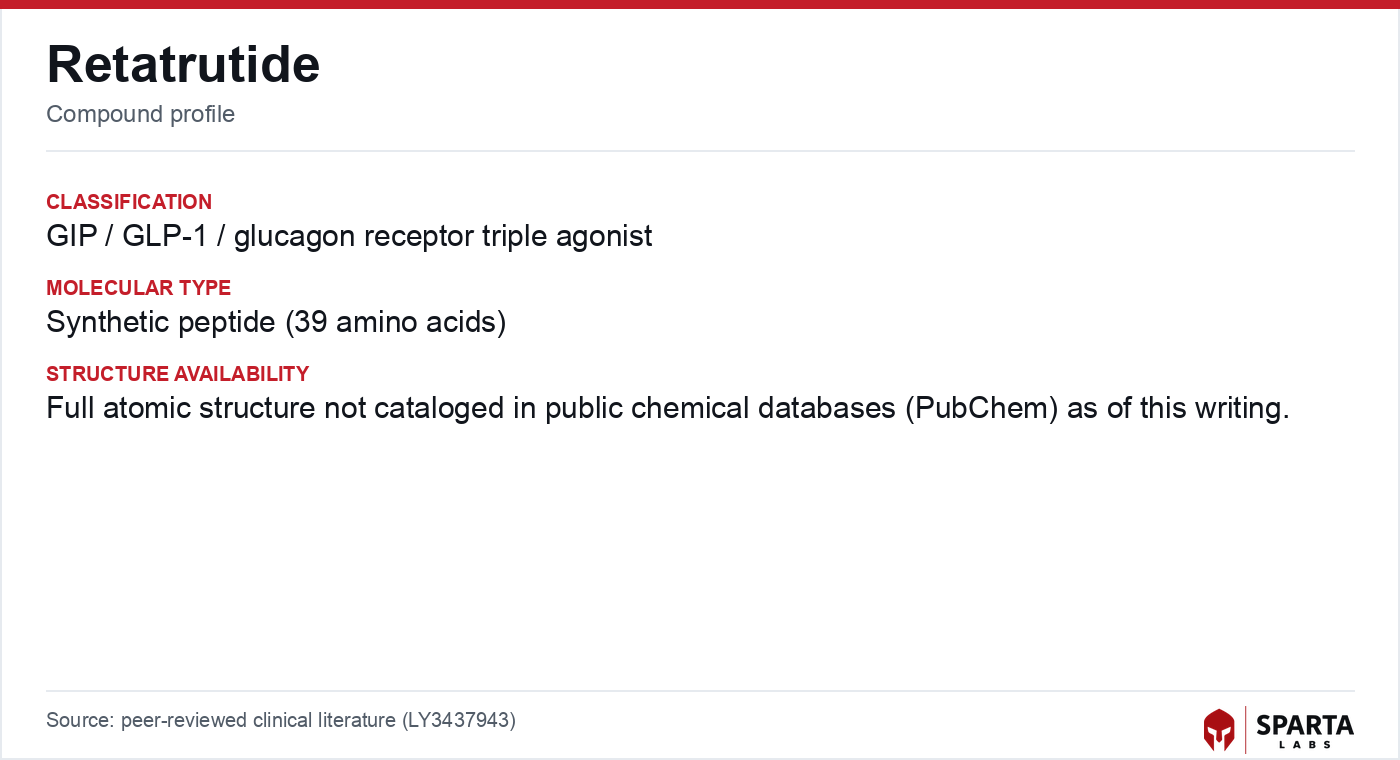
Figure: chemical structure of Retatrutide.
For a broader treatment of the compound's chemistry, classification, and development context, the retatrutide research overview provides complementary background.
The Single-Peptide, Three-Receptor Design
Retatrutide is a linear peptide bearing a fatty-diacid side chain conjugated to the backbone. Coskun et al. reported that this acylation confers albumin binding, which underlies a pharmacokinetic profile consistent with extended-interval exposure [1]. The acyl modification is a chemical strategy shared across the acylated incretin class and is not, in itself, what generates the triple-receptor activity; the receptor specificity is encoded in the peptide sequence and its side-chain positioning.
Because the three target receptors (GIPR, GLP-1R, GCGR) belong to the same secretin-like class B1 GPCR subfamily and recognize structurally related endogenous ligands, a single engineered sequence can present the distinct recognition determinants each receptor requires. Campbell and Drucker, in their review of incretin hormone biology, described the conserved architecture of these hormones and their receptors, which provides the physiological backdrop against which multi-receptor peptides are engineered [2].
Findings from research models do not establish safety or efficacy in humans. Sparta Labs makes no claims about the use of this compound.
Receptor-by-Receptor Pharmacology
GIP receptor: the highest-potency target
The GIPR is expressed in pancreatic beta cells, adipose tissue, bone, and central nervous system regions. Endogenous GIP is secreted by intestinal K cells after nutrient intake and acts to potentiate glucose-dependent insulin secretion. Coskun et al. reported that retatrutide's agonist potency at GIPR was high relative to its engagement of the other two receptors, positioning GIPR as the dominant target in the molecule's in vitro profile [1].
GLP-1 receptor: incretin engagement at lower relative potency
The GLP-1R is expressed in pancreatic beta cells, the gastrointestinal tract, the central nervous system, and cardiac tissue. Native GLP-1, released by intestinal L cells, potentiates glucose-dependent insulin secretion, suppresses glucagon release, slows gastric emptying, and engages hypothalamic and brainstem circuits involved in satiety signaling. Coskun et al. reported that retatrutide engaged GLP-1R at a lower relative potency than native GLP-1, in contrast to its high relative potency at GIPR [1].
Glucagon receptor: the axis absent from dual agonists
The GCGR is expressed predominantly in hepatocytes, with additional expression in kidney, adipose tissue, and the central nervous system. Endogenous glucagon, secreted by islet alpha cells during fasting, acts on hepatocytes to drive glycogenolysis and gluconeogenesis. Müller and colleagues, in their comprehensive physiological review of glucagon, described the hormone's roles that extend beyond hepatic glucose output to include effects on lipid handling and energy metabolism [3]. Coskun et al. reported that retatrutide engaged GCGR at a lower relative potency than native glucagon, and that this glucagon-receptor arm distinguishes the triple agonist from dual GIP/GLP-1 molecules [1]. A comparison of how a different glucagon-containing molecule balances these arms is discussed in the mazdutide mechanism of action article.
Shared Signaling: The Gs–Adenylyl Cyclase–cAMP Axis
All three of retatrutide's target receptors couple predominantly to the stimulatory Gs protein. Agonist binding promotes Gs activation, which stimulates adenylyl cyclase and raises intracellular cyclic AMP (cAMP). Elevated cAMP engages two principal effector systems: protein kinase A (PKA) and the exchange proteins directly activated by cAMP (EPAC).
In pancreatic beta cells, this cAMP signaling amplifies the insulin-secretory response, and it does so in a glucose-dependent manner. This glucose dependence — a property retatrutide's incretin arms share with the native hormones — means that GIPR and GLP-1R agonism potentiates insulin release in the context of elevated glucose rather than driving it unconditionally. Campbell and Drucker described the molecular basis of this glucose-dependent potentiation in beta cells for the incretin receptors [2].
In hepatocytes, GCGR-coupled cAMP signaling drives PKA-dependent phosphorylation cascades that regulate glycogenolytic and gluconeogenic enzyme activity, as characterized in Müller and colleagues' review of glucagon action [3]. The concurrent operation of glucagon-receptor signaling and incretin-driven insulin secretion within a single molecule is the mechanistic tension at the center of triple-agonist pharmacology; how these opposing influences on glucose handling net out is a question addressed in the clinical literature rather than resolvable from receptor assays alone.
Structural Context for the Potency Asymmetry
Why one engineered peptide binds three related receptors with different potencies is a question of molecular geometry. Single-particle cryo-electron microscopy has been used to resolve class B1 incretin and glucagon receptors in complex with peptide agonists and their G proteins. Zhao and colleagues reported cryo-EM structures characterizing how multiplexed peptide agonists engage the GIP, GLP-1, and glucagon receptors, identifying the distinct binding modes and contact-residue patterns that accompany differing pharmacology across these related targets [4].
This structural framework is informative because it establishes, at residue-level detail, how a peptide's contacts at each receptor interface relate to its measured potency. It provides a physical basis for interpreting the unbalanced in vitro profile reported by Coskun et al. Signaling-bias questions — whether a triple agonist favors cAMP generation over beta-arrestin recruitment at GLP-1R, as was reported for tirzepatide by Willard and colleagues [5] — sit at the intersection of this structural data and functional assays, and are discussed further in the tirzepatide mechanism of action article.
Reported Pharmacodynamics in Early Clinical Study
In the phase 1b multiple-ascending-dose study in adults with type 2 diabetes reported by Urva, Coskun, Loh and colleagues in The Lancet (2022), retatrutide administration was associated with dose-dependent changes in pharmacodynamic markers over the treatment period, and the pharmacokinetic profile was reported to be consistent with extended-interval exposure attributable to the albumin-binding acyl modification [6]. The authors characterized the observed pharmacodynamic pattern as consistent with engagement of the triple-receptor targets. These are the reported observations of that specific trial; broader summaries of the published study record are compiled in the retatrutide published research article.
Open Questions in the Mechanistic Literature
Several aspects of retatrutide's mechanism remain active research frontiers. First, the relative contribution of each of the three receptor arms to the pharmacodynamic effects seen in human studies has not been fully dissected; preclinical approaches use receptor-selective antagonists or knockout models, and comparable pharmacological dissection in humans is identified in the literature as future work. Second, the signaling-bias profile of retatrutide at GLP-1R and GCGR — the cAMP-versus-arrestin balance — remains to be characterized in the depth reported for related molecules. Third, the way glucagon-receptor agonism integrates with the incretin arms over chronic exposure, including questions of receptor desensitization, is expected to be informed by extended clinical data.
Research-grade retatrutide from Sparta Labs is supplied with third-party analytical documentation; the verification standards applied to that material are described in the retatrutide sourcing and quality article.
References
-
Coskun T, Urva S, Roell WC, Qu H, Loghin C, Moyers JS, et al. LY3437943, a novel triple glucagon, GIP, and GLP-1 receptor agonist for glycemic control and weight loss: From discovery to clinical proof of concept. Cell Metab. 2022;34(9):1234-1247.e9. DOI: 10.1016/j.cmet.2022.07.013. PubMed
-
Campbell JE, Drucker DJ. Pharmacology, physiology, and mechanisms of incretin hormone action. Cell Metab. 2013;17(6):819-837. DOI: 10.1016/j.cmet.2013.04.008. PubMed
-
Müller TD, Finan B, Clemmensen C, DiMarchi RD, Tschöp MH. The new biology and pharmacology of glucagon. Physiol Rev. 2017;97(2):721-766. DOI: 10.1152/physrev.00025.2016. PubMed
-
Zhao F, Zhou Q, Cong Z, Hang K, Zou X, Zhang C, et al. Structural insights into multiplexed pharmacological actions of tirzepatide and peptide 20 at the GIP, GLP-1 or glucagon receptors. Nat Commun. 2022;13:1057. DOI: 10.1038/s41467-022-28683-0. PubMed
-
Willard FS, Douros JD, Gabe MB, Showalter AD, Wainscott DB, Suter TM, et al. Tirzepatide is an imbalanced and biased dual GIP and GLP-1 receptor agonist. JCI Insight. 2020;5(17):e140532. DOI: 10.1172/jci.insight.140532. PubMed
-
Urva S, Coskun T, Loh MT, Du Y, Thomas MK, Gurbuz S, et al. LY3437943, a novel triple GIP, GLP-1, and glucagon receptor agonist in people with type 2 diabetes: a phase 1b, multicentre, double-blind, placebo-controlled, randomised, multiple-ascending dose trial. Lancet. 2022;400(10366):1869-1881. DOI: 10.1016/S0140-6736(22)02033-5. PubMed
Disclaimer. Statements in this article have not been evaluated by the Food and Drug Administration. This compound is not intended to diagnose, treat, cure, or prevent any disease. Sparta Labs sells research-use-only materials. Content is provided for educational and informational purposes only and does not constitute medical advice. Consult a qualified medical professional for any health concerns.
Frequently asked questions
What makes retatrutide a triple agonist rather than a dual incretin agonist?
Retatrutide is a single acylated peptide that engages three distinct class B G protein-coupled receptors at once: the GIP receptor, the GLP-1 receptor, and the glucagon receptor. Dual incretin agonists such as tirzepatide engage only the GIP and GLP-1 receptors. The addition of glucagon-receptor agonism is the defining feature reported by Coskun and colleagues in their 2022 discovery paper.
Why is retatrutide described as having 'unbalanced' receptor potency?
Coskun and colleagues reported that retatrutide's relative potency is not equal across its three targets. In their cell-based assays it showed high potency at the GIP receptor, alongside comparatively lower relative potency at the GLP-1 and glucagon receptors versus their native ligands. This imbalance in the pharmacology is described in the primary literature as a design characteristic rather than an accident of structure.
What second-messenger pathway do retatrutide's receptors use?
The GIP, GLP-1, and glucagon receptors are all class B1 GPCRs that couple predominantly to the Gs protein. Gs activates adenylyl cyclase, raising intracellular cyclic AMP, which in turn engages protein kinase A and EPAC effectors. In pancreatic beta cells this signaling potentiates glucose-dependent insulin secretion, a property the incretin receptors share with their native hormones.
How was the structural basis of these incretin receptors determined?
Researchers have used single-particle cryo-electron microscopy to resolve incretin and glucagon receptors bound to peptide agonists in complex with their G proteins. These structures characterize the distinct binding geometries a peptide adopts at each receptor and identify contact residues that help rationalize differing potencies across related targets. This body of structural work provides the framework for interpreting multi-receptor agonist pharmacology.