
Semax: Discovery and Regulatory History
How a stabilized ACTH(4-10) fragment became Semax: tracing the peptide from Soviet melanocortin pharmacology and the Myasoedov-Ashmarin collaboration through Russian registration and four decades of shifting research questions.

For research use only. Not for human consumption. This article is educational reference material. It is not medical advice and is not a recommendation to use any substance.
A Heptapeptide Engineered From a Hormone Fragment
Semax (Met-Glu-His-Phe-Pro-Gly-Pro) is a synthetic heptapeptide whose history is best understood not as the discovery of a new molecule in nature but as a deliberate engineering solution to a specific pharmacological problem inherited from mid-century endocrinology. That problem was durability: the behaviorally active fragments of adrenocorticotropic hormone (ACTH) worked in animal models but were cleaved too quickly in serum to be useful. Semax is the answer a Russian Academy of Sciences group arrived at, and its story is the story of how that answer was designed, registered, and then reinterpreted by successive generations of researchers.
This article traces four threads: the ACTH pharmacophore problem that motivated the design, the named investigators who solved it, the jurisdiction-dependent regulatory record, and the way the research questions themselves shifted across four decades. Readers seeking the compound's proposed molecular pharmacology rather than its historical arc may prefer the Semax mechanism of action article, which treats the neurotrophin and receptor literature in detail.
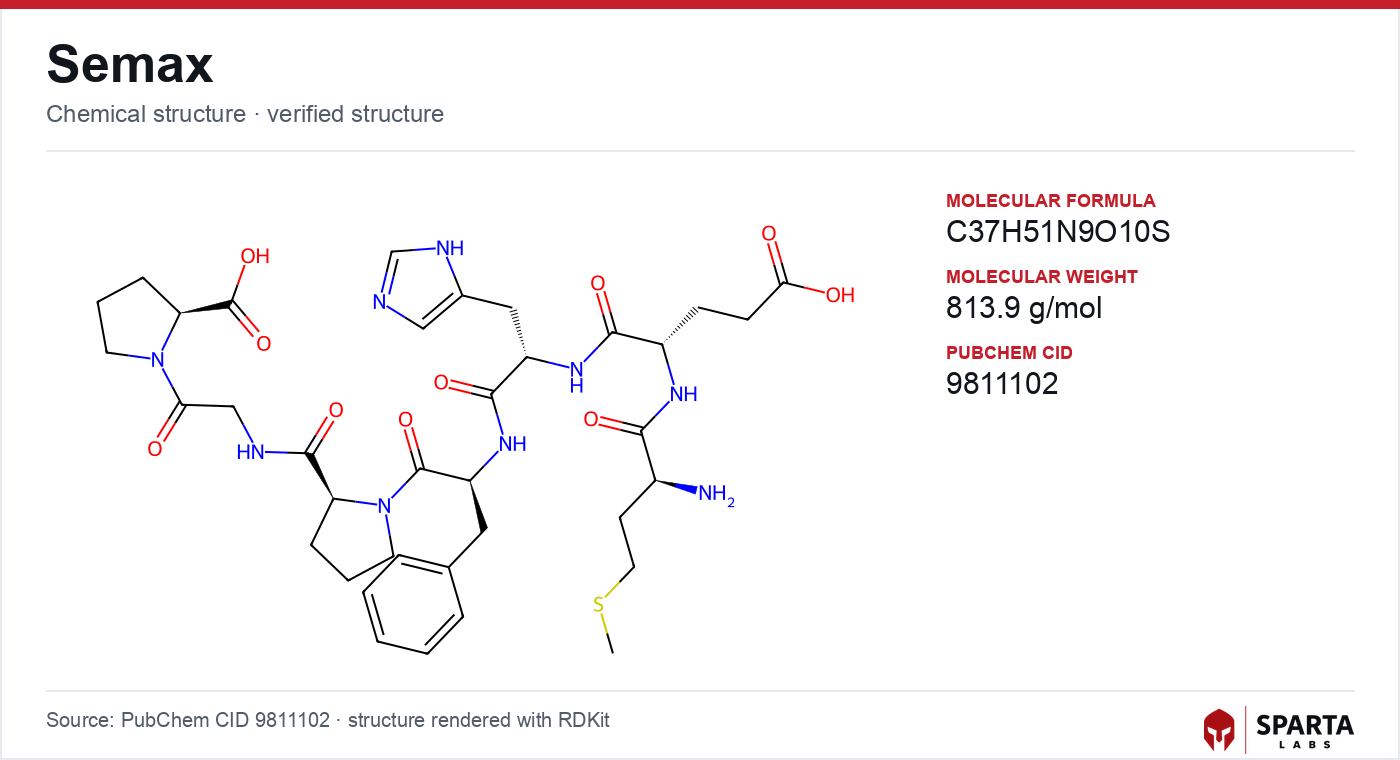
Figure: chemical structure of Semax.
The Inheritance: ACTH Fragments and the Degradation Problem
The scientific foundation predates Semax by two decades. Through the 1960s and 1970s, investigators in several countries reported that short N-terminal fragments of ACTH retained activity in rodent learning and conditioned-avoidance paradigms independent of the hormone's endocrine action on the adrenal cortex. The ACTH(4-10) segment emerged from this body of work as a minimal sequence sufficient for measurable neuromodulatory activity in those models.
Two structural facts framed everything that followed. First, the active pharmacophore was narrower still than ACTH(4-10): the tetrapeptide ACTH(4-7), Met-Glu-His-Phe, carried the essential activity. Second, the native fragment was rapidly degraded by serum carboxypeptidases, which foreclosed practical development. Any usable analog had to preserve the tetrapeptide core while defeating the enzymes that dismantled it. This is the design brief the Russian program set for itself.
Attribution: The Myasoedov-Ashmarin Program
In the late 1970s a research program was initiated at the Institute of Molecular Genetics of the Russian Academy of Sciences under the scientific direction of Academician Nikolai Fedorovich Myasoedov, in collaboration with Academician Igor Pavlovich Ashmarin of Moscow State University [1]. Soviet peptide pharmacology had built substantial institutional capacity during this period, and the program operated inside the coordinated academic-government research framework characteristic of the era.
The group's engineering insight was to append a Pro-Gly-Pro tripeptide to the C-terminus of the active fragment. Proline-rich termini resist exopeptidase attack, and the modification produced a molecule with markedly extended enzymatic stability while retaining the Met-Glu-His-Phe pharmacophore [1]. The resulting heptapeptide was designated Semax.
Findings from research models do not establish safety or efficacy in humans. Sparta Labs makes no claims about the use of this compound.
The primary published historical account of these origins is a 1997 review by Ashmarin, Nezavibatko, and Myasoedov in the Russian journal Zhurnal Vysshei Nervnoi Deyatelnosti, which surveyed fifteen years of work from initial synthesis through clinical evaluation and is cited in later literature as the foundational document of the compound's development arc [1]. This lineage — a proteolytically stabilized fragment produced inside the Russian Academy system — is shared by other neuropeptides of the same research generation; the parallel case of Epithalon's discovery and regulatory history and the closely related Selank discovery history illustrate how the same institutional program generated a small family of registered peptides.
Verifying the Design Held: Early Enzymatic Work
A design intention is not a demonstrated property, and the first systematic test of Semax's stability came from within the same research network. Inozemtseva and colleagues reported in 1993 in the journal Peptides that rat serum carboxypeptidase activity was substantially reduced on the Semax sequence relative to the unmodified ACTH/MSH(4-10) fragment [2]. Published in a Western peer-reviewed journal, this study was an early point of contact between the Russian program and the international literature, and it confirmed that the Pro-Gly-Pro tail conferred the intended protease resistance.
The preclinical characterization of this period leaned on behavioral pharmacology — maze learning, conditioned avoidance, and spatial memory in rodents — and on refining synthesis methods to yield material suitable for clinical evaluation. The compound was formulated as a nasal spray, a route selected for the preclinical program and carried forward into clinical development. Contemporary analytical verification standards for research-grade material are documented separately in the Semax sourcing and verification standards article.
Two Regulatory Records, Not One
Semax's regulatory history diverges sharply by jurisdiction, and conflating the two produces a misleading picture.
Inside the Russian Federation, Semax completed phase I and phase II clinical trials between 1990 and 1996 and received registration from the Russian Ministry of Health in 1994, becoming an approved pharmaceutical in the form of the nasal spray product [1, 3]. A 2022 review of Russian peptide biopharmaceutical development by Deigin and colleagues in Pharmaceutics documented this history and Semax's later listing on the Russian List of Vital and Essential Drugs, a governmental register of pharmaceuticals considered fundamental to the national formulary [3]. That review situated the compound within the institutional priorities of the Soviet and post-Soviet academic infrastructure, where neuropeptide pharmacology received sustained governmental support.
Outside Russia, the record is empty of therapeutic authorization. Semax is not included in the European Medicines Agency's centralized authorization database, and the United States Food and Drug Administration has not reviewed or approved it for any indication. In the United States and European Union, Semax accordingly occupies the status of a research-use-only material — a characterization reflecting the regulatory pathways available in those jurisdictions for a compound whose clinical data base was generated under the Russian system. For readers assembling a broader profile of the compound's classification and status, the Semax research overview consolidates the chemistry and regulatory framing.
The Literature in Waves
What distinguishes Semax's history from a static regulatory footnote is that the questions researchers asked of it changed markedly over time. The English-language corpus can be read as a sequence of overlapping waves, each reframing the compound.
Wave one: the neurotrophin framing (2001 to 2007)
The English-language literature grew substantially from 2001, as members of the Institute of Molecular Genetics group published mechanistic studies in Western journals. Shadrina and colleagues (2001) reported the first English-language characterization of neurotrophin mRNA induction by Semax in glial cell cultures in Neuroscience Letters, describing an approximately eightfold BDNF mRNA elevation and fivefold NGF mRNA elevation that became a quantitative reference point for later work [4]. The Dolotov group followed with papers in Brain Research and the Journal of Neurochemistry (2006) reporting BDNF protein and trkB receptor changes in rat hippocampus and basal forebrain [5, 6]. Agapova and colleagues (2007) then mapped neurotrophin gene expression across multiple brain regions, establishing the region-specificity of the transcriptional response [8]. Together these publications set the BDNF/NGF neurotrophin axis as the interpretive framework for the compound.
Wave two: monoaminergic pharmacology
Running alongside the neurotrophin work, Eremin and colleagues (Neurochemical Research, 2005) characterized dopamine and serotonin turnover across brain regions, framing these as downstream effects of melanocortin receptor engagement [7]. This line broadened the compound's reported pharmacology beyond neurotrophin induction alone.
Wave three: genome-wide methods (2014)
A methodological shift arrived with Medvedeva and colleagues (BMC Genomics, 2014), who applied high-throughput mRNA sequencing to characterize the full transcriptional response in an ischemia model, moving the field from candidate-gene measurement toward genome-scale analysis [9]. A consolidating review by Kolomin, Shadrina, and Myasoedov the previous year had already synthesized two decades of published research into a single English-language account of the program [1].
Wave four: stress models and new receptor axes (2021 to 2025)
More recent work extended the compound into new territory. Filippenkov and colleagues (2021, International Journal of Molecular Sciences) examined hippocampal gene expression in a stress model, positioning Semax within the wider melanocortin antistress literature [10]. Inozemtseva and colleagues (2025, European Journal of Pharmacology) reported a chronic unpredictable stress model comparing Semax and Melanotan-II as representative noncorticotropic melanocortins, with hippocampal BDNF protein as a primary outcome [11]. Liu and colleagues (2025, British Journal of Pharmacology) reported a characterization of Semax's interaction with the mu-opioid receptor gene Oprm1 in a murine spinal cord injury model via a USP18 deubiquitinase mechanism — a pharmacological axis not previously described for the compound and, notably, a study led by investigators outside the original Russian program [12].
Where the History Points
Read as a whole, the record shows a compound that was engineered for a narrow purpose in the early 1980s and then progressively reinterpreted as the surrounding fields of melanocortin pharmacology and neurotrophin biology matured. The research program remains centered at Russian institutions, primarily the Institute of Molecular Genetics, but the 2025 British Journal of Pharmacology paper indicates that the interpretive lens is no longer held exclusively by the founding group. Semax stands as a well-documented noncorticotropic ACTH(4-10) analog in the peer-reviewed literature, with an origin story unusually tied to a single named institutional program.
Researchers sourcing the compound for preclinical work can review batch-specific analytical documentation on the Sparta Labs Semax product page, and the Semax published research summary catalogs the individual studies referenced here in bibliographic form.
References
-
Kolomin T, Shadrina M, Slominsky P, Limborska S, Myasoedov N. A new generation of drugs: synthetic peptides based on natural regulatory peptides. Neuroscience & Medicine. 2013;4:223–252. DOI: 10.4236/nm.2013.44035
-
Inozemtseva LS, Dolotov OV, Zolotarev YA, Dolotova OS, Andreeva LA, Myasoedov NF. Degradation of ACTH/MSH(4-10) and its synthetic analog semax by rat serum enzymes: an inhibitor study. Peptides. 1993;14(4):745–50. PMID: 8392718. DOI: 10.1016/0196-9781(93)90104-U
-
Deigin VI, Poluektova EA, Beniashvili AG, Kozin SA, Poluektov YM. Development of peptide biopharmaceuticals in Russia. Pharmaceutics. 2022;14(4):716. PMCID: PMC9030433. DOI: 10.3390/pharmaceutics14040716
-
Shadrina MI, Dolotov OV, Grivennikov IA, Slominsky PA, Andreeva LA, Inozemtseva LS, Limborska SA, Myasoedov NF. Rapid induction of neurotrophin mRNAs in rat glial cell cultures by Semax, an adrenocorticotropic hormone analog. Neurosci Lett. 2001;308(2):115–8. PMID: 11457573. DOI: 10.1016/S0304-3940(01)01994-2
-
Dolotov OV, Karpenko EA, Seredenina TS, Inozemtseva LS, Levitskaya NG, Zolotarev YA, Kamensky AA, Grivennikov IA, Engele J, Myasoedov NF. Semax, an analog of ACTH(4-10) with cognitive effects, regulates BDNF and trkB expression in the rat hippocampus. Brain Res. 2006;1117(1):54–60. PMID: 16996037. DOI: 10.1016/j.brainres.2006.07.108
-
Dolotov OV, Karpenko EA, Inozemtseva LS, Seredenina TS, Levitskaya NG, Zolotarev YA, Kamensky AA, Grivennikov IA, Engele J, Myasoedov NF. Semax, an analogue of adrenocorticotropin (4–10), binds specifically and increases levels of brain-derived neurotrophic factor protein in rat basal forebrain. J Neurochem. 2006;97 Suppl 1:82–6. PMID: 16635254. DOI: 10.1111/j.1471-4159.2006.03658.x
-
Eremin KO, Kudrin VS, Saransaari P, Oja SS, Grivennikov IA, Myasoedov NF, Rayevsky KS. Semax, an ACTH(4-10) analogue with nootropic properties, activates dopaminergic and serotoninergic brain systems in rodents. Neurochem Res. 2005;30(12):1493–500. PMID: 16362768. DOI: 10.1007/s11064-005-8826-8
-
Agapova TY, Agniullin YV, Shadrina MI, Shram SI, Kolomin TA, Myasoedov NF, Slominsky PA, Limborska SA. Neurotrophin gene expression in rat brain under the action of Semax, an analogue of ACTH 4-10. Neurosci Lett. 2007;417(2):201–5. PMID: 17353092. DOI: 10.1016/j.neulet.2007.02.042
-
Medvedeva EV, Dmitrieva VG, Povarova OV, Limborska SA, Skvortsova VI, Myasoedov NF, Dergunova LV. The peptide Semax affects the expression of genes related to the immune and vascular systems in rat brain focal ischemia: genome-wide transcriptional analysis. BMC Genomics. 2014;15:228. PMID: 24661604. PMCID: PMC3987924. DOI: 10.1186/1471-2164-15-228
-
Filippenkov IB, Stavchansky VV, Glazova NYu, Sebentsova EA, Remizova JA, Valieva LV, Levitskaya NG, Myasoedov NF, Limborska SA, Dergunova LV. Antistress action of melanocortin derivatives associated with correction of gene expression patterns in the hippocampus of male rats following acute stress. Int J Mol Sci. 2021;22(18):10054. PMID: 34576218. PMCID: PMC8469576. DOI: 10.3390/ijms221810054
-
Inozemtseva LS, Poletaeva DA, Dolotov OV, Grivennikov IA, Myasoedov NF. Antidepressant-like and antistress effects of the ACTH(4-10) synthetic analogs Semax and Melanotan II on male rats in a model of chronic unpredictable stress. Eur J Pharmacol. 2025;984:177068. PMID: 39442746. DOI: 10.1016/j.ejphar.2024.177068
-
Liu Y, Chen X, Zhang Y, Wang H, Li Z, Wu J, et al. Semax peptide targets the μ opioid receptor gene Oprm1 to promote deubiquitination and functional recovery after spinal cord injury in female mice. Br J Pharmacol. 2025. PMID: 40692165. DOI: 10.1111/bph.70122
Disclaimer. Statements in this article have not been evaluated by the Food and Drug Administration. This compound is not intended to diagnose, treat, cure, or prevent any disease. Sparta Labs sells research-use-only materials. Content is provided for educational and informational purposes only and does not constitute medical advice. Consult a qualified medical professional for any health concerns.
Frequently asked questions
What ACTH fragment is Semax derived from?
Semax is a synthetic analog of the ACTH(4-10) heptapeptide segment, with the tetrapeptide ACTH(4-7) (Met-Glu-His-Phe) identified as the minimal behaviorally active pharmacophore. Its designers appended a Pro-Gly-Pro tripeptide to the C-terminus to slow enzymatic cleavage. A 1993 study in Peptides reported that this modification reduced rat serum carboxypeptidase activity on the sequence relative to the unmodified fragment.
Who developed Semax and at what institution?
Semax was developed at the Institute of Molecular Genetics of the Russian Academy of Sciences under Academician Nikolai Fedorovich Myasoedov, in collaboration with Academician Igor Pavlovich Ashmarin of Moscow State University. The program began in the late 1970s with the stated goal of producing a proteolytically stable, clinically usable ACTH(4-10) analog.
When was Semax registered in Russia?
Semax received registration from the Russian Ministry of Health in 1994 as a nasal spray formulation, following phase I and phase II clinical evaluation in the Russian regulatory system between 1990 and 1996. A 2022 review in Pharmaceutics documented its later inclusion on the Russian List of Vital and Essential Drugs.
Is Semax approved in the United States or European Union?
No. Semax has not been reviewed or approved by the United States Food and Drug Administration for any indication, and it is not listed in the European Medicines Agency's centralized authorization database. In those jurisdictions it is characterized as a research-use-only material.
How have the questions asked in Semax research changed over time?
Early Soviet-era work centered on behavioral pharmacology in rodent learning models. A wave of publications from 2001 onward framed the compound around BDNF and NGF neurotrophin induction, the 2014 literature added genome-wide transcriptional analysis, and studies through 2025 extended into monoaminergic pharmacology, stress-model comparisons, and mu-opioid receptor gene signaling.