
Semax: Published Research
A structured survey of PubMed-indexed Semax research, organized around neurotrophin gene expression, the intact-peptide versus Pro-Gly-Pro metabolite question, monoaminergic microdialysis data, ischemia-model transcriptomics, and copper(II) coordination chemistry.

For research use only. Not for human consumption.
This article is educational reference material. It is not medical advice and is not a recommendation to use any substance.
Semax as a Research Subject: What the Literature Covers
Semax is a synthetic heptapeptide with the sequence Met-Glu-His-Phe-Pro-Gly-Pro (MEHFPGP). Structurally, it fuses the 4–10 fragment of adrenocorticotropic hormone (ACTH(4-10), the Met-Glu-His-Phe-Pro-Gly sequence) with a C-terminal Pro-Gly-Pro tripeptide, a modification introduced to slow enzymatic degradation of the parent fragment. Because ACTH(4-10) shares its central His-Phe-Arg-Trp-adjacent melanocortin core with the broader melanocortin family, Semax is classified in the published literature as a noncorticotropic melanocortin analog: it retains sequence homology to ACTH but was designed to lack the corticotropic (steroidogenic) activity of the full hormone.
The peer-reviewed research body originated primarily at Russian academic institutions, notably the Institute of Molecular Genetics of the Russian Academy of Sciences and Lomonosov Moscow State University, with later contributions from Western European laboratories. Two features make the published record unusual and are worth flagging up front for anyone surveying the primary literature. First, a large portion of the early behavioral and clinical work appeared in Russian-language journals and is only partially represented in English-indexed databases. Second, the English-language mechanistic literature clusters tightly around two experimental questions: how Semax modulates neurotrophin gene expression, and how the intact peptide behaves relative to its Pro-Gly-Pro cleavage product. This article organizes representative English-language, PubMed-indexed studies around those threads. All findings are attributed to the cited primary sources; where a claim could not be tied to a source that could be verified, it has been omitted.
Researchers sourcing material for preclinical work can review the Sparta Labs Semax product page for batch-specific analytical documentation.
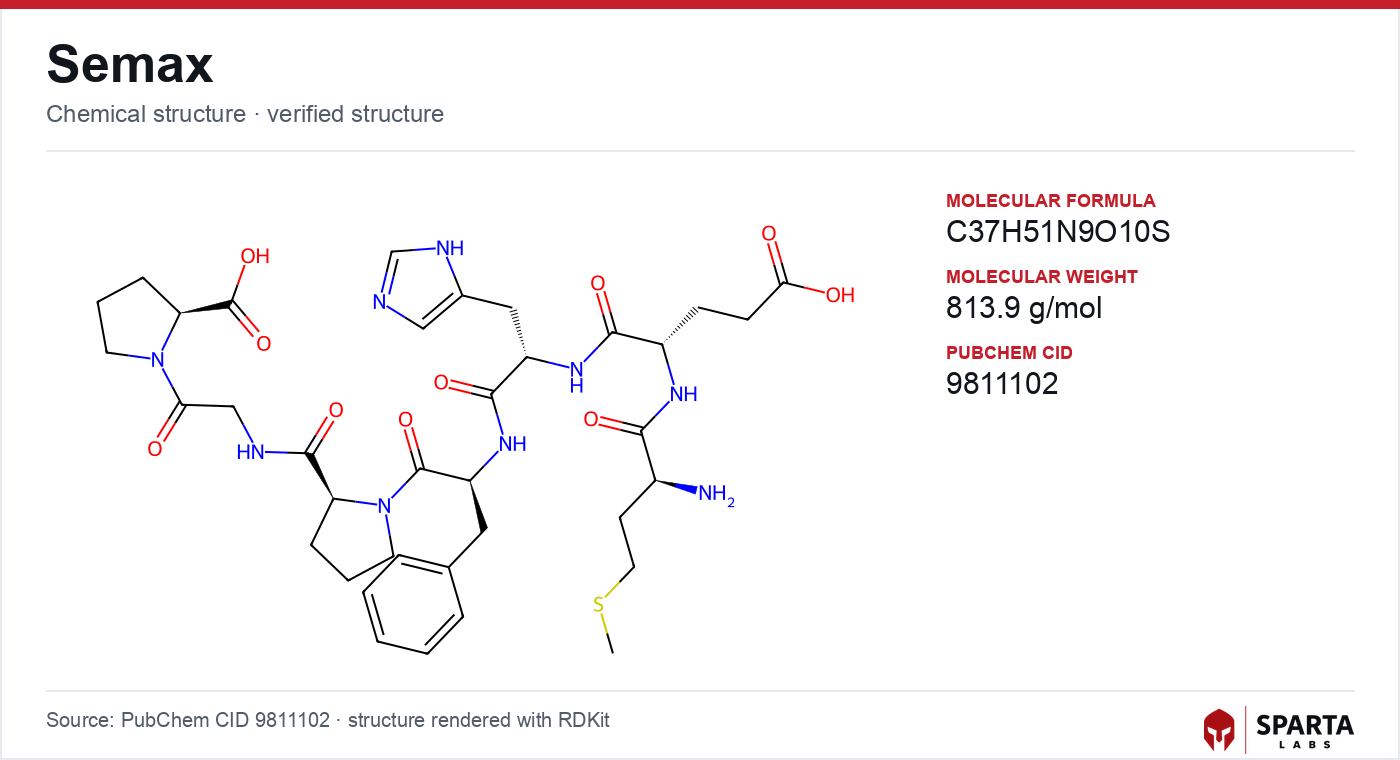
Figure: chemical structure of Semax (Met-Glu-His-Phe-Pro-Gly-Pro).
The Neurotrophin Thread: From mRNA Induction to Receptor Activation
The single most reproduced observation in the Semax literature concerns brain-derived neurotrophic factor (BDNF) and nerve growth factor (NGF), two neurotrophins central to neuronal maintenance and plasticity. The foundational English-language report came from Shadrina and colleagues in Neuroscience Letters (2001) [1]. Working in primary rat glial cell cultures derived from neonatal basal forebrain, the group exposed the cultures to Semax in vitro and quantified BDNF and NGF mRNA by PCR at 30 minutes post-treatment. They reported approximately eightfold elevation of BDNF mRNA and approximately fivefold elevation of NGF mRNA relative to vehicle controls, noting that the magnitude exceeded that observed for other agents tested in the same model at the time. The study measured transcript levels only; it did not establish protein-level outcomes or identify the receptor subtype involved.
Findings from research models do not establish safety or efficacy in humans. Sparta Labs makes no claims about the use of this compound.
The obvious follow-up question, whether the transcriptional signal translated to protein and to receptor activation in intact tissue, was addressed by Dolotov and colleagues in two 2006 papers. The Brain Research report described that a single Semax administration in adult rats was followed by roughly 1.4-fold higher BDNF protein, an approximately threefold rise in exon-III BDNF mRNA, and about twofold higher trkB mRNA in hippocampal tissue, alongside an approximately 1.6-fold increase in tyrosine phosphorylation of trkB, the BDNF receptor [2]. Because receptor phosphorylation is a proximal readout of activation rather than a downstream inference, this measurement is one of the more mechanistically informative points in the corpus. A companion paper in the Journal of Neurochemistry reported that Semax bound specifically to basal forebrain tissue preparations, with associated changes in regional BDNF protein, and the authors proposed that the basal forebrain interaction may differ mechanistically from the hippocampal one [3]. The molecular framing of these receptor interactions is treated in more depth in the Semax mechanism of action article.
A distinguishing feature of the in vivo neurotrophin data is that the response is regionally patterned rather than uniform. Agapova and colleagues, in Neuroscience Letters (2007), administered Semax to adult rats and measured BDNF and NGF mRNA across hippocampus, frontal cortex, brainstem, cerebellum, and retina [4]. Neurotrophin transcript changes differed by region, with BDNF changes concentrated in hippocampus, brainstem, and cerebellum, and a directional decrease in NGF reported in frontal cortex at the measured time points. The authors interpreted this as a spatially structured transcriptional response, a point that complicates any simple "Semax raises neurotrophins" summary of the literature.
The Metabolite Question: Does the Intact Heptapeptide Matter?
A methodologically important strand of Semax research asks whether the intact heptapeptide has pharmacology distinct from its degradation products, particularly the C-terminal Pro-Gly-Pro (PGP) tripeptide that the Pro-Gly-Pro tail was designed to generate on cleavage. This is not a trivial question: if the intact molecule were merely a delivery vehicle for PGP, the design rationale of the Pro-Gly-Pro modification would look different.
Dmitrieva and colleagues addressed this directly in Cellular and Molecular Neurobiology (2010), comparing the transcriptional effects of intact Semax against the Pro-Gly-Pro fragment in a rat cerebral ischemia model across a panel of neurotrophin and receptor genes (BDNF, NGF, trkA, trkB, trkC) [5]. The study reported that Semax and PGP produced different selectivity profiles across those targets, with the intact peptide showing a distinct pattern rather than a diluted version of the fragment's effect. The authors interpreted this as evidence that Semax's in vivo pharmacology is not fully reducible to its metabolites, and that the intact heptapeptide retains molecular selectivity of its own. For researchers, this framing matters because it argues against treating PGP data as a proxy for Semax data.
Beyond Neurotrophins: Monoaminergic and Ischemia-Model Data
Two additional experimental lines extend the picture beyond neurotrophin transcription. The first is monoaminergic pharmacology. Eremin and colleagues, in Neurochemical Research (2005), used in vivo microdialysis with HPLC-electrochemical detection in rat striatum, frontal cortex, and hippocampus to track dopamine, serotonin, and their metabolites (DOPAC, HVA, 5-HIAA) following Semax administration [6]. Altered monoamine turnover was reported in all three regions, which the authors discussed as consistent with downstream consequences of melanocortin-system engagement. Notably, the study did not include receptor-selective antagonist controls, so it does not by itself establish the melanocortin receptor as the proximate mechanism, a limitation the authors acknowledged.
The second line is genome-scale transcriptomics in an ischemia model, which situates Semax within a systems-biology rather than single-target frame. Medvedeva and colleagues, in BMC Genomics (2014), performed a genome-wide transcriptional analysis in a permanent middle cerebral artery occlusion (pMCAO) rat model, profiling ischemic cortex mRNA at 3 and 24 hours after Semax administration against both sham and vehicle-treated ischemia controls [7]. The most pronounced differential expression at 24 hours fell among innate-immune-response pathways and genes associated with vascular and blood-brain-barrier function, rather than among the neurotrophin genes that dominate the in vitro literature. This broadens the readout of Semax's transcriptional footprint and illustrates why the ischemia-model and cell-culture literatures should not be read as measuring the same thing.
A Non-Neurotrophic Property: Copper(II) Coordination
One line of inquiry sits entirely apart from the melanocortin and neurotrophin frameworks and is worth noting for its chemical specificity. The N-terminal Met-Glu-His motif of Semax presents the amino-terminal Cu(II)- and Ni(II)-binding (ATCUN) sequence motif, in which a histidine at the third position and the free alpha-amino terminus together chelate copper(II). Tabbì and colleagues, in the Journal of Inorganic Biochemistry (2015), characterized this coordination chemistry and reported that Semax forms a stable ATCUN-type Cu(II) complex [8]. In vitro work in SH-SY5Y neuroblastoma and RBE4 endothelial cell lines described reduced copper-induced cytotoxicity in the presence of the Semax-copper complex relative to copper alone. The authors framed this as a potential relevance in settings of metal-ion dysregulation, an avenue distinct from the neurotrophin-centered literature and one that draws a structural parallel to the copper-coordinating peptide chemistry discussed for GHK-Cu.
Placing Semax Among Related Neuropeptides
Semax does not sit alone in the research literature. It is frequently studied alongside other short Russian-origin regulatory peptides, most directly Selank, a heptapeptide from a different lineage (a Tuftsin analog) that occupies an adjacent anxiety- and stress-model research niche. Semax is also the parent scaffold for an amidated, N-acetylated derivative documented in the N-Acetyl Semax Amidate research overview, where terminal modifications are studied for their effect on metabolic stability. Comparing the primary literatures of these related peptides highlights how much of the published Semax work is mechanistic and preclinical rather than clinical.
Gaps and Open Questions in the Published Record
Several limitations recur across the corpus and define where the field remains open:
Human clinical data. No placebo-controlled, double-blinded clinical trial of Semax pharmacokinetics, pharmacodynamics, or clinical outcomes has been published in indexed English-language peer-reviewed journals. Regulatory registration in Russia rested on trial data that has not been made fully available in this form, which remains a recognized gap in the international record.
Receptor-subtype deconvolution. The relative contributions of MC3R, MC4R, and other melanocortin receptor subtypes to the reported neurotrophin and monoaminergic effects have not been resolved with receptor-selective antagonists or genetic models. Much of the mechanistic literature infers melanocortin involvement from sequence homology rather than direct pharmacological blockade.
Pharmacokinetics and CNS exposure. The relationship between administered quantity, central nervous system tissue concentration, and receptor occupancy in vivo has not been rigorously quantified, which constrains interpretation of the dose-response structure of the existing data.
Sex as a biological variable. The majority of the published rodent work used male animals, leaving open whether the reported neurochemical and transcriptional responses generalize across sex.
References
-
Shadrina MI, Dolotov OV, Grivennikov IA, Slominsky PA, Andreeva LA, Inozemtseva LS, Limborska SA, Myasoedov NF. Rapid induction of neurotrophin mRNAs in rat glial cell cultures by Semax, an adrenocorticotropic hormone analog. Neurosci Lett. 2001;308(2):115–8. PMID: 11457573. DOI: 10.1016/S0304-3940(01)01994-2. PubMed
-
Dolotov OV, Karpenko EA, Seredenina TS, Inozemtseva LS, Levitskaya NG, Zolotarev YA, Kamensky AA, Grivennikov IA, Engele J, Myasoedov NF. Semax, an analog of ACTH(4-10) with cognitive effects, regulates BDNF and trkB expression in the rat hippocampus. Brain Res. 2006;1117(1):54–60. PMID: 16996037. DOI: 10.1016/j.brainres.2006.07.108. PubMed
-
Dolotov OV, Karpenko EA, Inozemtseva LS, Seredenina TS, Levitskaya NG, Zolotarev YA, Kamensky AA, Grivennikov IA, Engele J, Myasoedov NF. Semax, an analogue of adrenocorticotropin (4–10), binds specifically and increases levels of brain-derived neurotrophic factor protein in rat basal forebrain. J Neurochem. 2006;97 Suppl 1:82–6. PMID: 16635254. DOI: 10.1111/j.1471-4159.2006.03658.x. PubMed
-
Agapova TY, Agniullin YV, Shadrina MI, Shram SI, Kolomin TA, Myasoedov NF, Slominsky PA, Limborska SA. Neurotrophin gene expression in rat brain under the action of Semax, an analogue of ACTH 4-10. Neurosci Lett. 2007;417(2):201–5. PMID: 17353092. DOI: 10.1016/j.neulet.2007.02.042. PubMed
-
Dmitrieva VG, Povarova OV, Skvortsova VI, Limborska SA, Myasoedov NF, Dergunova LV. Semax and Pro-Gly-Pro activate the transcription of neurotrophins and their receptor genes after cerebral ischemia. Cell Mol Neurobiol. 2010;30(1):71–9. PMID: 19633950. DOI: 10.1007/s10571-009-9432-0. PubMed
-
Eremin KO, Kudrin VS, Saransaari P, Oja SS, Grivennikov IA, Myasoedov NF, Rayevsky KS. Semax, an ACTH(4-10) analogue with nootropic properties, activates dopaminergic and serotoninergic brain systems in rodents. Neurochem Res. 2005;30(12):1493–500. PMID: 16362768. DOI: 10.1007/s11064-005-8826-8. PubMed
-
Medvedeva EV, Dmitrieva VG, Povarova OV, Limborska SA, Skvortsova VI, Myasoedov NF, Dergunova LV. The peptide Semax affects the expression of genes related to the immune and vascular systems in rat brain focal ischemia: genome-wide transcriptional analysis. BMC Genomics. 2014;15:228. PMID: 24661604. PMCID: PMC3987924. DOI: 10.1186/1471-2164-15-228. PubMed
-
Tabbì G, Magrì A, Giuffrida A, Lanza V, Pappalardo G, Naletova I, Nicoletti VG, Attanasio F, Rizzarelli E. Semax, an ACTH4-10 peptide analog with high affinity for copper(II) ion and protective ability against metal induced cell toxicity. J Inorg Biochem. 2015;142:39–46. PMID: 25310602. DOI: 10.1016/j.jinorgbio.2014.09.014. PubMed
Disclaimer. Statements in this article have not been evaluated by the Food and Drug Administration. This compound is not intended to diagnose, treat, cure, or prevent any disease. Sparta Labs sells research-use-only materials. Content is provided for educational and informational purposes only and does not constitute medical advice. Consult a qualified medical professional for any health concerns.
Frequently asked questions
What is the most reproduced finding in Semax research?
The most consistently reported observation concerns neurotrophin gene expression. Shadrina and colleagues (Neuroscience Letters, 2001) reported approximately eightfold elevation of BDNF mRNA and fivefold elevation of NGF mRNA in rat glial cultures exposed to Semax in vitro. Later work by Dolotov and colleagues (2006) extended this from transcript to protein level and to trkB receptor phosphorylation in rat hippocampus.
Why does Semax research compare the intact peptide to Pro-Gly-Pro?
Semax carries a C-terminal Pro-Gly-Pro (PGP) tripeptide that is released on enzymatic cleavage, raising the question of whether the intact heptapeptide has pharmacology of its own or simply delivers PGP. Dmitrieva and colleagues (Cellular and Molecular Neurobiology, 2010) compared the two in a rat ischemia model and reported distinct selectivity profiles across neurotrophin genes, which the authors interpreted as evidence that Semax's activity is not fully reducible to its metabolite.
Has Semax been studied in human clinical trials?
No placebo-controlled, double-blinded clinical trial of Semax pharmacokinetics, pharmacodynamics, or clinical outcomes has been published in indexed English-language peer-reviewed journals. Its regulatory registration in Russia rested on trial data that has not been made fully available in the international peer-reviewed record, which the literature treats as an open gap.
What did the Medvedeva et al. 2014 genome-wide study report?
Medvedeva and colleagues (BMC Genomics, 2014) conducted a genome-wide transcriptional analysis in a permanent middle cerebral artery occlusion rat model, profiling ischemic cortex mRNA at 3 and 24 hours after Semax administration. The most pronounced differential expression at 24 hours fell among innate-immune-response and vascular or blood-brain-barrier-associated genes rather than the neurotrophin genes emphasized in the cell-culture literature.
Does Semax interact with copper?
The N-terminal Met-Glu-His sequence of Semax presents an ATCUN-type copper(II)-binding motif. Tabbì and colleagues (Journal of Inorganic Biochemistry, 2015) characterized this coordination and reported that the Semax-copper complex was associated with reduced copper-induced cytotoxicity in SH-SY5Y and RBE4 cell lines relative to copper alone, a chemistry distinct from the neurotrophin-centered research.