
Thymosin Alpha-1: Sourcing, Purity, and Verification Standards
A sourcing-focused reference on research-grade Thymosin Alpha-1: the acetylation chemistry that defines it, solid-phase synthesis, and the analytical verification recorded on a batch certificate of analysis. Educational reference.

Thymosin Alpha-1: Sourcing, Synthesis Chemistry, and Analytical Verification
For research use only. Not for human consumption. This article is educational reference material. It is not medical advice and is not a recommendation to use any substance.
Why Thymosin Alpha-1 Sourcing Is a Chemistry Problem First
Thymosin Alpha-1 (Tα1) is a small acidic peptide whose research value rests on a precise molecular identity: a defined 28-residue sequence carrying an acetylated N-terminus. Sourcing standards for this compound are therefore not a generic checklist but a set of questions specific to its structure, its synthesis route, and its intended use in immunological research. This article describes the chemistry and analytical documentation associated with research-grade Tα1, the parameters recorded on a certificate of analysis, and why those parameters matter for reproducible experimental work. A broader treatment of the compound's chemistry and classification is available in the Thymosin Alpha-1 research overview, and its reported pharmacology is summarized in the Thymosin Alpha-1 mechanism of action article. Thymosin Alpha-1 from Sparta Labs ships with a batch certificate of analysis.
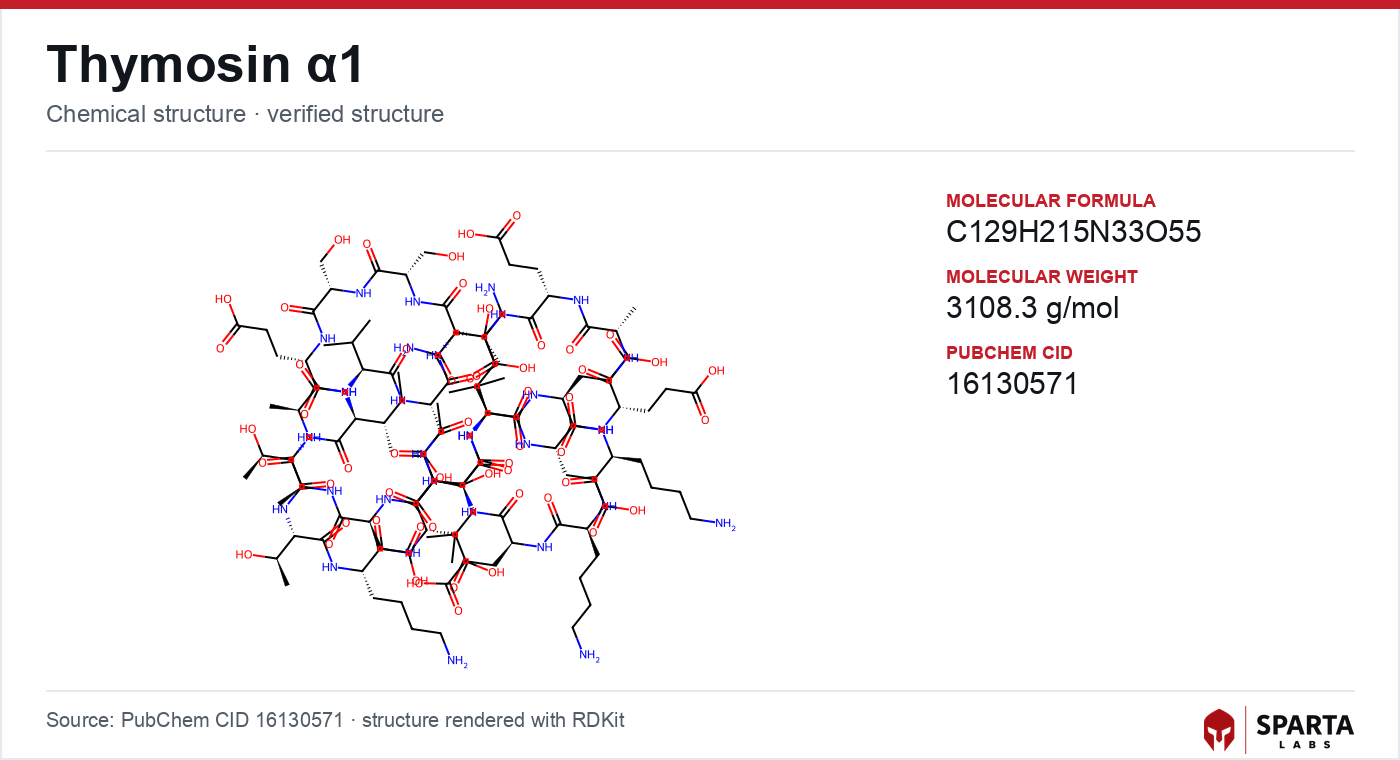
Figure: chemical structure of Thymosin Alpha-1.
The Defining Feature: N-Terminal Acetylation
The peptide that Goldstein and colleagues isolated and sequenced from thymosin fraction 5 in 1977 was reported as an acetylated 28-amino-acid polypeptide, and that acetylation is a defining structural feature of the natural molecule rather than an incidental modification [1].
Findings from research models do not establish safety or efficacy in humans. Sparta Labs makes no claims about the use of this compound.
The practical consequence for sourcing is that a synthetic material described as "Thymosin Alpha-1" must actually carry the N-terminal acetyl group to match the characterized natural sequence. Acetylation adds a defined mass increment to the peptide, which means high-resolution mass spectrometry can distinguish the acetylated peptide from an unmodified sequence of the same residues. N-terminal acetylation is itself a widely studied protein modification, and analytical methods for detecting and localizing it are well established in the biochemical literature [2]. On a certificate of analysis, reporting the measured monoisotopic or average mass against the theoretical acetylated mass documents that the modification is present in a given batch.
Solid-Phase Synthesis of a 28-Residue Peptide
Peptides in the size range of Tα1, roughly 3.1 kilodaltons across 28 residues, are typically produced by solid-phase peptide synthesis (SPPS), the resin-based approach first described by Merrifield in 1963 and recognized with the Nobel Prize in Chemistry in 1984 [3]. SPPS assembles the chain one residue at a time through iterative coupling and deprotection cycles on an insoluble support, and it remains the standard route for peptides up to roughly 50 residues.
For a peptide of this length, the variables that govern product quality are well documented in the peptide-manufacturing literature. Andersson and colleagues, in a 2000 review of large-scale peptide synthesis in Biopolymers, described how resin choice, protecting-group strategy, coupling reagents, deprotection conditions, and final cleavage chemistry each contribute to the purity and consistency of the finished peptide [4]. Introducing and verifying the N-terminal acetyl group is an additional step specific to Tα1 that must be reflected in the release specification rather than assumed.
Residual Counterions and the TFA Question
Solid-phase synthesis and reversed-phase purification frequently use trifluoroacetic acid (TFA) in cleavage and mobile-phase steps, and TFA can remain associated with a peptide as a counterion in the final lyophilized powder. The cleavage and purification chemistry that governs residual acid content is part of the manufacturing variable set described in the Biopolymers review of large-scale synthesis [4].
Thymosin Alpha-1 is an acidic peptide, with an isoelectric point near pH 4.2 arising from its several aspartate and glutamate residues. Characterizing residual solvents and counterions is therefore one component of understanding exactly what a lyophilized Tα1 powder contains beyond the peptide backbone itself. Documentation of these residual parameters helps a researcher account for the full composition of the material they are weighing out.
Analytical Verification: HPLC and Mass Spectrometry
Two orthogonal measurements anchor the identity and purity of research-grade Tα1. Reversed-phase high-performance liquid chromatography (RP-HPLC) separates the target peptide from other UV-absorbing species and reports the target as a percentage of total peak area; it is the standard chromatographic method for peptide purity assessment in pharmaceutical and research-reagent settings. High-resolution mass spectrometry then confirms molecular identity by measuring the peptide's mass, including the increment contributed by N-terminal acetylation [2].
The two techniques answer different questions. HPLC quantifies how much of the sample is the intended peptide relative to related impurities and deletion sequences, while mass spectrometry confirms that the principal species is in fact the acetylated 28-residue peptide and not a close analog. A certificate of analysis that reports both an HPLC purity figure with its chromatogram and a measured mass gives a more complete picture than either measurement alone. The same two-technique logic applies across the library's healing- and immune-peptide cluster; the KPV sourcing and quality article describes the parallel approach for a melanocortin-derived tripeptide also studied in immunological contexts.
Endotoxin as a Confound in Immune Research
For a peptide whose published literature centers on immune-cell pathways, bacterial endotoxin deserves specific attention. Endotoxin, the lipopolysaccharide component of gram-negative bacterial cell walls, is a potent activator of innate immune signaling and can produce immunological readouts independently of any intended research compound. In experiments that measure cytokine outputs or immune-cell activation states, uncharacterized endotoxin introduces a variable that can neither be controlled after the fact nor cleanly separated from the compound of interest.
The bacterial endotoxins test, historically based on the Limulus amebocyte lysate (LAL) reaction, is the compendial method described in official pharmacopeias for quantifying endotoxin in a material, with acceptance limits and validated procedures set out in the United States Pharmacopeia and equivalent compendia [5]. Including an endotoxin result on a Tα1 certificate of analysis documents this parameter for researchers whose readouts are immunological in nature.
Lyophilization and Stability
Lyophilized (freeze-dried) powder is the standard research form for Tα1 because removing water slows the chemical and physical degradation pathways that peptides undergo in solution. Manning and colleagues, in a widely cited update on the stability of protein pharmaceuticals in Pharmaceutical Research, described the primary degradation routes for peptides and proteins, hydrolysis, oxidation, deamidation, and aggregation, and noted that the lyophilized state retards these pathways relative to aqueous storage [6].
For an acidic peptide such as Tα1, solution pH is an additional variable that influences stability once material is dissolved, and repeated freeze-thaw cycling of reconstituted material is a recognized contributor to aggregation and oxidative degradation [6]. Storage guidance for small acidic peptides generally specifies low temperature, protection from light, and a sealed, moisture-controlled container, and expiry dating on a certificate of analysis reflects validated stability data for the lyophilized material under those conditions.
What a Batch Certificate of Analysis Records
A certificate of analysis (COA) is the document that connects a specific batch of material to its analytical results. For Thymosin Alpha-1, the parameters described above map onto discrete COA entries:
- Batch number linking the certificate to the manufacturing record
- Manufacturing and expiry dates
- Sequence confirmation with the N-terminal acetylation noted
- Molecular weight, theoretical and measured by mass spectrometry
- HPLC purity as a percentage with the accompanying chromatogram
- Endotoxin test result
- Independent laboratory identification and report reference where third-party verification is performed
Because analytical results are batch-specific, the COA is most useful when read against the exact batch number of the material in hand. Sparta Labs publishes a certificate of analysis with each batch of Tα1, and the same documentation logic is applied across related peptides discussed in the Epithalon sourcing and quality reference. The purpose is narrow and practical: to let a researcher account for material composition and quality as a controlled variable in experimental design and reporting.
References
-
Goldstein AL, Low TL, McAdoo M, McClure J, Thurman GB, Rossio J, et al. Thymosin alpha1: isolation and sequence analysis of an immunologically active thymic polypeptide. Proc Natl Acad Sci USA. 1977;74(2):725–729. PMID: 265536. PMC392366
-
Ree R, Varland S, Arnesen T. Spotlight on protein N-terminal acetylation. Exp Mol Med. 2018;50(7):1–13. PMID: 30054468. DOI: 10.1038/s12276-018-0116-z. View on PubMed
-
Merrifield RB. Solid phase peptide synthesis. I. The synthesis of a tetrapeptide. J Am Chem Soc. 1963;85(14):2149–2154. DOI: 10.1021/ja00897a025. Full text via DOI
-
Andersson L, Blomberg L, Flegel M, Lepsa L, Nilsson B, Verlander M. Large-scale synthesis of peptides. Biopolymers. 2000;55(3):227–250. PMID: 11074421. DOI: 10.1002/1097-0282(2000)55:3<227::AID-BIP50>3.0.CO;2-7. View on PubMed
-
United States Pharmacopeia. <85> Bacterial Endotoxins Test. In: USP–NF. Rockville (MD): United States Pharmacopeial Convention. Source: usp.org
-
Manning MC, Chou DK, Murphy BM, Payne RW, Katayama DS. Stability of protein pharmaceuticals: an update. Pharm Res. 2010;27(4):544–575. PMID: 20143256. DOI: 10.1007/s11095-009-0045-6. View on PubMed
Disclaimer. Statements in this article have not been evaluated by the Food and Drug Administration. This compound is not intended to diagnose, treat, cure, or prevent any disease. Sparta Labs sells research-use-only materials. Content is provided for educational and informational purposes only and does not constitute medical advice. Consult a qualified medical professional for any health concerns.
Frequently asked questions
What makes the N-terminal acetyl group important when characterizing Thymosin Alpha-1?
The natural thymic peptide sequenced by Goldstein and colleagues in 1977 carries an acetylated N-terminus, and that acetyl group is part of what distinguishes Thymosin Alpha-1 from an unmodified 28-residue sequence. Because acetylation shifts the exact monoisotopic mass, mass spectrometry can confirm whether the modification is present. A certificate of analysis that reports the measured mass alongside the theoretical acetylated mass documents this structural feature for a given batch.
Why is the trifluoroacetic acid (TFA) counterion relevant to Thymosin Alpha-1 material?
Trifluoroacetic acid is commonly used in the cleavage and reversed-phase purification steps of solid-phase peptide synthesis, and it can remain associated with the finished peptide as a counterion. Because Thymosin Alpha-1 is an acidic peptide with several negatively charged residues, residual TFA content is one of the parameters that peptide manufacturing literature identifies as worth characterizing. Analytical documentation of residual solvents and counterions helps researchers understand exactly what a lyophilized powder contains beyond the peptide itself.
What does reversed-phase HPLC measure for a peptide like Thymosin Alpha-1?
Reversed-phase high-performance liquid chromatography separates the target peptide from other UV-absorbing species in a sample and reports the target as a percentage of the total peak area. It is the standard chromatographic method for assessing peptide purity in pharmaceutical and research-reagent settings. For Thymosin Alpha-1, HPLC purity is typically paired with mass spectrometry so that both the proportion of target peptide and its molecular identity are recorded.
Why is endotoxin testing described in the context of Thymosin Alpha-1 research?
Bacterial endotoxin (lipopolysaccharide) from gram-negative organisms can activate innate immune signaling independently of any intended research compound, which is a recognized confound in immunological experiments. Because the published Thymosin Alpha-1 literature centers on immune-cell pathways, uncharacterized endotoxin could complicate interpretation of immunological readouts. The bacterial endotoxins test described in official pharmacopeias is the compendial method used to quantify endotoxin in a material.
How is lyophilized Thymosin Alpha-1 typically stored, and why?
Lyophilized (freeze-dried) peptide is the standard research form because the dry state slows the degradation pathways that affect peptides in solution. Reviews of peptide and protein stability identify hydrolysis, oxidation, deamidation, and aggregation as the main routes of degradation, all of which proceed more slowly in a lyophilized powder than in aqueous solution. Storage guidance for small acidic peptides generally specifies low temperature, protection from light, and a sealed, moisture-controlled container.