
AOD9604: Published Research
A thread-by-thread survey of the peer-reviewed AOD9604 literature: the antilipogenesis-versus-lipolysis question, the β3-adrenergic receptor line of study, the oral-activity puzzle, and the consolidated six-trial human safety dataset.

For research use only. Not for human consumption. This article is educational reference material. It is not medical advice and is not a recommendation to use any substance.
Introduction
AOD9604 (Tyr-hGH177–191) is a synthetic hexadecapeptide corresponding to the carboxy-terminal region of human growth hormone (hGH), with an N-terminal tyrosine added to the native 177–191 sequence. Its research literature is unusual among growth-hormone-derived fragments for two reasons: the mechanistic work was carried out by a single research lineage over roughly two decades, and the clinical program advanced far enough to generate a consolidated human safety dataset before development was discontinued. This article traces the published record along the specific scientific threads that define AOD9604 research, rather than a generic study-by-study inventory.
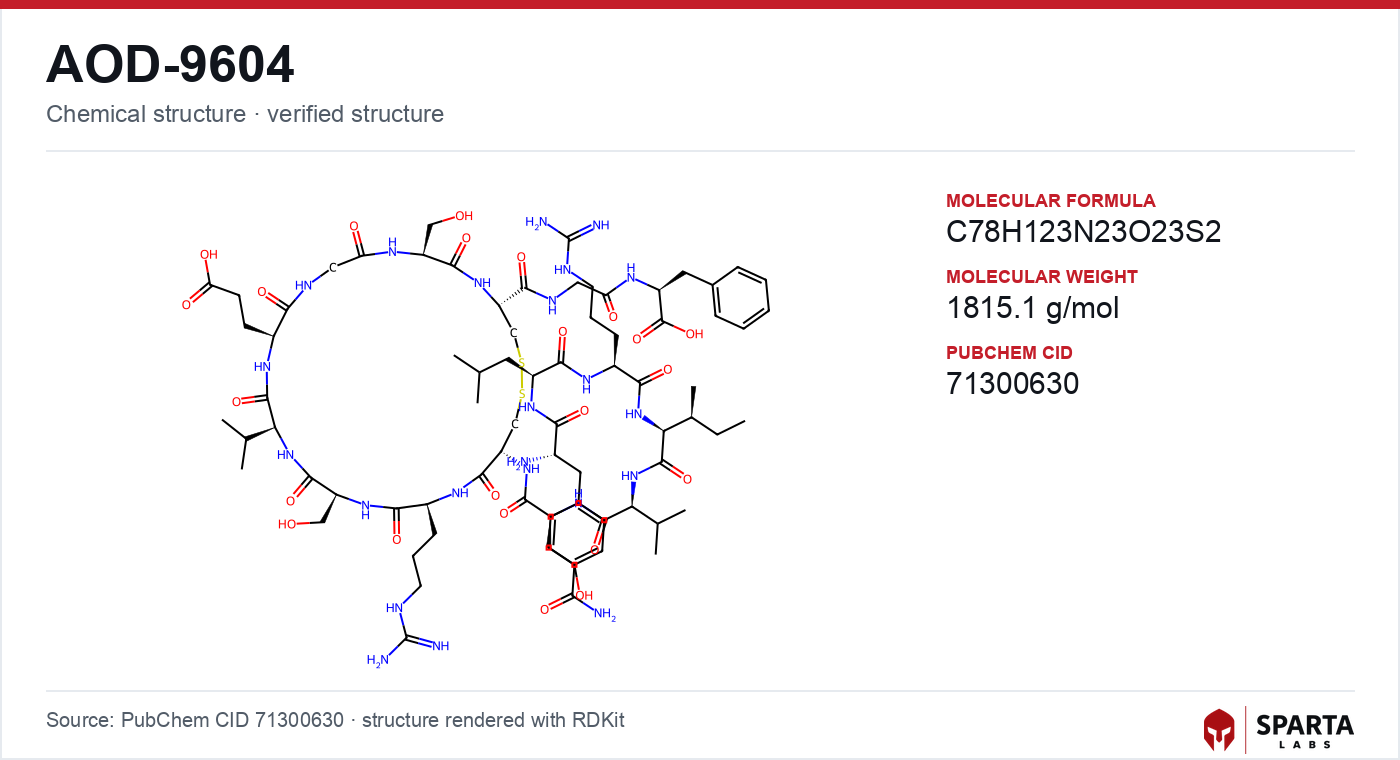
Figure: chemical structure of AOD-9604.
The central biochemical question: antilipogenesis versus lipolysis
The foundational hypothesis behind AOD9604 was that the metabolic activity of hGH on fat tissue is spatially separable from its growth-promoting activity, and that a short C-terminal fragment could reproduce the former without the latter. Wu and Ng (1993) reported that a synthetic peptide matching residues 177–191 of hGH exhibited antilipogenic activity in isolated rat adipose tissue comparable to that of intact hGH, measured as inhibition of lipid synthesis from radiolabeled acetate, while showing no statistically significant lipolytic effect (glycerol release) in the same in vitro preparation [1]. The authors interpreted this as evidence that the C-terminal domain carries antilipogenic activity operating through a mechanism distinct from lipolysis under those conditions [1].
Findings from research models do not establish safety or efficacy in humans. Sparta Labs makes no claims about the use of this compound.
A later report by Ng et al. (2000) complicated this clean separation. Working with a structurally related fragment (designated AOD9401) in isolated Zucker fatty rat adipose tissue, the authors described stimulation of hormone-sensitive lipase alongside inhibition of acetyl-CoA carboxylase, effects consistent with both pro-lipolytic and antilipogenic activity at the level of individual enzymes, and reported reduced adipocyte diameter in chronically treated animals [2]. The apparent tension between the 1993 and 2000 in vitro results, whether the fragment is primarily antilipogenic, primarily lipolytic, or both depending on tissue state, remains one of the more instructive unresolved threads in the literature.
The β3-adrenergic receptor thread
A distinct line of investigation examined whether the β3-adrenergic receptor (β3-AR) participates in the fragment's metabolic activity. Heffernan et al. (2001), publishing in Endocrinology, studied both hGH and AOD9604 in obese mice and in β3-AR knock-out animals [3]. The report described increased β3-AR messenger RNA in adipose tissue of treated wild-type animals and observed that chronic treatment with either compound was not associated with body-weight changes in β3-AR knock-out animals [3]. The authors concluded that β3-AR-dependent pathways contribute to the metabolic activity of hGH and AOD9604 during chronic treatment, while positioning β3-AR as a downstream participant rather than the primary molecular target [3]. The receptor-level interpretation of these findings is discussed further in the AOD9604 mechanism of action article.
A companion 2001 report in the International Journal of Obesity compared full-length hGH with a modified C-terminal fragment in obese mice and described reduced body-weight gain, elevated plasma glycerol (an index of lipolysis), and increased in vivo fat oxidation in treated animals relative to controls [4]. A pharmacologically salient observation was that the C-terminal fragment, unlike full-length hGH, was not associated with hyperglycemia or reduced insulin secretion in the models studied, a dissociation that shaped the compound's later safety rationale [4].
Whole-animal metabolic studies and the oral-activity puzzle
Chronic in vivo work predated and paralleled the receptor studies. Natera, Jiang, and Ng (1994) reported that chronic treatment of C57BL/6J (ob/ob) obese mice with synthetic hGH 177–191 was associated with reduced cumulative body-weight gain and adipose-tissue mass relative to saline-treated controls, together with inhibition of adipose lipogenesis, consistent with the earlier in vitro antilipogenic findings [5].
A 2000 study in the American Journal of Physiology — Endocrinology and Metabolism examined oral administration of the AOD9401 fragment in ob/ob mice and reported statistically lower body-weight gain in treated animals from roughly day 16 onward, alongside reduced lipogenic and increased lipolytic activity in adipose tissue and acute increases in energy expenditure and fat oxidation by indirect calorimetry [6]. The oral route was a notable feature, since peptides of this size are generally considered susceptible to gastrointestinal proteolysis; the mechanism by which meaningful activity survived oral administration in rodents was not fully resolved in the pharmacokinetic literature and remains an open question relevant to oral peptide delivery generally.
The human safety program
AOD9604 is among the growth-hormone-derived fragments to have accumulated a consolidated human safety dataset. Stier, Vos, and Kenley (2013) published a pooled analysis of six randomized, double-blind, placebo-controlled trials, spanning intravenous pilot studies, oral pilot studies, and larger oral Phase IIb studies [7]. The analysis focused on parameters of known concern with full-length hGH, including insulin-like growth factor 1 (IGF-1) elevation, insulin resistance, and glucose intolerance. The authors reported that AOD9604 displayed a safety and tolerability profile indistinguishable from placebo across all six studies, with no statistically significant effects on serum IGF-1, fasting glucose, insulin, HbA1c, cortisol, or thyroid hormone levels at any dose tested, and no serious adverse events attributed to the compound across the program [7].
Within that program, the Phase IIb efficacy study enrolled 536 obese adults in a 24-week multicenter randomized, double-blind, placebo-controlled trial. As summarized in the pooled analysis, the pre-specified primary endpoint for statistically significant weight reduction across the full dose range and study duration was not met, and the safety profile remained consistent with placebo across dose arms [7]. Readers examining human clinical data for a related growth-hormone-axis peptide may also consult the tesamorelin published research, which describes trials of a GHRH analogue operating through a distinct upstream mechanism.
Nonclinical safety and genotoxicity characterization
Moré and Kenley (2014) published a consolidated nonclinical safety evaluation describing chronic oral toxicology studies in rats and cynomolgus monkeys, pharmacokinetic studies following oral and intravenous administration in pigs, and a genotoxicity battery including an Ames test, chromosomal aberration assay, and bone-marrow micronucleus assay [8]. The authors reported no evidence of genotoxic activity in any assay and characterized the compound as generally well tolerated in chronic oral application across the rodent and primate species studied [8]. This body of nonclinical work, together with the human trials, formed part of the evidentiary basis considered in the compound's subsequent food-ingredient safety review.
Beyond metabolism: an isolated musculoskeletal report
One study extended AOD9604 research outside the metabolic domain. Kwon, Park, and Lee (2015), in the Annals of Clinical and Laboratory Science, examined intra-articular administration of AOD9604, with and without hyaluronic acid, in a collagenase-induced knee osteoarthritis rabbit model [9]. The authors reported that animals receiving combined AOD9604 and hyaluronic acid showed lower histopathological and morphological scores than control groups, describing cartilage-tissue characteristics consistent with the study's predefined endpoints [9]. This report stands largely alone; no human clinical trials of AOD9604 in musculoskeletal indications have been identified in the peer-reviewed literature, and the finding has not been mechanistically followed up in later publications.
Knowledge gaps and open threads
Several questions remain unresolved across the published record:
Primary receptor identity. The initial cell-surface target through which the fragment engages adipocytes has not been definitively identified. The β3-AR data situate that receptor as a downstream contributor rather than the primary mediator [3], leaving primary-target identification as a tractable but open problem.
Reconciling the in vitro data. The 1993 antilipogenic-without-lipolysis result [1] and the 2000 dual-activity result [2] have not been reconciled into a single mechanistic account, and the dependence of each activity on tissue metabolic state is not fully characterized.
Oral bioavailability mechanism. How a hexadecapeptide retains measurable rodent activity after oral administration [6] is not fully explained by the published pharmacokinetic work.
The compound's structural relationship to full-length hGH and its pharmacological classification are covered in the AOD9604 research overview, while independent identity and purity verification for research material is discussed in the AOD9604 sourcing and quality reference. Research-grade AOD9604 from Sparta Labs is batch-tested by independent third-party laboratories for HPLC purity and mass-spectrometric identity confirmation.
References
-
Wu Z, Ng FM. Antilipogenic action of synthetic C-terminal sequence 177-191 of human growth hormone. Biochemistry and Molecular Biology International. 1993;30(1):187–196. PMID: 8358331. PubMed
-
Ng FM, Sun J, Sharma L, Libinaka R, Jiang WJ, Gianello R. Molecular and cellular actions of a structural domain of human growth hormone (AOD9401) on lipid metabolism in Zucker fatty rats. Journal of Molecular Endocrinology. 2000;25(3):287–298. PMID: 11116208. PubMed
-
Heffernan MA, Summers RJ, Thorburn A, Ogru E, Gianello R, Jiang WJ, Ng FM. The effects of human GH and its lipolytic fragment (AOD9604) on lipid metabolism following chronic treatment in obese mice and β3-AR knock-out mice. Endocrinology. 2001;142(12):5182–5189. Full text via DOI PubMed
-
Heffernan M, Thorburn AW, Fam B, Summers R, Conway-Campbell B, Waters MJ, Ng FM. Increase of fat oxidation and weight loss in obese mice caused by chronic treatment with human growth hormone or a modified C-terminal fragment. International Journal of Obesity. 2001;25(10):1442–1449. PMID: 11673763. PubMed
-
Natera SH, Jiang WJ, Ng FM. Reduction of cumulative body weight gain and adipose tissue mass in obese mice: response to chronic treatment with synthetic hGH 177-191 peptide. Biochemistry and Molecular Biology International. 1994;33(5):1011–1021. PMID: 7987248. PubMed
-
Heffernan MA, Jiang WJ, Thorburn AW, Ng FM. Effects of oral administration of a synthetic fragment of human growth hormone on lipid metabolism. American Journal of Physiology – Endocrinology and Metabolism. 2000;279(3):E501–E507. Full text via DOI PubMed
-
Stier H, Vos E, Kenley D. Safety and tolerability of the hexadecapeptide AOD9604 in humans. Journal of Endocrinology and Metabolism. 2013;3(1–2):7–15. Full text via DOI
-
Moré MI, Kenley D. Safety and metabolism of AOD9604, a novel nutraceutical ingredient for improved metabolic health. Journal of Endocrinology and Metabolism. 2014;4(3):116–126. Full text via DOI
-
Kwon DR, Park GY, Lee SC. Effect of intra-articular injection of AOD9604 with or without hyaluronic acid in rabbit osteoarthritis model. Annals of Clinical and Laboratory Science. 2015;45(4):426–432. PMID: 26275694. PubMed
Disclaimer. Statements in this article have not been evaluated by the Food and Drug Administration. This compound is not intended to diagnose, treat, cure, or prevent any disease. Sparta Labs sells research-use-only materials. Content is provided for educational and informational purposes only and does not constitute medical advice. Consult a qualified medical professional for any health concerns.
Frequently asked questions
What kinds of studies have been published on AOD9604?
The peer-reviewed record spans in vitro biochemistry in isolated rat and Zucker fatty rat adipose tissue, chronic studies in genetically obese mouse models, nonclinical toxicology in rats, monkeys, and pigs, and six randomized human clinical trials. A single 2015 rabbit study also examined an intra-articular musculoskeletal application. Much of the mechanistic work came from one research lineage over roughly two decades.
What is the antilipogenesis-versus-lipolysis question in AOD9604 research?
A 1993 in vitro report described the C-terminal hGH fragment as antilipogenic without a significant lipolytic effect, while a 2000 report of a related fragment described both pro-lipolytic and antilipogenic enzyme-level activity. Whether the fragment is primarily antilipogenic, lipolytic, or both depending on tissue state has not been fully reconciled in the literature. It remains one of the more instructive open threads.
What did the pooled human safety analysis report?
Stier, Vos, and Kenley (2013) pooled six randomized, double-blind, placebo-controlled trials and reported a safety and tolerability profile indistinguishable from placebo. No statistically significant effects on serum IGF-1, fasting glucose, insulin, HbA1c, cortisol, or thyroid hormones were reported at any dose tested, and no serious adverse events were attributed to the compound. Findings from research models do not establish safety or efficacy in humans.
Did AOD9604 clinical trials meet their efficacy endpoints?
According to the pooled 2013 analysis, the Phase IIb study of 536 obese adults over 24 weeks did not meet its pre-specified primary endpoint for statistically significant weight reduction across the full dose range and study duration. The reported safety profile remained consistent with placebo across dose arms. Development as a pharmaceutical was subsequently discontinued.
What role does the β3-adrenergic receptor play in AOD9604 research?
Heffernan et al. (2001) reported increased β3-adrenergic receptor mRNA in adipose tissue of treated animals and observed no body-weight change from chronic treatment in β3-AR knock-out mice. The authors positioned the receptor as a downstream contributor rather than the primary molecular target. The initial cell-surface receptor for the fragment has not been definitively identified.