
Tesamorelin: Published Research
An annotated tour of the tesamorelin literature organized as two research programs: the pivotal HIV visceral-adiposity trials and the later pivot to hepatic-fat and GH-axis pharmacodynamics. Educational reference.

For research use only. Not for human consumption. This article is educational reference material. It is not medical advice and is not a recommendation to use any substance.
Reading the Tesamorelin Literature as Two Overlapping Research Programs
Tesamorelin is a synthetic analog of human growth-hormone-releasing hormone (GHRH), and its published clinical literature is unusually easy to organize because it grew out of a single, tightly focused development program before branching into secondary questions. The primary program was built around HIV-associated visceral adiposity and produced the pivotal randomized evidence that supported regulatory approval. A second, later line of inquiry redirected the same GHRH-receptor pharmacology toward hepatic fat and metabolic safety, using imaging endpoints such as proton magnetic resonance spectroscopy rather than the computed-tomography adiposity measures of the earlier work.
Reading the literature through that lens explains why so much of the evidence base sits in one clinical population, why the endpoints shift over time from fat-depot volume to intrahepatic lipid, and where the open research questions cluster today. This article summarizes the key published studies with attribution and citation, grouped by the research question each was designed to answer rather than by a generic chronology. Readers seeking the underlying GHRH-receptor pharmacology will find it in the tesamorelin mechanism of action article, and broader classification context in the tesamorelin research overview.
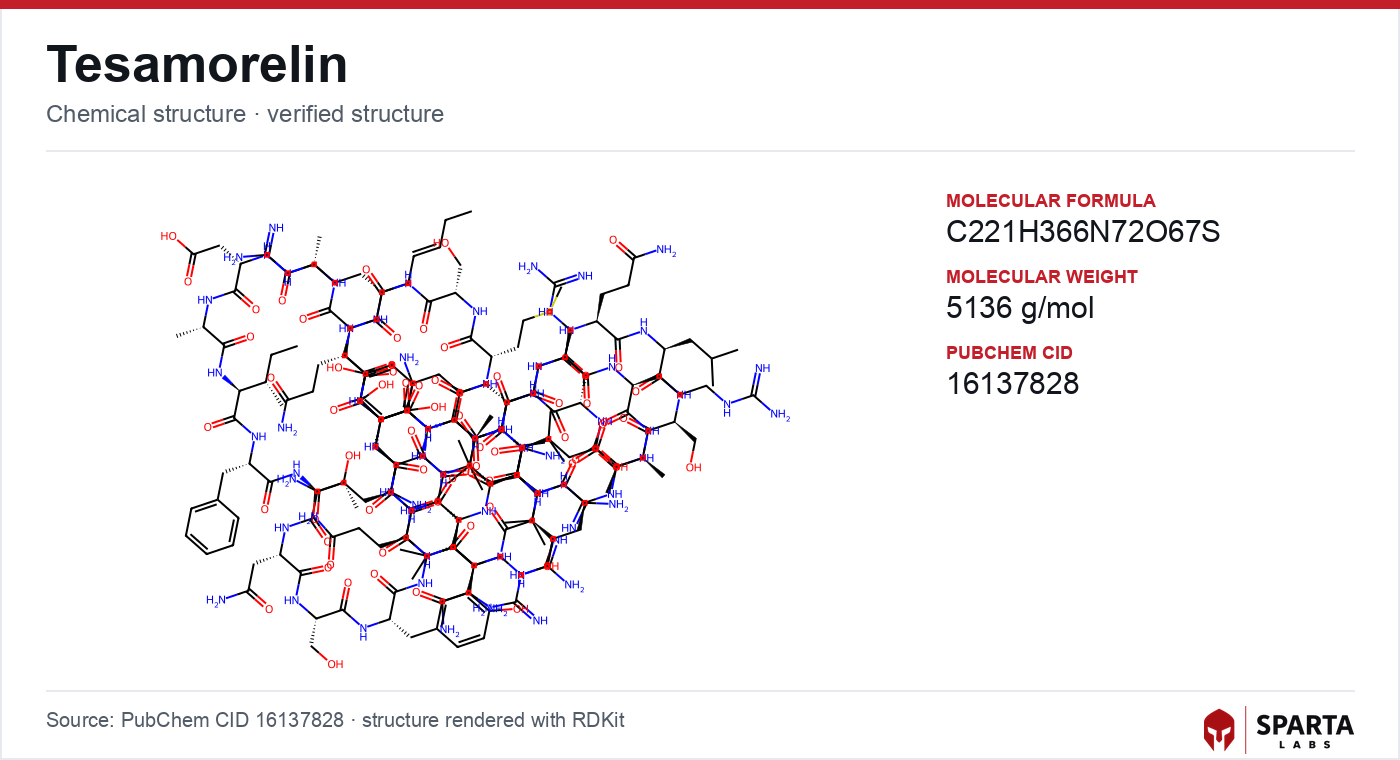
Figure: chemical structure of Tesamorelin.
Study Designs Represented in the Evidence Base
Before summarizing individual findings, it is worth cataloguing the study architectures that recur across the literature, because the strength of each reported observation depends on its design.
- Pivotal phase 3 randomized, double-blind, placebo-controlled trials. The registration studies (identified in the literature as LIPO-010 and LIPO-011) enrolled HIV-infected adults with excess visceral adiposity and used a 6-month efficacy phase followed by a re-randomized safety extension.
- Dedicated endpoint trials. Later randomized trials narrowed the primary outcome to intrahepatic lipid, enrolling participants pre-selected for a defined hepatic fat fraction.
- Mechanistic pharmacodynamic studies. Small, intensively sampled designs in healthy or HIV-positive cohorts characterized endogenous growth-hormone (GH) pulsatility, IGF-1 kinetics, and clamp-measured insulin sensitivity.
- Safety-oriented trials in at-risk populations. A randomized trial in adults with type 2 diabetes was designed to test metabolic tolerability where GH-axis stimulation is theoretically most consequential.
- Post-hoc and pooled analyses. Retrospective analyses of the pivotal datasets examined predictors of response and correlations between adiposity change and metabolic parameters.
The Pivotal Visceral-Adiposity Program
The earliest randomized evidence framed tesamorelin as a research tool for GHRH-receptor stimulation in HIV-associated fat redistribution.
Falutz and colleagues (2007) reported findings from a multicenter, double-blind, placebo-controlled trial in HIV-infected patients on stable antiretroviral therapy with excess visceral adiposity. Over a 26-week treatment period, patients in the tesamorelin group exhibited a statistically significant reduction in visceral adipose tissue (VAT) measured by computed tomography, compared with placebo. The authors also reported changes in triglyceride and IGF-1 levels in the tesamorelin group, while glycemic parameters did not differ significantly between groups [2].
Findings from research models do not establish safety or efficacy in humans. Sparta Labs makes no claims about the use of this compound.
The confirmatory pivotal trial was published by Falutz and colleagues (2010) in the Journal of Acquired Immune Deficiency Syndromes. This study enrolled 404 HIV-infected patients with documented excess abdominal fat accumulation on stable highly active antiretroviral therapy, randomizing them 2:1 to tesamorelin or placebo for a 6-month efficacy phase. A safety extension then re-randomized tesamorelin responders to continued treatment or placebo for a further 6 months, while eligible placebo participants could cross to open-label tesamorelin.
The authors reported that VAT decreased by approximately 10.9% in the tesamorelin group compared with approximately 0.6% in the placebo group during the primary efficacy phase. During the extension phase, VAT differences relative to the re-randomized placebo group were described as sustained in continued tesamorelin recipients. Adverse-event rates were characterized as similar between groups, with no significant differences in rates of clinically relevant hyperglycemia or glucose intolerance reported [3]. Together, the two Falutz trials constituted the pivotal evidence supporting NDA 022505, approved by the FDA in November 2010; the regulatory sequence is traced in the tesamorelin discovery and regulatory history article.
The Pivot to Hepatic Fat
A distinct research line emerged as investigators asked whether GH-axis stimulation altered liver fat, not only subcutaneous and visceral depots.
Stanley and colleagues (2014) reported a randomized trial in JAMA examining tesamorelin's effects on both visceral fat and liver fat in HIV-infected adults with abdominal fat accumulation. The study used magnetic resonance spectroscopy to quantify hepatic fat fraction alongside CT-based VAT measurement, and the authors reported reductions in liver fat in the tesamorelin group. This trial provided early randomized evidence linking GHRH-receptor stimulation to intrahepatic lipid content and set the stage for a dedicated hepatic-endpoint study [5].
That dedicated study was published by Stanley and colleagues (2019) in The Lancet HIV. It enrolled 61 HIV-infected individuals with non-alcoholic fatty liver disease (NAFLD), defined by a hepatic fat fraction of at least 5% on proton magnetic resonance spectroscopy, and assigned them 1:1 to tesamorelin or identical placebo for 12 months. The authors reported a significantly greater reduction in hepatic fat fraction in the tesamorelin group (absolute effect size −4.1%, 95% CI −7.6 to −0.7; p = 0.018). At 12 months, 35% of tesamorelin participants had a hepatic fat fraction below 5% compared with 4% of placebo participants, and fibrosis-stage progression assessed by liver biopsy in a subset was observed in a lower proportion of tesamorelin recipients [1]. The authors framed this as the first randomized controlled evidence for a pharmacological agent's effect on NAFLD-related outcomes in an HIV-infected population.
Characterizing the GH Axis and Insulin Sensitivity
Parallel to the outcome trials, mechanistic studies interrogated how tesamorelin engages the GH axis and whether that engagement disturbs glucose handling.
Stanley and colleagues (2011) examined endogenous GH pulsatility and insulin sensitivity in 13 healthy adult men, using frequent overnight blood sampling with deconvolution analysis and a hyperinsulinemic-euglycemic clamp. The authors reported statistically significant increases in mean overnight GH secretion, GH pulse amplitude, and total GH secretory mass relative to baseline, alongside elevated IGF-1 concentrations. Peripheral insulin-stimulated glucose uptake measured by clamp was not significantly different from baseline after the treatment period. The authors suggested that preserved IGF-1 feedback and intact somatostatin negative feedback during GHRH-receptor agonism may account for the maintained insulin sensitivity observed [4]. This pharmacodynamic distinction, retained pulsatility and feedback rather than a flat exogenous GH profile, is one of the features that differentiates GHRH-analog research from direct GH administration and from the ghrelin-mimetic secretagogues discussed in the GHRP-2 published research and ipamorelin published research articles.
Testing Metabolic Safety Where It Matters Most
Because GH stimulation carries a theoretical risk of worsening glycemic control, a randomized trial was designed specifically in a population with pre-existing insulin dysregulation.
Makimura and colleagues (2017) reported a 12-week randomized, placebo-controlled trial in PLOS ONE enrolling 53 adults with type 2 diabetes mellitus, assigned across three arms to placebo or one of two tesamorelin exposure levels. The authors reported no statistically significant differences between groups in fasting glucose, HbA1c, or overall glycemic control at week 12, and noted that no participant withdrew because of loss of diabetes control. The higher-exposure arm showed statistically significant reductions in total cholesterol and non-HDL cholesterol from baseline, which the authors flagged as warranting further investigation in longer studies [6]. This trial is frequently cited as the safety counterpart to the efficacy-focused pivotal program.
Where the Evidence Is Thin: Open Research Questions
Several directions in the tesamorelin literature remain actively open, and identifying them is as useful to a researcher as summarizing settled findings.
Mechanistic attribution of hepatic effects. The relative contributions of direct hepatic GH-receptor signaling, IGF-1-mediated hepatic effects, and indirect effects through adipose-tissue lipolytic flux to the observed changes in liver fat remain incompletely resolved. Exploratory hepatic transcriptomic analyses from the HIV-NAFLD population have been published, and independent replication would clarify the molecular mediators.
Generalizability beyond HIV lipodystrophy. The randomized evidence is concentrated in HIV-infected populations. Whether the visceral-adiposity and hepatic-fat observations extend to HIV-negative populations with GH-axis dysregulation is an open question that would require dedicated randomized investigation.
Long-term characterization. The pivotal-trial extensions provided safety data to roughly 12 months. Prospective randomized or registry-level data extending beyond that interval would strengthen understanding of the compound's longer-term pharmacological profile.
A pooled post-hoc analysis of the pivotal datasets examined associations between visceral-adiposity change and metabolic parameters, and such analyses have informed the design of subsequently planned investigations [7]. Research-grade tesamorelin from Sparta Labs is batch-tested by independent third-party analysis; the associated identity and purity documentation is described in the tesamorelin sourcing and quality reference.
References
-
Stanley TL, Fourman LT, Feldpausch MN, Purdy J, Zheng I, Pan CS, et al. Effects of tesamorelin on non-alcoholic fatty liver disease in HIV: a randomised, double-blind, multicentre trial. Lancet HIV. 2019;6(12):e821-e830. PMID: 31611038. DOI: 10.1016/S2352-3018(19)30338-8. PubMed
-
Falutz J, Allas S, Blot K, Potvin D, Kotler D, Somero M, et al. Metabolic effects of a growth hormone-releasing factor in patients with HIV. N Engl J Med. 2007;357(23):2359-70. DOI: 10.1056/NEJMoa072375. PubMed
-
Falutz J, Mamputu JC, Potvin D, Moyle G, Soulban G, Loughrey H, et al. Effects of tesamorelin, a growth hormone-releasing factor, in HIV-infected patients with abdominal fat accumulation: a randomized placebo-controlled trial with a safety extension. J Acquir Immune Defic Syndr. 2010;53(3):311-22. PMID: 20101189. PubMed
-
Stanley TL, Chen CY, Branch KL, Makimura H, Grinspoon SK. Effects of a growth hormone-releasing hormone analog on endogenous GH pulsatility and insulin sensitivity in healthy men. J Clin Endocrinol Metab. 2011;96(1):150-8. PMID: 20943777. DOI: 10.1210/jc.2010-1587. PubMed
-
Stanley TL, Feldpausch MN, Oh J, Branch KL, Lee H, Torriani M, Grinspoon SK. Effect of tesamorelin on visceral fat and liver fat in HIV-infected patients with abdominal fat accumulation: a randomized clinical trial. JAMA. 2014;312(4):380-9. PMID: 25038355. DOI: 10.1001/jama.2014.8334. PubMed
-
Makimura H, Feldpausch MN, Rope AM, Hemphill LC, Torriani M, Lee H, et al. Safety and metabolic effects of tesamorelin, a growth hormone-releasing factor analogue, in patients with type 2 diabetes: A randomized, placebo-controlled trial. PLOS ONE. 2017;12(6):e0179538. PMID: 28632777. DOI: 10.1371/journal.pone.0179538. PMC
-
Grunfeld C, Dritselis A, Kirkpatrick P. Tesamorelin. Nat Rev Drug Discov. 2011;10(1):95-6. PMID: 21203000. DOI: 10.1038/nrd3362. PubMed
Disclaimer. Statements in this article have not been evaluated by the Food and Drug Administration. This compound is not intended to diagnose, treat, cure, or prevent any disease. Sparta Labs sells research-use-only materials. Content is provided for educational and informational purposes only and does not constitute medical advice. Consult a qualified medical professional for any health concerns.
Frequently asked questions
How is the tesamorelin clinical literature organized?
Its published evidence grew from one focused development program before branching. The pivotal line studied HIV-associated visceral adiposity (Falutz et al., 2007 and 2010) using computed-tomography fat measurement, while a later line redirected the same GHRH-receptor pharmacology toward hepatic fat and metabolic safety using MR spectroscopy. Reading it this way explains the shift in endpoints and populations over time.
What did the pivotal phase 3 tesamorelin trials report?
Falutz and colleagues (2010) reported a 404-patient randomized trial in HIV-infected adults with abdominal fat accumulation. Visceral adipose tissue decreased by approximately 10.9% in the tesamorelin group versus approximately 0.6% with placebo during the efficacy phase, with adverse-event rates described as similar between groups. These trials supported the November 2010 FDA approval under NDA 022505.
What did the Lancet HIV tesamorelin liver study find?
Stanley and colleagues (2019) reported a 61-participant randomized trial in HIV-infected individuals with NAFLD. The tesamorelin group showed a significantly greater reduction in hepatic fat fraction (absolute effect −4.1%, p=0.018) over 12 months, and 35% of tesamorelin recipients reached a hepatic fat fraction below 5% versus 4% of placebo recipients. The authors framed it as the first randomized evidence for a pharmacological agent targeting NAFLD outcomes in this population.
Why was a tesamorelin trial run in people with type 2 diabetes?
Because GH-axis stimulation carries a theoretical risk of disturbing glucose control, Makimura and colleagues (2017) designed a 12-week randomized trial in 53 adults with type 2 diabetes to test metabolic tolerability. The authors reported no statistically significant differences between groups in fasting glucose, HbA1c, or overall glycemic control at week 12.
What tesamorelin research questions remain open?
The literature notes several open directions: the relative contributions of direct hepatic GH-receptor signaling, IGF-1-mediated effects, and adipose lipolytic flux to observed liver-fat changes; whether findings generalize beyond HIV-infected populations; and longer-term characterization past the roughly 12-month evidence base from the pivotal-trial extensions.