
CJC-1295 with DAC: Mechanism of Action
A mechanism reference on CJC-1295 with DAC: the four stabilizing substitutions in the GHRH(1-29) core, the maleimide-to-albumin Cys34 bioconjugation, and the Gs-cAMP-PKA cascade that drives pulsatile somatotroph output. Educational reference.
For research use only. Not for human consumption. This article is educational reference material. It is not medical advice and is not a recommendation to use any substance.
Introduction
CJC-1295 with DAC is a synthetic growth hormone-releasing hormone (GHRH) analog whose reported mechanism rests on two engineering layers stacked on a short peptide core. The first layer is a set of four amino acid substitutions in the GHRH(1-29) sequence that harden the molecule against the enzymatic and chemical breakdown that inactivates the native hormone within minutes. The second is the Drug Affinity Complex (DAC), a thiol-reactive chemical handle that covalently tethers the peptide to circulating albumin. This article reviews the published molecular pharmacology behind both layers and the receptor cascade they ultimately drive, drawing only on peer-reviewed primary literature.
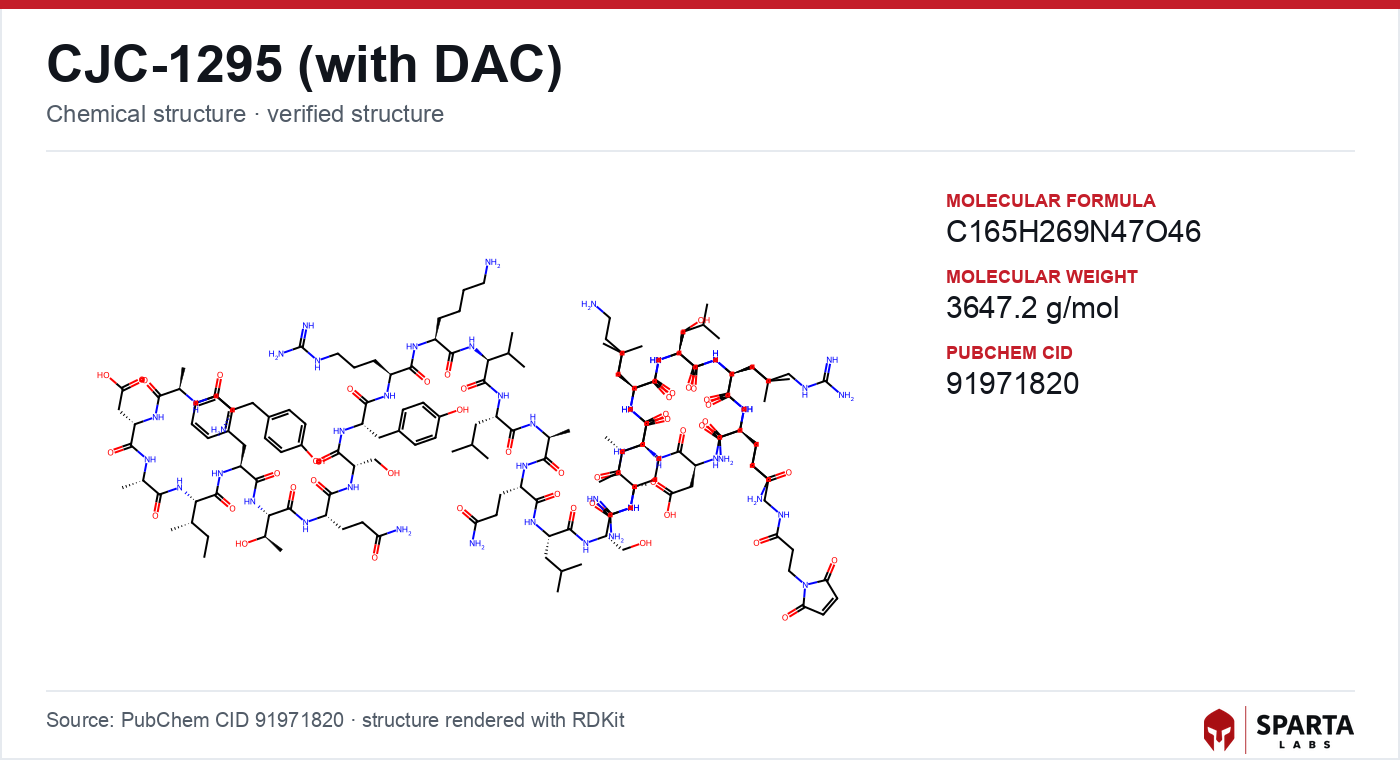
Figure: chemical structure of CJC-1295 (with DAC).
The GHRH(1-29) Core and Its Four Stabilizing Substitutions
Native GHRH signals through the first 29 residues of its 44-amino-acid sequence; the truncated GHRH(1-29) fragment, sometimes called sermorelin, retains full intrinsic activity at the receptor. This fragment is also fragile. Frohman and Jansson's classic review of GHRH physiology described how the native hormone is rapidly inactivated in plasma, giving it a circulating half-life on the order of minutes and limiting its window of receptor engagement [1].
Two breakdown routes dominate. Dipeptidyl peptidase-4 (DPP-4) cleaves the Tyr1-Ala2 bond at the N-terminus, removing the very residues that anchor the peptide in the receptor. Separately, the Asn8 residue is prone to spontaneous deamidation and isomerization, a chemical instability independent of any enzyme.
Jette and colleagues (2005) characterized the CJC-1295 scaffold as a tetra-substituted GHRH(1-29) analog engineered to blunt both routes [2]. The reported substitutions exchange the labile positions for more stable amino acids: D-Ala at position 2 resists DPP-4 cleavage, a substitution at Asn8 removes the deamidation-prone residue, and further exchanges guard against additional proteolytic and oxidative liabilities. The net design goal was a peptide backbone that survives long enough in plasma for the albumin-conjugation chemistry, described below, to take over and extend circulation on a scale of days.
The DAC: Maleimide Chemistry and Selective Albumin Conjugation
The DAC is the structural feature that distinguishes CJC-1295 with DAC from stabilized-but-unconjugated GHRH analogs such as CJC-1295 without DAC. Jette and colleagues (2005) detailed the conjugation chemistry: an N-epsilon-3-maleimidopropionamide group is appended through a lysine residue added at the C-terminus of the tetra-substituted GHRH(1-29) peptide [2].
The maleimide is a classic thiol-selective electrophile. In the near-neutral chemistry of plasma, it undergoes a Michael addition specifically with free sulfhydryl (thiol) groups. Human serum albumin (HSA) presents one dominant such target: the cysteine at position 34 (Cys34), the only free, solvent-accessible thiol on the native protein. The maleimide and Cys34 combine to form a stable covalent thioether bond, effectively grafting the peptide onto a carrier protein whose own half-life is measured in weeks rather than minutes.
Jette and colleagues reported that this in-plasma conjugation both increased resistance to DPP-4 degradation relative to unmodified hGRF(1-29) and preserved receptor activity: albumin-conjugated CJC-1295 activated the GRF receptor on rat anterior pituitary cells and produced a marked increase in growth hormone (GH) output compared with hGRF(1-29) [2].
Findings from research models do not establish safety or efficacy in humans. Sparta Labs makes no claims about the use of this compound.
The mechanistic elegance of the DAC lies in that Cys34 selectivity. Because HSA carries only one reactive free thiol, the conjugation site is predictable and largely homogeneous, which is what allows a small-molecule maleimide handle to convert a minutes-scale peptide into a species that persists in circulation. This bioconjugation strategy is what separates the DAC platform from stabilized GHRH fragments that rely on backbone substitutions alone.
Receptor Engagement: GHRH-R and the Gs-cAMP-PKA Cascade
Whatever its half-life, CJC-1295 ultimately acts through the same receptor as native GHRH. The molecular target is the GHRH receptor (GHRH-R), a class B secretin-family G protein-coupled receptor (GPCR) expressed predominantly on somatotroph cells of the anterior pituitary. Mayo cloned and characterized the pituitary GHRH receptor, establishing it as a seven-transmembrane GPCR with a large N-terminal extracellular domain that engages the amino-terminal alpha-helical region of GHRH peptides and couples to the stimulatory Gs protein [3].
The signaling logic follows the canonical class B cascade. Ligand binding shifts the receptor into an active conformation that stimulates adenylyl cyclase through the Gs alpha subunit, catalyzing the conversion of ATP to cyclic adenosine monophosphate (cAMP). Rising cAMP activates protein kinase A (PKA), which phosphorylates the transcription factor CREB (cAMP response element-binding protein) and modulates ion channels, promoting calcium influx. The resulting rise in intracellular calcium drives exocytosis of GH from secretory granules, while CREB-mediated transcription sustains GH gene expression over longer time frames.
Because the four substitutions in CJC-1295 lie away from the receptor-anchoring N-terminus that Mayo's work implicated in binding, the analog retains agonist activity at GHRH-R while gaining its stability. This is the point of the design: same receptor, same second-messenger pathway as endogenous GHRH, but a far longer duration of receptor availability. The GHRH-R route is mechanistically separate from the ghrelin-receptor pathway engaged by growth-hormone secretagogues such as ipamorelin and hexarelin, which act at the GHS-R1a receptor rather than GHRH-R.
Reported Downstream Effects in Human Studies
The most translationally relevant mechanistic data come from early-phase human pharmacology. Teichman and colleagues (2006) studied CJC-1295 in healthy adult volunteers and reported sustained, measurable GH secretion for six days or longer after a single administration, with concurrent elevations in plasma insulin-like growth factor 1 (IGF-1) persisting for roughly nine to eleven days [4]. The extended time course is the pharmacokinetic signature the albumin conjugation was engineered to produce.
Ionescu and Frohman (2006) then examined the character of that GH output in more detail [5]. The authors reported that pulsatile GH secretion persisted during sustained CJC-1295 exposure rather than collapsing into a flat, tonic release. The observed pattern featured increases in GH pulse amplitude and in interpulse trough concentrations while preserving the episodic secretory rhythm, a profile the authors distinguished qualitatively from the continuous exposure produced by administering exogenous GH. This distinction matters mechanistically because a GHRH analog works upstream, amplifying the pituitary's own secretory program, rather than supplying hormone directly.
Sackmann-Sala and colleagues (2009) applied serum proteomics to probe molecular consequences one week after CJC-1295 administration in healthy adult men [6]. Using two-dimensional gel electrophoresis and mass spectrometry, the investigators identified circulating proteins whose concentrations shifted with treatment and reported a linear relationship between IGF-1 levels and one identified protein cluster, proposing these as candidate biomarkers of GH/IGF-1 axis activity. The CJC-1295 with DAC published research article summarizes these study designs in more depth, and the broader profile of the compound is outlined in the CJC-1295 with DAC research overview.
Limits of Current Mechanistic Understanding
Several layers of the CJC-1295 with DAC mechanism remain incompletely characterized in the literature. The atomic-resolution structure of the CJC-1295-bound GHRH receptor has not been reported; while cryo-electron microscopy has advanced structural knowledge of class B GPCRs broadly, the specific contributions of each of the four scaffold substitutions to binding geometry and Gs coupling remain inferred rather than directly visualized.
The neuroendocrine question of how pulsatility survives continuous receptor stimulation, observed by Ionescu and Frohman, is also open [5]. The persistence of episodic GH release under sustained GHRH-R agonism points to intact counter-regulation, likely involving hypothalamic somatostatin tone, but the precise feedback architecture has not been fully resolved. Finally, the pharmacokinetics of the albumin conjugate across populations with altered albumin biology (for example, differing plasma albumin concentrations or turnover) are not extensively described. For researchers evaluating the compound, CJC-1295 with DAC is available from Sparta Labs with batch-level analytical documentation.
References
-
Frohman LA, Jansson JO. Growth hormone-releasing hormone. Endocr Rev. 1986;7(3):223-253. PMID: 3017690. DOI: 10.1210/edrv-7-3-223.
-
Jette L, Leger R, Thibaudeau K, Benquet C, Robitaille M, Pellerin I, Paradis V, van Wyk P, Pham K, Bridon DP. Human growth hormone-releasing factor (hGRF)1-29-albumin bioconjugates activate the GRF receptor on the anterior pituitary in rats: identification of CJC-1295 as a long-lasting GRF analog. Endocrinology. 2005;146(7):3052-3058. PMID: 15817669. DOI: 10.1210/en.2004-1286.
-
Mayo KE. Molecular cloning and expression of a pituitary-specific receptor for growth hormone-releasing hormone. Mol Endocrinol. 1992;6(10):1734-1744. PMID: 1333056. DOI: 10.1210/mend.6.10.1333056.
-
Teichman SL, Neale A, Lawrence B, Gagnon C, Castaigne JP, Frohman LA. Prolonged stimulation of growth hormone (GH) and insulin-like growth factor I secretion by CJC-1295, a long-acting analog of GH-releasing hormone, in healthy adults. J Clin Endocrinol Metab. 2006;91(3):799-805. PMID: 16352683. DOI: 10.1210/jc.2005-1536.
-
Ionescu M, Frohman LA. Pulsatile secretion of growth hormone (GH) persists during continuous stimulation by CJC-1295, a long-acting GH-releasing hormone analog. J Clin Endocrinol Metab. 2006;91(12):4792-4797. PMID: 16968793. DOI: 10.1210/jc.2006-1702.
-
Sackmann-Sala L, Ding J, Frohman LA, Kopchick JJ. Activation of the GH/IGF-1 axis by CJC-1295, a long-acting GHRH analog, results in serum protein profile changes in normal adult subjects. Growth Horm IGF Res. 2009;19(6):471-477. PMID: 19386527. DOI: 10.1016/j.ghir.2009.03.001.
Disclaimer. Statements in this article have not been evaluated by the Food and Drug Administration. This compound is not intended to diagnose, treat, cure, or prevent any disease. Sparta Labs sells research-use-only materials. Content is provided for educational and informational purposes only and does not constitute medical advice. Consult a qualified medical professional for any health concerns.
Frequently asked questions
What is the molecular target of CJC-1295 with DAC?
The reported molecular target is the growth hormone-releasing hormone receptor (GHRH-R), a class B secretin-family G protein-coupled receptor concentrated on anterior pituitary somatotrophs. As with native GHRH, the peptide's N-terminal segment engages the receptor, which couples to the stimulatory Gs alpha subunit to raise intracellular cyclic AMP.
Why does CJC-1295 have four amino acid substitutions?
Jette and colleagues (2005) described a tetra-substituted GHRH(1-29) core in which residues prone to enzymatic or chemical breakdown are exchanged for more stable amino acids. The substitutions were reported to reduce susceptibility to dipeptidyl peptidase-4 cleavage and to blunt Asn8 deamidation, so the scaffold survives longer in plasma before the albumin conjugation extends circulation further.
How does the DAC group attach CJC-1295 to albumin?
The Drug Affinity Complex is an N-epsilon-maleimidopropionamide group carried on a C-terminal lysine. Jette and colleagues (2005) reported that this maleimide undergoes a selective Michael addition with the single free cysteine (Cys34) of circulating human serum albumin, forming a stable covalent thioether bond that tethers the peptide to a long-lived carrier protein.
Does CJC-1295 with DAC keep growth hormone secretion pulsatile?
Ionescu and Frohman (2006) reported that in healthy adults, episodic pulsatile GH secretion persisted during sustained CJC-1295 exposure, with observed increases in pulse amplitude and interpulse trough concentrations. The authors noted this differed qualitatively from the non-pulsatile pattern associated with exogenous GH administration.
How does CJC-1295 with DAC differ mechanistically from ghrelin-mimetic peptides?
CJC-1295 with DAC engages the GHRH receptor and the Gs-cAMP-PKA pathway, whereas ghrelin-mimetic secretagogues such as ipamorelin and hexarelin act at the separate growth hormone secretagogue receptor (GHS-R1a). The two receptor systems are distinct, which is why the pharmacology of GHRH analogs is discussed separately from that of the ghrelin-receptor class.