
CJC-1295 Without DAC: Discovery and Research History
How CJC-1295 without DAC (Mod GRF 1-29) came to be: the 1982 isolation of GHRH, the DPP-4 degradation problem, and the four substitutions that define its scaffold. Educational reference.
For research use only. Not for human consumption. This article is educational reference material. It is not medical advice and is not a recommendation to use any substance.
A Peptide Defined by Four Substitutions
CJC-1295 without DAC is best understood not as a single invention but as the end point of a decades-long effort to keep a fragile hypothalamic peptide intact long enough to study it. The compound, also catalogued as Modified GRF 1-29 or Mod GRF 1-29, is a synthetic 29-amino-acid analog of human growth hormone-releasing hormone (GHRH) that carries four deliberate amino-acid substitutions relative to the natural N-terminal fragment. Its history is therefore a history of four decisions: which residues to change, and why.
This account traces that lineage through the primary literature — from the 1982 isolation of GHRH, through the mapping of the plasma enzymes that destroy it, to the tetrasubstituted scaffold that CJC-1295 shares in both its DAC-bearing and DAC-free forms. Readers seeking the chemistry and classification in isolation may prefer the CJC-1295 without DAC research overview; this article is concerned specifically with discovery chronology and regulatory record.
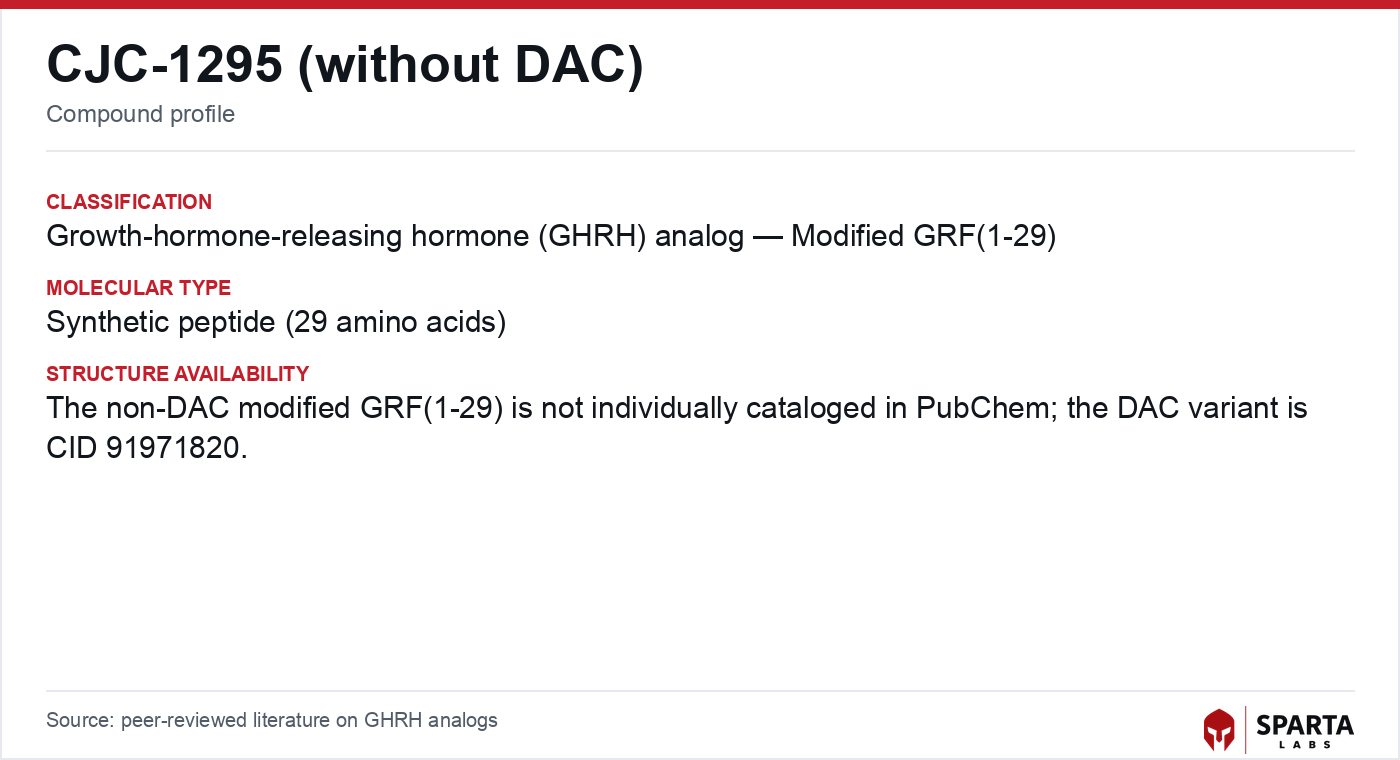
Figure: chemical structure of CJC-1295 (without DAC).
1982: Two Tumors, Two Laboratories, One Peptide
For most of the twentieth century the hypothalamic factor that stimulates pituitary growth hormone (GH) release was a missing piece of neuroendocrinology. Roger Guillemin's group had isolated somatostatin, the GH-inhibiting factor, in 1973, giving science one half of the regulatory circuit. The releasing factor itself resisted isolation because it is present in the hypothalamus at vanishingly low concentrations.
The breakthrough arrived from an unexpected clinical source: pancreatic tumors that caused acromegaly by secreting the releasing factor ectopically. In 1982, Guillemin, Brazeau, and colleagues at the Salk Institute isolated a 44-residue peptide with GH-releasing activity from such a tumor and reported its structure and activity in Science [1]. In the same year, Rivier, Spiess, Thorner, and Vale independently characterized a 40-residue peptide from a second acromegalic patient's tumor, published in Nature [2]. Both groups demonstrated specific, potent stimulation of pituitary GH secretion, and the sequences matched — the hypothalamic releasing factor had been found twice, simultaneously.
Findings from research models do not establish safety or efficacy in humans. Sparta Labs makes no claims about the use of this compound.
Follow-up work established that endogenous GHRH circulates chiefly as GHRH(1-44)-NH2 and GHRH(1-40)-OH, and that the tumor-derived and hypothalamic sequences were identical. That shared sequence became the raw material for every GHRH analog that followed.
The First Substitution Problem: Locating the Active Core
Once the sequence was known, laboratories asked which parts of it mattered. Structure-activity work through the 1980s established that the N-terminal 29 residues — hGRF(1-29)-NH2 — retained full agonist potency at the pituitary GHRH receptor, with residues beyond position 29 dispensable for receptor engagement. This finding produced sermorelin, the synthetic 29-residue fragment that became the practical research and clinical tool for the class, and it fixed the length of the scaffold that CJC-1295 without DAC would later inherit.
Naming this fragment mattered for a reason that recurs throughout the compound's history: CJC-1295 without DAC is a substituted GRF(1-29), so its entire structural discussion is anchored to the 29-residue core rather than to the full-length hormone.
The Second Substitution Problem: DPP-4 and the Half-Life Wall
A hard pharmacological limit became apparent early. Unmodified GHRH and GRF(1-29) are cleared from plasma within minutes, which frustrates any attempt to study sustained receptor engagement. In 1989 Frohman and colleagues characterized this degradation rigorously, identifying dipeptidyl peptidase-4 (DPP-4) as the dominant inactivating protease in human plasma [3]. DPP-4 cleaves the Tyr¹-Ala² bond at the N-terminus with high efficiency, releasing the inactive fragment GRF(3-29); trypsin-like plasma enzymes contribute secondary inactivation.
That paper reframed the entire analog-design program. It converted a vague stability problem into a specific molecular target: protect position 2 from DPP-4, and shield the internal sequences that secondary proteases recognize. Every substitution in CJC-1295 without DAC can be read as an answer to a degradation pathway Frohman's group named. The same enzymatic-stabilization logic runs through the broader class — the FDA-approved GHRH analog tesamorelin descends from the same problem statement.
Assembling the Tetrasubstituted Scaffold
The four substitutions that define the CJC-1295 core — D-Ala², Gln⁸, Ala¹⁵, and Nle²⁷ — were not chosen arbitrarily. Each maps to a distinct liability documented in the structure-activity and degradation literature:
- D-Ala² replaces L-Ala at the DPP-4 cleavage site, converting the enzyme's preferred substrate into one it processes poorly.
- Gln⁸ and Ala¹⁵ substitute residues within sequences recognized by secondary plasma proteases and by pathways prone to deamidation.
- Nle²⁷ (norleucine) removes the methionine at position 27, eliminating an oxidation-sensitive site that complicates handling and analytical characterization.
Systematic single- and multi-residue substitution studies through the 1980s and 1990s had mapped the receptor's tolerance for conservative changes across the GRF(1-29) sequence, and the tetrasubstituted design combined the four most favorable of these into one molecule. The receptor pharmacology of this core is treated in the CJC-1295 without DAC mechanism of action article.
The DAC Fork: Where the Two CJC-1295 Compounds Diverge
The designation "CJC-1295" originates with ConjuChem Inc., a Montreal biotechnology company whose research program extended the tetrasubstituted scaffold with a Drug Affinity Complex (DAC) — a lysine-linked maleimidopropionamide moiety attached at the C-terminus. In vivo, this appendage reacts with the free thiol of serum albumin at Cys34, forming a covalent albumin conjugate whose plasma half-life is measured in days rather than minutes. Jetté and colleagues formally characterized this DAC-bearing molecule as a long-lasting GRF analog in Endocrinology in 2005 [4].
CJC-1295 without DAC is the same four-substitution GRF(1-29) core with that albumin-binding appendage removed. Because it lacks the DAC moiety, its pharmacodynamic profile is short rather than sustained, and the two compounds are distinct research entities that happen to share a name and a core sequence. In secondary literature the DAC-free form is frequently listed as Modified GRF 1-29 precisely to keep the two apart. A parallel discussion of the DAC-bearing variant appears in the CJC-1295 with DAC history article.
The Regulatory Record of the Scaffold
The unmodified parent of the scaffold has a formal US regulatory history. Sermorelin acetate (hGRF(1-29)-NH2) was approved by the FDA in 1997 under the brand name Geref (Serono Laboratories), with indications for idiopathic GH deficiency in children with growth failure and for diagnostic assessment of pituitary GH reserve. Geref was voluntarily withdrawn from the US market in 2008, and the FDA confirmed in a 2013 Federal Register notice that the withdrawal was not for reasons of safety or effectiveness [5]. That determination is a meaningful part of the compound family's regulatory record: the underlying GRF(1-29) scaffold carries no safety-based disqualification in its documented history.
The substituted CJC-1295 forms themselves have remained research materials rather than approved drugs. In December 2024, the FDA's Pharmacy Compounding Advisory Committee evaluated CJC-1295 (both DAC and without-DAC forms) as candidate bulk drug substances under Section 503A. The committee's deliberations and any resulting FDA determination remained in progress at the time of writing, reflecting continued regulatory attention to the class.
The 2006 Cluster of Clinical Papers
The peer-reviewed clinical evidence for the CJC-1295 name derives from a concentrated burst of publications in 2006, all examining the DAC-bearing variant. Teichman and colleagues reported dose-dependent GH and IGF-1 secretory responses with a favorable tolerability profile in healthy adults, in the Journal of Clinical Endocrinology & Metabolism [6]. In the same journal, Ionescu and Frohman reported that pulsatile GH secretion persisted during continuous GHRH-receptor stimulation by CJC-1295 with DAC — a mechanistically notable observation, since sustained agonism did not abolish the physiological pulsatility of GH release [7]. Alba and colleagues published concurrent preclinical data showing growth normalization in GHRH-knockout mice given the tetrasubstituted core [8].
None of these three studies examined CJC-1295 without DAC as an isolated agent. They nonetheless supply the pharmacological framework within which the DAC-free variant is scientifically interpreted, and they anchor the compound family's presence in the indexed literature.
Current Research Landscape
CJC-1295 without DAC continues to circulate as a research material, and an open scientific question is whether its short pharmacodynamic pulse — as opposed to the tonic, sustained receptor engagement of the DAC form — carries distinct experimental implications. Broader interest in GHRH-receptor biology has persisted in the academic literature, including work extending the characterization of GHRH-R signaling and its splice variants [9]. Comparisons within the wider secretagogue class, such as the ghrelin-receptor agonist ipamorelin, remain a recurring theme in the surrounding literature.
Documentation of synthesis routes, purity verification, and storage standards applied to research-grade material is covered in the CJC-1295 without DAC sourcing and quality article. Research-grade CJC-1295 without DAC from Sparta Labs is supplied with third-party batch Certificates of Analysis.
References
-
Guillemin R, Brazeau P, Böhlen P, Esch F, Ling N, Wehrenberg WB. Growth hormone-releasing factor from a human pancreatic tumor that caused acromegaly. Science. 1982;218(4572):585-587. PMID: 6812220. DOI: 10.1126/science.6812220. View on PubMed
-
Rivier J, Spiess J, Thorner M, Vale W. Characterization of a growth hormone-releasing factor from a human pancreatic islet tumour. Nature. 1982;300(5892):276-278. PMID: 6292724. DOI: 10.1038/300276a0. View on PubMed
-
Frohman LA, Downs TR, Heimer EP, Felix AM. Dipeptidylpeptidase IV and trypsin-like enzymatic degradation of human growth hormone-releasing hormone in plasma. J Clin Invest. 1989;83(5):1533-1540. PMID: 2651468. DOI: 10.1172/JCI114049. View on PubMed
-
Jetté L, Léger R, Thibaudeau K, Benquet C, Robitaille M, Pellerin I, et al. Human growth hormone-releasing factor (hGRF)1-29-albumin bioconjugates activate the GRF receptor on the anterior pituitary in rats: identification of CJC-1295 as a long-lasting GRF analog. Endocrinology. 2005;146(7):3052-3058. PMID: 15817669. DOI: 10.1210/en.2004-1286. View on PubMed
-
US Food and Drug Administration. Determination that GEREF (Sermorelin Acetate) Injection Was Not Withdrawn From Sale for Reasons of Safety or Effectiveness. Fed Regist. 2013;78(43):14201. Source: federalregister.gov
-
Teichman SL, Neale A, Lawrence B, Gagnon C, Castaigne JP, Frohman LA. Prolonged stimulation of growth hormone (GH) and insulin-like growth factor I secretion by CJC-1295, a long-acting analog of GH-releasing hormone, in healthy adults. J Clin Endocrinol Metab. 2006;91(3):799-805. PMID: 16352683. DOI: 10.1210/jc.2005-1536. View on PubMed
-
Ionescu M, Frohman LA. Pulsatile secretion of growth hormone (GH) persists during continuous stimulation by CJC-1295, a long-acting GH-releasing hormone analog. J Clin Endocrinol Metab. 2006;91(12):4792-4797. PMID: 17018654. DOI: 10.1210/jc.2006-1702. View on PubMed
-
Alba M, Fintini D, Sagazio A, Lawrence B, Castaigne JP, Frohman LA, et al. Once-daily administration of CJC-1295, a long-acting growth hormone-releasing hormone (GHRH) analog, normalizes growth in the GHRH knockout mouse. Am J Physiol Endocrinol Metab. 2006;291(6):E1290-E1294. PMID: 16822960. DOI: 10.1152/ajpendo.00201.2006. View on PubMed
-
Szalai M, et al. Growth hormone-releasing hormone receptor (GHRH-R) and its signaling. Rev Endocr Metab Disord. 2025. DOI: 10.1007/s11154-025-09952-x. Full text via DOI
Disclaimer. Statements in this article have not been evaluated by the Food and Drug Administration. This compound is not intended to diagnose, treat, cure, or prevent any disease. Sparta Labs sells research-use-only materials. Content is provided for educational and informational purposes only and does not constitute medical advice. Consult a qualified medical professional for any health concerns.
Frequently asked questions
What does the "without DAC" in CJC-1295 without DAC mean?
DAC stands for Drug Affinity Complex, a maleimidopropionamide moiety that the ConjuChem research program attached to the tetrasubstituted GRF(1-29) core so it would bind covalently to serum albumin. CJC-1295 without DAC is the same four-substitution core with that appendage removed, so it is sometimes listed as Modified GRF 1-29. Because it lacks the albumin-binding group, it is a distinct research entity from CJC-1295 with DAC.
Which four substitutions define the CJC-1295 scaffold?
The tetrasubstituted GRF(1-29) core carries D-Ala at position 2, Gln at position 8, Ala at position 15, and Nle (norleucine) at position 27. Each change maps to a documented liability: D-Ala2 addresses DPP-4 cleavage identified by Frohman and colleagues in 1989, Gln8 and Ala15 address secondary protease and deamidation sites, and Nle27 removes an oxidation-prone methionine.
How does the 1982 isolation of GHRH relate to CJC-1295 without DAC?
CJC-1295 without DAC is a synthetic analog of human growth hormone-releasing hormone (GHRH). GHRH was isolated in 1982 by Guillemin and colleagues, reported in Science, and independently by Rivier and colleagues, reported in Nature, both from acromegaly-causing pancreatic tumors. That shared sequence became the starting material for the GRF(1-29) fragment on which CJC-1295 is built.
What is the regulatory status of the CJC-1295 compound family?
The substituted CJC-1295 forms are research materials and are not FDA-approved drugs. The scaffold's unmodified parent, sermorelin, was FDA-approved in 1997 and later withdrawn for non-safety reasons per a 2013 Federal Register notice. In December 2024 the FDA's Pharmacy Compounding Advisory Committee evaluated CJC-1295 as a candidate bulk drug substance under Section 503A, with the outcome ongoing at the time of writing.