
GHRP-2: Published Research
A bibliographic review of peer-reviewed GHRP-2 (pralmorelin) research, organized by the research communities that studied it: receptor pharmacology, human neuroendocrine work, the Japanese diagnostic dossier, and anti-doping detection chemistry. Educational reference.
For research use only. Not for human consumption. This article is educational reference material. It is not medical advice and is not a recommendation to use any substance.
Introduction
GHRP-2 (pralmorelin; development code KP-102) is a synthetic hexapeptide growth hormone secretagogue and a documented agonist of the growth hormone secretagogue receptor (GHS-R1a), the same receptor later identified as the target of the endogenous hormone ghrelin. Its published research record is unusual within the growth-hormone-secretagogue class in that it spans not only receptor pharmacology and rodent physiology but also human neuroendocrine investigation, a regulatory-grade diagnostic dossier in Japan, and validated anti-doping detection chemistry. This article organizes that literature around the distinct research communities that have studied the compound, with hedged attribution to the primary sources.
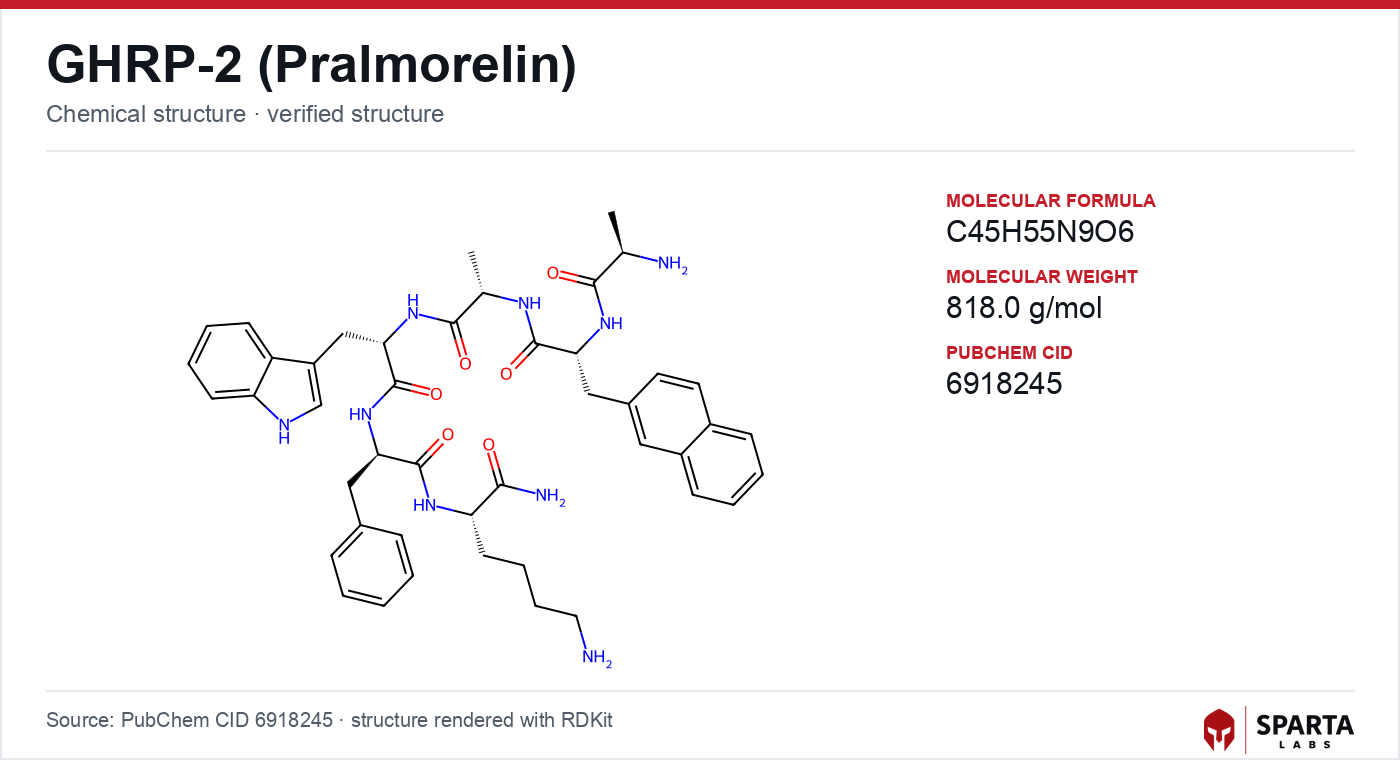
Figure: chemical structure of GHRP-2 (pralmorelin).
From Enkephalin Analogs to a Defined Receptor Target
The scientific interest in GHRP-2 is inseparable from the discovery of the receptor it acts upon. Howard and colleagues reported the cloning of the growth hormone secretagogue receptor (GHS-R) from human and swine pituitary and hypothalamic tissue in Science in 1996, characterizing it as a seven-transmembrane G-protein-coupled receptor coupled to the phospholipase C pathway and identifying it as the molecular target through which synthetic growth-hormone-releasing peptides act [1]. This paper reframed the earlier peptide work: compounds such as GHRP-2, which had been developed empirically from enkephalin-derived leads before any receptor was known, now had a defined molecular target.
Findings from research models do not establish safety or efficacy in humans. Sparta Labs makes no claims about the use of this compound.
The receptor-cloning result also set up the discovery of its endogenous ligand. Because GHRP-2 was a well-characterized synthetic agonist at an "orphan" receptor, it functioned as a pharmacological probe during the search that culminated in the identification of ghrelin. The mechanistic consequences of GHS-R1a agonism are treated in detail in the companion GHRP-2 mechanism of action article, and the broader receptor family context is summarized in the GHRP-2 research overview.
Human Neuroendocrine Pharmacology
A distinctive feature of the GHRP-2 literature is the volume of controlled human pharmacology conducted with the compound as an investigative tool rather than as a candidate therapeutic.
Arvat and colleagues at the University of Turin reported a comparative study of GHRP-2 and the related peptide hexarelin in healthy human volunteers in Peptides in 1997. The authors reported that both peptides elicited growth hormone responses markedly exceeding those observed with growth-hormone-releasing hormone (GHRH) administered alone, and they characterized the compounds' concurrent effects on prolactin, adrenocorticotropic hormone (ACTH), and cortisol [2]. This work provided an early systematic characterization of GHRP-2's multi-hormone secretagogue profile in humans and established it as a reagent for probing hypothalamic-pituitary interactions. The structural relationship between these two hexapeptides is discussed further in the hexarelin research overview.
A separate strand of human work examined the compound's relationship to appetite signaling. Laferrère and colleagues reported a crossover study in The Journal of Clinical Endocrinology & Metabolism in 2005 in which lean healthy male volunteers received intravenous GHRP-2 or saline. The authors reported greater ad libitum food intake during GHRP-2 infusion and framed the peptide as a pharmacological tool for studying ghrelin's role in human appetite regulation, given the shared receptor [3].
Regulatory and Diagnostic Dossier in Japan
GHRP-2, under the international nonproprietary name pralmorelin, holds a place in the class as a growth hormone secretagogue that progressed to regulatory authorization for a diagnostic indication. Pralmorelin was approved by Japan's regulatory authority for use as a growth-hormone-secretion challenge agent, and a published drug profile documents its development history and approval status [4]. The rationale for a secretagogue-based challenge rests on the observation that a GHS-R1a agonist provokes a measurable pituitary growth hormone response, allowing assessment of pituitary secretory reserve. The diagnostic use case is one of the few examples in this compound class of a growth hormone secretagogue reaching a formal regulatory dossier rather than remaining confined to research settings.
Anti-Doping Detection Chemistry
Because growth hormone secretagogues are prohibited in competitive sport, a parallel body of analytical-chemistry research has developed methods to detect GHRP-2 and its metabolites in biological matrices. Okano and colleagues reported a liquid-chromatography electrospray-ionization tandem mass spectrometry (LC-ESI-MS/MS) method for the determination of pralmorelin and a primary urinary metabolite in human urine in Rapid Communications in Mass Spectrometry in 2010 [5]. The method characterized the metabolite profile and analytical parameters needed to support routine screening, contributing to the detection framework used within anti-doping programs. This line of work is methodologically distinct from the pharmacology literature and reflects the compound's regulated status in sport.
Antinociceptive and Cardiovascular Model Studies
Beyond the endocrine axis, GHRP-2 has appeared in preclinical studies exploring GHS-R1a signaling in other systems.
Zeng and colleagues reported in Peptides in 2014 that GHRP-2 produced antinociceptive effects at the supraspinal level in murine models, with the effect attenuated by both the opioid receptor antagonist naloxone and a GHS-R1a antagonist [6]. The authors interpreted this as evidence of interaction between GHS-R1a and opioid circuitry, positioning the peptide as a tool for investigating that crosstalk.
In the cardiovascular domain, Titterington and colleagues reported in Endocrinology in 2009 that chronic GHRP-2 administration in apolipoprotein-E-deficient (ApoE−/−) mice was associated with reduced indices of vascular superoxide production, while noting a dissociation between oxidative-stress markers and atherosclerotic plaque endpoints in the model [7]. The reported dissociation is itself informative, illustrating that a change in one marker did not track with a downstream structural outcome.
Synthesis in the Review Literature
The primary studies above have been drawn together in narrative reviews of the secretagogue class. Berlanga-Acosta and colleagues published a historical appraisal in Clinical Medicine Insights: Endocrinology and Diabetes in 2017 synthesizing preclinical observations attributed to synthetic growth-hormone-releasing peptides, including GHRP-2, and tracing the scientific lineage of the class from its enkephalin-derived origins [8]. Reviews of this kind are useful for situating individual GHRP-2 findings within the wider secretagogue literature, though they inherit the methodological limits of the underlying preclinical work.
Researchers comparing across the GH-axis will find that the GHRH-analog compounds occupy a structurally and mechanistically separate category from the GHS-R1a agonists; the CJC-1295 with DAC published research article covers that adjacent literature. For quality and analytical-verification context specific to this compound, see the GHRP-2 sourcing and verification standards article, and GHRP-2 is available from Sparta Labs for research use with batch-specific third-party Certificates of Analysis.
Open Questions in the Current Literature
Several aspects of GHRP-2 research remain incompletely resolved. High-resolution structural data on the GHS-R1a receptor in complex with GHRP-2 would clarify the molecular contacts that distinguish its binding from other secretagogues and from ghrelin, and such structures remain an active area of receptor structural biology. The mechanistic basis for effects attributed to synthetic GHRPs that appear independent of growth hormone secretion, including the relative contributions of GHS-R1a versus other proposed binding partners, continues to be examined in the review literature [8]. Finally, the comparative behavior of pralmorelin as a diagnostic challenge agent across different populations and against alternative stimulation methods represents an area where the published evidence base is uneven.
References
-
Howard AD, Feighner SD, Cully DF, Arena JP, Liberator PA, Rosenblum CI, et al. A receptor in pituitary and hypothalamus that functions in growth hormone release. Science. 1996;273(5277):974–977. PMID: 8688086. DOI: 10.1126/science.273.5277.974. PubMed
-
Arvat E, Di Vito L, Maccario M, Broglio F, Boghen MF, Deghenghi R, et al. Effects of GHRP-2 and hexarelin, two synthetic GH-releasing peptides, on GH, prolactin, ACTH and cortisol levels in man. Comparison with the effects of GHRH, TRH and hCRH. Peptides. 1997;18(6):885–891. PMID: 9285939. DOI: 10.1016/s0196-9781(97)00016-8. PubMed
-
Laferrère B, Abraham C, Russell CD, Bowers CY. Growth hormone releasing peptide-2 (GHRP-2), like ghrelin, increases food intake in healthy men. J Clin Endocrinol Metab. 2005;90(2):611–614. PMID: 15699539. DOI: 10.1210/jc.2004-1585. PubMed
-
Pralmorelin: GHRP-2, GPA-748, growth hormone-releasing peptide 2, KP-102 D, KP-102 LN. Drugs R D. 2004;5(4):232–235. PMID: 15230633. DOI: 10.2165/00126839-200405040-00008. PubMed
-
Okano M, Sato M, Kageyama S, Niioka T, Yonezawa K, Suzuki H, et al. Determination of growth hormone secretagogue pralmorelin (GHRP-2) and its metabolite in human urine by liquid chromatography/electrospray ionization tandem mass spectrometry. Rapid Commun Mass Spectrom. 2010;24(14):2046–2056. PMID: 20552695. DOI: 10.1002/rcm.4619. PubMed
-
Zeng P, Li S, Zheng Y, Liu FY, Wang J, Zhang D, et al. Ghrelin receptor agonist, GHRP-2, produces antinociceptive effects at the supraspinal level via the opioid receptor in mice. Peptides. 2014;55:103–109. PMID: 24657737. DOI: 10.1016/j.peptides.2014.02.013. PubMed
-
Titterington JS, Sukhanov S, Higashi Y, Vaughn C, Bowers C, Delafontaine P. Growth hormone-releasing peptide-2 suppresses vascular oxidative stress in ApoE−/− mice but does not reduce atherosclerosis. Endocrinology. 2009;150(12):5478–5487. PMID: 19819949. PMC: PMC2795722. DOI: 10.1210/en.2009-0283. PubMed
-
Berlanga-Acosta J, Abreu-Cruz A, García-del Barco Herrera D, Mendoza-Marí Y, Rodríguez-Ulloa A, García-Ojalvo A, et al. Synthetic growth hormone-releasing peptides (GHRPs): a historical appraisal of the evidences supporting their cytoprotective effects. Clin Med Insights Endocrinol Diabetes. 2017;10:1179546817694558. PMID: 28469490. PMC: PMC5392015. DOI: 10.1177/1179546817694558. PubMed
Disclaimer. Statements in this article have not been evaluated by the Food and Drug Administration. This compound is not intended to diagnose, treat, cure, or prevent any disease. Sparta Labs sells research-use-only materials. Content is provided for educational and informational purposes only and does not constitute medical advice. Consult a qualified medical professional for any health concerns.
Frequently asked questions
What research communities have studied GHRP-2?
GHRP-2 (pralmorelin) has been studied across several distinct communities: receptor pharmacologists who cloned and characterized the GHS-R1a receptor, endocrinologists conducting controlled human neuroendocrine studies, a Japanese regulatory diagnostic dossier, and analytical chemists developing anti-doping detection methods. It has also appeared in preclinical antinociceptive and cardiovascular model research. Each strand uses different methodologies and citations.
How is GHRP-2 connected to the discovery of ghrelin?
Howard and colleagues reported the cloning of the growth hormone secretagogue receptor (GHS-R1a) in Science in 1996, using synthetic peptides such as GHRP-2 as pharmacological probes of what was then an orphan receptor. Because GHRP-2 was a well-characterized agonist at that receptor, it served as a tool during the subsequent identification of the receptor's endogenous ligand, ghrelin.
What did the Arvat et al. 1997 study report about GHRP-2?
Arvat and colleagues at the University of Turin reported in Peptides (1997) that GHRP-2 and hexarelin each elicited growth hormone responses in healthy human volunteers markedly exceeding those seen with GHRH alone. The study also characterized the peptides' concurrent effects on prolactin, ACTH, and cortisol, providing an early systematic profile of GHRP-2's multi-hormone secretagogue behavior in humans.
Is GHRP-2 detectable in anti-doping testing?
Yes. Okano and colleagues reported a validated LC-ESI-MS/MS method in Rapid Communications in Mass Spectrometry (2010) for determining pralmorelin (GHRP-2) and a primary urinary metabolite in human urine. The method characterized the analytical parameters and metabolite profile relevant to routine screening within anti-doping programs, reflecting the compound's prohibited status in competitive sport.