
GHRP-6: Published Research
A citation-based survey of the published GHRP-6 literature, tracing the peptide from its 1984 pharmacological characterization through the cloning of its receptor and the discovery of ghrelin. Educational reference.
For research use only. Not for human consumption. This article is educational reference material. It is not medical advice and is not a recommendation to use any substance.
Why GHRP-6 Occupies a Distinctive Place in the Literature
GHRP-6 (His-D-Trp-Ala-Trp-D-Phe-Lys-NH2) is a synthetic hexapeptide that predates the discovery of its own endogenous counterpart. Most of the peptides in the research-secretagogue literature were designed against a known receptor; GHRP-6 was characterized pharmacologically roughly a decade before the receptor it acts on was cloned, and roughly fifteen years before that receptor's natural ligand, ghrelin, was isolated. This inverted chronology, a functional peptide first, a receptor second, an endogenous hormone third, makes the GHRP-6 literature unusually instructive as a case study in reverse pharmacology.
This article summarizes selected peer-reviewed publications in neutral, attributed terms. Methodology and findings are described as reported by their authors, and no conclusions are drawn in Sparta Labs' voice regarding safety or efficacy in humans. The receptor-level detail behind these observations is treated separately in the GHRP-6 mechanism of action article, and the compound's classification and background are covered in the GHRP-6 research overview.
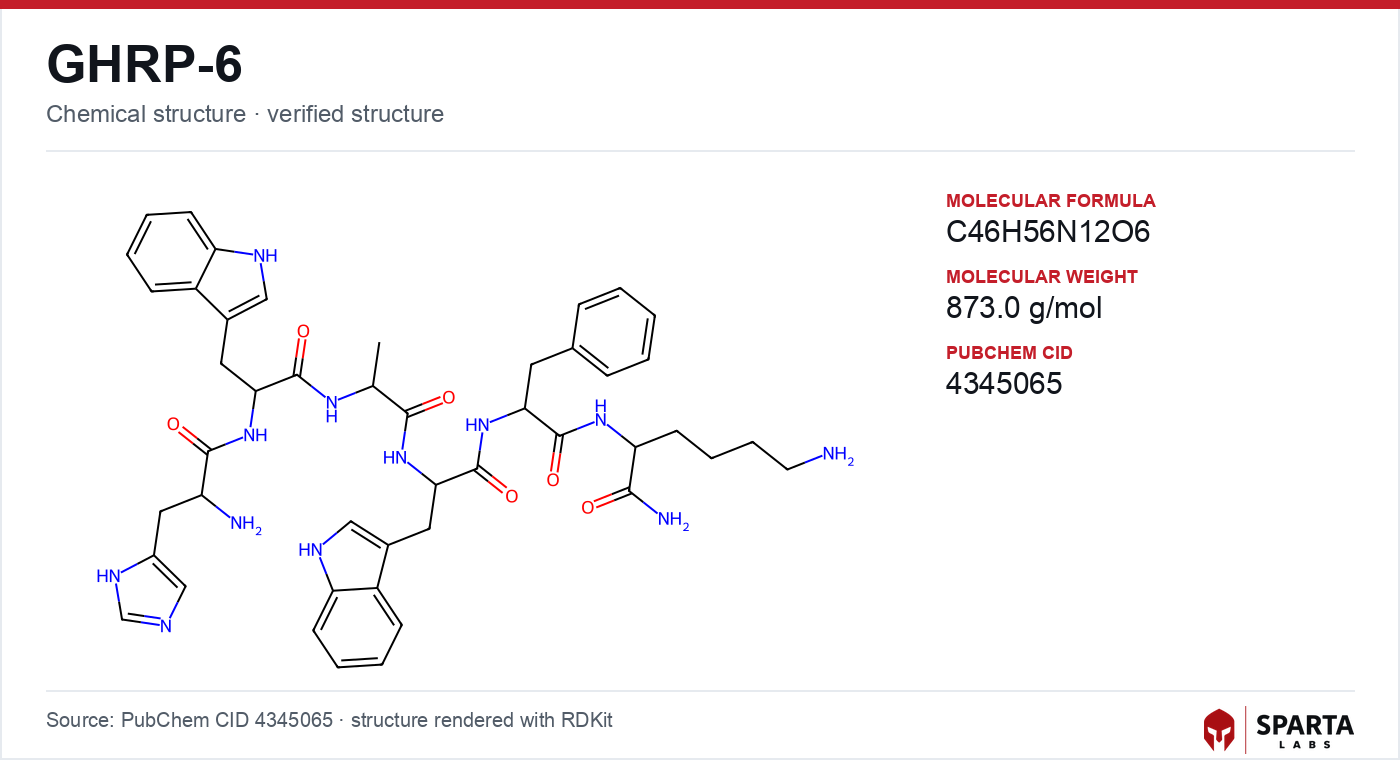
Figure: chemical structure of GHRP-6.
The 1984 Characterization: A Peptide Without a Named Receptor
The foundational paper on GHRP-6 was published by Bowers, Momany, Reynolds, and Hong in Endocrinology in 1984 [1]. Working from earlier observations that certain enkephalin-derived fragments influenced growth hormone (GH) release, the authors described a systematic structure-activity evaluation that produced the hexapeptide His-D-Trp-Ala-Trp-D-Phe-Lys-NH2. Using dispersed rat anterior pituitary cell cultures, they reported that the peptide elicited GH release in a concentration-dependent manner.
Two features of the report are frequently cited. First, the authors described the response as relatively selective for GH, without parallel release of luteinizing hormone, follicle-stimulating hormone, thyroid-stimulating hormone, or prolactin at the concentrations tested. Second, they noted that the peptide's activity did not depend on growth-hormone-releasing hormone (GHRH), which had been characterized around the same period, indicating a distinct site of action. The paper is generally credited as the first characterization of a synthetic GH secretagogue, and it introduced the "GHRP" nomenclature that later compounds inherited.
Findings from research models do not establish safety or efficacy in humans. Sparta Labs makes no claims about the use of this compound.
The Missing Receptor and Its 1996 Cloning
For more than a decade after the 1984 report, GHRP-6 was a pharmacological tool acting on a target that had not been molecularly defined. That gap was closed by Howard and colleagues, who reported the cloning of the growth hormone secretagogue receptor (GHS-R) in Science in 1996 [2]. Using an expression-cloning strategy, the authors identified a seven-transmembrane G-protein-coupled receptor that responded to GHRP-6 and to related non-peptide secretagogues, and they reported its expression in the pituitary and the hypothalamic arcuate nucleus.
The cloning of GHS-R1a converted GHRP-6 from an empirically active peptide into a defined receptor agonist. It also created what the authors framed as an "orphan receptor" problem: a receptor cloned by its response to a synthetic drug, whose natural ligand was unknown. The GHRP-6 literature and the ghrelin literature are joined at exactly this point.
Ghrelin (1999): The Endogenous Ligand Arrives Last
Kojima and colleagues reported the isolation of ghrelin, the endogenous GHS-R1a ligand, in Nature in 1999 [3]. Purifying the peptide from rat stomach extracts, they characterized ghrelin as a 28-amino-acid peptide carrying an unusual n-octanoyl modification on the serine at position 3, and reported that this acyl modification was required for receptor activation and for GH-releasing activity.
For the interpretation of GHRP-6, this paper is pivotal. It established that the synthetic hexapeptide had, since 1984, been acting as a pharmacological agonist of a receptor whose physiological role sits at the intersection of GH regulation and energy homeostasis. Subsequent reviews frequently frame GHRP-6 as an early, peptidic probe of the ghrelin system. The parallel research programs on other secretagogues, including the growth-hormone-releasing-factor analog discussed in the CJC-1295 without DAC research summary and the pituitary secretagogue covered in the ipamorelin research summary, are best read against this shared receptor-biology backdrop.
Human Pharmacokinetic Characterization
Published human data on GHRP-6 remain limited and are dominated by pharmacokinetic characterization rather than efficacy endpoints. Noa and colleagues reported a pharmacokinetic study in healthy male volunteers in Regulatory Toxicology and Pharmacology in 2013 [4]. The authors described the plasma disposition of the peptide following single administrations and reported that the concentration-time data were consistent with a two-compartment model, with a short distribution phase followed by rapid systemic clearance, a profile the authors noted was consistent with the behavior expected of a small unmodified peptide.
The authors characterized the study as exploratory given the small sample, and it was not designed to assess pharmacodynamic outcomes. In the published record, this study functions primarily as a human pharmacokinetic reference point rather than a source of clinical conclusions. Comparison with modified, longer-acting secretagogue constructs, several of which appear in the hexarelin research summary, illustrates how peptide half-life became a central design variable across this compound class.
Cardioprotection and Cytoprotection in Preclinical Models
A distinct strand of the GHRP-6 literature, largely developed by groups in Spain and Cuba, examined the peptide in tissue-injury models rather than in the GH axis. Granado and colleagues reported work in the American Journal of Physiology, Heart and Circulatory Physiology examining GHRP-6 in a rodent model of myocardial injury [5]. The authors reported reductions in indices of myocardial injury and in markers of oxidative stress in treated animals relative to controls, and proposed mechanisms consistent with an antioxidant, cytoprotective profile rather than a purely GH-mediated one.
This tissue-protection line of inquiry was synthesized by Berlanga-Acosta and colleagues in a review published in Mediators of Inflammation in 2017 [6]. The review compiled preclinical evidence across cardiac, hepatic, and other tissue models and advanced the hypothesis that some GHRP-6 observations involve the scavenger receptor CD36, a receptor distinct from GHS-R1a, expressed in non-pituitary tissues. The authors framed a GH-dependent versus GH-independent distinction as a central open question. Whether reported cytoprotective observations are attributable to GHS-R1a signaling, to CD36 engagement, or to a combination remains, per that review, unresolved.
What the Literature Does and Does Not Establish
Read as a whole, the published GHRP-6 record is strongest at the level of molecular pharmacology and receptor biology, where the 1984, 1996, and 1999 papers form a well-documented lineage. The tissue-protection literature is largely preclinical and mechanistically provisional, and the human data are confined to small pharmacokinetic characterization. The reviews in this field are consistent in flagging the same gaps: limited human study, unresolved GHS-R1a-versus-CD36 attribution, and a reliance on animal models whose translation to human biology is not established.
The published literature on GHRP-6 therefore supports a research narrative rather than a clinical one, and the disclaimers below apply to every finding summarized above. Researchers evaluating source material may also consult the GHRP-6 sourcing and quality standards reference for context on identity and purity verification.
References
-
Bowers CY, Momany FA, Reynolds GA, Hong A. On the in vitro and in vivo activity of a new synthetic hexapeptide that acts on the pituitary to specifically release growth hormone. Endocrinology. 1984;114(5):1537-45. PMID: 6714155. View on PubMed
-
Howard AD, Feighner SD, Cully DF, Arena JP, Liberator PA, Rosenblum CI, et al. A receptor in pituitary and hypothalamus that functions in growth hormone release. Science. 1996;273(5277):974-7. PMID: 8688086. View on PubMed
-
Kojima M, Hosoda H, Date Y, Nakazato M, Matsuo H, Kangawa K. Ghrelin is a growth-hormone-releasing acylated peptide from stomach. Nature. 1999;402(6762):656-60. PMID: 10604470. View on PubMed
-
Noa M, Mas R, Mendoza S, Rodríguez E, González JR, Oyarzábal A. Pharmacokinetic study of Growth Hormone-Releasing Peptide 6 (GHRP-6) in nine male healthy volunteers. Regul Toxicol Pharmacol. 2013;65(1):5-11. PMID: 23099431. View on PubMed
-
Granado M, Martín AI, Priego T, Villanúa MA, López-Calderón A. Growth-hormone-releasing peptide-6 and oxidative stress in a rat model of myocardial injury. Am J Physiol Heart Circ Physiol. PMID: 16989643. View on PubMed
-
Berlanga-Acosta J, Guillén-Nieto G, Rodríguez-Rodríguez N, Bringas-Vega ML. Synthetic Growth Hormone-Releasing Peptides (GHRPs): A Historical Appraisal of the Evidences Supporting Their Cytoprotective Effects. Mediators Inflamm. 2017;2017. PMC: PMC5392015. Full text on PMC
Disclaimer. Statements in this article have not been evaluated by the Food and Drug Administration. This compound is not intended to diagnose, treat, cure, or prevent any disease. Sparta Labs sells research-use-only materials. Content is provided for educational and informational purposes only and does not constitute medical advice. Consult a qualified medical professional for any health concerns.
Frequently asked questions
Why was GHRP-6 characterized before its receptor was discovered?
GHRP-6 was identified pharmacologically by Bowers and colleagues in 1984 through structure-activity work, several years before its target receptor (GHS-R1a) was cloned by Howard and colleagues in 1996. Its natural ligand, ghrelin, was not isolated until 1999 by Kojima and colleagues. This reverse-pharmacology sequence, a functional peptide first and an endogenous hormone last, is a notable feature of the published record.
What did the 1984 Bowers study report about GHRP-6?
The 1984 paper in Endocrinology reported that the hexapeptide His-D-Trp-Ala-Trp-D-Phe-Lys-NH2 elicited concentration-dependent growth hormone release in dispersed rat pituitary cell cultures. The authors described the response as relatively selective for growth hormone and independent of growth-hormone-releasing hormone, indicating a distinct site of action.
Has GHRP-6 been studied in humans?
Published human data are limited. Noa and colleagues (2013) reported a small pharmacokinetic study in healthy male volunteers, describing plasma disposition consistent with a two-compartment model and rapid systemic clearance. The authors characterized the study as exploratory, and it was not designed to assess pharmacodynamic or clinical outcomes.
How is GHRP-6 related to ghrelin?
Kojima and colleagues isolated ghrelin in 1999 as the endogenous ligand of the receptor GHRP-6 acts on. This retrospectively classified GHRP-6 as a synthetic peptidic agonist of the ghrelin receptor system, connecting the GHRP-6 literature to the biology of growth hormone regulation and energy homeostasis described in the ghrelin literature.
What tissue-protection research exists on GHRP-6?
A preclinical literature developed largely by groups in Spain and Cuba examined GHRP-6 in injury models. Berlanga-Acosta and colleagues (2017) reviewed this work and proposed that some observations may involve the scavenger receptor CD36 rather than only GHS-R1a. This literature is animal-model based and, per the reviewers, mechanistically unresolved.