
N-Acetyl Semax Amidate: Discovery and Research History
A history of N-Acetyl Semax Amidate told through its chemistry: how ACTH(4-10) fragment research, the Soviet Semax program, and later N-terminal acetylation and C-terminal amidation studies produced a doubly protected heptapeptide. Educational reference.
For research use only. Not for human consumption. This article is educational reference material. It is not medical advice and is not a recommendation to use any substance.
Introduction
N-Acetyl Semax Amidate (Ac-Met-Glu-His-Phe-Pro-Gly-Pro-NH₂) is a synthetic heptapeptide that carries two terminal chemical modifications relative to Semax, the ACTH(4-10)-derived heptapeptide from which it is drawn. Its history is best understood not as a single discovery but as a layered sequence of chemistry decisions: first the identification of a behaviorally active ACTH fragment, then the Soviet-era addition of a stabilizing C-terminal tripeptide that produced Semax, and finally the terminal-protection studies that characterized what happens when the peptide's amino and carboxyl ends are chemically capped. This article traces that lineage through the published literature and situates the amidate variant within the broader Semax research program. A parallel neuropeptide tradition from the same institutions produced Selank and its own terminally modified analog, offering a useful point of comparison for how Soviet and Russian peptide chemistry approached metabolic stabilization.
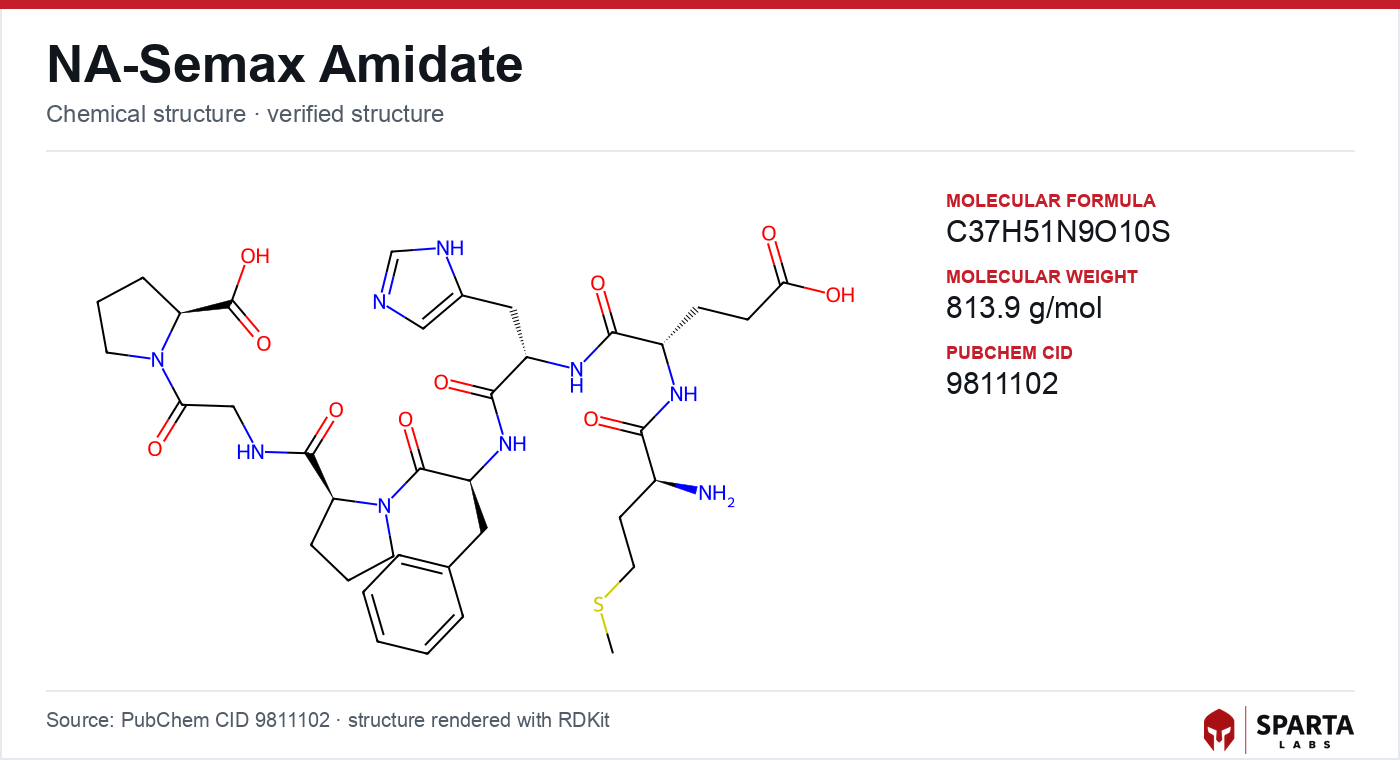
Figure: chemical structure of NA-Semax Amidate.
The ACTH(4-10) Fragment: A Behaviorally Active Sequence
Adrenocorticotropic hormone (ACTH) is a 39-amino-acid peptide secreted by the anterior pituitary that stimulates cortisol release from the adrenal cortex. During the mid-twentieth century, endocrinologists and behavioral pharmacologists observed that short fragments of the ACTH sequence retained neurotropic and behavioral properties that were separable from the steroidogenic activity carried by the N-terminal region of the intact hormone. The heptapeptide fragment ACTH(4-10) (Met-Glu-His-Phe-Pro-Gly-Pro) became a focal point of this work as a short sequence associated with effects in animal learning paradigms independent of adrenal steroid signaling.
This structural motif is shared across the melanocortin peptide family, because ACTH and the melanocyte-stimulating hormones derive from the same precursor, pro-opiomelanocortin. The His-Phe-Arg-Trp core central to melanocortin receptor recognition sits adjacent to the 4-10 window, which is one reason the fragment attracted sustained synthetic interest. That melanocortin lineage connects the Semax family conceptually to unrelated-in-purpose but structurally adjacent melanocortin research compounds such as Melanotan-2, even though the two lines diverged sharply in sequence and pharmacology.
The Soviet Semax Program: Appending Pro-Gly-Pro (1980s)
The direct antecedent of N-Acetyl Semax Amidate was developed in the Soviet Union beginning in the early 1980s. Research groups associated with Nikolai F. Myasoedov at the Institute of Molecular Genetics of the Academy of Sciences and Igor P. Ashmarin at Moscow State University pursued a specific structural strategy: appending the tripeptide Pro-Gly-Pro to the C-terminus of the ACTH(4-10) sequence. Prolines flanking a glycine are comparatively resistant to common exopeptidases, and the design rationale documented in the Semax research record was that this C-terminal extension would slow enzymatic degradation of the parent fragment [1].
The resulting heptapeptide, Semax (Met-Glu-His-Phe-Pro-Gly-Pro), thus embeds the ACTH(4-10) core together with an appended, metabolically motivated tripeptide tail. It is worth emphasizing what this design already tells us about the family: even at the Semax stage, the central engineering problem was metabolic stability, and the solution was a terminal modification. The later N-acetyl and C-amide chemistries that define the amidate variant are a continuation of that same problem-solving logic applied to the opposite (amino) terminus and to the carboxyl end. Koroleva and Myasoedov's 2018 review in Biology Bulletin summarizes the pharmacological characterization of the Semax program from the 1980s onward and remains one of the more accessible English-language accounts of this lineage [1].
Findings from research models do not establish safety or efficacy in humans. Sparta Labs makes no claims about the use of this compound.
Metabolic Fate: The Data That Motivated Further Protection
A recurring theme in Semax pharmacology is rapid metabolic processing, and this is the empirical thread that connects the parent peptide to its terminally protected derivatives. Kinetic work by Shevchenko and colleagues (2006) using radiolabeled Semax reported that intact peptide could be detected in rat brain tissue shortly after intranasal administration, but that a substantial fraction was already present as metabolic fragments, with the C-terminal Pro-Gly-Pro tripeptide accumulating as an early metabolite [2]. That the appended stabilizing tail was itself liberated as a fragment is precisely the kind of observation that motivates additional terminal protection.
This degradation picture frames why chemists explored capping both ends of the molecule. The Semax mechanism-of-action literature discusses how the intact sequence and its fragments have each been studied, and the pharmacokinetic constraints described there are the same constraints that terminal modification is designed to address. Sparta Labs reports these findings as published; it does not draw conclusions beyond what the cited authors stated.
N-Terminal Acetylation: Probing the Amino End
The first of the two modifications that define the amidate variant is N-terminal acetylation, in which an acetyl group caps the free amine of the terminal methionine. Two distinct lines of published work bear on this modification.
The first is structure-activity work on the N-terminal region. Levitskaya and colleagues (2005) reported a systematic comparison in rat behavioral learning models of Semax analogs bearing varied N-terminal residues or N-terminal acyl modifications, describing which substitutions were compatible with retention of the tested activity profile and which were not [3]. Studies of this kind established, in the peptide-chemistry sense, that the amino terminus is a modifiable position rather than an obligatory pharmacophore.
The second is coordination chemistry. Magrì and colleagues (2016), publishing in the Journal of Inorganic Biochemistry, synthesized N-acetyl Semax specifically to dissect the role of the free N-terminal amine in copper(II) and zinc(II) binding. Because a free peptide N-terminus is a common anchoring point for transition-metal coordination, blocking it with an acetyl group changes the geometry of the resulting metal complex. The authors reported that the acetylated peptide forms a distinct copper species and that a copper-dependent effect observed in their cell experiments with the free-amine form depended on the intact terminal amine [4]. This is one of the clearest published demonstrations that a single terminal modification can selectively switch one physicochemical property of the Semax scaffold while leaving the rest of the molecule intact.
C-Terminal Amidation and the Doubly Protected Molecule
The second defining modification is C-terminal amidation, which converts the terminal carboxyl group into a carboxamide. In peptide chemistry, amidation is a well-established strategy that removes the negatively charged carboxylate, changes the molecule's terminal electronics, and confers resistance to carboxypeptidase activity. Many endogenous neuropeptides are naturally amidated at the C-terminus, so amidation is also used to make a synthetic analog resemble the mature form of a signaling peptide.
Combined, N-terminal acetylation and C-terminal amidation constitute a symmetric, dual-terminal protection scheme: both chemically reactive chain ends are capped. This is the structural signature of the amidate variant relative to plain Semax. The same doubly protected logic was applied within the sibling N-Acetyl Selank Amidate line, which pairs the identical acetyl-plus-amide capping strategy with a tuftsin-derived scaffold rather than an ACTH-derived one, underscoring that terminal protection is a general design pattern in this Russian peptide tradition rather than a one-off choice.
Regulatory Milestones
Semax received registration from the Russian Ministry of Health in 1994 for specific cerebrovascular indications, as an intranasal formulation of the unmodified heptapeptide. This registration distinguished Semax from most synthetic neuropeptide analogs of its generation, which did not reach national regulatory approval in any jurisdiction [1].
Outside Russia, neither Semax nor its terminally modified derivatives have received marketing approval. In the United States, Semax (free base and acetate forms) entered the FDA's Section 503A bulk drug substances review framework, the pathway that governs whether a non-approved substance may be used in compounding, where it was categorized pending further review. The FDA's Pharmacy Compounding Advisory Committee calendar has listed Semax among substances scheduled for consideration [5]. The N-acetyl amidate variant is not separately named as an approved substance in that proceeding, and N-Acetyl Semax Amidate is offered in the United States as a research-use-only material. Any FDA documents produced by that review process would represent a primary source addition to the regulatory record of this compound class.
Current Research Landscape
Published Semax research through the 2020s has extended from the foundational behavioral and cerebral-ischemia work into molecular approaches. Sudarkina, Filippenkov and colleagues (2021) used a proteomic analysis to characterize protein-expression changes associated with the ACTH(4-7)PGP peptide in a rat model of cerebral ischemia-reperfusion, reporting a set of proteins whose abundance tracked with peptide exposure [6]. Work of this kind illustrates how the research program has moved from whole-animal behavioral endpoints toward molecular-level characterization.
For the fully modified variant specifically, the published record remains thinner than for the parent, and matched, head-to-head physicochemical comparison of Semax, N-acetyl Semax, and N-Acetyl Semax Amidate in identical experimental systems is one of the tractable open directions for this area. Readers tracing the broader family may find the N-Acetyl Semax Amidate research overview a useful companion for the chemistry and classification details. Research-grade N-Acetyl Semax Amidate from Sparta Labs is offered with batch-specific certificates of analysis for research use.
References
-
Koroleva SV, Myasoedov NF. Semax as a universal drug for therapy and research. Biol Bull. 2018;45(6):589–600. DOI: 10.1134/S1062359018060055. Full text via DOI
-
Shevchenko KV, Nagaev IY, Alfeeva LY, Andreeva LA, Kamenskii AA, Levitskaia NG, et al. Kinetics of Semax penetration into the brain and blood of rats after its intranasal administration. Russ J Bioorg Chem. 2006;32(1):57–62. DOI: 10.1134/S1068162006010055. Full text via DOI
-
Levitskaya NG, Sebentsova EA, Andreeva LA, Alfeeva LY, Kamenskiy AA, Myasoedov NF. Effect of modification of the N-terminal region of Semax on the expression of the nootropic effect of Semax analogs. Biol Bull. 2005;32(4):381–386. DOI: 10.1007/s10525-005-0116-0. Full text via DOI
-
Magrì A, Munzone A, Peana M, Medici S, Zoroddu MA, Hansson Ö, et al. Influence of the N-terminus acetylation of Semax, a synthetic analog of ACTH(4-10), on copper(II) and zinc(II) coordination and biological properties. J Inorg Biochem. 2016;164:59–69. PMID: 27586814. DOI: 10.1016/j.jinorgbio.2016.08.013. View on PubMed
-
US Food and Drug Administration. Pharmacy Compounding Advisory Committee — advisory committee calendar. Available at: Source: fda.gov
-
Sudarkina OY, Filippenkov IB, Stavchansky VV, Denisova AE, Gubsky LV, Limborska SA, et al. Brain protein expression profile confirms the protective effect of the ACTH(4-7)PGP peptide (Semax) in a rat model of cerebral ischemia-reperfusion. Int J Mol Sci. 2021;22(12):6179. PMID: 34201112. DOI: 10.3390/ijms22126179. View on PubMed
Disclaimer. Statements in this article have not been evaluated by the Food and Drug Administration. This compound is not intended to diagnose, treat, cure, or prevent any disease. Sparta Labs sells research-use-only materials. Content is provided for educational and informational purposes only and does not constitute medical advice. Consult a qualified medical professional for any health concerns.
Frequently asked questions
What is N-Acetyl Semax Amidate, and how is it related to Semax?
N-Acetyl Semax Amidate (Ac-Met-Glu-His-Phe-Pro-Gly-Pro-NH2) is a terminally modified analog of Semax. Semax itself is the heptapeptide Met-Glu-His-Phe-Pro-Gly-Pro, built from the ACTH(4-10) fragment with an appended Pro-Gly-Pro tripeptide. The amidate variant carries two additional chemical modifications documented in the peptide literature: N-terminal acetylation of the methionine amine and C-terminal amidation of the terminal proline.
Why do peptide chemists add acetyl and amide groups to the ends of a peptide like Semax?
N-terminal acetylation and C-terminal amidation are standard terminal-protection strategies in peptide chemistry. Acetylation caps the free amino group and amidation caps the free carboxyl group. Published work on Semax analogs reported that these terminal chemistries alter enzymatic susceptibility and, in the case of the amine, metal-coordination behavior. This article describes those chemistry studies rather than any use of the compound.
Who developed the parent compound Semax, and when?
Semax was developed in the Soviet Union beginning in the early 1980s by research groups associated with Nikolai F. Myasoedov at the Institute of Molecular Genetics of the Academy of Sciences and Igor P. Ashmarin at Moscow State University. Their program studied ACTH(4-10) analogs carrying a C-terminal Pro-Gly-Pro extension, and it later reached Russian national regulatory registration for the unmodified heptapeptide.
What is the regulatory status of N-Acetyl Semax Amidate in the United States?
N-Acetyl Semax Amidate has not received regulatory approval from any national regulatory authority and is offered in the United States as a research-use-only material. The parent compound Semax (free base and acetate forms) was placed in the FDA's Section 503A bulk drug substances review process. The N-acetyl amidate variant is not separately named as an approved substance in that proceeding.
What published research specifically involves the N-acetylated form of Semax?
A 2016 study by Magri and colleagues in the Journal of Inorganic Biochemistry synthesized N-acetyl Semax to examine how blocking the N-terminal amine changes copper(II) and zinc(II) coordination relative to the free-amine peptide. It is one of the clearest published examples of research on the acetylated terminus and illustrates how a single terminal modification can selectively alter one physicochemical property of the molecule.