
PT-141 (Bremelanotide): Discovery and Regulatory History
How a University of Arizona sunless-tanning peptide program produced bremelanotide (PT-141): the MT-II lineage, the redirecting observation of central effects, the intranasal-to-subcutaneous pivot, RECONNECT trials, and 2019 Vyleesi approval.

For research use only. Not for human consumption. This article is educational reference material. It is not medical advice and is not a recommendation to use any substance.
An Origin in Sunless-Tanning Chemistry
Bremelanotide (PT-141) is unusual among peptide research compounds in that its lineage begins not with a search for a central-nervous-system agent, but with pigmentation chemistry. The compound is a downstream product of a melanocortin analog program at the University of Arizona whose original object was a synthetic tanning agent. Understanding how a melanotropin analog became the first melanocortin receptor agonist to reach US market approval requires tracing several distinct research phases, each documented in the peer-reviewed and regulatory record.
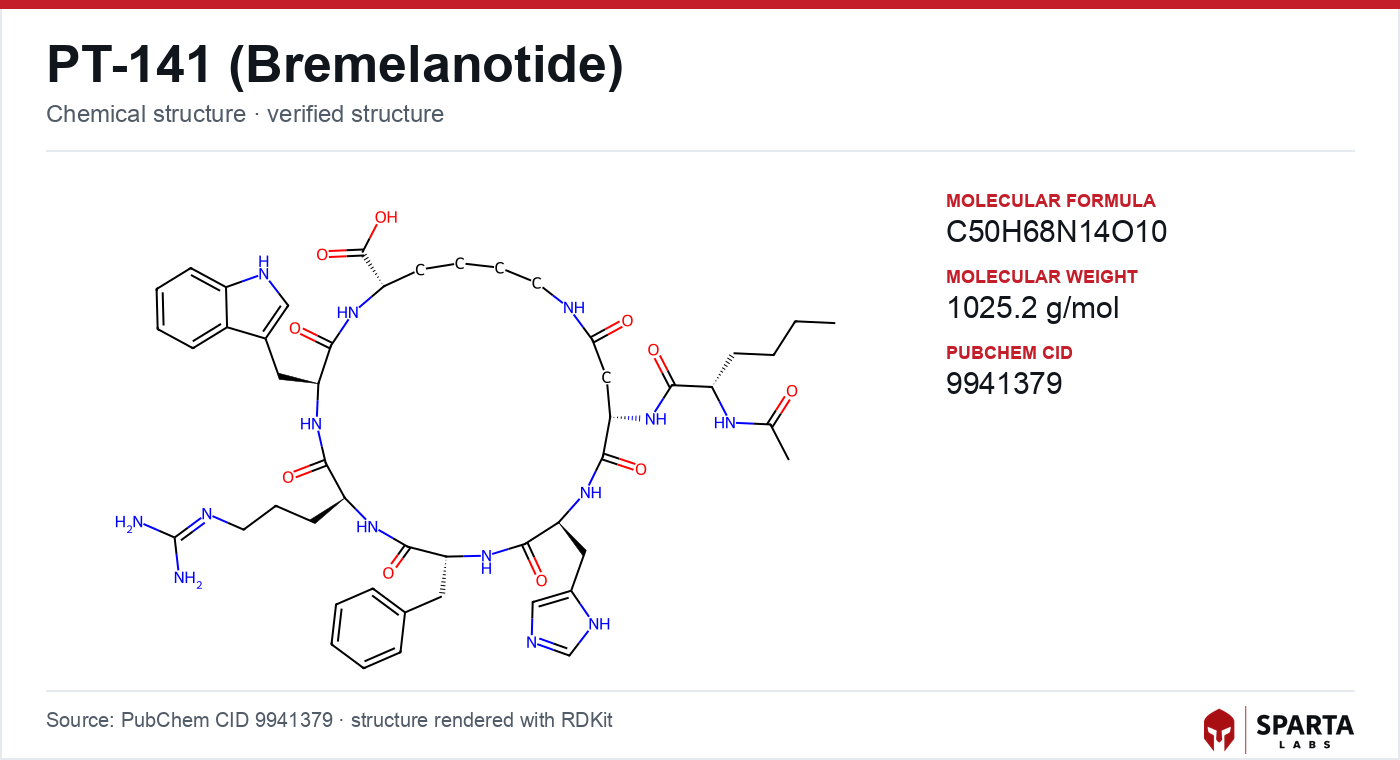
Figure: chemical structure of PT-141 (bremelanotide).
The parent molecule of this chemistry is alpha-melanocyte-stimulating hormone (alpha-MSH), a 13-residue peptide cleaved from pro-opiomelanocortin (POMC). Hadley and Dorr, in a 2006 review that remains a primary historical source for this program, traced how melanotropin chemistry at Arizona evolved from characterizing alpha-MSH toward engineering more stable, more potent analogs [1]. A parallel line of receptor biology established that the melanocortin system extended well beyond skin. Five receptor subtypes (MC1R through MC5R) were delineated by molecular cloning, with MC4R found densely expressed in hypothalamic nuclei; Huszar and colleagues reported in 1997 that targeted disruption of the MC4R gene in mice produced hyperphagia and obesity, placing MC4R at the center of central melanocortin circuitry [2].
Findings from research models do not establish safety or efficacy in humans. Sparta Labs makes no claims about the use of this compound.
Building a Stable Pharmacophore: Melanotan I and II
The synthetic strategy that produced bremelanotide's immediate ancestors was structure-activity work led by Victor Hruby and collaborators. Through iterative substitution and cyclization, the group isolated the tetrapeptide core His-Phe-Arg-Trp as the segment necessary for receptor activation, then stabilized it against enzymatic degradation. This work yielded melanotan I, a linear analog, and melanotan II (MT-II), a cyclic lactam-bridged heptapeptide with markedly higher melanotropic potency in vitro than native alpha-MSH [1].
MT-II is the structural pivot of the entire story, and the Melanotan-2 research history covers that lineage in its own right. For the purposes of bremelanotide's timeline, the salient fact is that MT-II entered phase 1 clinical evaluation at Arizona in the mid-1990s, and that those studies produced an observation the program had not been designed to investigate.
The Redirecting Observation
The pigmentation-focused MT-II trials generated reports of centrally mediated physiological responses that were incidental to the tanning endpoint. Hadley and Dorr document that these observations reframed the melanocortin program: rather than a peripheral pigmentation agent, the scaffold was now of interest as a probe of central melanocortin signaling [1]. This is the inflection point at which a dermatology-adjacent project became a neuroendocrine one.
The pharmacological plausibility of central action was reinforced by the receptor mapping already in hand: dense MC4R expression in the hypothalamus meant a brain-penetrant, degradation-resistant melanocortin agonist had a defined central target. The relationship between the melanocortin scaffold and the broader neuroendocrine control of reproductive and sexual behavior situates PT-141 alongside other neuroendocrine research compounds; the Kisspeptin-10 research overview covers a distinct but thematically adjacent signaling axis.
From MT-II to Bremelanotide: A Single Structural Edit
Palatin Technologies licensed the melanocortin agonist intellectual property and initiated a dedicated development program. The candidate that emerged, designated PT-141 and later given the generic name bremelanotide, is a structural derivative of MT-II in which the C-terminal amide of MT-II is converted to a free carboxylic acid (hydroxyl) group. This single terminal modification altered the compound's pharmacological and pharmacokinetic profile sufficiently to distinguish it from MT-II as a discrete clinical candidate.
Early human characterization followed. Wessells and colleagues reported a pilot phase 1 study of the melanocortin analog scaffold in the Journal of Urology in 2000, documenting dose-dependent pharmacodynamic observations and characterizing the pharmacological profile [3]. Diamond and colleagues published an overview of PT-141 as a melanocortin agonist in 2003, drawing together preclinical and early clinical data; that paper reported that systemic PT-141 administration in rodents was associated with increased c-Fos immunoreactivity in hypothalamic neurons, a marker consistent with central receptor engagement [4]. The mechanistic detail of that receptor engagement is treated separately in the PT-141 mechanism of action article, which parallels the receptor discussion in the Melanotan-2 mechanism article.
The Intranasal Program and Its Limits
Palatin initially advanced an intranasal formulation. Diamond and colleagues published a double-blind, placebo-controlled phase 1 evaluation of intranasal PT-141 in 2004, reporting on safety, pharmacokinetics, and pharmacodynamics in healthy males and in men with mild-to-moderate erectile dysfunction [5]. The intranasal route, however, produced meaningful inter-subject variability in bioavailability, and the cardiovascular signal associated with the compound became a defining constraint on its development.
Two decisions resolved these constraints and reshaped the program. The first was a route change from intranasal to subcutaneous delivery, motivated by the more reproducible pharmacokinetics of the subcutaneous route. The second was a shift in target population toward premenopausal women, a decision reflecting both the regulatory landscape and the pharmacological rationale for a centrally acting melanocortin agonist. Halpern and colleagues later characterized the cardiovascular profile of the subcutaneous formulation using ambulatory blood-pressure monitoring, reporting transient mean blood-pressure increases on the order of a few mmHg lasting several hours, an attenuated and more predictable signal than that associated with the intranasal compound [6]. This characterization ultimately informed prescribing guidance in the approved label.
The RECONNECT Program and Vyleesi Approval
With the subcutaneous formulation and the revised indication in place, Palatin advanced bremelanotide through late-stage clinical development. A phase 2b randomized, placebo-controlled dose-finding trial reported by Portman and colleagues in 2017 identified statistically significant differences from placebo at the selected subcutaneous dose across pre-specified psychometric endpoints, providing the dose-selection rationale for phase 3 [7].
The confirmatory phase 3 effort was the RECONNECT program, comprising two parallel randomized controlled trials enrolling 1,267 premenopausal women. Simon and colleagues reported in Obstetrics & Gynecology in 2019 that bremelanotide met both co-primary efficacy endpoints, with a safety profile consistent with the phase 2 characterization [8]. Kingsberg and colleagues reported the accompanying 52-week open-label extension the same year, identifying no new safety signals over the extended observation window and providing the longest published safety dataset available at the time of regulatory submission [9].
Palatin transferred commercial rights to AMAG Pharmaceuticals, which submitted NDA 210557. The FDA approved bremelanotide, marketed as Vyleesi, on June 21, 2019, for acquired, generalized hypoactive sexual desire disorder in premenopausal women [10]. The approval was notable on two counts documented in the label and contemporaneous record: it was the first FDA authorization of any melanocortin receptor agonist for a human indication, and it was the second approved pharmacological treatment in that indication following flibanserin (Addyi, 2015).
Market and Research Aftermath
The commercial trajectory diverged from the scientific one. Commercial rights to Vyleesi moved again when Covis Pharma acquired AMAG Pharmaceuticals in 2020, and post-marketing pharmacovigilance has continued under the approved label. On the research side, the melanocortin receptor field to which bremelanotide belongs has continued to expand: the MC4R agonist setmelanotide received FDA approval in 2020 for specific genetic forms of obesity, underscoring the therapeutic breadth of the receptor family that Huszar's 1997 knockout work first implicated in central physiology [2].
For historical and comparative context on the compound's chemistry and classification, the PT-141 research overview consolidates the structural and pharmacological background summarized here. Research-grade PT-141 from Sparta Labs is supplied with batch-level Certificate of Analysis documentation for laboratory use.
References
-
Hadley ME, Dorr RT. Melanocortin peptide therapeutics: historical milestones, clinical studies and commercialization. Peptides. 2006;27(4):921-930. PMID: 16412534. DOI: 10.1016/j.peptides.2005.01.029
-
Huszar D, Lynch CA, Fairchild-Huntress V, Dunmore JH, Fang Q, Berkemeier LR, et al. Targeted disruption of the melanocortin-4 receptor results in obesity in mice. Cell. 1997;88(1):131-141. PMID: 9019399. DOI: 10.1016/s0092-8674(00)81865-6
-
Wessells H, Gralnek D, Dorr R, Hruby VJ, Hadley ME, Levine N. Effect of an alpha-melanocyte stimulating hormone analog on penile erection and sexual desire in men with organic erectile dysfunction. Urology. 2000;56(4):641-646. PMID: 11018640. DOI: 10.1016/s0090-4295(00)00680-4
-
Diamond LE, Earle DC, Rosen RC, Willett MS, Molinoff PB. PT-141: a melanocortin agonist for the treatment of sexual dysfunction. Ann N Y Acad Sci. 2003;994:96-102. PMID: 12851303. DOI: 10.1111/j.1749-6632.2003.tb03168.x
-
Diamond LE, Earle DC, Rosen RC, Willett MS, Molinoff PB. Double-blind, placebo-controlled evaluation of the safety, pharmacokinetic properties and pharmacodynamic effects of intranasal PT-141, a melanocortin receptor agonist, in healthy males and patients with mild-to-moderate erectile dysfunction. Int J Impot Res. 2004;16(1):51-59. PMID: 14963471. DOI: 10.1038/sj.ijir.3901139
-
Halpern JA, Hill R, Brannigan RE. Usefulness of ambulatory blood pressure monitoring to assess the melanocortin receptor agonist bremelanotide. Ther Adv Drug Saf. 2017;8(4):125-133. PMID: 27977473. DOI: 10.1177/2042098616685893
-
Portman DJ, Brown L, Yuan J, Kissling R, Kingsberg SA. Bremelanotide for Female Sexual Dysfunctions in Premenopausal Women: A Randomized, Placebo-Controlled Dose-Finding Trial. Womens Health Issues. 2017;27(3):365-372. DOI: 10.1016/j.whi.2017.01.002
-
Simon JA, Kingsberg SA, Portman D, Williams LA, Krop J, Jordan R, et al. Bremelanotide for the Treatment of Hypoactive Sexual Desire Disorder: Two Randomized Phase 3 Trials. Obstet Gynecol. 2019;134(5):899-908. PMID: 31599840. DOI: 10.1097/AOG.0000000000003500
-
Kingsberg SA, Clayton AH, Portman D, Williams LA, Krop J, Jordan R, et al. Long-Term Safety and Efficacy of Bremelanotide for Hypoactive Sexual Desire Disorder. Obstet Gynecol. 2019;134(5):909-917. PMID: 31599847. DOI: 10.1097/AOG.0000000000003506
-
US Food and Drug Administration. Vyleesi (bremelanotide injection) prescribing information. NDA 210557. Approved June 21, 2019. Available at: Source: accessdata.fda.gov
Disclaimer. Statements in this article have not been evaluated by the Food and Drug Administration. This compound is not intended to diagnose, treat, cure, or prevent any disease. Sparta Labs sells research-use-only materials. Content is provided for educational and informational purposes only and does not constitute medical advice. Consult a qualified medical professional for any health concerns.
Frequently asked questions
How did PT-141 originate from a tanning-agent research program?
PT-141 (bremelanotide) descends from a melanocortin analog program at the University of Arizona originally aimed at a synthetic tanning agent. Structure-activity work on alpha-MSH analogs produced melanotan II, and incidental observations of centrally mediated effects in early clinical study redirected the program toward central melanocortin signaling. Palatin Technologies then developed PT-141 as a distinct clinical candidate.
What is the structural relationship between melanotan II and PT-141?
Bremelanotide (PT-141) is a structural derivative of melanotan II (MT-II) in which MT-II's C-terminal amide is converted to a free carboxylic acid group. This single terminal modification altered the pharmacological and pharmacokinetic profile enough to distinguish PT-141 as a separate development candidate from MT-II.
Why did the PT-141 program switch from intranasal to subcutaneous delivery?
Published phase 1 work characterized an intranasal PT-141 formulation, but the intranasal route showed meaningful inter-subject variability in bioavailability. Development moved to subcutaneous delivery for more reproducible pharmacokinetics, and later ambulatory blood-pressure monitoring reported an attenuated, more predictable cardiovascular signal for the subcutaneous formulation.
When was bremelanotide approved by the FDA and under what name?
The FDA approved bremelanotide, marketed as Vyleesi, on June 21, 2019, under NDA 210557. Contemporaneous documentation notes it was the first FDA authorization of any melanocortin receptor agonist for a human indication. Commercial rights later moved to Covis Pharma following its 2020 acquisition of AMAG Pharmaceuticals.
What were the RECONNECT trials?
RECONNECT was bremelanotide's confirmatory phase 3 program: two parallel randomized, placebo-controlled trials enrolling 1,267 premenopausal women. Simon and colleagues reported in 2019 that the compound met both co-primary efficacy endpoints, and a companion 52-week open-label extension reported by Kingsberg and colleagues identified no new safety signals over the extended observation window.