
Melanotan-2: Discovery and Research History
How Melanotan-2 (MT-II) was designed from alpha-MSH through two deliberate engineering choices, its first documented human evaluation, and the approved melanocortin drugs that share its research lineage. Educational reference.

For research use only. Not for human consumption. This article is educational reference material. It is not medical advice and is not a recommendation to use any substance.
Introduction
Melanotan-2 (MT-II) is a synthetic cyclic heptapeptide melanocortin receptor agonist whose documented history originates in a University of Arizona structure-activity program built around the alpha-melanocyte stimulating hormone (alpha-MSH) sequence. Unlike compounds discovered by high-throughput screening, MT-II is a designed molecule: it is the recorded outcome of a specific pair of medicinal-chemistry decisions applied to a native hormone. This article follows that record chronologically, from the melanocortin biology that made the design possible, through the two peptide-engineering choices that produced the molecule, into its first documented human evaluation, and forward to the approved melanocortin drugs whose regulatory files trace back to the same research lineage. Every factual claim below is anchored to peer-reviewed literature or a primary regulatory document.
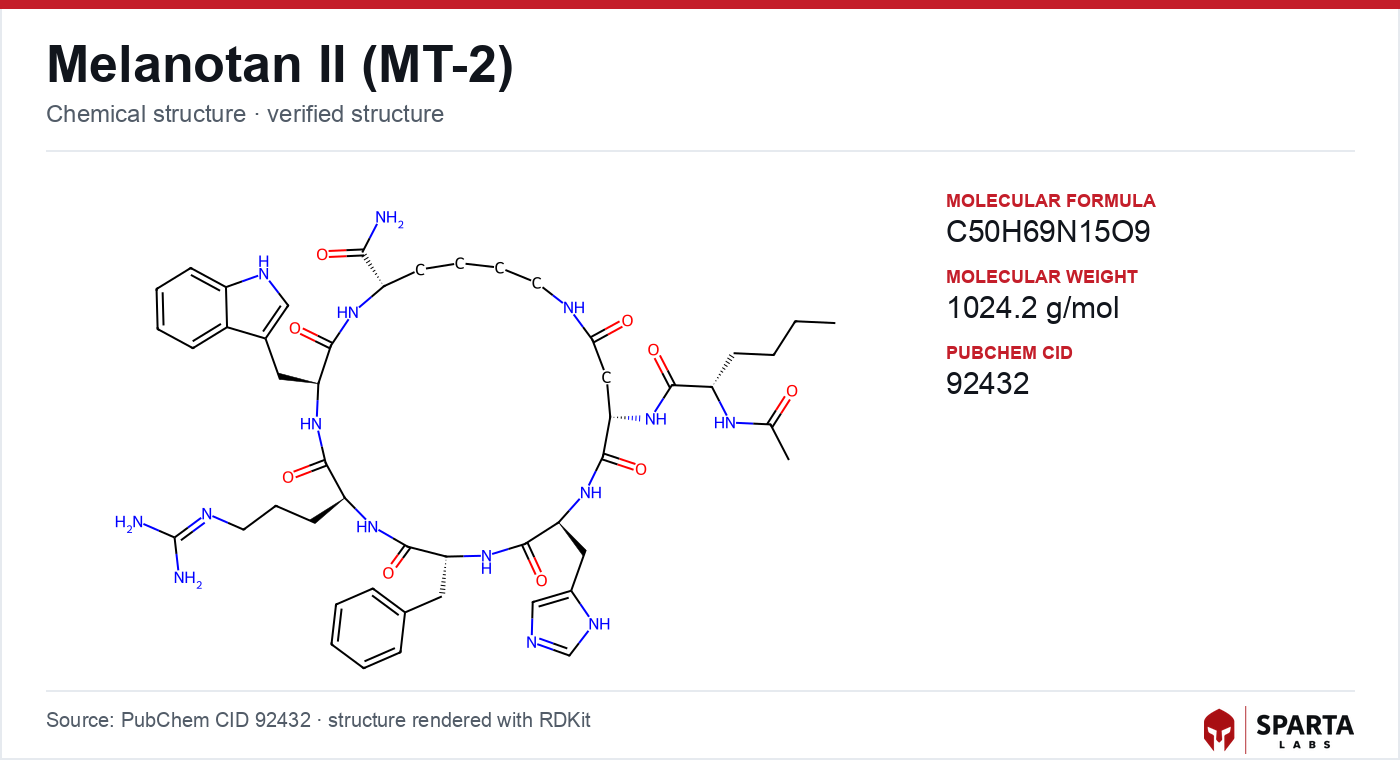
Figure: chemical structure of Melanotan II.
The alpha-MSH Starting Point: What the Designers Began With
The MT-II story begins not with MT-II but with the substrate its designers set out to improve. Alpha-MSH is a tridecapeptide processed from proopiomelanocortin (POMC), and by the 1980s its central pharmacophore, the His-Phe-Arg-Trp motif, was recognized as the region responsible for melanocortin activity. Two liabilities of the native sequence framed the entire redesign effort: the methionine residue at position 4 is chemically and enzymatically labile, and the linear peptide is conformationally flexible and rapidly degraded, limiting its usefulness as a durable research agonist.
A critical piece of context arrived only after the peptide chemistry was already underway. In 1992, Mountjoy, Robbins, Mortrud, and Cone reported in Science the molecular cloning of a family of genes encoding melanocortin receptors, establishing that melanocortin peptides act through multiple distinct G-protein-coupled receptor subtypes with different tissue distributions [1]. This receptor map is what later allowed the non-selective activity of MT-II to be described in precise subtype terms, and it reframed every alpha-MSH analog as a ligand for a defined receptor family rather than a single pigmentation hormone.
Two Engineering Decisions That Produced the Molecule
MT-II is best understood as the intersection of two independent design strategies, each with its own prior history in the Hruby and Hadley laboratories.
The first strategy was residue substitution. Earlier work on linear melanocortin analogs had shown that replacing the labile methionine at position 4 with norleucine, and swapping L-phenylalanine for D-phenylalanine at position 7, produced analogs with markedly greater potency and metabolic stability. This substitution pair, embodied in the linear compound NDP-alpha-MSH, was the proven foundation on which the cyclic design was built.
The second strategy was conformational constraint. Rather than leaving the pharmacophore free to sample many shapes, the designers introduced a lactam bridge, in MT-II's case between the aspartic acid at position 5 and the lysine at position 10. This covalent bridge locks the His-Phe-Arg-Trp core into a cyclic, receptor-favorable conformation. The resulting molecule, Ac-Nle4-c[Asp5-His6-D-Phe7-Arg8-Trp9-Lys10]-NH2, is thus a hybrid: a stabilized backbone carrying a pre-organized pharmacophore. Victor J. Hruby's 2016 review in Biopolymers situates this lactam-bridge cyclization within a broader account of designing biologically active cyclic peptides from native sequences, describing the strategy as a methodological contribution that shaped later melanocortin ligand programs [2].
The 2006 historical overview by Hadley and Dorr in Peptides documents that this optimization was carried out iteratively at the University of Arizona through the late 1980s and early 1990s, and characterizes the resulting compound as a highly potent, non-selective agonist substantially more active than native alpha-MSH across the receptor subtypes tested [3].
Confirming the Chemistry: A Reproducible Synthesis Route
A designed peptide only enters durable research use once it can be prepared reliably. In 2008, Ryakhovsky, Khachiyan, Kosovova, Isamiddinova, and Ivanov reported in the Beilstein Journal of Organic Chemistry the first preparative solution-phase synthesis of MT-II [4]. Their route used an orthogonal protection scheme with carbodiimide-mediated lactam cyclization and reached purities above 90% across a 12-step sequence without preparative chromatography. This report matters historically because it moved MT-II from a compound made by specialist solid-phase groups to one with a documented, reproducible preparation, formalizing the chemistry that underlies its use as a reference agonist.
First Documented Human Evaluation
The first controlled human research administration of MT-II was reported by Dorr, Lines, Levine, Brooks, Xiang, Hruby, and Hadley in Life Sciences in 1996 [5]. The pilot phase I study, conducted at the University of Arizona, enrolled three healthy male volunteers in a single-blind, alternating-day, placebo-controlled design and represented the first systematic documentation of MT-II pharmacodynamics in humans.
Findings from research models do not establish safety or efficacy in humans. Sparta Labs makes no claims about the use of this compound.
The authors reported pharmacodynamic signals consistent with melanocortin receptor engagement and concluded that the compound warranted further controlled investigation. The exploratory design and small sample size are important framing: this was an early proof-of-concept report, not a definitive clinical study, and it functioned primarily to establish that the receptor pharmacology observed in animal models had a measurable human correlate.
The Regulatory Fork: MT-II Versus Its Approved Descendants
MT-II's regulatory history is defined by a divergence. The molecule itself has never received regulatory approval for therapeutic use in any jurisdiction and remains classified as a research-use-only material. Its scientific descendants, however, reached the market.
The most direct descendant is bremelanotide, discussed in the PT-141 discovery and regulatory history article. Bremelanotide is derived from MT-II by removing the N-terminal norleucine and adding a C-terminal hydroxyl group, and Hadley and Dorr's 2006 review documents its early phase I and II development by Palatin Technologies [3]. Bremelanotide subsequently completed Phase III trials and received FDA approval in June 2019 under NDA 210557 as Vyleesi, indicated for hypoactive sexual desire disorder in premenopausal women [6]. The structural comparison between the two molecules is examined further in the PT-141 research overview.
A second, more distant regulatory outcome of the same receptor lineage is setmelanotide, a selective MC4R agonist that received FDA approval in November 2020 (Imcivree) for chronic weight management in rare genetic forms of early-onset obesity [7]. Setmelanotide is not a structural derivative of MT-II, but its development depended on the melanocortin receptor pharmacology that non-selective tool agonists like MT-II helped establish, illustrating the field's shift from broad-spectrum agonists toward subtype-selective ligands.
The chemistry that made MT-II possible is documented in more depth in the Melanotan-2 sourcing and verification standards article, and the receptor pharmacology underlying its non-selective profile is covered in the Melanotan-2 mechanism of action article. Sparta Labs lists the compound as a research material on the Melanotan II product page.
Safety Context in the Published Record
Any history of MT-II is incomplete without the case-report literature that accompanied its uncontrolled use. Because MT-II circulated outside clinical and research settings, the peer-reviewed medical literature contains documented adverse-event reports. Nelson, Bryant, and Aks described in Clinical Toxicology in 2012 a case of systemic toxicity and rhabdomyolysis following self-administration of MT-II [8]. Reports of this kind are part of the compound's documented scientific record and underscore why controlled research conditions are the only appropriate context for investigating it.
Current Research Landscape
MT-II continues to appear in academic and institutional research primarily as a reference agonist. Because it engages the melanocortin receptor family non-selectively and with high potency, it has served as a comparator against which more receptor-selective ligands are characterized, and it anchored much of the pharmacology that preceded the selective-agonist era. The trajectory of the field, from the non-selective MT-II toward the approved subtype-selective drugs bremelanotide and setmelanotide, is itself the clearest summary of MT-II's historical role: a designed research tool whose receptor pharmacology outlived its own therapeutic candidacy. A summary of the primary studies that used MT-II in this way is compiled in the Melanotan-2 published research article.
References
-
Mountjoy KG, Robbins LS, Mortrud MT, Cone RD. The cloning of a family of genes that encode the melanocortin receptors. Science. 1992;257(5074):1248-51. PMID: 1325670. DOI: 10.1126/science.1325670
-
Hruby VJ. Design of cyclic peptides with biological activities from biologically active peptides: the case of peptide modulators of melanocortin receptors. Biopolymers. 2016;106(6):884-8. PMID: 27486849. DOI: 10.1002/bip.22950
-
Hadley ME, Dorr RT. Melanocortin peptide therapeutics: historical milestones, clinical studies and commercialization. Peptides. 2006;27(4):921-30. PMID: 16412534. DOI: 10.1016/j.peptides.2005.01.029
-
Ryakhovsky VV, Khachiyan GA, Kosovova NF, Isamiddinova EF, Ivanov AS. The first preparative solution phase synthesis of melanotan II. Beilstein J Org Chem. 2008;4:39. PMID: 19043625. DOI: 10.3762/bjoc.4.39
-
Dorr RT, Lines R, Levine N, Brooks C, Xiang L, Hruby VJ, Hadley ME. Evaluation of melanotan-II, a superpotent cyclic melanotropic peptide in a pilot phase-I clinical study. Life Sci. 1996;58(20):1777-84. PMID: 8637402. DOI: 10.1016/0024-3205(96)00160-9
-
US Food and Drug Administration. Vyleesi (bremelanotide) injection: NDA 210557 approval. June 2019. Available at: Source: accessdata.fda.gov
-
US Food and Drug Administration. Imcivree (setmelanotide) injection: NDA 213793 approval. November 2020. Available at: Source: accessdata.fda.gov
-
Nelson ME, Bryant SM, Aks SE. Melanotan II injection resulting in systemic toxicity and rhabdomyolysis. Clin Toxicol (Phila). 2012;50(10):1169-73. PMID: 23121206. DOI: 10.3109/15563650.2012.740592
Disclaimer. Statements in this article have not been evaluated by the Food and Drug Administration. This compound is not intended to diagnose, treat, cure, or prevent any disease. Sparta Labs sells research-use-only materials. Content is provided for educational and informational purposes only and does not constitute medical advice. Consult a qualified medical professional for any health concerns.
Frequently asked questions
How was Melanotan-2 designed from alpha-MSH?
MT-II was engineered from the alpha-MSH pharmacophore through two documented choices reported in the University of Arizona literature: substituting norleucine for methionine at position 4 and D-phenylalanine for L-phenylalanine at position 7 to improve stability and potency, then adding a lactam bridge between positions 5 and 10 to lock the His-Phe-Arg-Trp core into a receptor-favorable cyclic conformation. The result is the cyclic heptapeptide Ac-Nle4-c[Asp5-His6-D-Phe7-Arg8-Trp9-Lys10]-NH2.
What was the first documented human study of Melanotan-2?
Dorr, Lines, Levine, Brooks, Xiang, Hruby, and Hadley reported the first controlled human research administration of MT-II in Life Sciences in 1996. The pilot phase I study enrolled three healthy male volunteers in a single-blind, alternating-day, placebo-controlled design at the University of Arizona and was an early proof-of-concept report rather than a definitive clinical study.
Which approved drugs share Melanotan-2's research lineage?
Bremelanotide (Vyleesi), a direct structural derivative of MT-II, received FDA approval in June 2019 under NDA 210557. Setmelanotide (Imcivree), a selective MC4R agonist that is not a structural derivative but depends on the same melanocortin receptor pharmacology, received FDA approval in November 2020. MT-II itself has never been approved for therapeutic use.
Why does Melanotan-2 appear in adverse-event case reports?
Because MT-II circulated outside clinical and research settings, the peer-reviewed medical literature includes case reports of adverse events. Nelson, Bryant, and Aks documented a case of systemic toxicity and rhabdomyolysis following self-administration in Clinical Toxicology in 2012. These reports are part of the compound's documented scientific record and are cited here for educational reference only.
Is Melanotan-2 an approved compound?
No. MT-II has not received regulatory approval for therapeutic use in any jurisdiction and remains classified as a research-use-only material. Its scientific descendants, bremelanotide and setmelanotide, reached the market, but MT-II itself did not.