
CJC-1295 with DAC: Published Research
What the peer-reviewed record actually reports on CJC-1295 with DAC, from the albumin-conjugation chemistry that defines the "DAC" designation to the human single-administration GH and IGF-1 kinetics measured by the original ConjuChem investigators.
For research use only. Not for human consumption. This article is educational reference material. It is not medical advice and is not a recommendation to use any substance.
Introduction
CJC-1295 with DAC is a synthetic analog of growth-hormone-releasing hormone (GHRH) built on the first 29 residues of human GHRH, hGRF(1-29). Within the class of GHRH analogs, its defining feature is the Drug Affinity Complex (DAC), a chemical handle that binds circulating serum albumin and thereby extends the compound's time in plasma. This article summarizes what the peer-reviewed record reports about that chemistry and its documented pharmacology, organized around the molecular feature that gives the compound its name rather than around generic study categories. For the compound's classification and broader context, the CJC-1295 with DAC research overview provides complementary background.
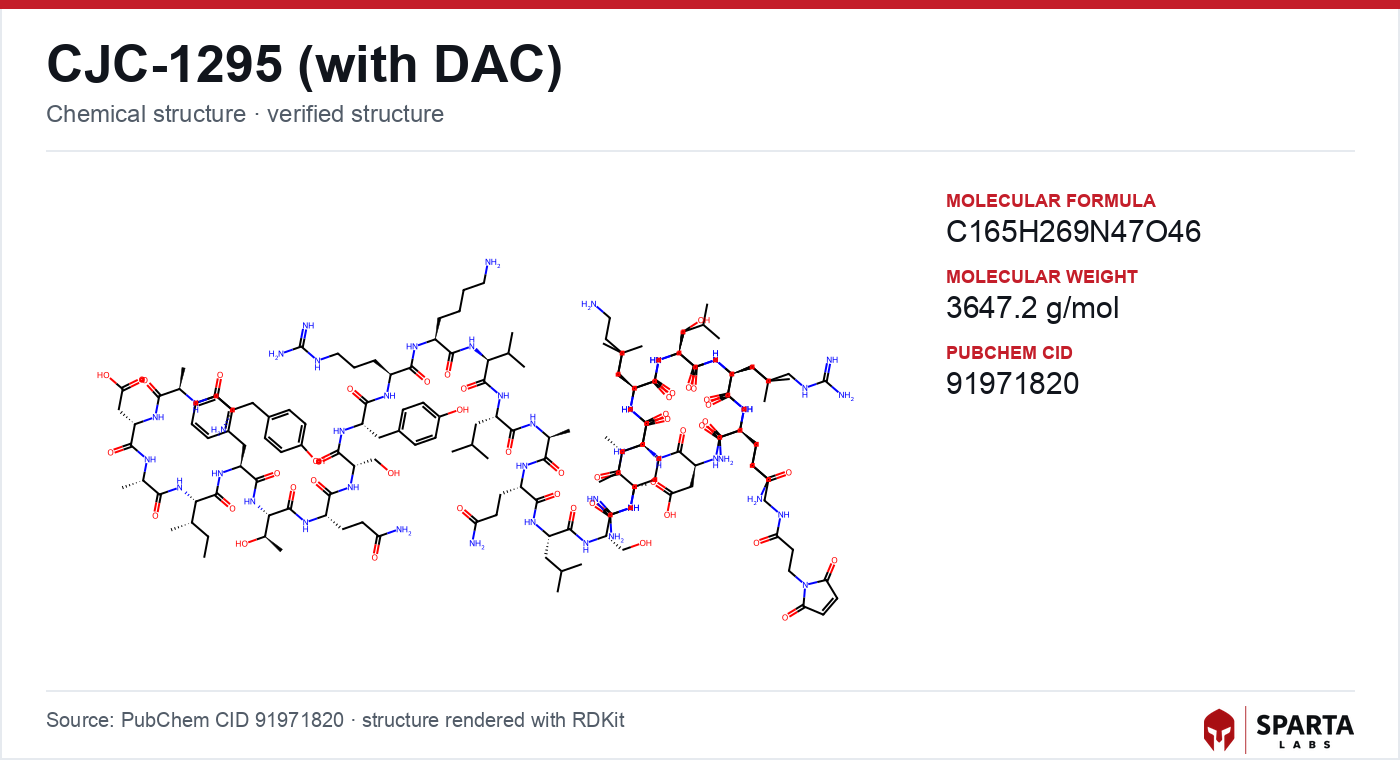
Figure: chemical structure of CJC-1295 (with DAC).
The Chemistry That Defines "DAC"
The published characterization of CJC-1295 begins with a chemistry problem. Native GHRH is cleaved rapidly at its N-terminus by dipeptidyl peptidase-4 (DPP-4), giving the natural peptide a plasma half-life on the order of minutes. Two strategies were combined in the CJC-1295 molecule to address this.
The first is backbone substitution. The hGRF(1-29) sequence in CJC-1295 carries four amino-acid substitutions (a tetra-substituted analog) chosen to resist DPP-4 cleavage and asparagine rearrangement and to stabilize the peptide against proteolytic and chemical degradation. This same DPP-4-resistant backbone is shared with the compound discussed in the CJC-1295 without DAC research overview.
The second strategy is the Drug Affinity Complex itself. Jétte and colleagues, working at ConjuChem with Lawrence Frohman, reported in Endocrinology in 2005 that appending a maleimidopropionyl group to the modified peptide produced a reactive handle that couples selectively to the free thiol of cysteine-34 on serum albumin [1]. Because albumin is abundant and long-lived in plasma, the peptide effectively borrows albumin's slow clearance. The 2005 paper synthesized several maleimido-derivatized hGRF(1-29) analogs, and the lead compound, CJC-1295, was reported to retain GHRH-receptor agonist activity on rat anterior-pituitary cells while showing markedly reduced in-vitro DPP-4 degradation relative to unconjugated hGRF(1-29). The authors described a roughly four-fold increase in growth-hormone area-under-the-curve over a two-hour window in rats compared with the unconjugated peptide.
Findings from research models do not establish safety or efficacy in humans. Sparta Labs makes no claims about the use of this compound.
The distinction between conjugated and unconjugated forms is not a formulation detail; it is the mechanistic pivot of the whole molecule. The receptor pharmacology is discussed further in the CJC-1295 with DAC mechanism of action article.
Human Pharmacokinetics: The Single-Administration Signature
The pharmacokinetic feature that made CJC-1295 with DAC a reference point in the GHRH-analog literature is the duration of its measured effect in humans after a single administration.
The most widely cited human data were reported by Teichman and colleagues in the Journal of Clinical Endocrinology and Metabolism in 2006 [2]. The investigators gave single doses to healthy adult volunteers and characterized the resulting plasma growth-hormone (GH) and insulin-like growth factor 1 (IGF-1) responses. They reported dose-dependent increases in mean plasma GH sustained for six days or longer, and mean plasma IGF-1 elevations sustained for approximately nine to eleven days, after one administration. The estimated half-life was reported as 5.8 to 8.1 days, an order of magnitude longer than native GHRH or short-acting synthetic GHRH analogs. The authors characterized the compound as well tolerated in that cohort and framed the result as the first published human evidence of prolonged, GHRH-analog-driven GH/IGF-1 axis activation from a single administration.
This half-life is the direct pharmacokinetic consequence of the albumin conjugation described above: the peptide's residence in plasma tracks the residence of the albumin it is bound to.
Retained Pulsatility Under Sustained Stimulation
A recurring question in GHRH pharmacology is what happens to the normal pulsatile rhythm of GH secretion when the receptor is stimulated continuously rather than in bursts.
Ionescu and Frohman addressed this in a companion 2006 study, also in the Journal of Clinical Endocrinology and Metabolism [3]. Using frequent GH sampling in healthy adults during the window of CJC-1295 action, they reported that episodic, pulsatile GH secretion persisted, with observed increases in pulse amplitude and in interpulse trough concentrations relative to baseline. The authors noted that this pattern was qualitatively different from the tonic, non-pulsatile exposure produced by administering exogenous GH directly. They discussed the finding in the context of somatostatin counter-regulation, and the mechanistic basis for preserved pulsatility under continuous GHRH-receptor agonism remains an open scientific question.
This distinction between endogenous-axis stimulation and direct hormone administration is one reason GHRH analogs and growth-hormone secretagogues such as GHRP-6 are studied separately from recombinant GH itself.
Downstream Serum Proteomics
Beyond the direct GH and IGF-1 measurements, one published study looked at the broader serum-protein consequences of axis activation.
Sackmann-Sala and colleagues (2009), reporting in Growth Hormone & IGF Research, applied two-dimensional gel electrophoresis and mass spectrometry to sera from healthy adult men collected before and roughly one week after CJC-1295 administration [4]. They identified several protein species with statistically significant intensity changes, including decreases in apolipoprotein A1 and transthyretin isoforms and increases in a set of hemoglobin- and albumin-derived fragments, and reported a linear correlation between IGF-1 concentrations and one of the increased protein clusters. The authors interpreted these as downstream molecular correlates of GH/IGF-1 axis activation and proposed the identified proteins as candidate biomarkers of GH and IGF-1 biological activity. The study is a rare example of an untargeted proteomic readout of a GHRH-analog administration.
Anti-Doping and Forensic Detection Science
Because the World Anti-Doping Agency (WADA) prohibits growth-hormone-releasing factors under the peptide-hormone and growth-factor sections of its Prohibited List, GHRH analogs such as CJC-1295 fall within the scope of doping-control analytics [5]. This regulatory status has driven a distinct strand of peer-reviewed analytical chemistry.
Thevis and colleagues (2011), publishing in Drug Testing and Analysis, reported the identification of CJC-1295 in an unknown pharmaceutical preparation submitted by Norwegian police and customs authorities, using liquid chromatography coupled to high-resolution tandem mass spectrometry [6]. They confirmed a 29-amino-acid peptide consistent with CJC-1295, demonstrating that forensic identification of the compound in seized material is analytically feasible. The large, heterogeneous albumin conjugate that gives the DAC form its long half-life also makes it an analytically demanding target, which is part of why detection methodology for this compound class remains an active area of published work.
Knowledge Gaps in the Published Record
The peer-reviewed picture of CJC-1295 with DAC is a well-characterized early-human pharmacology paired with a limited long-term record. The published human studies used healthy adult volunteer cohorts, so dose-response relationships across age groups, and the effect of altered albumin concentrations or of renal and hepatic impairment on pharmacokinetics, were not their subject. These remain recognized areas for prospective characterization.
Long-term consequences of repeated administration for pituitary somatotroph biology, including possible receptor desensitization and feedback dynamics, are likewise not addressed by the existing single-administration and short-window studies. Head-to-head experimental comparisons between CJC-1295 with DAC and other long-acting GHRH analogs have not been published, a gap future preclinical or translational research could address. The compound's discovery and regulatory arc is traced further in the CJC-1295 with DAC history article, and researchers reviewing batch analytical documentation can consult the CJC-1295 with DAC product page.
References
-
Jétte L, Léger R, Thibaudeau K, Benquet C, Robitaille M, Pellerin I, et al. Human growth hormone-releasing factor (hGRF)1-29-albumin bioconjugates activate the GRF receptor on the anterior pituitary in rats: identification of CJC-1295 as a long-lasting GRF analog. Endocrinology. 2005;146(7):3052-3058. PMID: 15817669. DOI: 10.1210/en.2004-1286. PubMed
-
Teichman SL, Neale A, Lawrence B, Gagnon C, Castaigne JP, Frohman LA. Prolonged stimulation of growth hormone (GH) and insulin-like growth factor I secretion by CJC-1295, a long-acting analog of GH-releasing hormone, in healthy adults. J Clin Endocrinol Metab. 2006;91(3):799-805. PMID: 16352683. DOI: 10.1210/jc.2005-1536. PubMed
-
Ionescu M, Frohman LA. Pulsatile secretion of growth hormone (GH) persists during continuous stimulation by CJC-1295, a long-acting GH-releasing hormone analog. J Clin Endocrinol Metab. 2006;91(12):4792-4797. PMID: 16968793. DOI: 10.1210/jc.2006-1702. PubMed
-
Sackmann-Sala L, Ding J, Frohman LA, Kopchick JJ. Activation of the GH/IGF-1 axis by CJC-1295, a long-acting GHRH analog, results in serum protein profile changes in normal adult subjects. Growth Horm IGF Res. 2009;19(6):471-477. PMID: 19386527. DOI: 10.1016/j.ghir.2009.03.001. PubMed
-
World Anti-Doping Agency. The Prohibited List: Section S2, Peptide Hormones, Growth Factors, Related Substances and Mimetics. World Anti-Doping Agency. wada-ama.org
-
Thevis M, Kohler M, Thomas A, Schänzer W. Doping control analysis of GHRH and GHRH analogs and identification of CJC-1295 in a pharmaceutical preparation. Drug Test Anal. 2011;3(1):56-61. PMID: 21204297. DOI: 10.1002/dta.242. PubMed
Disclaimer. Statements in this article have not been evaluated by the Food and Drug Administration. This compound is not intended to diagnose, treat, cure, or prevent any disease. Sparta Labs sells research-use-only materials. Content is provided for educational and informational purposes only and does not constitute medical advice. Consult a qualified medical professional for any health concerns.
Frequently asked questions
What is the Drug Affinity Complex (DAC) in CJC-1295?
In the published chemistry, the Drug Affinity Complex is a maleimidopropionyl group appended to the modified GHRH(1-29) peptide. Jétte and colleagues reported in 2005 that this maleimide reacts selectively with the free cysteine-34 thiol of circulating serum albumin, forming a covalent bioconjugate in situ. The albumin carrier is what distinguishes the DAC form from unconjugated CJC-1295, and the 2005 paper attributed the extended plasma residence to this albumin binding.
What did the human pharmacokinetic studies report for CJC-1295?
Teichman and colleagues (2006) administered single doses to healthy adult volunteers and reported that mean plasma growth hormone rose for roughly six days and IGF-1 for nine to eleven days after one administration, with an estimated half-life of 5.8 to 8.1 days. Findings from these studies do not establish safety or efficacy for any use in humans.
Does CJC-1295 change the pattern of growth-hormone secretion?
Ionescu and Frohman (2006) sampled growth hormone frequently in healthy adults during sustained CJC-1295 exposure and reported that episodic, pulsatile secretion persisted, with changes in pulse amplitude and trough concentrations relative to baseline. The authors framed this as qualitatively different from the continuous exposure produced by exogenous growth hormone, an observation relevant to the study of growth-hormone axis physiology.
Why does CJC-1295 appear in anti-doping research?
The World Anti-Doping Agency prohibits growth-hormone-releasing factors, which places GHRH analogs such as CJC-1295 within the scope of doping-control analytics. Thevis and colleagues (2011) reported identifying CJC-1295 in a seized pharmaceutical preparation using high-resolution tandem mass spectrometry, establishing that forensic confirmation of the peptide is analytically feasible.
How does CJC-1295 with DAC relate to CJC-1295 without DAC?
Both share the same tetra-substituted GHRH(1-29) peptide backbone that resists dipeptidyl peptidase-4 cleavage. The DAC form carries the additional maleimide handle that binds serum albumin, which the literature associates with a much longer plasma half-life; the without-DAC form lacks that handle. The two are frequently discussed together in the GHRH-analog research literature.